
Who is required to pay Advance Tax in India, what are the quarterly due dates, and how are Section 234B/C penalties calculated?
1. What is Advance Tax? The 'Pay-As-You-Earn' Concept
The sovereign tax collection machinery in India operates on the principle of 'Pay-As-You-Earn'. Rather than waiting until the end of the financial year to settle tax dues in a single lump sum, the Income Tax Act, 1961 mandates that taxpayers generate and remit tax payments in staggered installments during the exact financial year in which the income is earned.
Advance tax applies across all heads of income: salaries (where employer TDS is insufficient), capital gains, business profits, professional fees, rental income, and interest on fixed deposits or savings balances.
₹10,000 Threshold
Mandatory if net tax liability after TDS/TCS deductions equals or exceeds ₹10,000 for the financial year.
4 Quarterly Slabs
Discharged on the 15th of June (15%), September (45%), December (75%), and March (100%).
1% Monthly Interest
Mandatory non-waivable statutory interest penalties under Sections 234B and 234C for shortfalls.
2. Who is Liable to Pay Advance Tax? (Section 208 Threshold)
Under Section 208, advance tax is payable by all classes of assessees (Individuals, HUFs, Partnership Firms, LLPs, Private/Public Limited Companies, and AOPs/BOIs) if estimated net tax payable is ₹10,000 or more.
Senior Citizen Statutory Exemption (Section 207(2)):
A resident individual who:
- Is aged 60 years or more at any time during the financial year; AND
- Does NOT have any income chargeable under 'Profits and Gains of Business or Profession' (PGBP)
Is COMPLETELY EXEMPT from paying advance tax. Senior citizens living on pension, rental income, and interest can pay their entire tax liability through Self-Assessment Tax (Minor Head 300) before filing their ITR without attracting any Section 234B or 234C penalties!
3. Quarterly Slabs & Statutory Due Dates (Section 211)
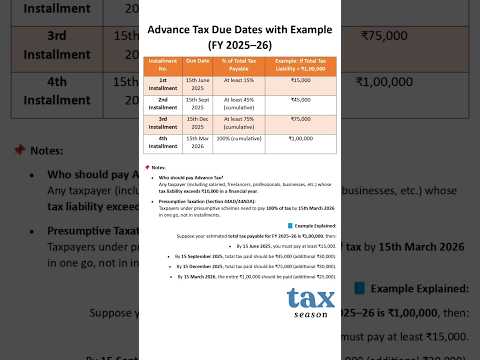
For all corporate and non-corporate assessees (excluding presumptive scheme users), advance tax must be deposited according to the following schedule:
| Installment | Statutory Due Date | Cumulative Minimum Amount Payable |
|---|---|---|
| 1st Installment | On or before 15th June | Not less than 15% of total advance tax liability |
| 2nd Installment | On or before 15th September | Not less than 45% (less amount paid in earlier quarters) |
| 3rd Installment | On or before 15th December | Not less than 75% (less amount paid in earlier quarters) |
| 4th Installment | On or before 15th March | 100% of total advance tax liability (less paid earlier) |
4. Special Relief: Presumptive Scheme (Section 44AD & 44ADA)
Small business owners and specified professionals opting for the presumptive taxation scheme enjoy a simplified single-installment schedule:
Section 44AD (Small Businesses) & Section 44ADA (Professionals):
Taxpayers declaring profits on presumptive basis (6%/8% for businesses up to ₹3 Crores; 50% for professionals up to ₹75 Lakhs) are NOT required to pay advance tax in June, September, or December.
They are permitted to pay 100% of their advance tax in a single installment on or before 15th March without attracting any Section 234C deferment interest.
5. How Advance Tax is Calculated: Step-by-Step Formula
Estimating advance tax requires projecting full financial year income:
Step 1: Estimate Total Gross Income: Salaries + Capital Gains + Business/Consultancy Fees + House Property Rent + Other Sources (Bank Interest/Dividends).
Step 2: Subtract Chapter VI-A Deductions: (Section 80C, 80D, 80G, 80TTA/TTB under Old Tax Regime; or standard deduction of ₹75,000 under New Tax Regime).
Step 3: Compute Gross Tax Liability: Apply applicable slab rates (Old or New Regime Section 115BAC) + 4% Health & Education Cess.
Step 4: Subtract Withheld Taxes: Deduct expected TDS (Section 192/194J/194C) + TCS (Section 206C) + Foreign Tax Credits (Section 90/91).
Step 5: Net Advance Tax Payable = Gross Tax – Deductions – TDS/TCS.
If the resulting figure is ₹10,000 or more, divide by the quarterly percentage milestones.
6. Section 234B: Interest for Default in Payment of Advance Tax
Section 234B penalizes taxpayers who fail to pay adequate advance tax before the close of the financial year:
When is Section 234B Triggered?
• The taxpayer failed to pay any advance tax; OR
• The total advance tax paid on or before March 31 is less than 90% of the assessed tax liability.
Rate & Tenure of Penalty:
Simple interest at 1% per month (or part of a month) computed on the shortfall amount, running from 1st April of the Assessment Year until the date of determination of income under Section 143(1) or actual self-assessment tax payment.
7. Section 234C: Interest for Deferment of Advance Tax Installments
Section 234C penalizes taxpayers who paid the total tax eventually, but delayed or deferred individual quarterly installments:
| Quarter Cut-Off | Safe Harbour Threshold | Interest Computation Period |
|---|---|---|
| 15th June | Advance tax paid < 12% of total tax | 1% per month for 3 months (3%) on shortfall |
| 15th September | Advance tax paid < 36% of total tax | 1% per month for 3 months (3%) on shortfall |
| 15th December | Advance tax paid < 75% of total tax | 1% per month for 3 months (3%) on shortfall |
| 15th March | Advance tax paid < 100% of total tax | 1% for 1 month (1%) on shortfall |
8. Statutory Exception: Capital Gains, Lottery & Dividend Windfalls
Because capital gains (e.g. selling stock or real estate) or speculative lottery/dividend windfalls cannot be accurately predicted in June or September, the law provides built-in immunity:
First Proviso to Section 234C(1):
Zero Section 234C interest is charged for shortfalls in earlier quarters if the shortfall occurred due to:
- Unexpected capital gains (LTCG / STCG);
- Lottery winnings, crossword puzzles, or betting receipts;
- Dividend income exceeding ₹5,000;
- Commencement of a new business during the financial year.
Requirement: The taxpayer must pay the entire tax on such unexpected gains in the remaining installments that fall due after the date of earning, or before March 31 if earned in March.
9. Challan ITNS 280 & Critical Minor Head Codes
| Challan Parameter | Correct Selection | Risk of Wrong Selection |
|---|---|---|
| Major Head | 0021 (Income Tax Other Than Companies) | Companies select 0020; wrong head creates unallocated tax |
| Type of Payment (Minor Head) | (100) Advance Tax | Selecting (300) Self-Assessment Tax causes automated 234B/C interest! |
| Assessment Year | Next Financial Year (e.g. FY 26-27 → AY 27-28) | Selecting wrong AY credits tax to prior year |
10. Step-by-Step Online Advance Tax Payment via e-Pay Tax
Open Income Tax Portal (e-Pay Tax)
Visit eportal.incometax.gov.in. Click on 'e-Pay Tax' under Quick Links on the left panel (or log in and go to e-File → e-Pay Tax).
Enter PAN & Authenticate via Mobile OTP
Enter your 10-digit PAN and mobile number. Submit the 6-digit OTP to verify your identity.
Select Income Tax & Assessment Year
Select 'Income Tax' and click Proceed. Choose the relevant Assessment Year. Under Type of Payment (Minor Head), select Advance Tax (100).
Enter Tax Amount & Settle via Net Banking / UPI
Fill the basic tax amount under the 'Tax' row. Pay via UPI, Net Banking, or Debit Card. Download Challan Receipt (CRN) with BSR code and CIN.
11. Comparison: Corporate vs Salaried vs Presumptive 44AD
| Taxpayer Category | Number of Installments | June 15 Due? | March 15 Obligation |
|---|---|---|---|
| Corporate Entities (Pvt / Ltd) | 4 Quarters | Yes (15%) | 100% Cumulative |
| Salaried with Rental/Capital Gains | 4 Quarters | Yes (15%) | 100% Cumulative |
| Presumptive Business (44AD / 44ADA) | 1 Single Installment | No (Exempt) | 100% in Single Shot |
| Resident Senior Citizen (No Business) | 0 Installments | Exempt | Exempt (Pay before ITR) |
12. Real-World Calculation Scenarios
Case A: Salaried Tech Lead Selling Shares in August (₹6 Lakh LTCG)
Context: A salaried employee has ₹20 Lakhs salary where employer TDS is exact. In August, she books ₹6,00,000 long-term capital gains on equities. Under Section 112A (above ₹1.25 Lakh exemption), taxable LTCG is ₹4,75,000 @ 12.5% = ₹59,375 tax + cess = ₹61,750.
Action: Because the gain occurred in August (after the June 15 due date), she has zero Section 234C liability for June. She must pay 45% (₹27,788) by September 15, 75% by December 15, and 100% by March 15 to completely avoid all interest penalties!
Case B: Freelancer Under Section 44ADA Paying on March 14
Context: A design consultant earns ₹40,00,000 in gross receipts. Under Section 44ADA, she declares 50% presumptive profit (₹20,00,000). Total tax liability after ₹1,50,000 80C deductions is ₹2,85,000. Clients deducted ₹1,20,000 under Section 194J TDS.
Action: Net advance tax payable = ₹2,85,000 – ₹1,20,000 = ₹1,65,000. She deposits ₹1,65,000 in a single challan on March 14. Result: 100% compliant, zero Section 234C or 234B penalty.
13. Costly Mistakes by Taxpayers
Selecting Self-Assessment Tax (300)
Paying tax in March under Minor Head 300 instead of Advance Tax (100). The CPC software treats it as tax paid after year-end, levying Section 234B interest automatically.
Assuming Employer TDS Covers Everything
Failing to declare bank FD interest or mutual fund capital gains to your employer. The resulting tax shortfall attracts compounding 234B and 234C interest when filing your ITR.
14. The Compounding Math of Sections 234B & 234C
Ignoring advance tax can cost thousands of rupees in pure dead-weight penalties:
• Section 234C: 1% per month on quarterly delays = 3% for June + 3% for Sept + 3% for Dec + 1% for March = up to 10% total penalty on deferred sums.
• Section 234B: 1% per month from April 1 until ITR filing date. Filing on July 31 adds another 4% interest.
A ₹2 Lakh unpaid tax balance can easily attract ₹18,000 to ₹25,000 in mandatory interest fees!
15. Statutory Framework: Income Tax Act, 1961
Section 207 & 208: Liability for payment of advance tax and conditions where tax is payable.
Section 211: Installments of advance tax and due dates.
Sections 234B & 234C: Statutory computation of interest for default and deferment.
16. Accurate Quarterly Forecasting Model
To maintain 100% safe harbor compliance without locking up excessive working capital, review your Annual Information Statement (AIS) and 26AS on the 5th of September, December, and March to capture unbilled receipts and capital gains before the 15th payment deadlines.
17. Taxpayer Advance Tax Checklist
Recommended Video Tutorials & Practical Walkthroughs
Watch these handpicked, expert video guides covering practical compliance, step-by-step application procedures, and real-world implementation:
Recommended Video Tutorials & Practical Guides

18. Frequently Asked Questions (FAQs)
What if I pay advance tax after 15th March but before 31st March?
Under Section 211(1), any tax paid on or before 31st March of the financial year is treated as advance tax paid during the financial year. You will avoid Section 234B interest, though you will incur 1% Section 234C interest for the delayed March 15 installment.
Can I get a refund if I overpaid advance tax?
Yes! If total advance tax paid exceeds your final tax liability, the excess amount is refunded with interest @ 0.5% per month (6% p.a.) under Section 244A from 1st April of the assessment year to the refund credit date.
Can salaried employees ask employers to deduct extra TDS instead of paying advance tax?
Yes! Salaried employees can declare their other incomes (rental income, FD interest, capital gains) to their employer via payroll portal declarations, authorizing higher Section 192 TDS deduction to avoid manual advance tax payments.
19. Statutory References & Official Citations
Income Tax Act, 1961: Section 208 (Condition of liability to pay advance tax), Section 211 (Installments and due dates), and Sections 234B & 234C.
Central Board of Direct Taxes (CBDT): Circular on e-Pay Tax payment procedures and Challan ITNS 280 guidelines.
Income Tax Rules, 1962: Rule 31A & Schedule IT reporting standards.