
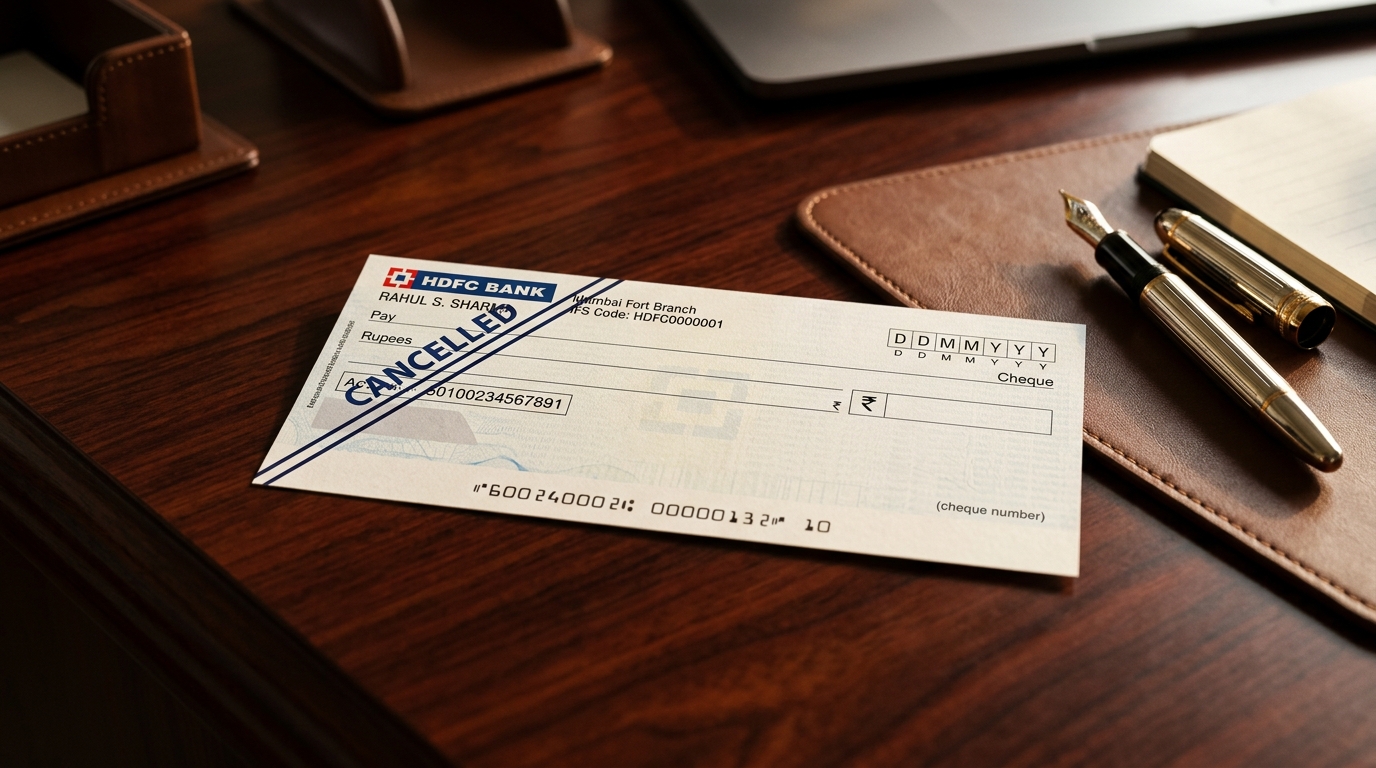
1. What is a Cancelled Cheque? Statutory Meaning & Core Purpose
A cancelled cheque is a standard paper cheque leaf drawn on a bank account that has been deliberately rendered non-negotiable by marking two parallel transverse lines across its face and writing the word “CANCELLED” between them.
Under Section 6 of the Negotiable Instruments Act, 1881, a cheque is legally defined as a bill of exchange drawn on a specified banker payable only on demand. When a customer or corporate entity draws two crossing lines with the word “CANCELLED”, the document ceases to function as a negotiable instrument of payment. No individual, firm, clearing house, or banking counter can legally encash, clear, or transfer funds using this leaf.
Why is a Cancelled Cheque Demanded if it Cannot Pay Money?
While it cannot move funds, a cancelled cheque serves as the gold standard of non-financial KYC verification in India. It contains machine-readable, tamper-resistant proof of:
2. The Anatomy of an Indian Bank Cheque: Interactive Hotspot Explorer
Every Indian cheque leaf follows the strict technical layout mandated by the Reserve Bank of India (RBI). Click on any component below to explore its technical purpose, format, and why it must remain unobstructed when writing “CANCELLED”:
Bank Name & Branch Address
Identifies the issuing commercial bank, branch location, and clearing circle.
Official Bank Logo, Full Branch Address, and PIN Code.
Ensures the entity receiving the document knows which physical institution hosts the account.
3. Step-by-Step: How to Write “Cancelled” on a Cheque Correctly
Cancelling a cheque requires surgical precision. Follow these four definitive steps to ensure your cheque is completely invalid for payments while 100% compliant for verification:
Take an unused cheque leaf from your chequebook. In the top-left quadrant, draw two straight, neat parallel diagonal lines across the corner at an angle of roughly 45 degrees.
Write the word CANCELLED in clean, legible capital letters between the two parallel lines. You can also write it across the body, ensuring you do not obscure any numbers.
Ensure that your Account Number, IFSC Code, MICR Code, and Name are not crossed or smudged. If any digit is covered by ink, the document will be rejected.
Under no circumstances should you sign the cheque! A cancelled cheque does not require a signature. Leaving the signature line blank protects you from signature theft or forgery.
4. Fatal Mistakes & Security Risks When Issuing a Cancelled Cheque
Because a cancelled cheque carries your exact bank account number, branch routing code, and MICR signature, handing it over carelessly can expose your identity to financial fraud. Avoid these 5 common mistakes:
Signing the Cancelled Cheque
Critical RiskDrawing Lines Over Account Number or MICR Band
Rejection RiskUsing Red, Green, or Purple Ink
Rejection RiskProviding a Cheque Without Pre-Printed Name
Rejection in Demat / EPFOTearing or Mutilating the Edges
Invalid Document5. Top 10 Real-World Financial Scenarios Requiring a Cancelled Cheque
Whether you are an individual opening a Demat account, an employee claiming retirement benefits, or a business receiving GST refunds, a cancelled cheque is an essential prerequisite:
Demat & Stock Trading Account Opening
SEBI & Stock MarketWhen opening an equity trading and demat account with Zerodha, Groww, AngelOne, or Upstox, SEBI regulations mandate proof of a verified primary bank account. All dividend distributions and sale proceeds are legally linked to this verified account.
PF & EPFO Online Claim Withdrawal
Retirement & Social SecurityFor EPF member claim settlements, full retirement withdrawals, or advance medical claims on the EPFO UAN portal, a clean scan of a cancelled cheque with the member's name printed is mandatory to ensure pension funds transfer to the correct account.
Bank Loan Disbursement & EMI Setup
Credit & LendingBanks and NBFCs requiring home, personal, or business loan execution request a cancelled cheque to verify the disbursement account and establish the NACH auto-debit track for monthly EMI deduction.
Mutual Fund SIP & Lumpsum Investment
Wealth ManagementTo prevent third-party deposits and comply with Association of Mutual Funds in India (AMFI) guidelines, Asset Management Companies (AMCs) verify bank details via a cancelled cheque before accepting Systematic Investment Plans (SIPs).
NACH / ECS / e-Mandate Activation
Automated Recurring BillingSetting up automated monthly deductions for insurance premiums, recurring gym fees, corporate subscriptions, or utility bills uses the exact MICR code from the cancelled cheque to bind the NPCI NACH clearing instruction.
Payment Gateway & Merchant KYC
Fintech & E-CommercePayment aggregators like Razorpay, Cashfree, PayU, and Stripe India require a business cancelled cheque to verify the legal business entity and settle daily payment gateway collections without credit risk.
GST Refund Account Validation
Government Tax ComplianceWhen filing for an IGST export refund or accumulated ITC refund on the GST Portal (gst.gov.in), Form GST RFD-01 requires a validated bank account matching the taxpayer's legal PAN name to prevent fraudulent tax credits.
Corporate Vendor Empanelment
B2B ProcurementEnterprise procurement and accounts payable teams require vendors and suppliers to submit a cancelled cheque during vendor registration to ensure vendor payments are routed to the verified corporate bank account.
Salary Account Direct Deposit Setup
Human Resources & PayrollNew employees joining corporate organizations must submit a cancelled cheque to the HR and payroll team to ensure monthly salaries are deposited accurately via automated bank batch transfers.
Insurance Policy Claim Settlements
Life & Health InsuranceHealth insurance cashless reimbursements and life insurance death claim payouts are settled strictly via NEFT into the nominee or policyholder's verified bank account backed by a cancelled cheque leaf.
6. Different Types of Cheques in India & Legal Framework
Cheques in India are governed by the Negotiable Instruments Act, 1881. Understanding the different types helps prevent unauthorized cash withdrawals:
| Cheque Type | Distinguishing Feature | Payment Mode | Risk Level |
|---|---|---|---|
| Bearer Cheque | Contains “Or Bearer”. Payable to whoever holds the leaf physically. | Cash at Bank Counter without ID | Extremely High |
| Order Cheque | “Bearer” is struck out and “Order” is written. Payable only to named person. | Cash with identity verification | Medium |
| Crossed Cheque (General) | Two parallel transverse lines on top-left. Cannot be encashed over counter. | Bank Account Credit Only | Low (Traceable) |
| Account Payee Cheque | Two parallel lines with “A/C PAYEE ONLY”. Non-transferable by endorsement. | Strictly Payee Bank Account | Extremely Safe |
| Stale Cheque | Cheque presented more than 3 months after the issue date. | Dishonored / Rejected by CBS | Zero (Expired) |
| Post-Dated Cheque (PDC) | Cheque bearing a future date. Cannot be cleared before that date. | Account credit after arrival of date | Medium |
| Cancelled Cheque | Two parallel lines with “CANCELLED”. Completely void for money transfer. | Zero Payment (KYC Document Only) | Zero Financial Risk |
Cheque Bouncing Law: Criminal Penalties Under Section 138 of NI Act
Unlike a cancelled cheque which carries no financial obligation, issuing an active cheque that bounces due to insufficient funds (or exceeding balance) constitutes a criminal offense under Section 138 of the Negotiable Instruments Act, 1881.
- The payee must serve a formal Statutory Legal Demand Notice within 30 days of the bounce memo.
- The drawer is granted a mandatory 15-day cure period to make the full payment.
- Failure to pay within 15 days allows the payee to file a criminal complaint in the Magistrate court within 30 days.
- Conviction carries imprisonment up to 2 years, a fine of up to twice (200%) the cheque amount, or both.
7. RBI CTS-2010 Standards: Security Features Embedded in Cheque Leaves
The Cheque Truncation System (CTS-2010) was mandated by the Reserve Bank of India to eliminate the physical movement of cheques and facilitate electronic image-based clearing. Every authentic CTS-2010 cheque includes six advanced security features:
Hidden microscopic text that reveals the word “VOID” or “COPY” when scanned or photocopied on standard office copiers.
High-security “CTS-INDIA” watermark embedded directly into the pulp during paper manufacture, visible when held against light.
Cheque paper does not fluoresce under UV rays, while the issuing bank’s logo glows vividly in invisible fluorescent ink.
Treated with fugitive protective dyes that permanently stain or dissolve if a fraudster applies chemical solvents or bleaches.
The pay and rupee line boundaries are printed as ultra-fine micro-text with the bank name, visible only under high-magnification lenses.
The bottom 9-digit MICR band is printed in specialized magnetic ink readable by high-speed sorting machines in clearing centers.
8. Modern Digital Alternatives to Cancelled Cheques in 2026
Carrying and scanning physical paper cheques is rapidly being replaced by instant, tamper-proof digital rails across Indian fintech and banking platforms:
The merchant or broker initiates an automated IMPS transfer of ₹1 to the user’s account. The receiving bank’s Core Banking Solution automatically returns the account holder’s official registered name in the payment response. If it matches the applicant’s PAN name, the account is verified instantly with zero paperwork.
Leading public and private sector banks are now integrated with the Government of India’s DigiLocker ecosystem. Users can grant one-time consent to fetch verified digital bank account credentials signed with a cryptographic certificate.
Instead of manually capturing MICR codes from a cancelled cheque for recurring loan EMIs or SIPs, users authenticate automated mandates via Net Banking credentials, Debit Card OTP, or UPI PIN in under 30 seconds.
Most platforms accept a digitally generated Net Banking PDF statement or a clear photo of the first page of an updated bank passbook displaying the customer’s name, photo, IFSC code, and branch seal.
9. Printable Educational Infographic: Cancelled Cheque Anatomy & Rules
This educational reference chart is optimized for students preparing school/college commerce projects, banking examination aspirants (IBPS/SBI PO), and finance professionals. Click the print button above to output a clean, high-resolution A4 sheet:
Anatomy of a Cancelled Cheque & Security Standards
Created & Presented by GST Munshi (www.gstmunshi.com)
India’s Free Cloud GST Billing, E-Invoicing & Accounting Suite. Empowering over 100,000+ Indian Businesses & Students.
10. Curated Video Masterclasses: Practical Cheque Demos & Banking Law
Watch visual walkthroughs and legal explanations curated from India’s foremost Chartered Accountants, advocates, and banking professionals:
How to Properly Cancel a Cheque: Step-by-Step Practical Demonstration
Visual demonstration showing the exact angle for parallel lines, correct pen ink, and how to preserve the MICR band without errors.
What is MICR Code & IFSC Code on Cheque? Complete Breakdown
Comprehensive guide explaining the 9-digit magnetic ink character code, city codes, bank routing codes, and CTS-2010 security standards.
Section 138 NI Act: Cheque Bounce Law, Penalties & Legal Notice
Senior Advocate breakdown of criminal liabilities, notice timelines, bailable vs non-bailable warrants, and 2x fine provisions.
EPFO Cancelled Cheque Upload Rules: Prevent Rejection of PF Claim
Why thousands of PF claims get rejected due to starter cheques, poor image resolution, or missing names, and how to upload properly.
Penny Drop Verification vs Physical Cancelled Cheque (Fintech KYC 2026)
How NPCI Penny Drop API verifies bank account holder name in under 1.2 seconds, replacing physical paperwork across leading apps.
Cheque Truncation System (CTS-2010): Watermarks, UV Dull Paper & Clearing
Technical insight into the optical clearing process, pantographs that say 'VOID' on photocopies, and cheque truncation clearing grids.
11. Frequently Asked Questions on Cancelled Cheques (FAQ)
Is it mandatory to write “CANCELLED” in capital letters?
While the Negotiable Instruments Act does not specify letter casing, writing in uppercase block letters (“CANCELLED”) prevents any visual ambiguity and ensures automated OCR scanners and compliance auditors immediately recognize the leaf as invalid for payment.
Can I cancel a cheque using an online banking mobile app?
No. In Net Banking or mobile banking apps, you can “Stop Payment” on an issued cheque serial number to prevent it from clearing, but you cannot generate a physical “cancelled cheque” leaf digitally. For physical submissions, you must cross a physical leaf from your chequebook.
What should I do if my chequebook does not have my name printed on it?
Cheques issued in standard welcome kits often lack pre-printed account holder names. If your broker, mutual fund, or EPFO rejects a non-personalized cheque, submit the cancelled leaf accompanied by a self-attested bank statement or the front page of your bank passbook bearing your photo and bank stamp.
Can a photocopy or scanned PDF of a cancelled cheque be used?
Yes! For online onboarding (such as opening Demat accounts on Zerodha/Groww or merchant KYC on Razorpay), a clear, high-resolution color scan or photo of the cancelled cheque is standard. Ensure all corners are visible, lighting is even, and all text is razor-sharp.
What if someone steals my cancelled cheque? Can they take my money?
If the cheque was properly cancelled and was NOT signed, they cannot withdraw money from it directly. However, they possess your account number, IFSC, and MICR code, which could be used to attempt social engineering or phishing attacks. If you suspect foul play, immediately notify your bank to place a stop-cheque flag on that leaf serial number.
Recommended Video Tutorials & Practical Walkthroughs
Watch these handpicked, expert video guides covering practical compliance, step-by-step procedures, and real-world implementation:
Recommended Video Tutorials & Practical Guides

Found this guide helpful?
Share this master guide with fellow entrepreneurs, accountants, or students.