Quick Summary & Key Takeaways (Featured Snippet)
1. Section 208 Threshold: Who is Required to Pay Advance Tax?
The philosophy of the Indian direct tax code is based on the statutory doctrine of "Pay as you earn". Rather than waiting until the end of the assessment year to collect taxes, the Central Government mandates staggered tax payments during the financial year in which the income is earned.
Section 208 Applicability Test
Under Section 208, advance tax is obligatory if the estimated net tax payable satisfies:
This rule applies to all taxable entities: salaried employees with substantial interest/rental earnings, freelance consultants, private limited companies, LLPs, and partnership firms.
2. The 4 Quarterly Payment Deadlines & Cumulative Slabs
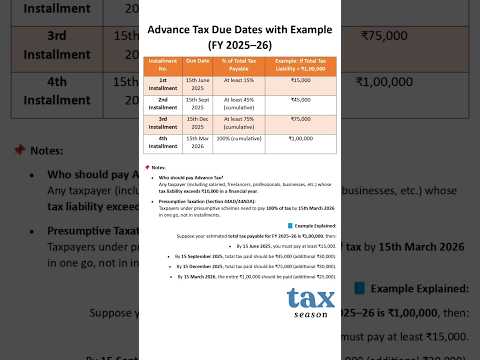
Under Section 211(1) of the Income Tax Act, advance tax must be deposited in four statutory tranches:
| Installment | Statutory Due Date | Cumulative Minimum Percentage Payable | Tolerated Safe-Harbour Threshold |
|---|---|---|---|
| 1st Tranche | On or before June 15 | 15% of estimated tax | 12% (No 234C if ≥ 12% paid) |
| 2nd Tranche | On or before September 15 | 45% of estimated tax | 36% (No 234C if ≥ 36% paid) |
| 3rd Tranche | On or before December 15 | 75% of estimated tax | 75% (Strict milestone) |
| 4th Tranche | On or before March 15 | 100% of estimated tax | 100% of assessed tax |
3. Section 44AD / 44ADA Presumptive Taxpayers (Single March 15 Rule)
To relieve small business owners, professionals, and freelancers from the administrative burden of quarterly accounting estimates, the Finance Act provided an exclusive procedural carve-out:
Single Installment Mandate (Section 211(1)(b))
Taxpayers opting for presumptive taxation under Section 44AD (small businesses with turnover up to ₹3 Crore) or Section 44ADA (specified professionals with gross receipts up to ₹75 Lakh) are NOT required to pay four quarterly installments.
They can pay 100% of their advance tax in a single consolidated tranche on or before March 15 of the financial year without attracting any Section 234C interest for June, September, or December!
4. Section 234C Interest: Step-by-Step Deferment Formula
Section 234C penalizes taxpayers for deferring payment of individual quarterly installments. Simple interest is levied at 1% per month:
5. Section 234B Interest: The 90% Threshold & Post-March 31 Penalties
While Section 234C looks back at quarterly installments, Section 234B assesses whether the taxpayer entered the new financial year with a major tax shortfall:
The 90% Statutory Benchmark
Under Section 234B, if the total advance tax paid by an assessee before March 31 is less than 90% of the assessed tax:
- Simple interest is charged at 1% per month (or part of a month).
- Interest runs from April 1 of the Assessment Year until the date of regular assessment or actual payment of self-assessment tax under Section 140A.
- If you pay your balance tax in July when filing your return, you suffer 4 full months (April, May, June, July = 4%) of Section 234B penal interest!
6. Senior Citizen Exemption: Section 207 Safe Harbour
Under Section 207(2) of the Income Tax Act, resident senior citizens enjoy a complete statutory exemption from advance tax obligations:
Section 207(2) Eligibility Conditions
- The individual must be a Resident of India for tax purposes.
- Must be aged 60 years or above at any point during the financial year.
- Must NOT have any income from business or profession (PGBP).
Even if a resident senior citizen earns ₹50 Lakh from bank interest, capital gains on real estate, or stock market profits, they pay ZERO advance tax and suffer ZERO interest under Section 234B or 234C. They can settle 100% of their tax as self-assessment tax at the time of ITR filing in July!
7. Comparison: Section 234A vs 234B vs 234C
| Section | Nature of Default | Interest Rate | Period of Computation |
|---|---|---|---|
| Section 234A | Delay in filing Income Tax Return (ITR) | 1% per month | From due date (July 31) till actual filing date |
| Section 234B | Shortfall of total advance tax (< 90% paid) | 1% per month | From April 1 of AY till date of tax payment |
| Section 234C | Deferment of quarterly installments | 1% per month | Fixed 3 months for Q1-Q3; 1 month for Q4 |
8. Unpredictable Incomes: Safe Harbour for Capital Gains & Lottery
How can an investor estimate capital gains on a property sold in February or dividend windfalls earned in January for their June 15 installment?
First Proviso to Section 234C(1)
The statute provides that Section 234C interest shall NOT be levied on shortfalls arising from:
- Capital gains (short-term or long-term);
- Winnings from lotteries, crossword puzzles, horse races;
- New business income arising for the first time;
- Dividend income exceeding ₹10,000.
Provided the assessee pays the entire tax liability on such unexpected windfall income in the remaining upcoming advance tax tranches (or before March 31 if earned in March)!
9. How to Pay Advance Tax Online via Challan 280 / e-Pay Tax
- Step 1: Access e-Filing Portal: Navigate to
incometax.gov.in> Quick Links > Click "e-Pay Tax". - Step 2: Enter PAN & Mobile OTP: Enter your 10-digit PAN and mobile number to verify via 6-digit OTP.
- Step 3: Select Assessment Year & Type of Payment: Choose the Assessment Year (e.g. AY 2027-28 for FY 2026-27). Under Type of Payment, select "Advance Tax (100)".
- Step 4: Pay via NetBanking, UPI, or Debit Card: Enter the tax amount and pay instantly. Download the signed Challan Receipt containing BSR Code, Challan No., and Tender Date.
10. Top Audit Pitfalls & Avoiding AIS Interest Traps
Major Advance Tax Calculation Errors
- Selecting Wrong Challan Minor Head: Depositing under "Self-Assessment Tax (300)" instead of "Advance Tax (100)" before March 31 prevents automated credit against 234B/C calculations.
- Ignoring Savings Account & FD Interest: Assuming TDS on FD covers total tax. TDS is only 10%, but taxpayers in the 30% bracket owe an extra 20% + cess as advance tax!
- Forgetting Stock Market Gains: Automated quarterly capital gains reports in AIS mean CPC will automatically calculate 234C interest if gains are not matched to subsequent advance tax tranches.
Recommended Video Tutorials & Practical Walkthroughs
Watch these handpicked, expert video guides covering practical compliance, step-by-step procedures, and real-world implementation:
Recommended Video Tutorials & Practical Guides