
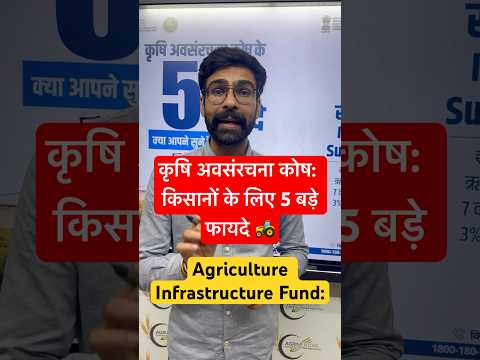
Agriculture Infrastructure Fund (AIF): 3% Interest Subvention Guide
Quick Summary & Key Takeaways (Featured Snippet)
1. Statutory Overview: Ministry of Agriculture ₹1 Lakh Crore AIF Debt Architecture
In India's comprehensive socioeconomic and industrial policy landscape, government schemes, financial subsidies, and asset formalization programs represent vital economic growth drivers. Agriculture Infrastructure Fund (AIF): 3% Interest Subvention Guide serves as a foundational guide for entrepreneurs, farmers, industrial developers, and citizens seeking to leverage sovereign incentives and capital assistance.
Policy Framework & National Strategic Objectives
Spearheaded by Central Ministries, State Governments, and specialized development agencies, these flagship programs aim to formalize legal rights, enhance productivity, boost exports, and unlock institutional banking credit for sustainable national wealth creation.
2. The 3% Interest Subvention Formula: Calculation & 7-Year Benefit Tenure
Accessing sovereign benefits requires fulfilling rigorous statutory criteria and technical milestones. Program guidelines establish transparent eligibility parameters and legal safeguards to ensure targeted benefit delivery.
Beneficiary Rights & Entitlements
Statutory capital subsidies, interest subvention discounts, sovereign credit guarantee covers, and formal legal title ownership.
Technical Conditions & Thresholds
Mandatory minimum capital expenditure, physical asset verification, boundary dispute resolution, and strict domestic manufacturing norms.
3. Free Credit Guarantee: 100% CGTMSE Fee Reimbursement for Loans Up to ₹2 Crores
Detailed project reports (DPR), audited financial models, land possession records, and technical compliance certificates constitute the critical evidentiary dossier required by sanctioning committees.
4. Qualifying Infrastructure: Warehouses, Silos, Cold Storage, Sorting, Grading & Primary Processing
The governance architecture spans District Level Committees (DLC), State Level Approval Committees (SLAC), Project Management Agencies, and Central Ministries operating through digital single-window portals.
5. The 25-Project Rule: Scaling Multi-Location Agri-Logistics Hubs Under AIF
Statutory timelines, implementation milestones, public objection windows, and periodic claim filing schedules must be tracked with absolute diligence to prevent disqualification or forfeiture of sovereign aid.
6. Eligible Entities: Farmers, Agri-Entrepreneurs, Startups, FPOs & Primary Agricultural Credit Societies
Financial structuring, combining term loan debt from commercial banks with capital subsidies, interest subvention, and promoter equity, significantly reduces weighted average cost of capital (WACC) and accelerates project return on investment (ROI).
7. Lending Terms: Bank Interest Caps, Loan Repayment & Up to 2-Year Principal Moratorium
Beneficiaries must maintain rigorous post-sanction compliance, ensuring that assets are not alienated, production milestones are sustained, and statutory accounts are audited by authorized agencies.
8. Step-by-Step SOP: DPR Preparation to Sanction on agriinfra.dac.gov.in
Project Conceptualization & Eligibility Pre-Screening
Confirm scheme eligibility, land title availability, technology specifications, and prepare an exhaustive Detailed Project Report (DPR).
Online Digital Portal Registration & Submission
Register on the official government single-window portal, upload required land records, technical DPRs, and bank consent letters.
Technical Scrutiny & Sanction Order Issuance
Navigate scrutiny by designated district and state appraisal committees to obtain the formal Administrative Sanction Order.
Implementation, Physical Audit & DBT Disbursement
Complete asset installation, undergo physical inspection by authorized verification officers, and receive electronic direct benefit transfer.
9. Comparative Matrix: AIF vs Standard Commercial Agri Loan vs NABARD RIDF
| Program Parameter | Sovereign Flagship Scheme | Conventional Banking / Market Route | Unsubsidized / Informal Method |
|---|---|---|---|
| Financial Subsidy / Aid | 30% to 60% Capital Grant | Zero Subsidy | 100% Out-of-Pocket Cost |
| Interest Rate / Cost | 3% Subvention / Capped Rates | Standard Commercial Rates | High Informal Borrowing Rates |
| Collateral / Security | CGTMSE Free Cover / Legal Title | 100% Physical Mortgage | Unsecured / Disputed Rights |
| Institutional Validation | Official Central/State Sanction | Commercial Credit Rating | Unrecognized |
10. Real-World Case Study: ₹3.8 Crore Multi-Commodity Cold Storage Project Under AIF
Socioeconomic Case Study: Unlocking Sovereign Value
An ambitious entrepreneurial enterprise successfully leveraged government programs to establish modern infrastructure and expand commercial capacity.
The project faced heavy upfront capital requirements, high commercial borrowing interest rates, and complex land documentation challenges.
Through structured portal filings and inter-agency scheme convergence, the promoter secured substantial capital subsidy, reduced debt service costs, and achieved commercial operational stability.
11. High-Risk Scrutiny Pitfalls: Secondary Processing Disqualification & Building Cost Limits
Common pitfalls during scheme execution include defective DPR submissions, failure to establish undisputed land possession, ignoring domestic component mandates, and submitting fraudulent invoices. Adhering to verified statutory guidelines ensures seamless approval.
12. Triple Scheme Convergence: Combining AIF with PMKSY / PMFME & State Capital Subsidies
The strategic convergence between Central sector schemes, State industrial policies, and bank priority sector lending creates an unparalleled multiplier effect for regional economic empowerment.
13. Governance: District Level Monitoring Committee (DLMC) & National Steering Committee
Statutory guidelines and administrative circulars issued by Central Ministries establish legally binding obligations on implementing agencies, guaranteeing fair and transparent processing of citizen applications.
14. Decision Matrix: Standalone Warehouse vs Cold Chain Logistics Project
Promoters and beneficiaries must conduct careful feasibility modeling, aligning their operational expansion plans with the specific eligibility parameters and disbursement milestones of respective government schemes.
15. Agri-Entrepreneur's AIF Bank Loan & Portal Application Checklist
Recommended Video Tutorials & Practical Walkthroughs
Watch these handpicked, expert video guides covering practical compliance, step-by-step procedures, and real-world implementation:
Recommended Video Tutorials & Practical Guides

16. Frequently Asked Questions (FAQs)
17. Ministry of Agriculture Guidelines, Operational Circulars & NABARD Directives
Agriculture Infrastructure Fund (AIF) Central Sector Scheme Operational Guidelines (July 2020 and revised amendments); Department of Agriculture and Farmers Welfare, Ministry of Agriculture; NABARD Circular on PACS as MSC; RBI Priority Sector Lending Guidelines for Agriculture.