
Aviation Hull, Spares & Aircraft Third-Party Liability Insurance: DGCA Compliance Guide
Quick Summary & Key Takeaways (Featured Snippet)
1. The High-Stakes Aerospace Risk Landscape: DGCA & International Conventions
Civil aviation is the most technologically sophisticated, capital-intensive, and strictly regulated industry in the world. With modern narrow-body airliners (Airbus A320neo, Boeing 737 MAX) valued at ₹400 to ₹600 Crores and wide-body aircraft exceeding ₹1,500 Crores, a single hull loss or major in-flight incident can trigger hundreds of millions of dollars in direct physical and third-party liabilities.
In India, aviation operations are overseen by the Directorate General of Civil Aviation (DGCA) and governed by the Aircraft Act, 1934, the Carriage by Air Act, 1972, and the International Civil Aviation Organization (ICAO) Chicago Convention. No aircraft can be operated in Indian airspace without proof of continuous, unencumbered aviation hull and third-party liability insurance.
2. DGCA Civil Aviation Requirements (CAR): Mandatory Insurance Compliance
Under DGCA CAR Series I, Part VIII, every commercial airline, Non-Scheduled Operator (NSOP), and general aviation private operator must maintain statutory insurance coverage:
Mandatory Insurance Categories Enforced by DGCA:
- Passenger Liability: Mandatory compensation for passenger death or bodily injury.
- Baggage & Cargo Liability: Coverage for lost, delayed, or destroyed checked baggage and cargo.
- Third-Party Public Liability: Indemnity for death, bodily injury, and property damage to persons on the ground caused by aircraft collision, falling components, or emergency landings.
3. Aviation Hull All Risks (HAR): Agreed Value vs Constructive Total Loss (CTL)
The Aviation Hull All Risks (HAR) policy is the core asset protection policy for aircraft owners and lessors. Key operational mechanics include:
Agreed Value Basis
Unlike auto or property insurance, aviation hull policies never apply depreciation or average clauses. The agreed value stated in the policy schedule is payable in full upon total loss.
Constructive Total Loss (CTL)
If an aircraft suffers severe structural damage where the estimated cost of repairs exceeds a specified threshold (typically 75% to 80% of the Agreed Value), the underwriter declares a CTL and disburses the full Agreed Value.
4. Hull War & Allied Perils (AVN 48B / LSW 555D): Terrorism & Hijacking
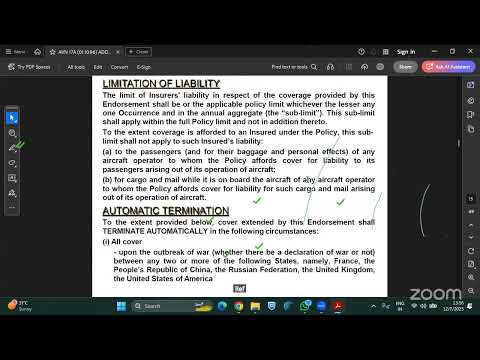
Standard aviation hull policies incorporate clause AVN 48B (War, Hi-Jacking and Other Perils Exclusion), which completely removes coverage for:
- War, invasion, civil war, rebellion, or sovereign military hostilities.
- Acts of international terrorism, sabotage, or strikes.
- Aircraft hijacking, illegal seizure of command, or hostage-taking.
- Confiscation, nationalization, or requisition by civil or military government authorities.
To protect multimillion-dollar aircraft, operators must purchase a separate Hull War and Allied Perils Policy (under LSW 555D wording), ensuring uninterrupted financial solvency across volatile international routes.
5. Spares All Risks (SAR) & Engine Transit Breakdown Protection
An airline's spare turbofan engines, landing gear assemblies, APUs (Auxiliary Power Units), and avionics boxes stored at maintenance hangars represent tens of millions of dollars in capital:
Spares All Risks (SAR) Underwriting Scope:
Covers engines and spare parts while in storage, during maintenance handling, and during worldwide air/ocean/road transit between MRO facilities. It includes engine test-bench running risks and accidental ingestion damage during pre-installation certification.
6. Aircraft Third-Party Liability & Passenger Bodily Injury: Combined Single Limit (CSL)
Aviation liability insurance is packaged as a Combined Single Limit (CSL). Under standard airline wordings (such as AVN 52E):
7. Montreal Convention 1999: Special Drawing Rights (SDR) Liability Framework
Under the Montreal Convention 1999, enacted in India through the Carriage by Air (Amendment) Act:
Two-Tier Strict Liability Architecture:
- First Tier (Strict Liability): Up to 128,821 SDRs (approx ₹1.45 Crores per passenger). The airline cannot exclude or limit its liability, regardless of whether negligence occurred.
- Second Tier (Fault-Based Unlimited Liability): For damages exceeding 128,821 SDRs, the carrier faces unlimited liability unless it proves that the damage was not due to the negligence, wrongful act, or omission of the carrier or its servants.
- Baggage Liability: Limited to 1,288 SDRs (approx ₹1.45 Lakhs) per passenger for lost or damaged luggage.
8. Aircraft Lessor Covenants: Cut-Through Clauses, Loss Payees & IDERA Compliance
Over 80% of commercial aircraft operating in India are dry-leased from international leasing companies (based in Ireland, Singapore, or GIFT City IFSC). Lessors impose rigorous contractual covenants under the Cape Town Convention:
Key Aircraft Lease Endorsements (AVN 67B):
- Sole Loss Payee: Hull claim proceeds must be paid directly to the lessor's offshore escrow account.
- Breach of Warranty: The insurer cannot void coverage to the innocent lessor even if the airline operator violated operating manuals.
- Reinsurance Cut-Through: Grants the lessor direct legal action against international Lloyd's reinsurers if the domestic Indian insurer defaults.
- IDERA Registration: Irrevocable De-Registration and Export Request Authorisation filed with DGCA.
9. Aviation Hull vs Hull War vs Spares vs Third-Party Liability Matrix
| Coverage Line | Primary Trigger | Valuation Basis | Key Stakeholder |
|---|---|---|---|
| Hull All Risks (HAR) | Accidental crash, hard landing, runway overrun, bird strike | Agreed Value | Aircraft Owner / Lessor |
| Hull War & Allied Perils | Hijacking, terrorism, civil strife, hostile missile strike | Agreed Value | Financing Banks / Lessors |
| Spares All Risks (SAR) | Transit damage, hangar fire, engine test cell failure | Invoice / Replacement Value | Airline Maintenance / CAMO |
| Third-Party Liability (CSL) | Passenger injury/death & ground collision damage | Combined Single Limit ($50M-$1B) | DGCA & General Public |
10. Aviation Incident Case Study: Corporate Jet Runway Excursion & Engine Ingestion
Case Study: Bombardier Challenger 605 Excursion at Mumbai Airport
During heavy monsoon rain, a corporate Bombardier Challenger 605 suffered aquaplaning upon touchdown, veering off the active runway. The starboard GE CF34 engine ingested runway threshold signage, causing catastrophic blade shear and landing gear collapse.
Hull Claim: Insured at Agreed Value of $12.5 Million with Lloyd's syndicate lead through an Indian PSU fronting insurer.
Repair Assessment: Total repair cost estimated at $8.90 Million (structural wing box damage + new engine). Exceeded 70% threshold.
Settlement: Declared a Constructive Total Loss (CTL). Full $12.5 Million Agreed Value disbursed within 45 days, with salvage rights retained by the reinsurers.
11. Fatal Underwriting Traps: Pilot Flying Hours Breaches & Unapproved AOD Operations
Pitfall 1: Non-Compliance with Named Pilot Warranty
Aviation policies stipulate exact pilot qualifications (e.g. Captain must have 3,000 total hours with 500 hours on-type). If an incident occurs while a pilot below warranty thresholds is at the controls, the insurer repudiates the hull claim immediately.
Pitfall 2: Operating Outside Geographic Limits
Corporate jets with domestic flight territorial warranties that venture into international or war-risk zones without prior written underwriter endorsements forfeit all insurance coverage.
12. Core Exclusions: Wear & Tear, Unairworthy Dispatch & Nuclear War Perils
Standard aviation insurance strictly excludes:
- Normal mechanical wear, tear, corrosion, metal fatigue, and gradual degradation of airframes and turbine components.
- Operating an aircraft known to be in an unairworthy state without valid DGCA Certificate of Airworthiness (C of A).
- Nuclear detonations, ionizing radiation, and radioactive contamination.
13. Flight Crew & Pilot Loss of License (LoL) Disability Insurance
Commercial pilots must undergo mandatory Class 1 DGCA medical evaluations every 12 months (or 6 months past age 60). If a medical impairment (cardiac event, neurological disorder, vision loss) results in permanent revocation of the Airline Transport Pilot License (ATPL), Loss of License (LoL) Insurance pays a lump-sum indemnity (typically ₹50 Lakhs to ₹2.5 Crores) to replace lost career earnings.
14. Decision Matrix: Structuring Combined Single Limits (CSL) by Aircraft MTOW
Recommended Liability Limits Based on Aircraft Type:
- Turboprop & Light Twins (King Air B200 / Cessna Caravan): Minimum $25 Million to $50 Million CSL.
- Midsize Corporate Jets (Hawker 900XP / Falcon 2000): $100 Million to $250 Million CSL.
- Commercial Narrow-Body (Airbus A320 / Boeing 737): $750 Million to $1.25 Billion CSL.
- Commercial Wide-Body (Boeing 777 / 787, Airbus A350): $1.50 Billion to $2.00 Billion CSL.
15. Chief Operating Officer & Chief Pilot's Annual DGCA Aviation Audit Checklist
Recommended Video Tutorials & Practical Walkthroughs
Watch these handpicked, expert video guides covering practical compliance, step-by-step procedures, and real-world implementation:
Recommended Video Tutorials & Practical Guides

16. Frequently Asked Questions (FAQs)
17. Official DGCA CAR, Ministry of Civil Aviation & ICAO References
Statutory Authority: DGCA Civil Aviation Requirements (CAR Series I, Part VIII); Aircraft Act, 1934; Carriage by Air Act, 1972; Convention for the Unification of Certain Rules for International Carriage by Air (Montreal Convention 1999); Cape Town Convention on International Interests in Mobile Equipment; ICAO Annex 8 (Airworthiness).