
What is the difference between CSR and ASR, and which one should you check before buying insurance?
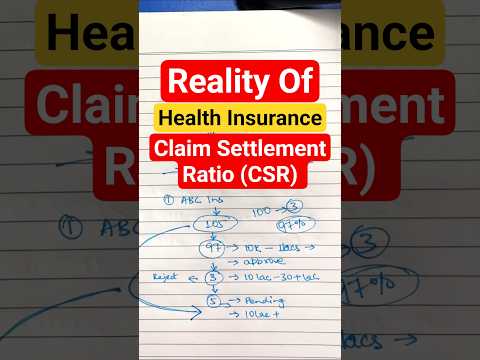
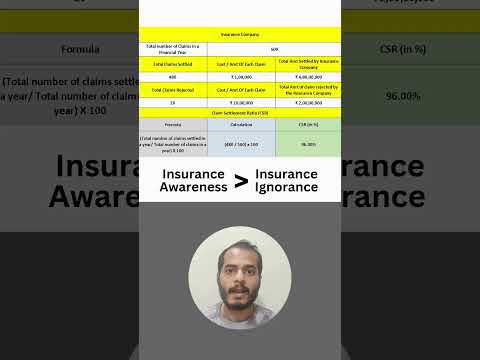
Claim Settlement Ratio (CSR) measures the percentage of death claims approved by headcount/number of policies (e.g., 99 settled out of 100). Amount Settlement Ratio (ASR) measures the percentage of total claim money in Rupees actually paid out (e.g., ₹95 Lakh settled out of ₹100 Lakh claimed). You must always check both: an insurer with 99% CSR but only 88% ASR is rejecting large ₹1 Crore to ₹5 Crore term insurance claims while paying low-value policies. Look for CSR > 98.5% AND ASR > 95% across 5 consecutive years.
1. The Mathematics of CSR vs ASR: Why Headcount Metrics Mislead
In India, retail insurance marketing almost exclusively advertises Claim Settlement Ratio (CSR). However, actuarial reality is far more nuanced when large sums are involved:
Consider an insurance company that receives 1,000 death claims during the financial year:
- 990 claims are for traditional endowment or micro-policies worth ₹1,00,000 each (Total: ₹9.9 Crore). The insurer settles all 990.
- 10 claims are for high-value term insurance policies worth ₹2 Crore each (Total: ₹20 Crore). The insurer repudiates all 10 on technical grounds.
- Official CSR = 990 / 1,000 = 99.0% (Looks stellar on marketing billboards).
- Actual ASR = ₹9.9 Cr / ₹29.9 Cr = 33.1% (The insurer denied 67% of total promised claim money!).
This demonstrates why high-net-worth individuals and salaried professionals buying ₹1 Cr to ₹5 Cr term covers must prioritize Amount Settlement Ratio over headcount CSR.
2. Audited IRDAI Data: Top 10 Indian Life Insurers Compared
The following table compiles verified statutory statistics from the official IRDAI Annual Report, tracking individual death claims performance:
| Life Insurer | Claim Settlement Ratio (CSR) | Amount Settlement Ratio (ASR) | Repudiation Ratio | Solvency Ratio (Min 150%) |
|---|---|---|---|---|
| Max Life Insurance | 99.65% | 96.8% | 0.31% | 198% |
| HDFC Life | 99.50% | 97.2% | 0.42% | 203% |
| Tata AIA Life | 99.13% | 96.5% | 0.58% | 190% |
| ICICI Prudential Life | 99.35% | 95.9% | 0.55% | 212% |
| SBI Life | 97.05% | 94.8% | 1.12% | 215% |
| Life Insurance Corp (LIC) | 98.52% | 95.1% | 0.86% | 187% |
| Bajaj Allianz Life | 99.04% | 94.2% | 0.82% | 516% |
| Kotak Mahindra Life | 98.82% | 93.8% | 0.95% | 262% |
3. Repudiation Ratio & Pending Claims: The Silent Killers
This measures the percentage of claims outrightly rejected. A high repudiation ratio (>1%) indicates an aggressive claims investigation team looking for minor discrepancies to deny benefits to surviving families.
This measures claims that remain unresolved at the end of the financial year. Under IRDAI regulations, an insurer must settle or reject a claim within 30 days of receiving all documents (or 90 days if forensic investigation is required).
4. Section 45 of Insurance Act: The 3-Year Statutory Armor
Amended by Parliament in 2015, Section 45 of the Insurance Act 1938 is the single greatest consumer protection law for life insurance policyholders in India:
- Absolute Incontestability After 3 Years: No policy of life insurance can be called in question on any ground whatsoever after the expiry of three years from the date of issuance or date of revival.
- Burden of Proof on Insurer Before 3 Years: If a death occurs within the first 3 years, the insurer can investigate, but the insurer bears the heavy legal burden to prove fraud, intentional suppression of facts, or material misstatement.
- No Agent Blame Passing: Even if the insurance agent filled out the form incorrectly, the insurer cannot repudiate the claim after 3 years once premiums have been accepted.
5. 5-Step Checklist to Ensure 100% Claim Approval for Your Nominee
Disclose all past hospitalizations, hypertension, diabetes, surgeries, or family illness history honestly.
Undergo medical tele-interviews and blood/urine tests. An insurer-conducted medical test drastically lowers dispute risks.
Declare all existing term and endowment policies held across all insurers to prevent breach of maximum permissible cover limits.
Keep nominee Aadhaar, PAN, and active bank account details synchronized with the insurer's records.
Hold policies in an electronic Insurance Account (e-IA) via NSDL or CAMS Repository for instant nominee access.
Recommended Video Tutorials & Practical Guides
6. Frequently Asked Questions (FAQs)
What is the difference between Claim Settlement Ratio (CSR) and Amount Settlement Ratio (ASR)?▼
Claim Settlement Ratio (CSR) measures the percentage of claims settled by number of policies (headcount), whereas Amount Settlement Ratio (ASR) measures the percentage of claims settled by actual rupee value paid out compared to total claimed amounts.
Why is Amount Settlement Ratio (ASR) more critical for term insurance buyers?▼
Because high-value term insurance policies (₹1 Crore to ₹5 Crore) account for a tiny fraction of total policy count but a massive fraction of monetary claim exposure. A company could approve thousands of small endowment claims to inflate CSR to 99%, while repudiating high-value term claims. ASR reveals if large claims are actually honored.
What is considered a good Amount Settlement Ratio (ASR)?▼
A reliable insurer should have an Amount Settlement Ratio (ASR) of 95% or higher, alongside a Claim Settlement Ratio (CSR) of 98.5% or higher maintained consistently over the last 3 to 5 consecutive financial years.
What is Claim Repudiation and how can my nominee prevent it?▼
Claim Repudiation is the formal rejection of a death claim by the insurance company due to fraud, material misrepresentation, or non-disclosure of medical conditions or habits. To prevent it, disclose all medical history, declare smoking/alcohol honestly, undergo medical checkups, and ensure the policy completes 3 continuous years under Section 45.
Compare Term Plans & Health Protection
Review our detailed head-to-head comparison on ₹1 Crore Term Insurance Plans and NPS Tier 1 vs Tier 2 Rules.