
Quick Summary & Key Takeaways (Featured Snippet)
What is Form 16 Part A and Part B?
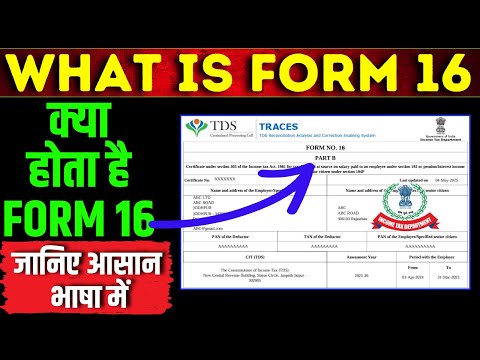
Form 16 is the cornerstone document for salaried taxpayers in India. Issued under Section 203 of the Income Tax Act, 1961 read with Rule 31 of the Income Tax Rules, it certifies that your employer deducted tax from your salary under Section 192 and deposited it into the Central Government’s account.
Form 16 - Part A (TRACES Certificate)
Generated and downloaded exclusively from the Centralized Processing Cell (TDS) portal—TRACES (tdscpc.gov.in). It carries a unique TRACES barcode and certificate number.
- • Employer’s Name, Address, and Tax Deduction Account Number (TAN).
- • Employee’s Name and Permanent Account Number (PAN).
- • Quarter-wise breakdown of gross salary paid and TDS deposited.
- • Government challan numbers, BSR codes, and deposit dates.
Form 16 - Part B (Salary Annexure)
Prepared by the employer as an annexure to Part A. It provides the granular mathematical computation of how your taxable income and tax liability were determined.
- • Gross salary under Section 17(1), perquisites 17(2), profits in lieu 17(3).
- • Allowances exempt under Section 10 (HRA, LTA, child education).
- • Standard deduction (₹75,000 New Regime / ₹50,000 Old Regime).
- • Itemized Chapter VI-A deductions (80C, 80D, 80CCD(1B), etc.).
- • Relief under Section 89 and net payable/refundable tax.
Who Receives Form 16?
Salaried Staff with TDS
Every employee from whose monthly salary tax was deducted under Section 192 is statutorily entitled to receive Form 16 by June 15.
Employees Below Tax Slabs
If your total income was below the basic exemption limit (₹3,00,000) and zero TDS was deducted, employers are not legally required to issue Form 16, though many provide Part B as a salary certificate.
Dual-Employment Switchers
Professionals who resigned and joined a new company during the financial year will receive separate Form 16s from each employer.
TDS Certificates: Form 16 vs Form 16A vs Form 16B
Form 16: Salary Income (Section 192)
Issued exclusively by employers to salaried employees annually covering the entire fiscal year.
Form 16A: Non-Salary TDS (Sections 194A, 194C, 194J, 194H)
Issued quarterly by banks (for FD interest), clients (for professional/freelance fees), and companies (for contractual payments).
Form 16B: TDS on Immovable Property (Section 194-IA)
Issued by property buyers to property sellers certifying that 1% TDS was deducted on transactions exceeding ₹50 Lakh.
How TRACES & Section 192 TDS Operate
The issuance of Form 16 involves a rigid quarterly compliance cycle between the employer, the banking clearing house (OLTAS), and the Income Tax Department:
Employer Obligation & Statutory Deadlines
Annual Compliance Timeline
- • March 31: End of Financial Year (FY).
- • May 31: Employer filing deadline for Q4 Form 24Q.
- • June 15: Statutory cutoff for employer to issue Form 16 to employee.
- • July 31: Statutory deadline for individual salaried taxpayers to file ITR.
Legal Consequences of Non-Issuance
- • Under Section 272A(2)(g), employers face a mandatory penalty of ₹500 per day of delay.
- • Employees can lodge a formal grievance on the e-filing portal (e-Nivaran) against defaulting employers.
Statutory Cost & Employer Penalties
| Compliance Parameter | Statutory Amount / Rate | Responsible Party |
|---|---|---|
| Issuance of Form 16 to Employee | ₹0 (Strictly Free) | Employer must provide free of cost |
| Late Issuance Penalty (Sec 272A(2)(g)) | ₹500 per day of default | Payable by defaulting employer |
| Late Filing of Q4 24Q (Sec 234E) | ₹200 per day | Payable by employer until return is filed |
Documents Needed for Three-Way Tax Reconciliation
Primary Employer Certificates
- • Form 16 Part A (Signed with valid TRACES unique certificate ID).
- • Form 16 Part B (Itemized salary computation statement).
- • Monthly salary slips for April through March.
- • Full and Final Settlement (FNF) statement (if switched jobs).
Government Portal Tax Statements
- • Form 26AS: Tax Credit Statement downloaded from TRACES.
- • Annual Information Statement (AIS): Comprehensive financial summary.
- • Taxpayer Information Summary (TIS): Aggregated direct tax figures.
- • Bank account interest certificates (Savings & FD interest).
Step-by-Step Verification & ITR Filing Process
Step 1: Check TRACES Authenticity of Part A
Verify that Part A displays the official TRACES logo, unique 8-character certificate number, and that your 10-digit PAN and employer's TAN match exactly.
Step 2: Cross-Verify with Form 26AS & AIS
Log into the Income Tax portal (incometax.gov.in). Open Form 26AS and AIS. Compare the total salary paid and total TDS deposited against Part A. Every single rupee must match.
Step 3: Review Part B Salary Breakdown
Check your gross salary under Section 17(1). Confirm that the standard deduction (₹75,000 for New Regime / ₹50,000 for Old Regime) has been accurately deducted.
Step 4: Verify Missing Deductions & Rebates
If you forgot to submit ELSS, LIC, 80D Mediclaim, or home loan interest proofs to payroll, add them manually into your ITR schedule.
Step 5: Compare New vs Old Tax Regime
Use the portal’s regime comparison calculator. In FY 2024-25 / 2025-26, the New Tax Regime is the default regime with a basic exemption of ₹3 Lakh and Section 87A rebate up to ₹7 Lakh (effective ₹7.75 Lakh with standard deduction).
Step 6: File ITR-1 (Sahaj) & e-Verify via Aadhaar OTP
Validate the return, confirm zero pending tax or claim refund, submit the ITR, and complete immediate e-verification using your Aadhaar-linked mobile OTP.
Comparison: Form 16 vs Form 26AS vs AIS / TIS
| Feature | Form 16 (Part A & B) | Form 26AS | Annual Information Statement (AIS) |
|---|---|---|---|
| Issuing Authority | Your Employer | Income Tax TRACES Portal | Income Tax Department (e-Filing) |
| Scope of Income | Salary Income Only | All TDS, TCS & Advance Tax | Comprehensive (Salary, Stocks, Mutual Funds, Dividends, High-value buys) |
| Deduction Details | Detailed (Chapter VI-A itemized in Part B) | None (Only gross payment and TDS) | None (Only transaction values) |
| ITR Filing Utility | Primary source for salary schedule | TDS tax credit verification | 360-degree audit avoidance |
Real-World Salaried Tax Scenarios
Case A: The Job Switcher Tax Shock
Vikram worked for Company X for 6 months (earned ₹6 Lakh, TDS ₹0 due to standard deduction & rebate) and joined Company Y for 6 months (earned ₹6 Lakh, TDS ₹0).
Case B: Missing TDS in Form 26AS
Priya’s payslips showed ₹45,000 TDS deducted across the year, but her Form 26AS showed only ₹20,000 deposited by her employer.
Common Mistakes When Filing with Form 16
Job changers often claim the ₹75,000 standard deduction twice in their ITR because both Form 16s show it. Standard deduction is allowed strictly once per taxpayer per year.
Claiming TDS shown on your payslip or Form 16 that does not reflect in 26AS will lead to immediate credit denial by CPC Bengaluru and a tax demand notice.
Form 16 only covers salary. Omitting bank interest, mutual fund dividends, or capital gains visible in your AIS results in automated high-risk scrutiny notices.
Accepting a typed Excel or Word document from an employer. Part A must strictly be the PDF downloaded from TRACES with a valid digital signature.
Risks of Undeposited TDS & CBDT Protection
Statutory Framework: Section 192, Section 203 & Rule 31
Section 192 TDS on Salary
Mandates employers to estimate annual taxable salary, apply chosen regime tax rates, and deduct TDS proportionately in equal monthly installments.
Section 203 Certificate Rule
Imposes a legal duty on every deductor to furnish a certificate of tax deduction specifying the amount deducted, deposit date, and treasury challan.
Section 192(2) & Form 12B
Enables an employee joining a new company mid-year to declare their previous salary and TDS to the new employer via statutory Form 12B.
New Tax Regime vs Old Tax Regime for Salaried Employees
New Tax Regime (Default)
- ✓ Higher Standard Deduction of ₹75,000 for salaried employees.
- ✓ Zero tax on income up to ₹7.75 Lakh (₹7 Lakh + ₹75,000 standard deduction).
- ✓ Lower slab rates: 5% (₹3–7L), 10% (₹7–10L), 15% (₹10–12L), 20% (₹12–15L), 30% (>₹15L).
- ✓ Zero paperwork or requirement to preserve investment receipts.
- ✓ Deductions disallowed: 80C, 80D, HRA, LTA, home loan interest.
Old Tax Regime (Optional)
- ✓ Standard deduction of ₹50,000.
- ✓ Full deductions permitted: Section 80C (up to ₹1.5L), 80D Mediclaim (₹25k–₹50k).
- ✓ Section 24(b) Home Loan Interest deduction up to ₹2 Lakh.
- ✓ Section 10(13A) House Rent Allowance (HRA) exemption.
- ✓ Beneficial only if: Total eligible deductions exceed ₹3.75 Lakh to ₹4 Lakh.
Pre-Filing Form 16 Verification Checklist
Recommended Video Tutorials & Practical Walkthroughs
Watch these handpicked, expert video guides covering practical compliance, step-by-step procedures, and real-world implementation:
Recommended Video Tutorials & Practical Guides
Frequently Asked Questions
What is the difference between Form 16 Part A and Part B?
Part A is a standardized TDS certificate downloaded directly by your employer from the government TRACES portal (tdscpc.gov.in). It contains the employer's TAN, employee's PAN, and a quarter-wise breakdown of salary deposited and tax deducted. Part B is an annexure prepared by the employer detailing the complete salary computation, including allowances under Section 10, perquisites under Section 17(2), standard deductions, Chapter VI-A deductions (80C, 80D), and the final net tax liability.
What is the statutory deadline for employers to issue Form 16?
Under Rule 31 of the Income Tax Rules, 1962, employers must compulsorily issue Form 16 to employees on or before June 15 of the assessment year immediately following the financial year in which tax was deducted.
How do I file an Income Tax Return (ITR) if I changed jobs and have two Form 16s?
When you switch jobs during a financial year, you must combine the gross salaries from both Form 16s. Crucially, ensure that the standard deduction and the basic exemption limit are claimed only ONCE. If both employers gave you the basic exemption or full standard deduction, your combined income will push you into a higher tax bracket, resulting in additional tax payable along with interest under Section 234B and 234C.
What should I do if my employer deducted TDS from my salary but it does not appear in Form 26AS or AIS?
If salary TDS is missing from your Form 26AS, your employer either failed to deposit the tax into the government treasury or entered an incorrect PAN in their quarterly Form 24Q filing. You must immediately request your employer's payroll team to file a TDS Correction Return. As per CBDT instructions, the Income Tax Department cannot deny credit or issue recovery notices to an employee if tax was duly deducted from salary as proven by monthly pay slips.
Can an employee claim tax deductions that were not declared in Form 16 Part B?
Yes. If you failed to submit investment proofs (such as ELSS mutual funds, LIC premiums, health insurance, home loan interest, or donation receipts) to your employer before the payroll cutoff, you can still legitimately claim them while filing your Income Tax Return on the e-filing portal and claim a tax refund.
Statutory Sources & Regulatory Citations
- Income Tax Act, 1961: Section 192 (Salary TDS), Section 203 (TDS Certificate), Section 272A(2)(g) (Late Penalty).
- Income Tax Rules, 1962: Rule 31 (Form 16 Certificate Format and Timelines).
- Central Board of Direct Taxes (CBDT) Circular No. 275/29/2014-IT(B) on Non-Recovery of Tax from Employees.
- Directorate of Income Tax (Systems), TRACES Portal Guidelines for Form 16 Generation.