
Should an Indian MSME choose the GST Composition Scheme or the Regular Scheme?
The Composition Scheme under Section 10 is ideal for small local B2C retailers, grocery shops, and standalone restaurants with turnover under ₹1.5 Crore whose end-customers do not need Input Tax Credit. It offers minimal compliance (quarterly payment via CMP-08 and annual GSTR-4) at a flat 1% to 5% tax rate. However, if your business sells to B2B clients, makes interstate sales, or sells via e-commerce marketplaces (Amazon/Flipkart), you must register under the Regular Scheme to pass on ITC and maintain commercial viability.
1. Head-to-Head Comparison: Composition vs Regular Scheme
| Parameter | Composition Scheme (Section 10) | Regular Scheme |
|---|---|---|
| Turnover Threshold | Up to ₹1.5 Crore (Goods) / ₹50 Lakh (Services) | Mandatory above ₹40 Lakh goods / ₹20 Lakh services (or optional for any turnover) |
| Applicable Tax Rates | Flat 1%, 5%, or 6% on turnover | Standard slabs: 0%, 5%, 12%, 18%, 28% |
| Input Tax Credit (ITC) | No ITC Allowed (Cost in P&L) | Full ITC Available across purchases |
| Can Collect Tax from Buyer? | Strictly Prohibited | Yes, charged on Tax Invoice |
| Document Issued to Buyer | Bill of Supply | Tax Invoice (with E-Invoice if >₹5 Cr) |
| Interstate Sales Allowed? | No (Intrastate Only) | Yes (All-India & Global Exports) |
| Return Filing Compliance | Quarterly CMP-08 + Annual GSTR-4 | Monthly/Quarterly GSTR-1 + GSTR-3B + GSTR-9 |
2. Composition Tax Rates by Business Category
0.5% CGST + 0.5% SGST payable only on the taxable turnover of goods (exempt sales are excluded).
0.5% CGST + 0.5% SGST payable on total turnover (including both taxable and exempt goods).
2.5% CGST + 2.5% SGST on total turnover. Applies to food establishments not serving alcohol.
3% CGST + 3% SGST on turnover up to ₹50 Lakh for salons, repair shops, and small consultants.
3. Who CANNOT Opt for the Composition Scheme?
- Any business engaged in making interstate outward supplies of goods or services.
- Suppliers selling goods through an e-commerce operator required to collect TCS under Section 52 (e.g. Amazon, Flipkart), subject to specific small-seller exemptions.
- Manufacturers of notified goods: Ice cream, Pan Masala, Tobacco, Aerated waters, Fly ash bricks, and Building bricks.
- Casual taxable persons or Non-Resident Taxable Persons.
- Suppliers of goods exempt from GST (e.g. alcoholic liquor for human consumption).
4. Financial Profitability Simulation: Composition vs Regular
Consider a retail hardware shop with annual sales of ₹80 Lakh purchasing goods at ₹60 Lakh + 18% GST (₹10.80 Lakh):
| Financial Line Item | Composition Scheme (1%) | Regular Scheme (18% B2C) |
|---|---|---|
| Gross Selling Price (collected from buyers) | ₹80,00,000 | ₹80,00,000 (Incl. 18% GST = ₹67.80L Net + ₹12.20L GST) |
| Purchase Cost | ₹60,00,000 + ₹10,80,000 GST = ₹70,80,000 | ₹60,00,000 (₹10.80L GST claimed as ITC) |
| GST Payable to Government | ₹80,000 (1% of ₹80 Lakh out of pocket) | ₹12,20,000 - ₹10,80,000 ITC = ₹1,40,000 |
| Net Profit Earned | ₹8,40,000 | ₹7,80,000 |
Key Insight: When selling purely to retail consumers who cannot utilize tax credits, Composition often yields slightly higher net margins because the dealer avoids competitive price inflation. However, if selling to corporate clients, those clients will refuse to purchase because they lose ₹10.80 Lakh in tax credits.
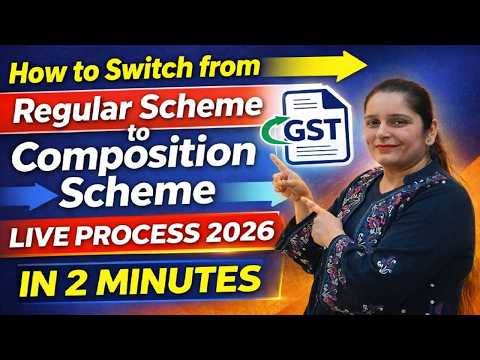
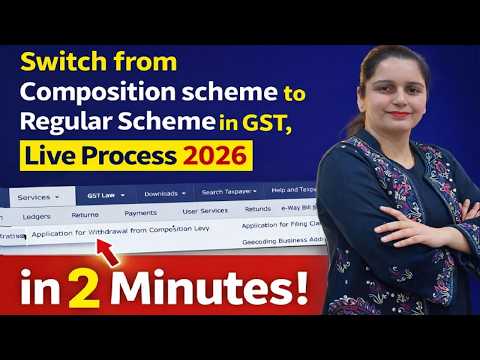
Recommended Video Tutorials & Practical Guides
5. Frequently Asked Questions (FAQs)
When can a taxpayer switch from Regular to Composition scheme?▼
You can opt into the Composition Scheme only at the beginning of a financial year by filing Form GST CMP-02 before 31st March of the preceding financial year. You must also reverse ITC on closing stock by filing Form GST ITC-03 within 60 days.
Can I voluntarily opt out of the Composition Scheme mid-year?▼
Yes. You can exit the Composition Scheme at any time during the year by filing Form GST CMP-04 within 7 days of the occurrence of any event disqualifying you or by voluntary choice. You can claim credit on stock held on that date by filing Form GST ITC-01 within 30 days.
Is a composition dealer subject to Tax Audit under Section 44AB?▼
Under Income Tax law, tax audit applicability is governed by Section 44AB and Section 44AD presumptive taxation limits (up to ₹3 Crore turnover if digital transactions exceed 95%). Review our detailed Section 44AB Tax Audit Guide for exact thresholds.
Manage Billing for Composition or Regular Scheme
Print customized Bills of Supply, issue E-Invoices, and generate accurate quarterly CMP-08 statements with GST Munshi.