
Is GST applicable on director remuneration in India, and how does CBIC Circular 140 distinguish between salary and sitting fees?
1. GST on Director Remuneration: The Regulatory Landscape
The remuneration paid by companies to their board of directors has historically been one of the most litigated arenas under Indian indirect taxation. Following diverse advance rulings from state Authority for Advance Rulings (AAR) benches, the Central Board of Indirect Taxes and Customs (CBIC) issued landmark guidance to harmonize statutory provisions.
Under the Central Goods and Services Tax (CGST) Act, 2017, director payouts are governed by two opposing statutory forces: the Employer-Employee exclusion under Schedule III and the Reverse Charge Mechanism (RCM) under Notification No. 13/2017-Central Tax (Rate).
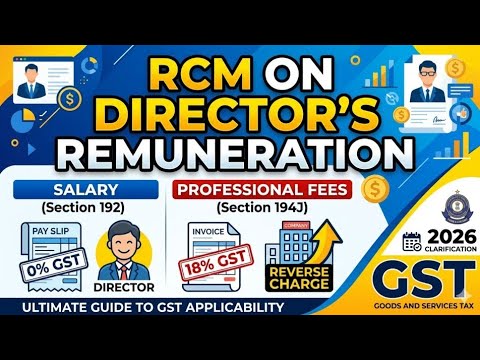
0% GST on Salaries
Executive director salaries subject to Section 192 TDS are completely outside GST scope under Schedule III.
18% RCM on Sitting Fees
Independent / Non-Executive director fees subject to Section 194J TDS attract 18% RCM payable by the company.
100% ITC Recovery
Companies can immediately reclaim the 18% RCM cash payment as Input Tax Credit against outward tax obligations.
2. Applicable Corporate Entities
These statutory provisions apply universally across all corporate entities incorporated under the Companies Act, 2013:
- Private Limited Companies: Paying monthly executive remuneration or director advisory fees.
- Public Limited Companies (Listed & Unlisted): Paying board sitting fees, committee meeting charges, and profit-sharing commissions.
- One Person Companies (OPC): Where the sole director draws managerial compensation.
- Section 8 Non-Profit Companies: Reimbursing professional out-of-pocket expenses to directors.
3. The Two Director Categories: Executive vs Non-Executive
Category A: Executive / Whole-Time Directors
Includes Managing Directors (MD), Whole-Time Directors (WTD), and Executive Directors bound by employment contracts, operational executive duties, and company HR policies.
Tax Rule: Section 192 TDS applied → Schedule III Exemption (0% GST).
Category B: Independent & Non-Executive Directors
Includes Independent Directors, Nominee Directors representing banks/PE funds, and Non-Executive Directors attending board meetings without employer-employee relations.
Tax Rule: Section 194J TDS applied → 18% Reverse Charge Mechanism (RCM).
4. Landmark CBIC Circular No. 140/10/2020-GST Clearances
On June 10, 2020, the CBIC issued authoritative clarifications ending nationwide tax confusion:
Issue 1: Remuneration Paid to Independent / Non-Employee Directors: Circular 140 conclusively held that services supplied by non-employee directors to a company are taxable and subject to Reverse Charge Mechanism under Section 9(3) in the hands of the company.
Issue 2: Remuneration Paid to Whole-Time Directors: Circular 140 established a clean two-part bifurcation test:
- Part 1 (Salary Element): The portion of remuneration declared as 'Salaries' in the company's books and subjected to TDS under Section 192 is covered under Schedule III Entry 1. NO GST is leviable.
- Part 2 (Professional Fee Element): Any portion paid for specialized technical, financial, or management consultancy declared separately and subjected to TDS under Section 194J is treated as non-employee services. Subject to 18% RCM.
5. Notification No. 13/2017 18% RCM Mechanics
Under Entry 6 of Notification No. 13/2017-Central Tax (Rate), the reverse charge operates under the following statutory parameters:
| Parameter | Statutory Mandate |
|---|---|
| Category of Supply | Services supplied by a director of a company or body corporate to the said company |
| Supplier of Service | Individual Director |
| Recipient Liable to Pay Tax | The Company or Body Corporate |
| Applicable GST Rate | 18% (9% CGST + 9% SGST or 18% IGST) |
| Payment Mode | Strictly 100% Cash Ledger (ITC cannot be used) |
6. Schedule III Entry 1: The Employer-Employee Shield
Entry 1 of Schedule III of the CGST Act explicitly provides:
"Services by an employee to the employer in the course of or in relation to his employment."
Because Schedule III items are statutorily deemed as neither a supply of goods nor a supply of services, salaries paid to executive directors are completely exempt from GST, regardless of turnover size.
7. Mandatory Documentation to Defend Schedule III Status
During GST audits under Section 65, tax officers routinely challenge director salary exemptions. To withstand scrutiny, companies must maintain:
- Service Agreement / Employment Contract: Specifying designation, executive responsibilities, working hours, leave entitlement, and reporting hierarchy.
- Board Resolution & Form DIR-12: Passed under Section 196/197 of the Companies Act, appointing the individual as a Whole-Time Director.
- Form 16 Part A & B: Verifying that income tax was deducted under Section 192 (Salaries).
- PF / ESI Statements: If applicable, evidencing employee payroll integration.
8. Step-by-Step Corporate Compliance Workflow
Monthly Director Payroll Bifurcation
Segregate all director payouts at month-end into: (a) Section 192 Employee Salaries, and (b) Section 194J Sitting Fees / Professional Commissions.
Generate Self-Invoicing Under Section 31(3)(f)
Because independent directors are unregistered suppliers, the company must generate a Self-Invoice for all RCM sitting fees under Section 31(3)(f) of the CGST Act.
Report Liability in Form GSTR-3B Table 3.1(d)
Enter the gross value of sitting fees and 18% GST under Table 3.1(d) (Inward supplies liable to reverse charge). Settle 100% of this tax via cash payment.
Avail 100% Input Tax Credit in Table 4(A)(3)
In the exact same GSTR-3B filing, claim the entire 18% tax paid under Table 4(A)(3) (Inward supplies liable to reverse charge other than import). The transaction is cash-neutral!
9. Direct Comparison: Section 192 Salary vs Section 194J Sitting Fees
| Feature | Executive Director Remuneration | Independent Director Fees |
|---|---|---|
| Income Tax TDS Section | Section 192 (Salaries) | Section 194J (Professional / Fees) |
| GST Applicability | EXEMPT (Schedule III Entry 1) | 18% GST Applicable |
| Payment Mechanism | None | Reverse Charge Mechanism (RCM) |
| Tax Certificate Issued | Form 16 Part A & B | Form 16A |
| ITC Available to Company? | N/A | Yes (100% Eligible) |
10. Real-World Corporate Case Scenarios
Case A: Managing Director with ₹3,00,000 Monthly Salary
Context: The Managing Director of a software firm draws ₹3,00,000 per month. The company deducts TDS under Section 192 according to personal income tax slab rates and issues Form 16.
GST Position: Fully exempt under Schedule III Entry 1. The company has zero RCM liability and does not report this salary in Form GSTR-3B Table 3.1(d).
Case B: Independent Director Attending 4 Board Meetings (₹2,00,000)
Context: An independent director receives ₹50,000 sitting fee per meeting, totaling ₹2,00,000 in Q2. The company deducts 10% TDS under Section 194J (₹20,000).
GST Position: The company generates a self-invoice for ₹2,00,000 under Section 31(3)(f), deposits 18% RCM (₹36,000) in cash in GSTR-3B Table 3.1(d), and claims ₹36,000 as Input Tax Credit in Table 4(A)(3).
11. Costly Tax Audit Mistakes
Omitting RCM Cash Payment
Assuming that because RCM is eligible for ITC, you don't need to report or pay it in cash. Failure to pay RCM attracts 18% interest under Section 50, which CANNOT be claimed as credit.
Mismatched Income Tax & GST Heads
Deducting TDS under Section 194J in Form 26Q while claiming Schedule III GST exemption in GSTR-3B. The department's automated cross-matching tools will flag this discrepancy immediately.
12. Legal & Financial Consequences of Default
- Mandatory 18% Interest (Section 50): Interest accrues from the due date of return filing until actual cash discharge.
- Section 73/74 Penalty: 10% penalty for bona fide errors, escalating to 100% penalty for suppression of facts.
- Loss of ITC: If RCM is paid past the statutory November 30 annual deadline following an audit notice, the department may disallow corresponding ITC under Section 16(4).
13. Statutory Harmonization: Companies Act, IT Act & CGST Act
Companies Act, 2013 (Section 197): Regulates overall managerial remuneration limits (11% of net profits) and sitting fees limits (₹1,00,000 per meeting under Rule 4).
Income Tax Act, 1961: Section 192 (Salaries) vs Section 194J (Fees for professional or technical services).
CGST Act, 2017: Section 9(3) RCM read with Notification 13/2017 and Schedule III Entry 1.
14. How Companies Can Claim 100% ITC on RCM Payments
Because board governance and directorial oversight directly further the company's business operations, the 18% GST paid under RCM satisfies Section 16(1) criteria. It is NOT blocked under Section 17(5), enabling full recovery as input tax credit.
15. Corporate Governance & CFO Action Checklist
Recommended Video Tutorials & Practical Walkthroughs
Watch these handpicked, expert video guides covering practical compliance, step-by-step procedures, and real-world implementation:
Recommended Video Tutorials & Practical Guides
16. Frequently Asked Questions (FAQs)
Is GST payable if an executive director receives rent for commercial property leased to the company?
Yes. Renting commercial property to the company is supplied in the individual's personal capacity as a landlord, not as an employee. If the director's aggregate turnover exceeds the registration threshold (₹20 Lakhs), the director must obtain GST registration and charge 18% GST forward charge (or RCM if unregistered commercial property rules apply).
Are reimbursements of travel and hotel expenses to directors subject to GST?
Pure reimbursements on actual cost-to-cost basis supported by third-party hotel and airline bills issued in the company's name do not attract RCM. However, if a lump-sum travel allowance is paid without third-party supporting vouchers, it may be treated as sitting fee component subject to 18% RCM.
Does RCM apply to a foreign director attending board meetings from abroad?
Yes. Services provided by a foreign non-executive director qualify as an Import of Services under Section 2(11) of the IGST Act, and the Indian company must pay 18% IGST under Reverse Charge Mechanism.
17. Statutory References & Official Citations
Central Board of Indirect Taxes and Customs (CBIC): Circular No. 140/10/2020-GST dated June 10, 2020.
Notification No. 13/2017-Central Tax (Rate): Entry 6 governing reverse charge on director services.
Central Goods and Services Tax Act, 2017: Section 9(3) (Reverse charge) and Schedule III Entry 1.