Quick Summary & Key Takeaways (Featured Snippet)
1. Overview & Slump Sale Definition
In corporate reorganizations, mergers, and acquisitions (M&A), a Slump Sale represents the transfer of one or more business undertakings for a lump-sum consideration without values being assigned to individual assets and liabilities. The legal definition mirrors Section 2(42C) of the Income Tax Act, 1961.
Under the Goods and Services Tax framework, transferring a business involves land, factory buildings, capital machinery, raw materials, customer contracts, licenses, and human resources. If treated as individual itemized sales, the transaction would trigger complex rates (18% for machinery, 12% for supplies, 0% for land) and cash flow friction. Recognizing this commercial necessity, the GST law treats a genuine going-concern transfer as an exempt service.
2. Notification 12/2017-CT(R) Exemption Analysis
Entry 2 of Notification No. 12/2017-Central Tax (Rate)
Chapter 99: "Services by way of transfer of a going concern, as a whole or an independent part thereof."
Rate of Tax: NIL (100% Exempt)
To satisfy the statutory benchmark of a "Going Concern":
- The transferred unit must be an operational commercial activity capable of carrying on business independently without interruption.
- Employees, operational contracts, leases, and licenses must seamlessly transition to the purchaser.
- The business must not be in liquidation or dismantled into scrap.
3. Schedule II Entry 4(c): Deemed Supply Exclusions
Under Paragraph 4(c) of Schedule II to the CGST Act, where any person ceases to be a taxable person, any goods forming part of the assets of a business shall be deemed to be supplied by him in the course of his business immediately before he ceases to be a taxable person.
Statutory Proviso to Paragraph 4(c)
The deemed supply rule does NOT apply if:
- The business is transferred as a going concern to another person; OR
- The business is carried on by a personal representative who is deemed to be a taxable person.
This statutory carve-out ensures that when an enterprise shuts down its old GST registration following a 100% slump sale, no deemed output GST is levied on the leftover plant, machinery, or inventory!
4. Slump Sale vs Itemized Asset Sale Matrix
| Feature | Slump Sale (Going Concern) | Itemized Asset Sale |
|---|---|---|
| Subject Matter | Entire operating undertaking with liabilities | Selected machines, vehicles, or inventory |
| Pricing Mechanism | Single lump-sum consideration | Asset-by-asset itemized invoice prices |
| GST Applicability | 0% NIL (Entry 2, Notif 12/2017) | Standard GST rates (18% / 28%) |
| Transfer of ITC Balances | Yes, via Form GST ITC-02 | No; buyer claims fresh ITC on invoices |
| Income Tax Treatment | Section 50B Capital Gains on Net Worth | Section 50 Short-Term Capital Gains on Block |
5. Form GST ITC-02: Transfer of Credit under Rule 41
When a business unit is sold as a going concern, what happens to the accumulated Input Tax Credit sitting in the seller's Electronic Credit Ledger? Under Section 18(3) and Rule 41, this credit is not lost:
The Rule 41 ITC-02 Process
- Filing by Transferor: The seller submits Form GST ITC-02 electronically on the common GST portal, declaring the unutilized ITC balances (IGST, CGST, SGST, Cess) to be transferred.
- Apportionment Ratio for Demergers: If only an independent unit/branch is transferred, the ITC is apportioned based on the value of assets transferred to the total value of assets of the enterprise.
- Acceptance by Transferee: The buyer logs into the GST portal and accepts the transfer in their ITC-02 dashboard. The credits are immediately credited to the buyer's electronic credit ledger.
6. Alignment with Income Tax Section 50B (Net Worth)
Under the Income Tax Act, 1961, any profits or gains arising from a slump sale are taxed under Section 50B as capital gains. The cost of acquisition is computed as the Net Worth of the Undertaking:
Capital Gain = Full Value of Consideration (Rule 11UAE) − Net Worth
Net Worth = Aggregate Value of Total Assets (depreciated book values) − Book Liabilities
If the seller owned the undertaking for more than 36 months, the gain is taxed as Long-Term Capital Gains (LTCG) at 20% (or 12.5% post-Finance Act 2024 revisions), with zero indexation benefit.
7. Drafting Business Transfer Agreements (BTA): Must-Have Clauses
The Business Transfer Agreement (BTA) is the primary piece of evidence scrutinized by GST auditors. Crucial clauses include:
1. Going Concern Recital
Explicit recital stating that the seller sells and the buyer purchases the business undertaking intact as an active, going concern capable of uninterrupted operations.
2. Lump-Sum Consideration
Strict statement that the transfer is for a consolidated lump-sum amount without any separate allocation of prices to individual fixed assets, stock, or intangibles.
3. Employee Transition
Commitment that all operating employees of the transferred division are absorbed by the buyer with continuity of service and gratuity/provident fund safeguards.
4. GST Indemnity Clause
Mutual indemnity ensuring that if tax authorities re-characterize the transaction as an itemized asset sale, liabilities and ITC claim mechanisms are contractually defined.
8. Step-by-Step Execution SOP for Buyers & Sellers
- Step 1: Board Resolution & BTA Execution: Secure shareholder approvals under Section 180(1)(a) of Companies Act and sign the Business Transfer Agreement with clean going-concern covenants.
- Step 2: Obtain CA Certificate for ITC Transfer: Obtain an audited certificate from a practicing CA or CMA confirming the value of assets transferred and that liabilities have been legally transferred.
- Step 3: Submit Form GST ITC-02: Seller files Form GST ITC-02 online on the GST portal attaching the CA certificate.
- Step 4: Transferee Portal Acceptance: Buyer logs into their GST dashboard, navigates to ITC-02, and accepts the credits into their live electronic credit ledger.
9. CA Certification & Ratio of Assets Apportionment
Rule 41(2) mandates that the transferor shall submit a copy of a certificate issued by a practicing Chartered Accountant or Cost Accountant certifying that the sale of business was accompanied by the transfer of liabilities.
Demerger Asset Ratio Formula
Transferable ITC = Total Unutilized ITC in State × (Book Value of Transferred Assets ÷ Total Enterprise Assets in State)
Valuation must be benchmarked as per the latest audited balance sheet prior to the effective date of the slump sale.
10. Departmental Scrutiny Pitfalls & Disallowances
Major GST Audit Red Flags
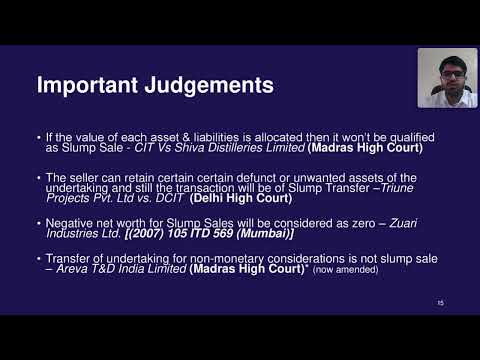
- Assigning Specific Values in Invoices: If the commercial invoice or schedules list individual prices (e.g. Plant = ₹4 Cr, Stock = ₹1 Cr), GST authorities will dismantle the going-concern claim and demand 18% GST on each line item.
- Transferring Assets Without Any Liabilities: Cherry-picking only profitable machinery while leaving debt and creditors behind does NOT qualify as a transfer of a business under Rule 41.
- Failing to Transfer Employees: If all staff are retrenched prior to transfer, tax authorities may argue the unit was merely an asset liquidation rather than an active going concern.
Recommended Video Tutorials & Practical Walkthroughs
Watch these handpicked, expert video guides covering practical compliance, step-by-step procedures, and real-world implementation:
Recommended Video Tutorials & Practical Guides