
Quick Summary & Key Takeaways (Featured Snippet)
What is Form GSTR-9C?
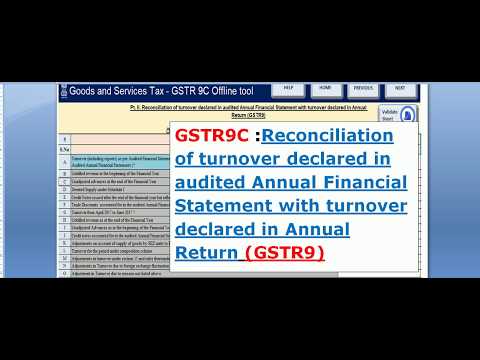
Form GSTR-9C is a comprehensive reconciliation statement designed to bridge accounting records and tax filings. Because financial statements (P&L and Balance Sheet) are prepared under corporate accounting standards (Ind AS / AS) on an accrual basis, while GST returns are filed under the CGST Act’s supply and time-of-supply rules, mathematical variances routinely arise.
Part A: Reconciliation Statement
Captures financial-year data across 5 distinct sections:
- • Part I: Basic registration and legal details.
- • Part II: Reconciliation of gross and taxable turnover (Tables 5 to 8).
- • Part III: Reconciliation of rate-wise tax paid (Tables 9 to 11).
- • Part IV: Reconciliation of Input Tax Credit (Tables 12 to 16).
- • Part V: Auditor / Management recommendations on additional liability.
Part B: Self-Certification Undertaking
A formal legal declaration executed by the authorized signatory confirming that the reconciliation statement, balance sheet, and profit and loss account reflect true and correct values under penalty of perjury under Section 132.
Who Must File GSTR-9C? The ₹5 Crore Turnover Threshold
GSTR-9C applicability is governed strictly by the taxpayer’s Aggregate Annual Turnover:
| Aggregate PAN-India Turnover | Form GSTR-9 (Annual Return) | Form GSTR-9C (Reconciliation) |
|---|---|---|
| Up to ₹2 Crore | Exempt / Optional | Not Applicable |
| Between ₹2 Crore and ₹5 Crore | Compulsory Mandatory | Exempt (Not required) |
| Exceeding ₹5 Crore | Compulsory Mandatory | Compulsory Mandatory (Self-Certified) |
*Exempt entities: Central/State Government departments, local authorities, and non-resident taxable persons are exempt from filing GSTR-9C under Rule 80(3).
Self-Certification vs Legacy CA Audit Regime
1. Pre-2021 Legacy Regime (Repealed)
Section 35(5) of the CGST Act previously required every taxpayer exceeding ₹2 Crore turnover to get their accounts audited by a practicing Chartered Accountant or Cost Accountant who issued a formal audit certificate with UDIN.
2. Current Self-Certification Regime (Active)
Section 35(5) was omitted and Section 44 substituted by the Finance Act, 2021. Taxpayers now independently reconcile their numbers, upload audited financials, and self-certify the return. While this reduces CA compliance costs, it shifts 100% legal responsibility and penal exposure onto company directors.
Architecture: Understanding Table 5, Table 9 & Table 12
The core mechanics of GSTR-9C reside in three critical reconciliation tables:
Table 5: Gross Turnover Reconciliation
Starts with turnover as per Audited Annual Financial Statements (5A). Taxpayers make statutory additions/deductions: unbilled revenue at year-end (5B), unadjusted advances (5C), deemed supplies under Schedule I (5D), trade discounts not allowed under GST (5F), turnover from April to June 2017 (5G), and credit notes accounted after year-end.
Table 9: Rate-Wise Tax Liability Reconciliation
Bifurcates reconciled taxable value across GST slabs (0%, 0.25%, 3%, 5%, 12%, 18%, 28%, RCM) and compares the calculated tax against actual tax paid in GSTR-9. Any difference appears in Table 11 as "Unreconciled Tax Liability".
Table 12: Input Tax Credit (ITC) Reconciliation
Compares ITC booked in Audited Accounts (12A) with net ITC availed in GSTR-9 (12E). Adjustments include ITC booked in previous FY availed this year (12B) and ITC booked this year to be availed next FY (12C). Any variance must be explained in Table 13.
How to Calculate Aggregate PAN-India Turnover
Under Section 2(6) of the CGST Act, Aggregate Turnover is calculated on a single PAN across all states:
- • All taxable outward supplies (B2B and B2C).
- • Zero-rated exports of goods and services.
- • Interstate branch transfers (distinct persons).
- • Exempt, nil-rated, and non-GST supplies (petrol, alcohol).
- • Inward supplies liable to Reverse Charge (RCM).
- • Taxes paid (CGST, SGST, IGST, UTGST, Cess).
- • Value of capital assets sold at loss (accounting deduction).
Late Fees, Penalties & Section 47 Statutory Limits
Failing to file GSTR-9C within the prescribed deadline attracts severe late fees and general penalties:
| Turnover Bracket | Late Fee per Day of Default | Maximum Capped Penalty |
|---|---|---|
| Turnover between ₹5 Crore and ₹20 Crore | ₹100 per day (₹50 CGST + ₹50 SGST) | 0.04% of State / UT Turnover |
| Turnover exceeding ₹20 Crore | ₹200 per day (₹100 CGST + ₹100 SGST) | 0.50% of State / UT Turnover |
| General Penalty under Section 125 (If no late fee applies) | Discretionary by Proper Officer | Up to ₹50,000 (₹25k CGST + ₹25k SGST) |
Reconciliation Dossier & Audit Files
Financial & Audit Reports
- • Audited Annual Financial Statements (Balance Sheet, P&L, Notes).
- • Statutory Audit Report / Tax Audit Report in Form 3CA-3CD.
- • State-wise Trial Balance (for multi-state GSTINs under same PAN).
- • Fixed Asset Register (FAR) with additions/disposals schedule.
GST Filing Records
- • Filed Form GSTR-9 PDF and JSON summary.
- • Monthly GSTR-1 and GSTR-3B filed acknowledgments.
- • GSTR-2B annual master download for ITC comparison.
- • Challan receipts for taxes paid via Form DRC-03.
Step-by-Step GSTR-9C Preparation & Filing Workflow
Step 1: Successfully File Form GSTR-9
File your Annual Return GSTR-9 on the GST portal. The system takes approximately 15 to 30 minutes to generate the GSTR-9 PDF required for GSTR-9C.
Step 2: Download GSTR-9C Offline Utility & Tables
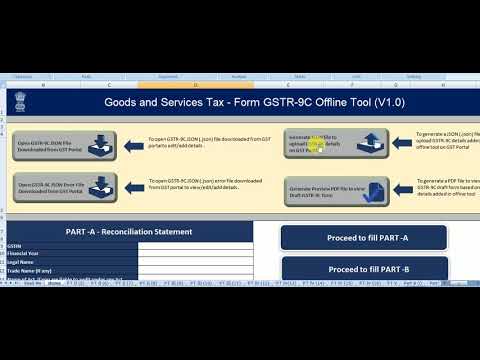
Download the official GSTR-9C Excel offline utility from the portal. Open the utility and import the filed GSTR-9 JSON file.
Step 3: Populate Table 5 & Table 7 Turnover Figures
Enter the turnover as per audited balance sheet. Input adjustments for unbilled revenue, unadjusted advances, and inter-branch supplies to match GSTR-9.
Step 4: Reconcile Rate-Wise Tax Liability in Table 9
Map reconciled turnover across 0%, 5%, 12%, 18%, and 28% slabs. Verify that unreconciled differences in Table 11 are zero or accounted for.
Step 5: Reconcile Input Tax Credit in Table 12
Input ITC booked in financial accounts and adjust for prior/subsequent year entries. Provide reasons for any variance in Table 13.
Step 6: Generate JSON, Upload & Self-Certify via DSC
Generate the GSTR-9C JSON, upload it to the GST portal along with PDF copies of your Audited Balance Sheet and P&L, and complete self-certification using Digital Signature Certificate (DSC).
Direct Comparison: Form GSTR-9 vs Form GSTR-9C
| Feature | Form GSTR-9 | Form GSTR-9C |
|---|---|---|
| Statutory Nature | Annual Return of outward/inward supplies | Reconciliation Statement with Audited Accounts |
| Turnover Threshold | Mandatory above ₹2 Crore | Mandatory above ₹5 Crore |
| Filing Sequence | Must be filed FIRST | Filed second (Cannot be filed without GSTR-9) |
| Mandatory Attachments | None | PDF of Audited Balance Sheet, P&L & Notes |
| Legal Certification | Taxpayer Return | Self-Certified Legal Declaration |
Real-World Reconciliation Scenarios
Case A: Unbilled Revenue Discrepancy (₹40 Lakh)
A software services exporter had ₹40 Lakh in unbilled revenue recognized in its March P&L under Ind AS 115. Invoices were issued to clients in May of the following fiscal year.
Case B: Discovery of Unreported Scrap Sale
During GSTR-9C preparation, an engineering unit discovered that factory metal scrap sales of ₹8 Lakh (18% GST = ₹1.44 Lakh) was booked in the P&L but omitted from GSTR-1 and GSTR-3B.
Common Mistakes When Filing Form GSTR-9C
Multi-state companies often enter company-wide PAN turnover into a single state's GSTR-9C instead of deriving state-specific trial balances.
Having unreconciled differences without typing mandatory descriptive explanations in Table 6 or Table 13 triggers automated system defect alerts.
GSTR-9C is purely a reconciliation statement. You CANNOT claim missed ITC through GSTR-9C; missed ITC past November 30 deadline lapses permanently.
Uploading encrypted or password-protected PDF copies of the Balance Sheet and P&L causes portal rejection or scrutiny notices for non-submission.
Departmental Scrutiny (ASMT-10) Trigger Points
Statutory Provisions: Section 44 & Rule 80(3)
Section 44 Substitution
Substituted by Finance Act, 2021 empowering every registered person to furnish an annual return which may include a self-certified reconciliation statement.
CGST Rule 80(3)
Prescribes Form GSTR-9C format and fixes the aggregate turnover limit at ₹5 Crore for mandatory reconciliation filing.
Rule 80(1) GSTR-9 Threshold
Notification No. 14/2024-CT exempts taxpayers with aggregate turnover up to ₹2 Crore from filing annual return Form GSTR-9.
Voluntary DRC-03 Tax Payment Strategy
Pay via DRC-03 Before Filing If:
- ✓ Unreconciled tax liability is detected in Table 11.
- ✓ Ineligible ITC was mistakenly claimed in monthly 3B.
- ✓ RCM liabilities were omitted on director fees or legal bills.
- ✓ Benefit: Saves 100% penalties under Section 73(5) by voluntary discharge.
Provide Written Explanation If:
- ✓ Difference is purely timing/accrual (unbilled revenue under Ind AS 115).
- ✓ Financial statements include non-GST goods (crude oil, alcohol).
- ✓ Inter-branch supply valuation differences under Rule 28.
- ✓ Action: Record complete reconciliation in Table 6/13 to pre-empt audit queries.
GSTR-9C Pre-Filing Audit Checklist
Recommended Video Tutorials & Practical Walkthroughs
Watch these handpicked, expert video guides covering practical compliance, step-by-step procedures, and real-world implementation:
Recommended Video Tutorials & Practical Guides
Frequently Asked Questions
What is Form GSTR-9C and who is required to file it?
Form GSTR-9C is an annual statutory reconciliation statement reconciling the figures declared in the taxpayer's annual GST return (Form GSTR-9) with the figures reflected in their audited annual financial statements. Under Section 44 of the CGST Act read with Rule 80(3), every registered taxpayer whose aggregate PAN-India turnover exceeds ₹5 Crore in a financial year MUST compulsorily submit Form GSTR-9C.
Is CA or CMA certification still mandatory for Form GSTR-9C?
NO. The Finance Act, 2021 amended Section 44 of the CGST Act, completely eliminating the requirement for mandatory audit certification by a Chartered Accountant (CA) or Cost Accountant (CMA). Taxpayers now SELF-CERTIFY their GSTR-9C reconciliation statement digitally using an authorized DSC or EVC on the GST portal.
How is the ₹5 Crore turnover threshold calculated for GSTR-9C applicability?
The ₹5 Crore threshold is calculated on an AGGREGATE PAN-INDIA TURNOVER basis across all GSTINs registered under the same Permanent Account Number (PAN). It includes taxable supplies, zero-rated exports, interstate supplies to branches, and exempt supplies, but excludes inward supplies liable to reverse charge (RCM) and taxes (CGST, SGST, IGST).
What happens if there are unreconciled turnover or tax differences in GSTR-9C?
If the reconciliation reveals additional tax liability that was not reported in monthly returns (GSTR-3B) or annual return (GSTR-9), the taxpayer must disclose the reason for variance in Table 6 (turnover) or Table 10 (tax liability) and voluntarily pay the differential tax along with applicable 18% interest using Form DRC-03.
What is the statutory deadline for filing Form GSTR-9C?
Form GSTR-9C must be filed on or before December 31 of the financial year following the relevant fiscal year, along with Form GSTR-9. Form GSTR-9 must be successfully filed FIRST before the portal unlocks Form GSTR-9C.
Statutory Acts, Rules & Official Notifications
- Central Goods and Services Tax Act, 2017: Section 44 (Annual Return & Reconciliation Statement).
- Central Goods and Services Tax Rules, 2017: Rule 80(3) (Prescription of Form GSTR-9C & Thresholds).
- Finance Act, 2021: Omission of Section 35(5) and Removal of Mandatory CA/CMA Audit Certification.
- Notification No. 14/2024-Central Tax: Threshold Limits for Annual Return Exemption.