Quick Summary & Key Takeaways (Featured Snippet)
1. The Apprentices Act 1961 & NAPS-2 Statutory Framework
Industrial enterprises in India face an acute paradox: high youth unemployment juxtaposed against widespread shop-floor talent shortages. The Apprentices Act 1961 was instituted to regulate training curricula and enforce mandatory industrial apprenticeship across manufacturing, automotive, electronics, logistics, and service sectors.
To modernize this mandate, the Ministry of Skill Development and Entrepreneurship (MSDE) introduced NAPS-2 (National Apprenticeship Promotion Scheme Phase 2). The updated architecture transitions from a cumbersome post-facto employer reimbursement claim procedure to an automated, end-to-end digital model with Direct Benefit Transfer (DBT) credited directly to trainees via the unified portal (apprenticeshipindia.gov.in).
2. Mandatory Quotas: 2.5% to 15% Headcount Band
Statutory apprentice engagement requirements vary depending on aggregate employee headcount (including permanent, probationary, contractual, and third-party staffing agency workers):
Optional Engagement
Establishments are not legally compelled to engage apprentices but can voluntarily hire apprentices and claim the ₹1,500/month DBT subsidy.
Strict Legal Mandate
Mandated to engage apprentices between 2.5% and 15% of aggregate annual headcount. At least 5% must be reserved for fresher apprentices.
15% Max Enterprise Cap
To prevent enterprises from replacing their core workforce with cheap trainee labor, engagement cannot exceed 15% in any financial year.
3. Stipend Subsidy Architecture: ₹1,500/Month DBT Mechanics
Under previous rules, employers paid full stipends upfront and submitted quarterly invoices to government bodies, resulting in working capital lockups and processing delays. NAPS-2 solved this structural bottleneck:
The NAPS-2 Direct Benefit Transfer (DBT) Flow
- Government Contribution: 25% of the statutory monthly stipend, up to a statutory maximum ceiling of ₹1,500 per month per apprentice.
- Employer Contribution: The enterprise pays the balance stipend (prescribed stipend minus ₹1,500) directly into the candidate's payroll account via net banking or portal integrated gateway.
- DBT Transfer: Once the employer logs monthly attendance on the portal and confirms its share has been paid, the government DBT engine transfers the ₹1,500 directly to the apprentice's Aadhaar-linked bank account within 72 hours.
- Curriculum Duration: The subsidy covers the entire contracted training period, ranging from 6 months up to a maximum of 36 months depending on the registered trade.
4. Labor Law Exemptions: Zero EPF, ESI & Industrial Disputes Act
One of the most compelling advantages of engaging youth through registered apprenticeship programs is total immunity from heavy social security compliances:
Zero EPF & EPS Overhead
Section 18 of the Apprentices Act clearly establishes that apprentices are trainees and not workmen. Consequently, the Employees' Provident Funds and Miscellaneous Provisions Act 1952 does not apply. Employers save 12% employer matching contribution, 0.5% EDLI, and administrative inspection charges.
Zero ESI Premium Liabilities
Employers are fully exempt from the 3.25% ESI employer contribution and 0.75% employee deduction under the Employees' State Insurance Act 1948. Employers only maintain standard group personal accident insurance policies covering medical risks on the shop floor.
Immunity from Industrial Disputes Act
Apprentices cannot form trade union bargaining blocks or raise industrial dispute claims under the Industrial Disputes Act 1947 regarding termination, retrenchment compensation, or regularization of service after their training tenure concludes.
No Guaranteed Employment Obligation
Under Section 22 of the Act, it is not obligatory on the part of the employer to offer permanent employment to any apprentice upon completion of their apprenticeship period unless specified by prior written contract.
5. Curriculum Tracks: Designated Trades vs Optional Trades
The apprenticeship system provides two distinct pathways tailored for heavy engineering vs modern service-oriented corporate requirements:
Designated Trades (CTS / ITI)
Notified by the Central Apprenticeship Council. Includes conventional industrial trades such as Fitter, Turner, Electrician, Machinist, Welder, and Tool & Die Maker. Follows rigorous National Council for Vocational Training (NCVT) curriculum guidelines.
Optional Trades (Sector Skill Councils)
Designed flexibly by Sector Skill Councils (SSCs) or individual enterprises to match dynamic industry needs. Includes retail sales associates, front-office desk executives, warehouse logistics pickers, digital marketing trainees, and data processing specialists.
6. NAPS-2 vs NATS vs Regular Industrial Employment
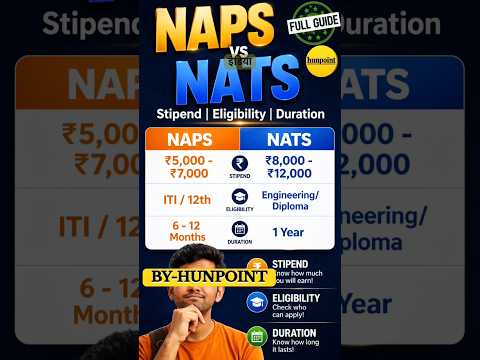
| Compliance Feature | NAPS-2 (MSDE / NSDC) | NATS (MoE / BOAT) | Regular Employment |
|---|---|---|---|
| Governing Ministry | Skill Development (MSDE) | Ministry of Education (MoE) | Ministry of Labour & Employment |
| Target Candidates | ITI, PMKVY, 10th/12th, Graduates | Engineering Diploma & Degree Holders | Any qualified job seeker |
| Govt Stipend Subsidy | 25% up to ₹1,500/month via DBT | 50% of prescribed stipend via DBT | Zero (100% employer borne) |
| EPF / ESI Liability | 100% Exempted | 100% Exempted | Mandatory (12% EPF + 3.25% ESI) |
| Contract Registration | apprenticeshipindia.gov.in | nats.education.gov.in | Standard Appointment Letter |
7. Employer Portal Onboarding SOP via apprenticeshipindia.gov.in
Follow this step-by-step statutory onboarding roadmap to register your establishment and hire apprentices legally:
Establishment Portal Registration
Navigate to apprenticeshipindia.gov.in. Register with Company PAN, CIN/LLPIN, GSTIN, and declare total annual workforce strength.
Create Apprenticeship Opportunity
Post vacancy openings declaring trade (Designated or Optional), monthly stipend amount (above statutory minimum), duration (e.g., 12 months), and qualifications.
Issue Contract & Candidate E-Sign
Select shortlisted applicants, issue apprenticeship contracts through the portal, and execute Aadhaar-based OTP e-signatures with the apprentice.
Monthly Attendance & DBT Release
Upload candidate monthly attendance before the 10th of every month. Pay employer stipend share via electronic clearing. The NSDC DBT engine automatically dispatches ₹1,500 directly into the apprentice's Aadhaar bank account.
8. Fiscal Dividends: Section 80JJAA Tax Deductions & CSR Integration
Beyond the direct ₹1,500/month government stipend reimbursement, corporate employers enjoy powerful secondary financial incentives:
Section 80JJAA Income Tax Deductions
Under Section 80JJAA of the Income Tax Act 1961, corporate entities subjected to tax audits can claim a 30% additional tax deduction over 3 assessment years on additional employee emoluments. Where apprentices are absorbed into regular employment upon completing their training, their payroll costs qualify for this massive tax benefit.
CSR Compliance Under Section 135
Expenditures incurred on building Basic Training Centers (BTP), procurement of training simulators, and curriculum development for apprentices qualify as eligible Corporate Social Responsibility (CSR) spends under Schedule VII of the Companies Act 2013 (Skill Development and Vocational Training).
9. Attendance Tracking, Joint Certification & AITT Examinations
At the conclusion of the training period:
- Designated Trades: Apprentices must appear for the All India Trade Test (AITT) conducted by the National Council for Vocational Training (NCVT). Successful candidates receive a National Apprenticeship Certificate (NAC), which is recognized internationally.
- Optional Trades: Assessment is conducted jointly by the establishment and the corresponding Sector Skill Council (SSC). Candidates receive a joint industry-recognized completion certificate.
10. Top Audit Pitfalls, Penalty Provisions & Compliance Checklist
Common Non-Compliance Traps
- Failing to Meet 2.5% Minimum Quota: Under Section 30 of the Apprentices Act, establishments failing to engage the minimum prescribed apprentices face statutory fines of ₹500 per apprentice shortfall per month for the first three months, escalating to ₹1,000 per month thereafter.
- Delayed Monthly Attendance Uploads: Failing to submit attendance records on the portal by the 10th of every month causes government DBT disbursement freezes, generating trainee grievances.
- Exceeding the 15% Cap: Over-hiring apprentices beyond 15% invites reclassification audits by the Labour Department, which may treat excess apprentices as regular workmen entitled to minimum wages and EPF/ESI.
- Paying Below Prescribed Stipend Slabs: Stipends cannot be lower than the government rates prescribed under Rule 11 of the Apprenticeship Rules (graduated based on qualification from ₹5,000 to ₹9,000/month).
Recommended Video Tutorials & Practical Walkthroughs
Watch these handpicked, expert video guides covering practical compliance, step-by-step procedures, and real-world implementation:
Recommended Video Tutorials & Practical Guides