Quick Summary & Key Takeaways (Featured Snippet)
1. Statutory Genesis: Post-Bhopal Public Liability Insurance Act 1991
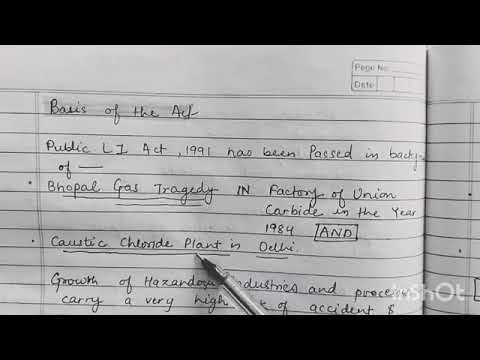
Following the tragic 1984 Bhopal Gas Disaster and the landmark Supreme Court ruling in M.C. Mehta vs. Union of India (Oleum Gas Leak Case) which established the doctrine of Absolute Liability, Parliament enacted the Public Liability Insurance Act, 1991 (Act No. 6 of 1991).
The Act's legislative objective is to provide immediate, interim financial relief to victims of industrial accidents occurring while handling hazardous substances, completely bypassing prolonged tort litigation in civil courts.
2. Act Policy (Mandatory) vs Non-Act Commercial Policy
Public Liability (Act) Policy
- Statutory mandate under PLI Act 1991.
- Applies strictly to defined hazardous chemicals.
- Operates on "No-Fault" strict liability.
- Fixed statutory compensation schedule.
- Mandatory matching payment to Environment Relief Fund.
Public Liability (Non-Act) Policy
- Voluntary commercial contract.
- Applies to general factories, malls, hotels, and offices.
- Requires claimant to prove common-law negligence.
- Flexible multi-crore Sum Insured chosen by business.
- No ERF surcharge applicable.
3. Hazardous Substances Thresholds & Manufacture/Storage Rules
Under Section 2(d) of the Act, "hazardous substance" means any substance or preparation which is defined as hazardous under the Environment (Protection) Act, 1986 and exceeding quantities specified under the Manufacture, Storage and Import of Hazardous Chemical (MSIHC) Rules, 1989:
Common Trigger Substances
Chlorine, Ammonia, Benzene, Liquefied Petroleum Gas (LPG), Hydrogen Sulphide, Methyl Isocyanate, Sulphuric Acid, and toxic solvents stored beyond threshold quantities (e.g., 50 kg to 500 tonnes depending on schedule).
4. Section 3 'No-Fault Liability': Relief Without Proving Negligence
Under traditional law of torts, an injured third party had to prove that the factory management was guilty of negligence or structural fault. Section 3 fundamentally transforms this burden:
Section 3(2) Strict Statutory Mandate
"In any claim for relief under sub-section (1), the claimant shall not be required to plead and prove that the death, injury or damage in respect of which the claim is made was due to any wrongful act, neglect or default of any person."
If toxic fumes escape or a chemical tank ruptures, liability is automatic. The victim needs only to prove physical presence in the affected zone and resulting injury or property damage.
5. Statutory Limits: Any One Accident (AOA) & Any One Year (AOY)
The Public Liability Insurance Rules, 1991 specify strict statutory limits for Act policies:
| Parameter | Statutory Cap under Act Policy | Commercial Non-Act Policy |
|---|---|---|
| Any One Accident (AOA) | Equal to Paid-Up Capital (Max ₹5 Cr) | ₹10 Cr to ₹100 Cr+ |
| Any One Year (AOY) | Maximum ₹15 Crore | Usually 1:1, 1:2 or 1:4 of AOA |
| Fatal Accident Relief per Victim | ₹25,000 fixed interim relief + medical | Court-awarded damages / settlement |
| Private Property Damage per Incident | Up to ₹6,000 per victim | Actual market value of damaged assets |
6. Environment Relief Fund (ERF): The Mandatory 100% Surcharge
Under Section 7A of the Act, every insured owner must deposit a sum equal to the insurance premium into the Environment Relief Fund (ERF) managed by the central government.
The 100% Matching Rule
If an industrial plant's annual premium for a Public Liability (Act) policy is ₹2,50,000, the company must draw a separate payment of ₹2,50,000 payable directly to the Environment Relief Fund account. The insurer cannot issue the policy certificate without proof of this ERF deposit!
7. Comparison: Public Liability Act vs Commercial CGL vs Product Liability
| Feature | PLI Act Policy (1991) | Commercial General Liability (CGL) | Product Liability Policy |
|---|---|---|---|
| Primary Risk Trigger | Hazardous substance accident | Premises and operational accidents | Defective goods/products sold |
| Legal Basis | Strict No-Fault Liability | Common Law Negligence | Consumer Protection Act 2019 |
| Statutory Mandate | Compulsory by Law | Voluntary / Commercial Contract | Voluntary / Commercial Contract |
8. Claim Procedure: Filing Applications Before the District Collector
- Step 1: Application Within 5 Years: An application for relief under Section 6 must be submitted by the victim or legal heirs to the District Collector within 5 years of the accident.
- Step 2: Summary Inquiry by Collector: The Collector gives notice to the owner and insurer, conducting a summary inquiry without the formalities of a civil court trial.
- Step 3: Immediate Award & 30-Day Payment: The insurer must deposit the awarded relief amount with the Collector within 30 days of receiving the order for immediate disbursement to the victims.
9. Criminal Penalties for Non-Compliance under Section 14 & 15
Severe Criminal Penalties
- Under Section 14, whoever fails to comply with the statutory insurance mandate shall be punishable with imprisonment for a term of 18 months up to 6 years, or with a fine of not less than ₹1,00,000, or with both!
- Under Section 16, where an offense is committed by a company, every person who at the time was in charge of and responsible for the conduct of the business (Directors, Plant Heads) shall be deemed guilty!
10. Top Audit Flaws & Inadequate Sum Insured Pitfalls
Recommended Video Tutorials & Practical Walkthroughs
Watch these handpicked, expert video guides covering practical compliance, step-by-step procedures, and real-world implementation:
Recommended Video Tutorials & Practical Guides