
RBI Floating Rate Savings Bonds (FRSB): 8.05% Interest & Rules Guide
The authoritative investor manual on Government of India Floating Rate Savings Bonds (FRSB 2020 - Taxable). Discover complete sovereign credit safety, biannual NSC-linked coupon resets, semi-annual interest payment schedules, senior citizen premature redemption rules, and online purchase via RBI Retail Direct.
Quick Summary & Key Takeaways (Featured Snippet)
1. Overview: Sovereign Guarantee & Safety Architecture
Introduced by the Ministry of Finance via Notification F.No.4(10)-B(W&M)/2020 dated June 26, 2020, the Floating Rate Savings Bonds, 2020 (Taxable) replaced the erstwhile 7.75% fixed-rate savings bonds.
In an era where bank fixed deposits are insured only up to ₹5 Lakh per depositor by the Deposit Insurance and Credit Guarantee Corporation (DICGC), RBI Bonds offer unlimited sovereign protection. There is no cap on investment, and 100% of the invested principal and accrued interest is guaranteed directly by the Government of India.
2. The NSC + 35 bps Floating Rate Formula
The core feature of FRSB is that its coupon rate is not fixed for the 7-year life of the bond. Instead, it resets dynamically every 6 months:
• January 1: Coupon resets for January to June based on NSC rate announced for Q4.
• July 1: Coupon resets for July to December based on NSC rate announced for Q2.
When inflation increases and the government hikes small savings rates, your bond yield automatically rises by 35 bps above the NSC benchmark without requiring manual reinvestment.
3. Eligibility & Investment Limits
- Resident Indian Citizens (in single, joint, or survivor mode).
- Minors (invested through legal or natural parents/guardians).
- Hindu Undivided Families (HUF) through the Karta.
- Non-Resident Indians (NRIs) are strictly prohibited from subscribing.
- Foreign Institutional Investors (FIIs) and Overseas Corporate Bodies.
- Companies, Partnership Firms, and LLPs.
4. Semi-Annual Interest Payout Schedule
Unlike traditional cumulative fixed deposits, FRSB operates strictly on a non-cumulative payout structure:
Interest for the period January 1 to June 30 is credited directly to the investor's linked bank account on July 1 via ECS/NEFT.
Interest for the period July 1 to December 31 is credited directly to the investor's linked bank account on January 1.
*If a bond is purchased mid-cycle (e.g., September 15), broken-period interest from the date of realization up to December 31 is credited on January 1.
5. Seven-Year Tenure & Senior Citizen Premature Exit Rules
The standard tenure of the bond is 7 years from the date of issue. While investors below 60 years cannot exit prematurely, senior citizens benefit from graded liquidity windows:
| Age Category of Investor | Minimum Lock-in Period | Permissible Exit Window | Penalty Deduction |
|---|---|---|---|
| Super Senior Citizens (80+ years) | 4 Years | Anytime after 4th year | 50% of interest due for last 6 months |
| Senior Citizens (70 to 80 years) | 5 Years | Anytime after 5th year | 50% of interest due for last 6 months |
| Senior Citizens (60 to 70 years) | 6 Years | Anytime after 6th year | 50% of interest due for last 6 months |
| General Category (Below 60 years) | 7 Years (Full lock-in) | No premature exit permitted | N/A |
6. Income Tax Treatment, Section 193 TDS & Form 15G/15H
Interest on FRSB is classified as "Income from Other Sources" and taxed at the investor's normal applicable income tax slab (ranging from 5% to 39%).
No Section 80C deduction is available on the principal invested.
TDS is deducted at 10% if total annual interest paid on the bonds exceeds ₹10,000.
Taxpayers can submit Form 15G (below 60) or Form 15H (senior citizens) to prevent TDS deduction if total taxable income is below basic exemption limits.
7. RBI Floating Rate Bonds vs Bank FDs vs Post Office SCSS
| Parameter | RBI Floating Rate Bonds (FRSB) | Bank Fixed Deposit (5-Year) | Senior Citizen Savings Scheme (SCSS) |
|---|---|---|---|
| Current Interest Rate | 8.05% (Floating) | 6.80% to 7.25% (Fixed) | 8.20% (Fixed for 5 yrs) |
| Safety / Guarantee | 100% Sovereign (Unlimited) | DICGC insured up to ₹5 Lakh only | 100% Sovereign |
| Maximum Investment Limit | No Upper Limit (Unlimited) | No Limit | Capped at ₹30 Lakhs per person |
| Payout Frequency | Semi-Annual (Jan 1 / Jul 1) | Monthly, Quarterly, or Cumulative | Quarterly (March, June, Sept, Dec) |
| Section 80C Tax Benefit? | No | Yes (only on 5-yr Tax Saver FD) | Yes (up to ₹1.5 Lakhs) |
8. Step-by-Step Purchase via RBI Retail Direct Portal
Step 1: Open an RBI Retail Direct Account
Visit the official RBI portal (rbiretaildirect.org.in). Sign up using your PAN, Aadhaar e-KYC, and bank account details. The Bond Ledger Account (BLA) is opened within 24 hours.
Step 2: Navigate to Floating Rate Savings Bonds
Log in to your dashboard and select 'Floating Rate Savings Bonds (FRSB 2020)'. Review the current coupon (8.05%) and payout terms.
Step 3: Enter Investment Amount & Nominee Details
Enter the subscription amount (minimum ₹1,000, in multiples of ₹1,000). Add your legal nominee (or up to two joint nominees) with relationship and percentage allocation.
Step 4: Complete Payment via Net Banking or UPI
Transfer the funds using integrated net banking or UPI. The RBI issues an electronic Certificate of Holding (CoH) confirming your Bond Ledger Account balance.
9. Bond Ledger Account (BLA) & Non-Transferability Rules
Investors must be aware of statutory restrictions governing the holding format:
FRSB bonds cannot be traded on stock exchanges (NSE/BSE), transferred to third parties (except to a legal heir upon death), or pledged as collateral for bank loans.
Bonds are held in electronic book-entry form in a BLA maintained by the RBI or designated receiving banks (SBI, HDFC, ICICI). Physical certificate of holding is issued as proof.
10. Investor Suitability & Asset Allocation Matrix
| Investor Profile | Suitability | Strategic Rationale |
|---|---|---|
| Retirees Needing Semi-Annual Cash Flow | Highly Recommended | Guaranteed 8.05% yield with zero default risk, providing steady income every July and January. |
| HNIs with Surplus Liquidity Beyond ₹30L | Highly Recommended | Once SCSS ₹30L quota is exhausted, FRSB offers unlimited sovereign capacity at competitive rates. |
| Young Investors Under 40 (Accumulation Stage) | Not Recommended | 7-year strict lock-in with non-cumulative interest prevents compounding; equity index funds are superior. |
| Investors Needing Emergency Fund Liquidity | Not Recommended | Zero premature exit for non-senior citizens; use Arbitrage Funds or Liquid Funds instead. |
11. Pre-Investment Action Checklist
Recommended Video Tutorials & Practical Walkthroughs
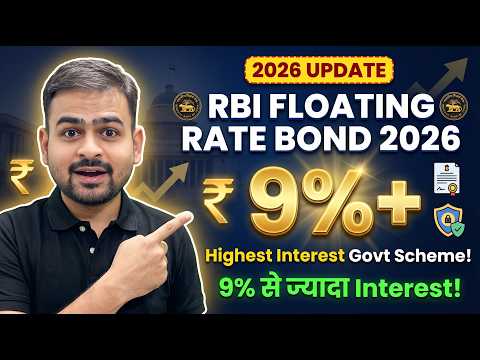
Watch these handpicked, expert video guides covering practical compliance, step-by-step procedures, and real-world implementation:
Recommended Video Tutorials & Practical Guides

12. Frequently Asked Questions
What are RBI Floating Rate Savings Bonds (FRSB 2020)?↓
RBI Floating Rate Savings Bonds (FRSB 2020 - Taxable) are interest-bearing government debt securities issued by the Reserve Bank of India on behalf of the Government of India. They carry 100% sovereign credit guarantee with zero risk of default. The tenure is 7 years with a floating interest rate reset semi-annually.
How is the interest rate on RBI Floating Rate Bonds determined?↓
The interest rate on FRSB is statutorily pegged to the prevailing National Savings Certificate (NSC) rate with an additional positive spread of 35 basis points (+0.35%). If the NSC rate is 7.70%, the RBI floating rate bond pays 8.05% per annum. The rate is reviewed and reset biannually on January 1 and July 1.
When is interest paid to investors in RBI Floating Rate Bonds?↓
Interest is paid semi-annually on July 1 and January 1 directly into the investor's registered bank account via electronic clearing. There is no cumulative option available; interest cannot be compounded to maturity.
Can investors withdraw from RBI Floating Rate Bonds before the 7-year maturity?↓
For investors below 60 years of age, premature withdrawal is not permitted. However, senior citizens enjoy special early exit windows: (1) Investors aged 80 and above can exit after 4 years; (2) Investors aged 70 to 80 can exit after 5 years; and (3) Investors aged 60 to 70 can exit after 6 years, subject to a nominal penalty equal to 50% of the interest due for the last 6 months.
How is interest on RBI Floating Rate Bonds taxed?↓
Interest earned on FRSB is fully taxable under 'Income from Other Sources' at the investor's applicable marginal slab rates. Under Section 193 of the Income Tax Act, Tax Deducted at Source (TDS) is deducted at 10% if total annual interest exceeds ₹10,000, unless the investor submits Form 15G/15H.
How can retail investors buy RBI Floating Rate Savings Bonds?↓
Investors can purchase FRSB online with zero brokerage through the official RBI Retail Direct portal (rbiretaildirect.org.in), or via internet banking / branch applications across nationalized banks (SBI, PNB, Bank of Baroda) and designated private banks (HDFC, ICICI, Axis Bank). Minimum investment is ₹1,000 with no upper ceiling.
13. Official Government Notifications & Guides
Official statutory references: Ministry of Finance Notification F.No.4(10)-B(W&M)/2020 dated June 26, 2020; Reserve Bank of India Master Direction on Government Bonds; Section 193 of the Income Tax Act, 1961; and RBI Retail Direct Operational Guidelines.