Quick Summary & Key Takeaways (Featured Snippet)
1. The 3 Pillars of NPS Tax Deductions: 80CCD(1), (1B) & (2)
The National Pension System (NPS), regulated by the Pension Fund Regulatory and Development Authority (PFRDA), offers a unique multi-tiered tax incentive framework under Section 80CCD of the Income Tax Act, 1961:
Employee Self-Contribution
Deduction up to 10% of salary (Basic + DA) or 20% of Gross Total Income for self-employed. Subsumed inside the overall ₹1,50,000 cap of Section 80CCE.
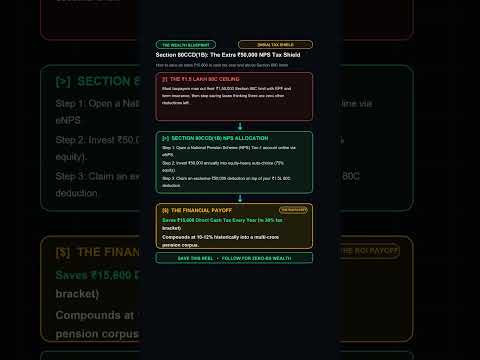
Additional ₹50,000 Boost
Exclusive additional deduction of ₹50,000 strictly outside the Section 80CCE limit. Only available under the Old Tax Regime.
Employer Contribution
Up to 14% of Basic + DA contributed by employer. Available under BOTH Old and New Tax Regimes without ceiling!
2. Section 80CCD(1B): The Exclusive ₹50,000 Deduction
Introduced by the Finance Act, 2015 to promote long-term retirement planning in a nation without a universal social safety net, Section 80CCD(1B) provides:
Tax Savings Simulation across Income Slabs (Old Regime)
| Tax Bracket | Contribution | Base Tax Saved | Cess (4%) | Net Cash Saved in Hand |
|---|---|---|---|---|
| 20% Slab (₹5L - ₹10L) | ₹50,000 | ₹10,000 | ₹400 | ₹10,400 |
| 30% Slab (Above ₹10L) | ₹50,000 | ₹15,000 | ₹600 | ₹15,600 |
| 30% + Surcharge (High Net Worth) | ₹50,000 | ₹17,250 | ₹690 | ₹17,940 - ₹21,450 |
3. Section 80CCD(2): Corporate NPS 14% Employer Benefit
While self-deductions are restricted under the New Tax Regime, Corporate NPS under Section 80CCD(2) is a game-changer. Under the Finance (No. 2) Act, 2024, the deduction limit for non-government employers was standardized up to 14% of salary (Basic + DA) under the New Tax Regime:
Corporate Salary Restructuring Example
If an employee earns a Basic Salary of ₹15,00,000 per year and opts for Corporate NPS with their employer contributing 14% (₹2,10,000):
Taxable Salary reduced by ₹2,10,000 → Net Tax Saved at 30% slab = ₹65,520 annually, fully legal under Section 115BAC!
4. NPS in Old vs New Tax Regime (Section 115BAC Comparison)
| Statutory Section | Old Tax Regime | New Tax Regime (Section 115BAC) |
|---|---|---|
| Section 80CCD(1) (Self-Contribution) | Allowed (within ₹1.5L 80C) | Disallowed |
| Section 80CCD(1B) (Extra ₹50,000) | Allowed (up to ₹50,000) | Disallowed |
| Section 80CCD(2) (Employer Contribution) | Allowed (up to 10% / 14%) | Allowed (up to 14% of Basic + DA) |
| Section 10(12A) (60% Tax-Free Exit) | 100% Tax-Free | 100% Tax-Free |
5. Tier 1 (Retirement) vs Tier 2 (Savings): Complete Comparison
| Feature | NPS Tier 1 Account | NPS Tier 2 Account |
|---|---|---|
| Account Purpose | Dedicated Pension & Retirement Vehicle | Voluntary Liquid Investment Account |
| Tax Deductions on Deposit | Yes (80CCD(1), 1B, and 2) | None (except Central Govt 3-yr lock) |
| Withdrawal Flexibility | Locked until age 60 (limited partial exit) | 100% Flexible anytime (T+2 credit) |
| Tax on Withdrawals | 60% Lump Sum is 100% Tax-Free | Capital gains taxed at applicable rates |
6. Asset Allocation: Equity (E), Corporate Debt (C) & Govt Bonds (G)
NPS allows investors to customize their portfolios or choose automated lifecycle rebalancing managed by top pension fund managers (SBI Pension Funds, HDFC, ICICI Prudential, UTI):
Asset Class E (Equity)
Invests in Nifty 50 and BSE Sensex blue chips. Maximum permitted allocation = 75% under Active Choice.
Asset Class C (Corporate Bonds)
High-grade corporate debentures and infrastructure bonds yielding stable fixed-income returns.
Asset Class G (Govt Securities)
Sovereign treasury bills and central/state government bonds offering zero credit risk.
7. Retirement Exit Rules at Age 60: 60% Lump Sum vs 40% Annuity
Upon attaining age 60, subscribers face a dual distribution mandate:
60% Lump Sum (100% Tax-Free)
Under Section 10(12A), up to 60% of the accumulated corpus can be withdrawn as a single tax-free lump sum or phased out systematically via Systematic Lump-sum Withdrawal (SLW) up to age 75.
40% Mandatory Annuity
Under Section 80CCD(5), at least 40% of the corpus must be deployed to purchase an immediate life annuity from an IRDAI-regulated insurer. The annuity investment itself is not taxed, but the monthly pension is taxed at your income slab.
8. Head-to-Head: NPS vs PPF vs Mutual Fund ELSS
| Parameter | NPS Tier 1 | Public Provident Fund (PPF) | ELSS Mutual Funds |
|---|---|---|---|
| Total Deduction Window | ₹2,00,000 (80C + 80CCD(1B)) | ₹1,50,000 (80C only) | ₹1,50,000 (80C only) |
| Lock-In Period | Until Age 60 | 15 Years | 3 Years (Shortest) |
| Historical Returns (Equity) | 11% - 14% CAGR | 7.1% Sovereign Fixed | 12% - 16% CAGR |
| Maturity Tax Status | 60% Tax-Free / 40% Annuity | 100% Tax-Free (EEE) | 12.5% LTCG above ₹1.25L |
9. Step-by-Step Claim Procedure in ITR-1 & ITR-2
- Step 1: Download PRAN Statement from CRA Portal: Log into Protean (NSDL) or KFintech CRA and download your Transaction Statement for the financial year.
- Step 2: Enter Section 80CCD(1) under Part B-TI: Declare your primary contribution up to ₹1.5 Lakh under Section 80CCD(1).
- Step 3: Enter Section 80CCD(1B) Dedicated Schedule: Report your voluntary deposit (up to ₹50,000) under Section 80CCD(1B) in Schedule 80-IA / Chapter VI-A.
- Step 4: Verify Employer NPS in Form 16 Part B: Verify that your company has reported Section 80CCD(2) employer contributions under allowable allowances.
10. Top Audit Pitfalls & Premature Withdrawal Penalties
Costly NPS Mistakes
- Attempting to Claim 80CCD(1B) in New Regime: Filing under Section 115BAC while claiming 80CCD(1B) triggers an automated defective return notice under Section 139(9).
- Premature Exit Before Age 60: If you exit NPS before age 60, you are legally compelled to annuitize 80% of your corpus; only 20% can be withdrawn as a lump sum (which is taxable)!
- Assuming Tier 2 Deposits Are Tax-Deductible: Depositing funds into Tier 2 expecting Section 80C benefits is a frequent blunder among corporate employees.
Recommended Video Tutorials & Practical Walkthroughs
Watch these handpicked, expert video guides covering practical compliance, step-by-step procedures, and real-world implementation:
Recommended Video Tutorials & Practical Guides