
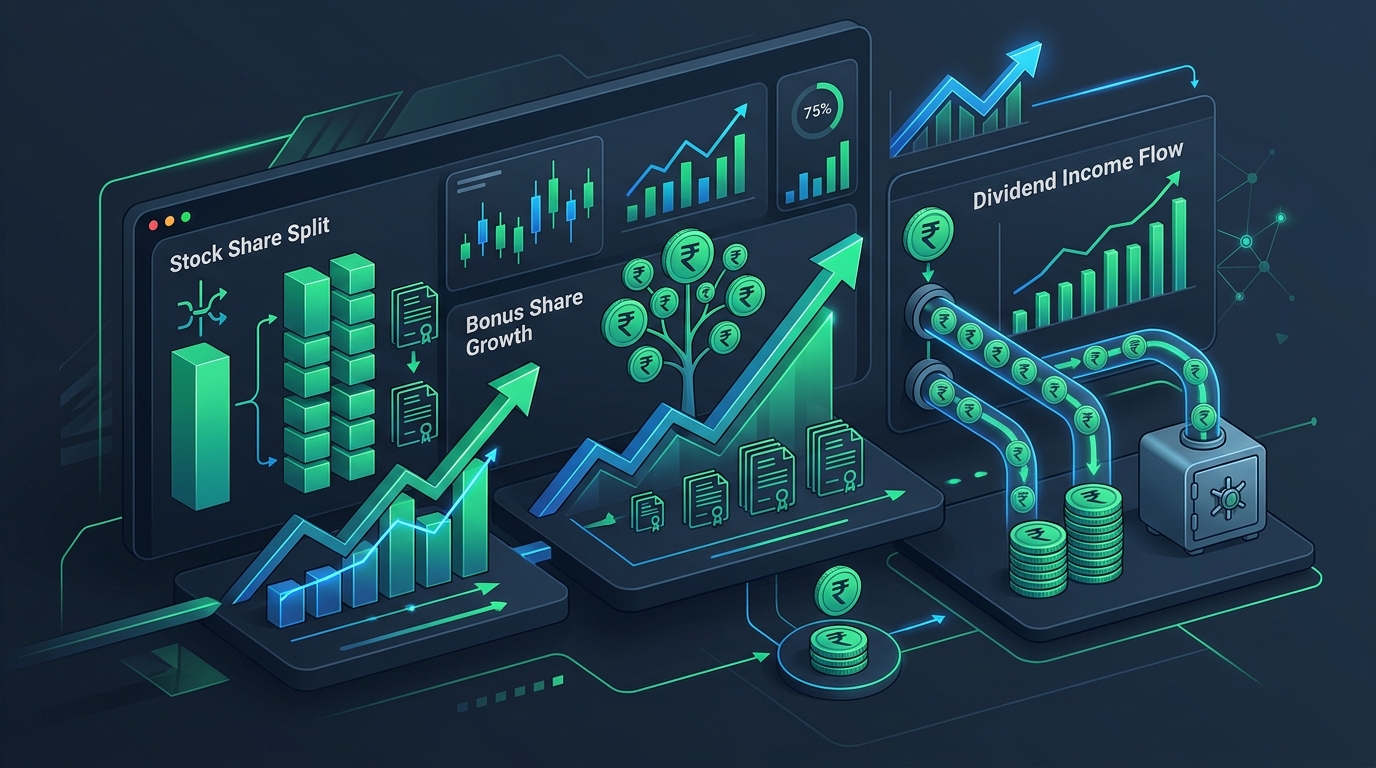
1. Executive Summary: Split vs Bonus vs Dividend
When an Indian listed company announces a Stock Split, issues Bonus Shares, or declares a Cash Dividend, investors often believe they have received free wealth. In reality, each corporate action is treated radically differently by the Indian Income Tax Department, determining your cost basis, holding period, and tax liability:
Face value decreases. Share count multiplies. Cost per share is proportionally divided. Holding period does not reset. Zero tax at event.
Face value remains same. Free shares issued out of reserves. Cost of acquisition is ₹0. Holding period resets strictly on allotment.
Cash transferred directly to bank account. Taxable immediately at your personal income slab rate under Other Sources. 10% TDS over ₹5,000.
Corporate Action & Capital Gains Tax Simulator
Simulate any corporate action scenario. Enter your purchase price, action type (split or bonus), and sale price to compute adjusted cost bases, capital gains tax, and post-tax returns:
Research Valuation Ratios & Financial Statements on GST Munshi Stocks
Track PE, PB, ROCE, debt-to-equity, institutional shareholding patterns, and upcoming corporate action announcements across all NSE and BSE tickers with our automated quantitative engine.
3. Stock Split: Taxation Mechanics & Cost Allocation
A stock split occurs when a company subdivides its face value to enhance retail market liquidity and lower share price barriers.
Key Tax Principles for Stock Splits:
- No Transfer under Section 2(47): A stock split does not constitute a "transfer". No capital gains tax is triggered on the record date or ex-split date.
- Proportionate Cost Allocation: If you bought 100 shares at ₹2,000 (Total ₹2,00,000) and the company executes a 1:5 split, you will hold 500 shares. Your cost of acquisition per share is revised to exactly ₹2,000 / 5 = ₹400 per share.
- Holding Period Does NOT Reset: The date of acquisition for all 500 split shares remains the original purchase date when you initially bought the stock. If you held the stock for 11 months before the split and sold it 2 months after the split (total 13 months), it is qualified as Long-Term Capital Gain (LTCG).
5. Dividend Taxation: Slab Rates, 10% TDS & Form 26AS Reconciliation
Following the abolition of the Dividend Distribution Tax (DDT), all dividends received from domestic companies or mutual funds are taxed directly in the hands of the recipient:
Taxed at Applicable Slab Rates
Dividend income is classified under "Income from Other Sources" and taxed at your marginal slab rate (from 5% up to 30% + surcharge & cess).
Mandatory 10% TDS under Section 194
If your cumulative dividend from a single company exceeds ₹5,000 in a financial year, the company deducts 10% TDS (20% if PAN is not linked or invalid) and issues Form 16A. You can claim this TDS credit in your ITR against final tax liability.
Only Interest Expense Allowed (Section 57)
Under Section 57, no advisory fees, commissions, or depository charges can be deducted against dividend income. The only permitted deduction is interest expense on borrowed capital used to buy the shares, capped at a maximum of 20% of gross dividend income.
6. Comprehensive Comparative Summary Matrix
| Attribute | Stock Split | Bonus Shares | Cash Dividend |
|---|---|---|---|
| Face Value Impact | Reduces proportionally | Remains strictly unchanged | No change |
| Cost of Acquisition | Divided by split ratio | ₹0 (Zero Cost) | Not applicable |
| Holding Period | Original purchase date | Resets on allotment date | Not applicable |
| Tax Trigger Point | Only when shares are sold | Only when shares are sold | Immediately in the year received |
| Applicable Tax Rate | STCG 20% / LTCG 12.5% | STCG 20% / LTCG 12.5% | Individual Income Tax Slab (up to 30%+) |
| TDS Withholding | Zero TDS on resident sales | Zero TDS on resident sales | 10% TDS if > ₹5,000/FY |
Recommended Video Tutorials & Practical Walkthroughs
Watch these handpicked, expert video guides covering practical compliance, step-by-step procedures, and real-world implementation:
Recommended Video Tutorials & Practical Guides


Frequently Asked Questions (FAQs)
Is a Stock Split taxable at the time of the split in India?▸
No. A stock split is purely a corporate subdivision of face value (e.g. from ₹10 to ₹2). There is no receipt of income or transfer of property under Section 2(47) of the Income Tax Act. Tax is payable only when the split shares are eventually sold.
What is the Cost of Acquisition for Bonus Shares?▸
Under Section 55(2)(aa) of the Income Tax Act, the cost of acquisition of bonus shares allotted on or after February 1, 2001, is strictly deemed to be ZERO (₹0.00). When bonus shares are sold, the entire net sale consideration is treated as capital gain.
Does the holding period reset for bonus shares or stock splits?▸
For a Stock Split, the holding period does NOT reset; it dates back to the original purchase date of the pre-split shares. For Bonus Shares, the holding period DOES reset and begins strictly from the date the bonus shares are officially allotted to your demat account.
What are the current STCG and LTCG tax rates on equity shares in 2026?▸
Short-Term Capital Gains (STCG on equity held for 12 months or less) are taxed at 20% under Section 111A. Long-Term Capital Gains (LTCG on equity held for more than 12 months) are taxed at 12.5% under Section 112A for gains exceeding the annual exemption limit of ₹1,25,000.
How is Dividend income taxed in India?▸
Dividends are added to the investor's total income under the head 'Income from Other Sources' and taxed at applicable slab rates. Under Section 194, Indian companies deduct 10% TDS if the total dividend paid to a resident shareholder exceeds ₹5,000 in a financial year.