
Surety Insurance Bonds in India: Bank Guarantee Alternative for EPC & Infra Guide
Quick Summary & Key Takeaways (Featured Snippet)
1. Evolution: IRDAI (Surety Insurance Contracts) Guidelines & GFR Rule 144 Amendment
In India's highly competitive industrial, commercial, and financial sectors, safeguarding business operations against unforeseen liabilities, contractual defaults, and catastrophic risks is vital. Surety Insurance Bonds in India: Bank Guarantee Alternative for EPC & Infra Guide serves as an indispensable pillar of corporate governance, capital liquidity, and statutory compliance.
Regulatory Framework & Commercial Mandate
Regulated by statutory bodies such as the Insurance Regulatory and Development Authority of India (IRDAI), the Reserve Bank of India (RBI), and respective labor and commercial codes, these risk mechanisms provide institutional certainty and protect corporate balance sheets.
2. Tripartite Legal Structure: Principal (Contractor), Obligee (Owner) & Surety (Insurer)
The operational architecture of this risk framework balances legal rights, statutory obligations, and insurer warranties. Establishing clear boundary lines between covered perils and commercial defaults prevents catastrophic uncovered losses.
Core Covered Perils & Rights
Statutory indemnification, balance sheet protection, fast-track liquidity release, and third-party liability insulation.
Key Exclusions & Policy Conditions
Commercial contractual disputes, wilful breach of warranties, lack of insurable interest, and unapproved delays.
3. Working Capital Revolution: Surety Bonds vs Bank Guarantees (Margin Money & Collateral)
Understanding the governing statutory acts, public tender requirements, and industry-specific regulations ensures that contractual agreements remain legally enforceable and aligned with insurer underwriting guidelines.
4. Core Surety Bond Products: Bid, Performance, Advance Payment & Maintenance Bonds
The practical implementation requires tight coordination between commercial teams, risk managers, legal counsel, and certified insurance brokers to structure customized wordings.
5. Public Procurement Acceptance: NHAI, MoRTH, Indian Railways & CPWD Tender SOPs
Statutory timelines for incident reporting, damage surveys, waiting periods, and formal claims filing must be monitored rigorously to prevent repudiation under policy conditionality clauses.
6. Underwriting & Risk Assessment: Financial Net Worth, Debt-Equity & Past Execution Record
Financial structuring, including annual premium rates, deductibles, self-insured retentions (SIR), and aggregate liability limits, directly influences corporate profitability and risk retention strategy.
8. Step-by-Step SOP: Onboarding with Insurer to Receiving Stamped Digital Surety Bond
Risk Exposure & Policy Scope Auditing
Conduct an exhaustive internal review of supply contracts, employee exposure, or shipping routes to establish required sum insured and policy limits.
Underwriter Evaluation & Wordings Customization
Negotiate specialized endorsements, elimination of standard restrictive warranties, and ensure alignment with institutional lender or tender mandates.
Incident Intimation & Loss Mitigation
Immediately report any incident or overdue default within statutory notice periods, initiating loss containment and independent surveyor inspection.
Claims Dossier Compilation & Settlement
Submit certified survey reports, invoices, police/medical records, and statutory orders to secure timely electronic indemnification.
9. Comparative Matrix: Bank Guarantee (BG) vs Surety Insurance Bond vs Letter of Credit
| Evaluation Parameter | Primary Risk Vehicle | Secondary / Standard Vehicle | Self-Insurance / Unhedged Risk |
|---|---|---|---|
| Scope of Protection | Comprehensive & Specialized | Standard / Conditional | 100% Direct Balance Sheet Hit |
| Cash Flow Impact | Unlocks Liquidity & Margins | Encumbers Credit Lines | Severe Working Capital Drain |
| Regulatory Standing | Approved Statutory Instrument | Standard Commercial Contract | Non-Compliant / Legal Risk |
| Dispute Resolution | IRDAI / Arbitral Forum | Civil Litigation / Courts | Protracted Loss |
10. Real-World Case Study: ₹450 Crore Highway Project Performance Bond Structuring
Corporate Risk Case Study: Managing Enterprise Liabilities
An established corporate enterprise operating in India experienced a major commercial event involving multi-crore exposure and potential operational paralysis.
The company faced unexpected default, third-party liability demands, and severe working capital stress threatening ongoing projects.
Leveraging a meticulously structured policy endorsement, the enterprise obtained full claims indemnification and restored financial equilibrium within 60 days.
11. Invocation Protocols: Conditional vs Unconditional Demand & Dispute Adjudication
Critical underwriting pitfalls include failure to report turnover fluctuations, under-insuring operational assets, neglecting warranty compliance, and missing statutory notification windows. Rigorous corporate reviews protect insurance recoverability.
12. Impact on Bank Non-Fund Limits: Enhancing Borrowing Capacity for EPC Expansion
The synergy between insurance architecture, bank credit ratings, and working capital cycles allows enterprises to expand commercial turnover with confidence.
13. Reinsurance Landscape: Role of GIC Re and Global Reinsurers in Expanding Capacity
The Supreme Court of India and appellate tribunals have consistently upheld that insurance contracts must be interpreted reasonably, and insurers cannot repudiate valid claims on minor technicalities where bonafide loss is proven.
14. Decision Matrix: When to Deploy Surety Bonds vs Traditional Bank Guarantees
Commercial leaders must determine the optimal balance between insurance premium costs, deductible levels, and balance sheet risk tolerance to protect long-term shareholder value.
15. Infrastructure Contractor's Surety Bond Readiness Checklist
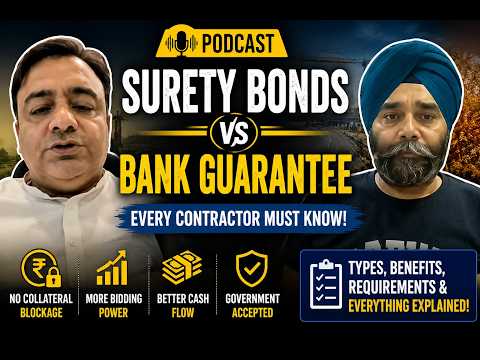
Recommended Video Tutorials & Practical Walkthroughs
Watch these handpicked, expert video guides covering practical compliance, step-by-step procedures, and real-world implementation:
Recommended Video Tutorials & Practical Guides

16. Frequently Asked Questions (FAQs)
17. Statutory Guidelines, Ministry of Finance Memorandums & Precedents
IRDAI (Surety Insurance Contracts) Guidelines, 2022; Ministry of Finance Office Memorandum No. F.1/1/2022-PPD (GFR Rule 144); NHAI Circular on Acceptance of Insurance Surety Bonds; Indian Contract Act, 1872 (Section 126 Contract of Guarantee).