
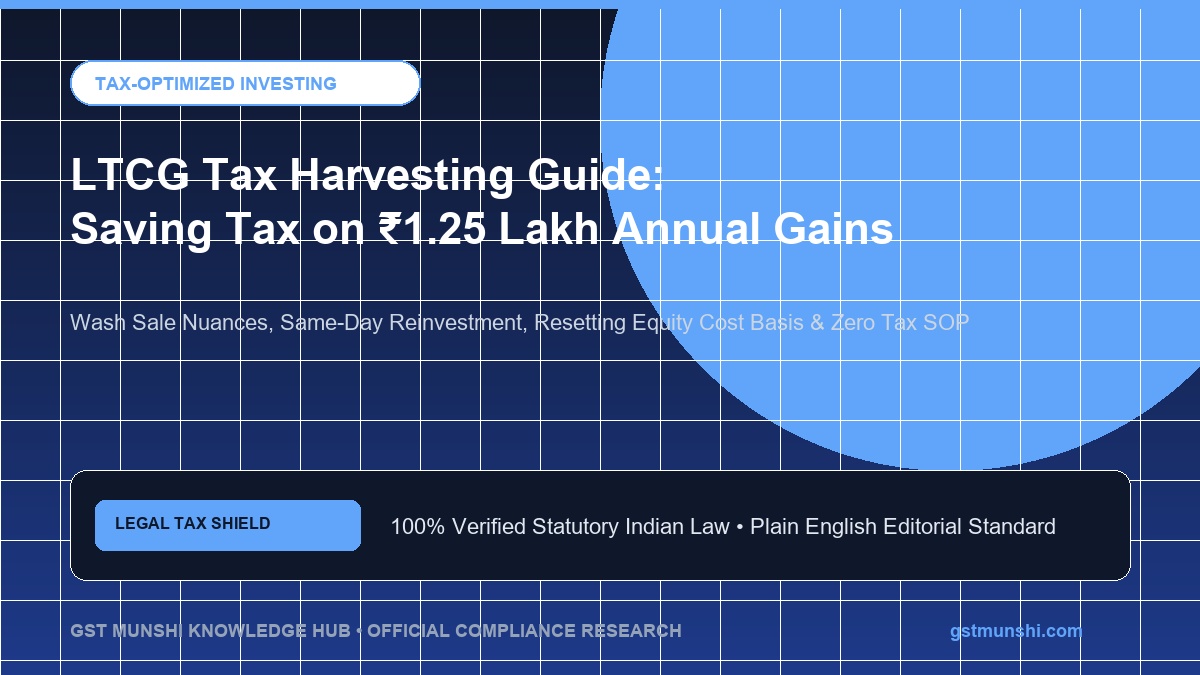
How does LTCG tax harvesting legally save tax on stocks and mutual funds?
Under Section 112A of the Income Tax Act, Long-Term Capital Gains on listed equities and equity mutual funds are completely exempt from tax up to ₹1,25,000 per financial year (revised from ₹1 Lakh). If you do not book gains, this annual exemption lapses forever. Tax Harvesting is the strategy of selling eligible units before 31st March to lock in up to ₹1.25 Lakh in profit (at 0% tax) and immediately buying back the same assets. This resets your purchase cost higher, saving you 12.5% tax (₹15,625) when you finally liquidate years later.
1. What is Tax Gain Harvesting?
The government grants every Indian taxpayer an annual quota of ₹1.25 Lakh in tax-free long-term equity profits under Section 112A. However, this quota is on a "use-it-or-lose-it" basis: if you make ₹0 capital gains in FY 2024-25, your unused ₹1.25 Lakh exemption disappears; it cannot be carried forward to the next year.
Tax harvesting converts paper profits into realized gains within the tax-free limit, without changing your asset allocation or taking cash out of the market.
2. Who Should Harvest Equity Gains?
- SIP Investors with Portfolios > ₹5 Lakh: After 3 to 5 years of compounding, unrealized gains build up. Harvesting prevents a massive tax bill at retirement.
- Direct Stock Investors: Holding multibagger shares where original cost basis is low.
- High-Income Taxpayers: Wanting to extract maximum legal exemptions without triggering IRS/CBDT notices.
3. Tax Gain Harvesting vs Tax Loss Harvesting
Tax Gain Harvesting (Section 112A)
Selling profitable holdings that have crossed 365 days to capture up to ₹1.25 Lakh of profit at 0% tax, resetting your cost price higher.
Tax Loss Harvesting (Section 70/71)
Selling loss-making stocks (e.g. down 20%) to book capital losses, which can be set off against taxable STCG (20%) or LTCG (12.5%) to reduce your net tax bill.
4. How Resetting Cost Basis Works: The Mathematical Proof
Here is how the cost basis reset fundamentally changes your future tax liability:
Scenario: 1,000 Units Purchased at ₹100 (Total Cost: ₹1,00,000)
Approach A: Buy and Hold Without Harvesting (Sold at Year 5 @ ₹300)
Sale Value: ₹3,00,000 | Original Cost: ₹1,00,000 | Total Gain: ₹2,00,000
Exemption: ₹1,25,000 | Taxable Gain: ₹75,000
Tax Paid @ 12.5%: ₹9,375
Approach B: Annual Tax Harvesting (Harvested at Year 2 @ ₹225)
Sold at Year 2: ₹2,25,000 | Gain: ₹1,25,000 (100% Tax-Free under 112A)
Immediately Repurchased at ₹225 (New Cost Basis: ₹2,25,000)
Final Sale at Year 5 @ ₹300: Sale Value ₹3,00,000 | Cost ₹2,25,000 | Gain: ₹75,000
Exemption: ₹1,25,000 (Covers full ₹75,000 gain!)
Tax Paid @ 12.5%: ₹0.00 (Total Tax Saved: ₹9,375!)
5. Holding Period & STT Eligibility Rules
For gains to qualify under Section 112A:
- Holding Period: Must exceed 365 days (1 year). If sold on day 365 or earlier, it is STCG taxed at 20%!
- STT Paid: Securities Transaction Tax must have been paid at both purchase and sale (for listed shares), or at sale (for equity mutual funds).
6. Transaction Slippage: STT, Stamp Duty & Brokerage
When harvesting, you incur minor transactional costs:
Mutual Funds: Zero brokerage, zero DP charges, negligible 0.005% stamp duty on re-purchase. Slippage is virtually ₹0.
Direct Stocks: Brokerage (₹0 to ₹20 per trade), STT (0.1% on delivery buy/sell), DP charges (~₹15.93 per script on sell), and GST. On ₹1.25 Lakh stock harvesting, total friction is ~₹300 to ₹400, against ₹15,625 in tax savings (a 40x return on friction!).
7. Reports Needed Before Executing
- Capital Gains Statement: Download from Zerodha Console, Groww Reports, or CAMS/KFintech for the current FY.
- Unrealized P&L Report: Filtering specifically for "Long-Term Holding (>365 Days)".
8. Step-by-Step Harvesting Execution SOP
Step 1: Check Already Realized LTCG in Current FY
Check how much LTCG you have already booked between 1st April and today. If you already booked ₹40,000, you have ₹85,000 headroom left.
Step 2: Identify Long-Term Units with Gains up to Remaining Headroom
Select mutual fund folios or stocks held for >1 year where unrealized profit equals your remaining exemption.
Step 3: Execute Sale & Immediately Place Re-purchase Order
For mutual funds: Place a redemption order and immediately submit a fresh lump-sum purchase order. For stocks: Sell shares and immediately buy back the exact quantity in the delivery cash segment.
9. 10-Year Wealth Outcome: Annual Harvesting vs Passive Hold
| Parameter | No Harvesting (Passive Hold) | Annual Tax Harvesting Strategy |
|---|---|---|
| Exemption Utilization | Only ₹1.25L in the final exit year | ₹1.25L utilized EVERY year (₹12.5L total) |
| Cost Basis of Portfolio | Stuck at historical low price | Steadily stepped up to market price |
| Total Taxes Paid over 10 Yrs | ₹1,56,250 | ₹0.00 |
| Net Cash Saved in Pocket | ₹0.00 | + ₹1,56,250 Clean Profit |
10. Real-World Case Study: IT Professional in March 2026
Priya has ₹15 Lakh in a Nifty 50 Index Fund showing ₹3,20,000 in unrealized gains on units held for 3 years. On 10th March 2026, she redeems units containing exactly ₹1,20,000 in gains and immediately re-invests the payout into the same fund.
Result: Her purchase cost jumps by ₹1,20,000. She files Schedule 112A in ITR-2 showing ₹1,20,000 LTCG with tax payable = ₹0.00. When she eventually withdraws to buy a flat in 2030, her taxable profit is reduced by ₹1,20,000, saving her ₹15,000 in hard cash!
11. Fatal Mistakes in Tax Harvesting
1. Intraday Squaring Off (The Delivery Trap)
If you buy back the same stock on the same exchange before 3:30 PM in standard stockbroking accounts, the broker's RMS system may treat it as an intraday speculative trade rather than delivery! To avoid this: buy back on the opposite exchange (sell on NSE, buy on BSE), or buy back the following morning (T+1).
2. Selling ELSS Funds Before 3 Years
ELSS tax-saving funds have a statutory 3-year lock-in from the date of each SIP installment. You cannot harvest ELSS units before 36 months have elapsed.
12. Market Timing Risk During Reinvestment
For mutual funds, redemption takes 1 to 2 business days (T+1 or T+2) for money to credit. If the market surges 3% while your funds are in transit, you face market timing slippage. To neutralize this, maintain an emergency buffer to place the re-purchase order simultaneously!
13. Statutory Framework & Judicial Legality
Section 112A of Income Tax Act: Tax on long-term capital gains in certain cases exceeding ₹1,25,000.
CBDT Circular No. 9/2018: Frequently Asked Questions on Section 112A confirming that capital gains must be computed based on actual transfers.
Absence of Wash Sale Rule: Unlike US Section 1091, Indian courts (including landmark rulings) uphold that legitimate sales on stock exchanges with transfer of title are valid even if repurchased immediately.
14. When to Execute: The February-March Calendar
The optimal window for tax harvesting is between 1st February and 20th March. Never leave it until 31st March, as bank clearing holidays or settlement delays could push the trade into April, wasting your current financial year quota!
15. Pre-Harvesting Execution Checklist
Recommended Video Tutorials & Practical Walkthroughs
Watch these handpicked, expert video guides covering practical compliance, step-by-step procedures, and real-world implementation:
Recommended Video Tutorials & Practical Guides
16. Frequently Asked Questions (FAQs)
What is LTCG tax harvesting in Indian equity investing?
LTCG tax harvesting is a legal tax-optimization technique where an investor sells a portion of their long-term equity shares or equity mutual fund units to realize up to ₹1.25 Lakh in capital gains before 31st March, and immediately re-invests the money. This resets the purchase price (cost basis) higher at zero tax cost.
Are wash sale rules applicable to tax harvesting in India?
Unlike the United States (where the IRS enforces a 30-day wash-sale rule), the Indian Income Tax Act, 1961 does NOT have a statutory wash-sale prohibition for tax-gain harvesting. An investor can sell shares at 11:00 AM and buy them back at 11:05 AM on the same exchange, provided delivery is given.
How much tax can an investor save every financial year through tax harvesting?
By harvesting ₹1.25 Lakh in LTCG each financial year, an investor saves 12.5% on ₹1,25,000, which equals ₹15,625 in pure tax savings every year (plus health and education cess). Over 10 years, this compounds to over ₹2.5 Lakh in cumulative tax benefits.
Can you harvest tax gains on mutual fund units held for less than 12 months?
No. Units held for 12 months or less are classified as Short-Term Capital Gains (STCG) under Section 111A and are taxed at flat 20% with zero basic exemption. Only units held for more than 365 days qualify for the ₹1.25 Lakh Section 112A exemption.
Can you harvest tax losses (Tax-Loss Harvesting) to offset equity gains?
Yes. Under Section 70 and Section 71 of the Income Tax Act, short-term capital losses can be set off against both STCG and LTCG, while long-term capital losses can only be set off against LTCG. Unadjusted losses can be carried forward for 8 consecutive assessment years.