GST Munshi Logo
Start Free
Free Job Alert & Results2026 LIVE
Sponsored AdvertisementGoogle Ad Slot (728×90 / Responsive)
GST Munshi Professional Billing & Tax Suite100% FREE

Automated e-Invoices, GSTR-1 JSON exports, barcode labels, and instant business accounting.

Home›Free Job Alert›CSIR›NTA CSIR UGC NET Dec 2026
Read in Your Regional Language:
CSIRGovt. Board
NEW JOB
New Job AlertCSIRAll India State Jobs →Central SectorAdvt No: Public Notice Dated: 07.10.2026 (Joint CSIR-UGC NET Examination December 2026 for JRF, Assistant Professor & Ph.D. Admission)

NTA CSIR UGC NET Dec 2026

NTA CSIR UGC NET December 2026: Apply Online for JRF & Assistant Professor Eligibility, Ph.D. Admission, 5 Subjects Syllabus, Exam Dates & Information Bulletin

National Testing Agency (NTA) and Council of Scientific & Industrial Research (CSIR) have released the official Public Notice dated 07.10.2026 inviting online applications for the Joint CSIR-UGC NET Examination December 2026 in Computer Based Test (CBT) mode across 5 scientific disciplines: Chemical Sciences, Earth Sciences, Life Sciences, Mathematical Sciences, and Physical Sciences. The examination determines eligibility for Junior Research Fellowship (JRF) with ₹37,000/month fellowship stipend, appointment as Assistant Professor, and admission to Ph.D. programs in Indian universities and research institutes. Read the official NTA Public Notice PDF on this page, explore the complete 30-page subject-wise syllabus, verify age criteria as on 01.12.2026, and simulate your score.
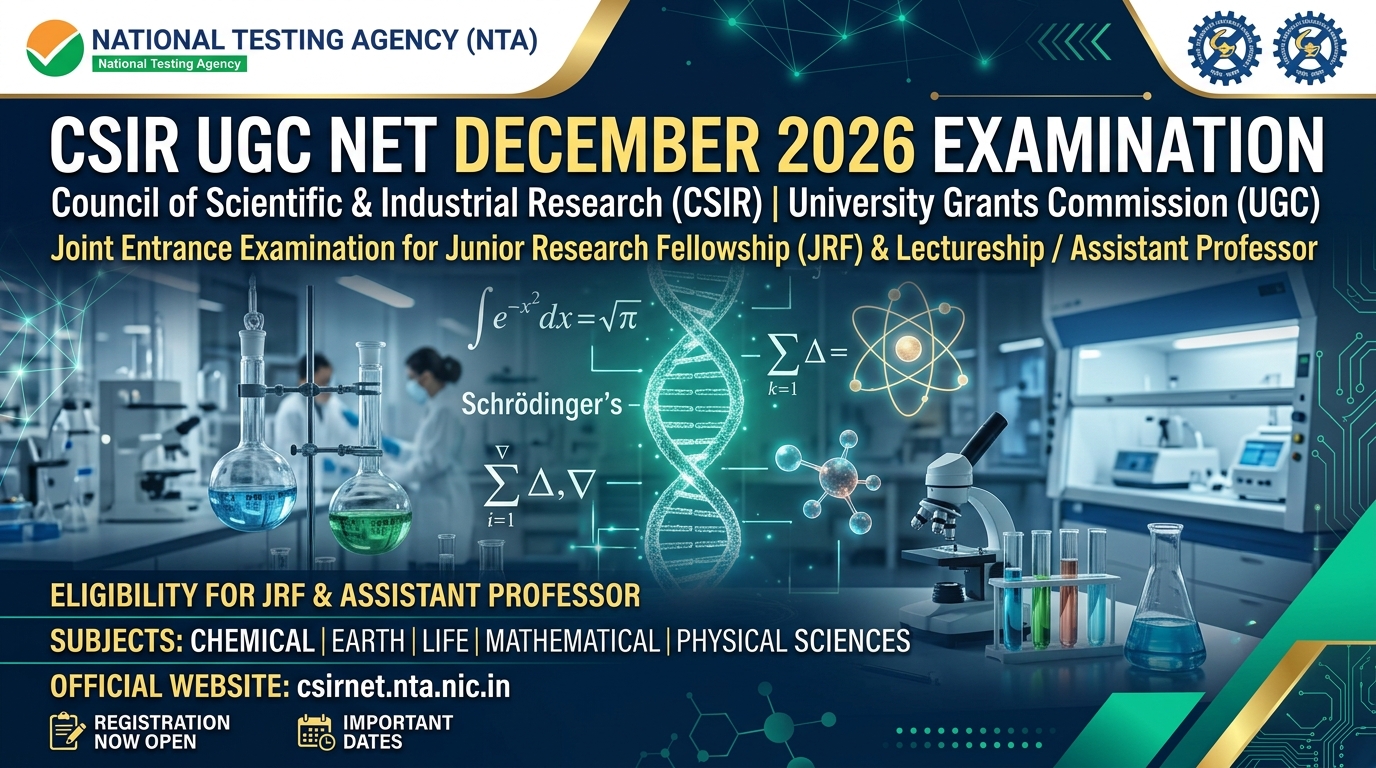
NTA CSIR UGC NET December 2026: Apply Online for JRF & Assistant Professor Eligibility, Ph.D. Admission, 5 Subjects Syllabus, Exam Dates & Information Bulletin
Official 2026
NTA CSIR UGC NET Dec 2026 Official Guide0 Posts
Vacancies
Various
Last Date
05 November 2026
Status
Application Open
NTA Public Notice Dated 07.10.2026 • Apply 07 Oct – 05 Nov 20265 Science Subjects • JRF Fellowship ₹37,000/mo + HRAExam: 19, 22 & 27 Dec 2026 (CBT Mode)

Joint CSIR UGC NET December 2026: Official Public Notice, 3-Category Eligibility, 30-Page Master Syllabus & Fellowship Guide!

Published by the National Testing Agency (NTA) & Council of Scientific & Industrial Research (CSIR) via Public Notice dated 07 October 2026, online applications are invited for the Joint CSIR-UGC NET December 2026 Examination across 5 scientific subjects: Chemical Sciences (701), Earth Sciences (702), Life Sciences (703), Mathematical Sciences (704), and Physical Sciences (705). Determines eligibility for: (i) Award of Junior Research Fellowship (JRF) & Assistant Professor appointment, (ii) Appointment as Assistant Professor & Ph.D. Admission, and (iii) Ph.D. Admission Only. CBT exam is scheduled for 19, 22, and 27 December 2026 (3 Hours, 200 Marks).

Apply Online (NTA Portal)

All-in-One Exam Command Hub & Latest Official UpdatesSingle-Page Live Tracker

Every update (Syllabus, Exam Pattern, Notification, Apply Online, Admit Card, Result) is updated right here on this single page — tap any tab below

Exam: 19, 22 and 27 December 2026 (CBT Mode: Shift 1: 09:00 AM – 12:00 PM | Shift 2: 03:00 PM – 06:00 PM)3 Verified Updates Active
Live Recruitment Lifecycle Stage Tracker (Tap any stage to inspect):
Latest Official Updates Log (Click any update to open its tab view immediately):

Important Dates

Notification Release Date07 October 2026
Online Application Start Date07 October 2026
Last Date to Apply Online05 November 2026 (upto 11:50 PM)
Last Date to Pay Fee05 November 2026 (upto 11:50 PM) | With Late Fee (₹500): 09 November 2026 (upto 11:50 PM)
Form Correction Window10 November to 12 November 2026 (upto 11:50 PM)
Exam Date19, 22 and 27 December 2026 (CBT Mode: Shift 1: 09:00 AM – 12:00 PM | Shift 2: 03:00 PM – 06:00 PM)
Admit Card Release DateAdvance City Intimation: 10 Days Before Exam | Admit Card: 3 to 4 Days Before Exam (December 2026)
Result DateJanuary / February 2027 (NTA Scorecard & Category-Wise Cut-Off Percentage/Percentile)

Application Fee

General / OBC / EWSGeneral: ₹1,150/- | General-EWS / OBC-NCL (Central List): ₹600/-
SC / ST / ReservedSC / ST / Persons with Disability (PwD) / Third Gender: ₹325/-
PH (Divyang) / FemaleGeneral Female: ₹1,150/- | Gen-EWS / OBC-NCL Female: ₹600/- | SC/ST/PwD Female: ₹325/- (Late Submission Fee: ₹500/- additional for online transactions between 06.11.2026 and 09.11.2026)
Payment Mode:Online Mode via Debit Card, Credit Card, Net Banking, or UPI through SBI / ICICI / HDFC / Canara Bank Payment Gateway

Eligibility Criteria

Educational Qualification:

M.Sc. or Equivalent Degree / Integrated BS-MS / BS-4 Years / BE / B.Tech / B.Pharma / MBBS with at least 55% Marks for General/General-EWS/OBC-NCL (50% Marks for SC/ST/PwD/Third Gender) in Chemical, Earth, Life, Mathematical, or Physical Sciences. Final Year / Result Awaited (RA) students are also eligible to apply.

Age Limit:

Maximum 30 Years for JRF as on 01/12/2026 (Born on or after 01/12/1996; Age Relaxation up to 5 Years for SC/ST/PwD/Third Gender & Female candidates, up to 3 Years for OBC-NCL) | No Upper Age Limit for Assistant Professor / Lectureship & Admission to Ph.D. Only

Instant Age & Eligibility Checker (As on 01/07/2026):
✅ You Are Age-Eligible!
Exact Age on 01/07/2026: 25 Yrs, 6 Months, 16 Days (Allowed: 19–30 Yrs)

Exam Pattern

SubjectQuestionsMarksDuration
Part-A: General Aptitude (Common to All 5 Subjects — Quantitative, Reasoning & Research Aptitude)2030Attempt Any 15 Qs (2 Marks Each • 0.5 Neg)
Part-B: Subject-Specific Core Knowledge MCQs (Conventional Scientific Concepts)5070Attempt 20–35 Qs depending on subject
Part-C: Higher-Order Analytical & Scientific Problem Solving (Advanced Application)75100Attempt 20–25 Qs depending on subject

Selection Process

1Computer Based Test (CBT) Written Examination: Single paper of 3 hours duration (180 minutes) carrying 200 marks, consisting of Part A (General Aptitude - 30 Marks), Part B (Subject Concept MCQs - 70/75 Marks), and Part C (Higher Order Analytical & Scientific Problems - 95/100 Marks)
2Multi-Shift Normalization: Normalization across shifts using NTA Equipercentile / Percentile Equivalence formula for multi-shift papers (Life Sciences and Chemical Sciences)
3Three-Tier Category Eligibility Declaration: Category-1 (Eligible for JRF and Assistant Professor), Category-2 (Eligible for Assistant Professor and Ph.D. Admission), and Category-3 (Eligible for Admission to Ph.D. Only)
4Issuance of JRF Award Letter & E-Certificate: JRF Award Letter issued to Category-1 qualifiers (valid for 2 years); Lifetime validity Assistant Professor eligibility certificate issued to Category-1 and Category-2 qualifiers

Syllabus

Compulsory Part-A General Aptitude (20 Qs, Attempt Any 15 = 30 Marks): Common across all 5 subjects testing Graphical Analysis, Numerical Ability, Quantitative Reasoning, Puzzles, Geometry, Series Formation, and Research Aptitude with 0.5 mark deduction per wrong answer.
Chemical Sciences (Subject Code: 701 — 120 Qs, Max Attempt 75 = 200 Marks): Inorganic Chemistry (Periodicity, Coordination, Organometallics, Bioinorganic), Physical Chemistry (Quantum Mechanics, Thermodynamics, Kinetics, Electrochemistry, Spectroscopy), Organic Chemistry (Stereochemistry, Reaction Mechanisms, Named Reactions, Pericyclic, Heterocycles), and Interdisciplinary Chemistry.
Earth, Atmospheric, Ocean and Planetary Sciences (Subject Code: 702 — 150 Qs, Max Attempt 75 = 200 Marks): Earth and Solar System, Mineralogy, Petrology, Structural Geology, Plate Tectonics, Physical & Chemical Oceanography, Atmospheric Dynamics, Climatology, Environmental Geosciences & Remote Sensing.
Life Sciences & Biotechnology (Subject Code: 703 — 145 Qs, Max Attempt 75 = 200 Marks): Molecules & Cellular Organization, Fundamental Processes (Replication, Transcription, Translation), Cell Signaling & Immunology, Developmental Biology, System Physiology (Plant & Animal), Inheritance Biology, Ecological Principles, Evolution, and Methods in Biology.
Mathematical Sciences (Subject Code: 704 — 120 Qs, Max Attempt 60 = 200 Marks): Real Analysis, Linear Algebra, Complex Analysis, Abstract Algebra, ODEs, PDEs, Numerical Analysis, Calculus of Variations, Classical Mechanics, Probability, Mathematical Statistics & Operations Research. Note: Part C has multi-correct options with ZERO negative marking.
Physical Sciences (Subject Code: 705 — 75 Qs, Max Attempt 55 = 200 Marks): Mathematical Physics, Classical Mechanics, Electromagnetic Theory, Quantum Mechanics, Thermodynamic & Statistical Physics, Electronics, Atomic & Molecular Physics, Condensed Matter Physics, and Nuclear & Particle Physics.

NTA CSIR UGC NET Dec 2026 Official Subject-Wise & Micro-Topic Syllabus (6 Subjects)

CSIR_NET Master Syllabus

Joint CSIR-UGC NET Examination December 2026 Information Bulletin & CSIR HRDG Official Syllabus (CBT Mode: 200 Marks • 180 Mins across 5 Scientific Disciplines)

Total Questions
75–150 MCQs (Candidates attempt 55–75 Questions depending on subject)
Maximum Marks
200 Marks (Part A: 30 Marks + Part B: 70/75 Marks + Part C: 95/100 Marks)
Exam Duration
3 Hours (180 Minutes — Single Paper CBT)
Negative Marking
25% Negative Marking (0.5 Marks deducted in Part A; 0.5 to 1.32 in Parts B & C; Part C Mathematical Sciences has ZERO Negative Marking)
#CSIR-PART-A

Compulsory Part-A: General Aptitude (Common to All 5 Subjects — 20 Questions, Attempt Any 15 × 2 = 30 Marks)

30 Marks
Graphical Analysis & Data Interpretation: Histograms, Pie Charts, Line Graphs, Tables, Bar Charts, Mean, Median, Mode, Variance, Standard Deviation, and Statistical Inferences
Numerical Ability & Arithmetic Reasoning: Number Systems, Surds & Indices, LCM & HCF, Ratio & Proportion, Percentage, Profit & Loss, Simple & Compound Interest, Work & Time, Speed & Distance
Geometry, Mensuration & Coordinate Geometry: Properties of Triangles, Circles, Polygons, Area, Perimeter, Surface Area, Volume of 3D Solids, Trigonometric Ratios, Coordinate Planes
Logical Reasoning & Analytical Puzzles: Series Completion (Number, Letter, Alpha-Numeric), Analogies, Classification, Coding-Decoding, Blood Relations, Direction Sense, Venn Diagrams, Seating Arrangement, Syllogisms
Research Aptitude & Scientific Observation: Observation, Modeling, Hypothesis Testing, Deductive & Inductive Logic, Scientific Experimentation Principles, Measurement Units & Dimensional Analysis
#CSIR-CHEM

Subject 1: Chemical Sciences (Code: 701 — 120 MCQs, Attempt Any 75: Part A 15, Part B 35, Part C 25 = 200 Marks)

200 Marks
Inorganic Chemistry: Chemical Periodicity, Structure and Bonding in Homo- and Heteronuclear Molecules, Concepts of Acids and Bases, Main Group Elements and their Compounds, Transition Elements and Coordination Compounds (Ligand Field Theory, Electronic Spectra, Magnetic Properties), Organometallic Compounds (Synthesis, Structure, Bonding and Reactivity, 18-Electron Rule), Cages and Metal Clusters, Bioinorganic Chemistry (Porphyrins, Metalloenzymes, Oxygen Transport), Nuclear Chemistry
Physical Chemistry: Basic Principles of Quantum Mechanics, Operator Algebra, Schrödinger Equation, Particle in a Box, Harmonic Oscillator, Rigid Rotor, Hydrogen Atom, Variation Method and Perturbation Theory; Chemical Bonding in Diatomics; Chemical Thermodynamics (Laws, Free Energy, Phase Equilibria, Clausius-Clapeyron, Partial Molar Quantities); Statistical Thermodynamics (Ensembles, Partition Functions); Chemical Kinetics (Rate Laws, Arrhenius, Transition State Theory, Photochemical Reactions); Catalysis; Electrochemistry (Nernst Equation, Debye-Hückel, Overpotential); Colloids and Surfaces (Adsorption Isotherms, BET); Solid State (Bragg's Law, Band Theory, Defects); Molecular Spectroscopy (Rotational, Vibrational, Electronic, NMR, ESR)
Organic Chemistry: IUPAC Nomenclature of Organic Molecules; Principles of Stereochemistry (Conformational Analysis, Optical Activity, R/S, E/Z, Topicity, Prochirality); Aromaticity (Hückel's Rule, Annulenes, Non-benzenoid); Organic Reactive Intermediates (Carbocations, Carbanions, Radicals, Carbenes, Nitrenes); Organic Reaction Mechanisms (SN1, SN2, SNi, E1, E2, Addition, Elimination, Rearrangements); Named Reactions and Rearrangements; Organic Synthesis (Organometallic Reagents Li, Mg, Cu, Zn, B, Si, P, Pd, Ru, Coupling Reactions Heck, Suzuki, Sonogashira); Asymmetric Synthesis; Pericyclic Reactions (Woodward-Hoffmann, Electrocyclic, Cycloaddition, Sigmatropic); Photochemical Reactions; Heterocyclic Chemistry; Natural Products and Biomolecules (Carbohydrates, Amino Acids, Peptides, Lipids, Nucleic Acids, Terpenes, Alkaloids); Spectroscopy in Organic Chemistry (UV-Vis, IR, 1H and 13C NMR, Mass Spectrometry)
Interdisciplinary Chemistry: Chemistry in Nanoscience and Technology, Green Chemistry and Catalysis, Environmental Chemistry, Supramolecular Chemistry, Medicinal Chemistry Fundamentals
#CSIR-EARTH

Subject 2: Earth, Atmospheric, Ocean and Planetary Sciences (Code: 702 — 150 MCQs, Attempt Any 75 = 200 Marks)

200 Marks
The Earth and the Solar System: Milky Way, Solar System Evolution, Kepler's Laws, Meteorites, Moon, Terrestrial Planets, Giant Planets, Bulk Earth Composition, Earth's Internal Structure (Crust, Mantle, Core, Discontinuities)
Earth Materials, Surface Features and Processes: Mineralogy, Optical Mineralogy, Igneous, Sedimentary, and Metamorphic Petrology; Weathering, Soil Formation, Fluvial, Glacial, Aeolian, Coastal, and Karst Landforms; Plate Tectonics (Continental Drift, Seafloor Spreading, Plate Boundaries, Orogeny)
Interior of the Earth, Deformation and Tectonics: Structural Geology, Stress and Strain, Folds, Faults, Joints, Shear Zones, Foliation, Lineation; Seismology (P, S, Surface Waves, Earthquake Mechanism, Focal Mechanism)
Oceans and Atmosphere: Chemical Oceanography (Salinity, Nutrients, Dissolved Gases), Physical Oceanography (Waves, Tides, Currents, Ekman Transport, El Niño/La Niña); Atmospheric Structure, Solar Radiation, Greenhouse Effect, Atmospheric Dynamics, Cyclones, Monsoons, Climate Classification
Environmental Earth Sciences: Natural Hazards (Earthquakes, Volcanoes, Landslides, Floods, Tsunamis), Mineral and Energy Resources, Groundwater Hydrology, Remote Sensing and GIS Applications in Geosciences
#CSIR-LIFE

Subject 3: Life Sciences & Biotechnology (Code: 703 — 145 MCQs, Attempt Any 75: Part A 15, Part B 35, Part C 25 = 200 Marks)

200 Marks
Molecules and their Interaction Relevant to Biology: Structure of Atoms, Molecules and Chemical Bonds; Composition, Structure and Function of Biomolecules (Carbohydrates, Lipids, Proteins, Nucleic Acids, Vitamins); Stablizing Interactions (Van der Waals, Electrostatic, Hydrogen, Hydrophobic); Bioenergetics, Glycolysis, Oxidative Phosphorylation, Coupled Reactions; Principles of Catalysis, Enzymes, Kinetics, Inhibition; Conformation of Proteins (Ramachandran Plot, Secondary, Tertiary, Quaternary Domains); Conformation of Nucleic Acids (A-, B-, Z-DNA, t-RNA, micro-RNA); Stability of Proteins and Nucleic Acids
Cellular Organization: Membrane Structure and Function (Lipid Bilayer, Fluid Mosaic, Transport Across Membranes, Ion Channels, Pumps); Structural Organization and Function of Intracellular Organelles (Nucleus, Mitochondria, Golgi, Lysosomes, ER, Peroxisomes, Plastids, Vacuoles); Organization of Genes and Chromosomes (Operons, Unique and Repetitive DNA, Transposons); Cell Division and Cell Cycle (Mitosis, Meiosis, Cell Cycle Regulation, Checkpoints, CDKs, Cyclins); Microbial Physiology
Fundamental Processes: DNA Replication, Repair and Recombination (Prokaryotic and Eukaryotic DNA Polymerases, Replication Forks, Mismatch Repair, Recombination, Plasmids); RNA Synthesis and Processing (Transcription Factors, RNA Polymerases, Capping, Polyadenylation, Splicing, RNA Editing); Protein Synthesis and Processing (Ribosomes, Genetic Code, Initiation, Elongation, Termination, Post-Translational Modifications); Control of Gene Expression (Prokaryotic and Eukaryotic Transcription Regulation, Chromatin Remodeling, Epigenetics)
Cell Communication and Cell Signaling: Host-Parasite Interaction; Cell Signaling (G-Protein Coupled Receptors, Receptor Tyrosine Kinases, Second Messengers, MAP Kinase Cascade, Apoptosis, Autophagy); Cellular Communication (Cell Adhesion Molecules, Extracellular Matrix, Integrins, Tight Junctions, Gap Junctions); Cancer (Oncogenes, Tumor Suppressors, Metastasis, Angiogenesis); Innate and Adaptive Immunity (Antigens, Antibodies, B-Cell and T-Cell Receptors, MHC Molecules, Complement System, Vaccines)
Developmental Biology & System Physiology: Gametogenesis, Fertilization, Early Embryonic Development, Morphogenesis, Organogenesis in Animals and Plants; Plant Physiology (Photosynthesis C3/C4/CAM, Nitrogen Fixation, Plant Hormones Auxin, Cytokinin, Gibberellin, ABA, Ethylene, Photoperiodism); Animal Physiology (Blood and Circulation, Respiratory System, Nervous System, Excretory System, Thermoregulation, Endocrinology)
Inheritance Biology, Ecology, Evolution & Applied Biology: Mendelian Genetics, Linkage, Crossing Over, Gene Mapping, Chromosomal Aberrations; Ecological Principles (Population Ecology, Community Ecology, Ecosystem Dynamics, Biomes, Conservation Biology); Evolution and Behavior (Darwinism, Speciation, Phylogenetic Trees, Molecular Evolution, Altruism, Kin Selection); Applied Biology (Transgenic Animals and Plants, Genomics, Proteomics, Molecular Breeding); Methods in Biology (Recombinant DNA, PCR, CRISPR-Cas9, Gel Electrophoresis, Blotting, Chromatography, Spectroscopy, X-ray Crystallography, Patch Clamping, Flow Cytometry)
#CSIR-MATH

Subject 4: Mathematical Sciences (Code: 704 — 120 MCQs, Attempt Any 60: Part A 15, Part B 25, Part C 20 = 200 Marks)

200 Marks
Unit 1: Analysis and Linear Algebra: Real Analysis (Sequences and Series, Uniform Convergence, Riemann-Stieltjes Integral, Metric Spaces, Compactness, Connectedness, Lebesgue Measure and Integration); Linear Algebra (Vector Spaces, Subspaces, Basis, Dimension, Linear Transformations, Matrix Representation, Rank-Nullity Theorem, Eigenvalues and Eigenvectors, Cayley-Hamilton Theorem, Diagonalizability, Canonical Forms, Inner Product Spaces, Bilinear and Quadratic Forms)
Unit 2: Complex Analysis, Algebra & Topology: Complex Analysis (Analytic Functions, Cauchy-Riemann Equations, Cauchy's Theorem and Integral Formula, Taylor and Laurent Series, Singularities, Residue Theorem, Conformal Mapping, Maximum Modulus Principle); Modern Algebra (Groups, Subgroups, Normal Subgroups, Lagrange's Theorem, Homomorphisms, Sylow Theorems, Rings, Ideals, Fields, Field Extensions, Galois Theory, Finite Fields); Topology (Topological Spaces, Basis, Product Topology, Connectedness, Compactness)
Unit 3: Ordinary & Partial Differential Equations, Numerical Analysis, Calculus of Variations & Classical Mechanics: ODEs (First-order ODEs, Linear ODEs with Constant/Variable Coefficients, Wronskian, Sturm-Liouville Problems, Green's Functions); PDEs (First-order PDEs, Method of Characteristics, Classification of Second-order PDEs, Wave, Heat, and Laplace Equations, Boundary Value Problems); Numerical Analysis (Numerical Solutions of Algebraic Equations, Interpolation, Numerical Differentiation and Integration, Numerical Solutions of ODEs); Calculus of Variations (Euler-Lagrange Equation, Variational Problems with Constraints); Classical Mechanics (Generalized Coordinates, Lagrange's Equations, Hamilton's Principle, Hamilton's Equations, Canonical Transformations)
Unit 4: Descriptive Statistics, Probability, Statistical Inference & Operations Research: Probability Theory (Random Variables, Distribution Functions, Expectation, Moment Generating Functions, Central Limit Theorem, Laws of Large Numbers); Standard Distributions; Statistical Inference (Estimation, Point and Interval Estimation, Testing of Hypotheses, Neyman-Pearson Lemma, Likelihood Ratio Tests); Linear Models and Regression; Multivariate Analysis; Sampling Techniques; Operations Research (Linear Programming, Simplex Method, Duality, Transportation and Assignment Problems)
#CSIR-PHYS

Subject 5: Physical Sciences (Code: 705 — 75 MCQs, Attempt Any 55: Part A 15, Part B 20, Part C 20 = 200 Marks)

200 Marks
Mathematical Methods of Physics: Dimensional Analysis, Vector Algebra and Vector Calculus, Linear Algebra (Matrices, Cayley-Hamilton, Eigenvalues), Ordinary and Partial Differential Equations, Special Functions (Legendre, Hermite, Laguerre, Bessel), Fourier and Laplace Transforms, Complex Analysis (Cauchy-Riemann, Residues), Probability and Statistics
Classical Mechanics: Newton's Laws, Dynamical Systems, Phase Space Dynamics, Stability Analysis, Central Force Motion, Kepler's Laws, Rigid Body Dynamics, Euler's Equations, Small Oscillations and Normal Modes, Lagrangian and Hamiltonian Formalisms, Poisson Brackets, Canonical Transformations, Hamilton-Jacobi Theory, Special Theory of Relativity
Electromagnetic Theory: Electrostatics (Gauss's Law, Laplace and Poisson Equations, Boundary Value Problems, Multipole Expansion), Magnetostatics (Biot-Savart, Ampere's Law, Vector Potential), Electrodynamics (Maxwell's Equations, Gauge Invariance, Electromagnetic Waves in Vacuum and Media, Poynting Vector, Reflection and Refraction, Radiation from Accelerating Charges)
Quantum Mechanics: Wave-Particle Duality, Schrödinger Equation (Time-Dependent and Time-Independent), 1D Potentials (Square Well, Barrier, Harmonic Oscillator), Orbital Angular Momentum, Spin, Addition of Angular Momenta, Wigner-Eckart Theorem, Perturbation Theory (Time-Independent and Time-Dependent, Fermi's Golden Rule), Variational Method, WKB Approximation, Scattering Theory (Born Approximation, Partial Wave Analysis)
Thermodynamic and Statistical Physics: Laws of Thermodynamics, Thermodynamic Potentials, Maxwell Relations, Chemical Potential, Phase Transitions, Microcanonical, Canonical, and Grand Canonical Ensembles, Partition Functions, Classical and Quantum Statistics (Bose-Einstein and Fermi-Dirac Distributions), Ideal Bose and Fermi Gases, Blackbody Radiation, Bose-Einstein Condensation, Ising Model
Electronics and Experimental Methods: Semiconductor Devices (Diodes, Transistors, FETs, MOSFETs), Operational Amplifiers and Applications, Digital Electronics (Logic Gates, Flip-Flops, Counters, Registers, A/D and D/A Converters), Microprocessors and Microcontrollers, Measurement Principles, Transducers, Noise Reduction Techniques
Atomic, Molecular, Condensed Matter & Nuclear Physics: Quantum States of an Electron in an Atom, LS and JJ Coupling, Zeeman, Stark and Paschen-Back Effects, Rotational and Vibrational Spectra, Laser and Masers; Crystal Structure, X-ray Diffraction, Lattice Vibrations, Phonons, Free Electron Theory, Band Theory of Solids, Superconductivity (BCS Theory, Josephson Effect); Nuclear Properties, Liquid Drop Model, Shell Model, Radioactive Decay (Alpha, Beta, Gamma), Nuclear Reactions, Particle Physics (Classification of Elementary Particles, Quark Model, Conservation Laws, Fundamental Interactions)
Official Commission Note: Per NTA & CSIR Information Bulletin: Joint CSIR-UGC NET determines eligibility for (1) Award of JRF & Assistant Professor, (2) Assistant Professor & Ph.D. Admission, and (3) Ph.D. Admission only. JRF Award Letter is valid for 2 Years from declaration date. Lectureship / Assistant Professor eligibility is valid for LIFETIME across all Indian Universities and Colleges. Category-3 Ph.D. score is valid for 1 Year.
Exam Preparation & Education Hub100% Free Practice

Ready to Master the Syllabus for NTA CSIR UGC NET Dec 2026?

Practice 100+ verified General Knowledge, Constitution, History, and Science questions with instant statutory explanations, attempt live timed CBT mock tests with negative marking, or download high-yield digital study e-books.

Start Free Practice & Mock Tests →

CSIR UGC NET Dec 2026 Interactive Score, Negative Marking & 3-Category Predictor

200 Marks • 3-Hour CBT • 3-Category Model

Simulate Part A (General Aptitude, 30M), Part B (70M/75M), & Part C (100M/95M) scores against official CSIR JRF, Assistant Professor, and Ph.D. cutoffs

200 Total Marks
Part A: General Aptitude22 / 30 Marks
0 M15 Qs × 2 Marks (-0.50)30 M
Part B: Subject Fundamentals48 / 70 Marks
0 MSubject Knowledge70 M
Part C: Higher Scientific Analytical58 / 100 Marks
0 MScientific Application100 M
Part A (Aptitude)
22 / 30
Reasoning & Quant
Part B + C (Core)
106 / 170
Subject Specialization
Total Raw Score
128 / 200
64% Aggregate
Top Status Tier
Category 1 (JRF Qualified)
UGC 3-Category Framework
Official UGC 3-Tier Qualification Status (UR Quota in LIFE Sciences):
Category 1: JRF + Asst. Prof. + Ph.D.₹37k/mo Stipend + 27% HRA
Eligible for ₹37,000/mo JRF Fellowship + Assistant Professor + Ph.D. Admission
Target Cut-Off: 115 / 200✓ Qualified (+13)
Category 2: Asst. Professor + Ph.D.Lifetime NET Validity
Eligible for Assistant Professor appointments across Indian Universities & Ph.D.
Target Cut-Off: 104 / 200✓ Qualified (+24)
Category 3: Admission to Ph.D. OnlyValid for 1 Year
Eligible for Ph.D. Admission interviews across IITs, IISc & Central Universities
Target Cut-Off: 92 / 200✓ Qualified (+36)

NTA CSIR UGC NET Dec 2026 Exam Timings & 2 Shifts Schedule

Computer Based Test (CBT) scheduled for 19, 22 and 27 December 2026 across two daily shifts (180 Minutes Duration, 200 Objective Marks)

ShiftReporting TimeExam StartsExam Ends
Shift 1 (Morning Session — 19, 22 and 27 December 2026)07:30 AM (Gate Closes 08:30 AM Strictly)09:00 AM12:00 Noon (180 Minutes CBT)
Shift 2 (Afternoon Session — 19, 22 and 27 December 2026)01:30 PM (Gate Closes 02:30 PM Strictly)03:00 PM06:00 PM (180 Minutes CBT)
Crucial Exam Day Instructions:

• CBT Test Lab Entry Rules: Candidates must report at the CBT exam centre at least 90 minutes before exam commencement (07:30 AM for Shift-1 and 01:30 PM for Shift-2). Gate closes strictly at 08:30 AM (Shift-1) and 02:30 PM (Shift-2). No late entry permitted under any circumstances.

• Mandatory Documents for CSIR NET CBT: (1) Printed NTA Admit Card with self-declaration (Undertaking) downloaded from NTA website, (2) One passport size photograph (same as uploaded on online application) for pasting on Attendance Sheet, (3) Original authorized Photo ID (PAN card / Driving License / Voter ID / Passport / Aadhaar Card with photograph / E-Aadhaar), (4) PwD certificate issued by competent medical authority (if applicable).

NTA CSIR UGC NET Dec 2026 5 Scientific Subject Codes & Category Eligibility Breakdown

Chemical Sciences (701), Earth Sciences (702), Life Sciences (703), Mathematical Sciences (704), and Physical Sciences (705) across JRF, Assistant Professor, and Ph.D. Admission

5 Scientific Subjects
Category-1: Award of JRF & Eligibility for Assistant Professor
1
Top Ranks in Merit List (₹37,000/Month Fellowship + Lifetime LS)
Category-2: Eligibility for Assistant Professor & Admission to Ph.D.
1
Lifetime Assistant Professor Eligibility Across Indian Colleges
Category-3: Admission to Ph.D. Only (Score Valid for 1 Year)
1
Direct Admission to Doctoral Programs Without Institutional Entrance
Chemical Sciences (Subject Code: 701)
1
120 MCQs (Attempt 75) • Single Paper CBT
Earth, Atmospheric, Ocean & Planetary Sciences (Code: 702)
1
150 MCQs (Attempt 75) • Single Paper CBT
Life Sciences & Biotechnology (Subject Code: 703)
1
145 MCQs (Attempt 75) • Multi-Shift CBT
Mathematical Sciences (Subject Code: 704)
1
120 MCQs (Attempt 60) • Zero Neg Marking in Part C
Physical Sciences (Subject Code: 705)
1
75 MCQs (Attempt 55) • Single Paper CBT

Subject Code, Question Distribution & Maximum Marks Breakdown

Scientific Subject & Official CodeScheme of Exam & Marks
1. Chemical Sciences (Code: 701)Part A (15/20 Qs) + Part B (35/40 Qs) + Part C (25/60 Qs) = 75 Qs / 200 Marks (Inorganic, Physical & Organic Chemistry)
2. Earth, Atmospheric, Ocean & Planetary Sciences (Code: 702)Part A (15/20 Qs) + Part B (35/50 Qs) + Part C (25/80 Qs) = 75 Qs / 200 Marks (Geology, Geophysics & Meteorology)
3. Life Sciences & Biotechnology (Code: 703)Part A (15/20 Qs) + Part B (35/50 Qs) + Part C (25/75 Qs) = 75 Qs / 200 Marks (Cellular, Genetic, Physiological & Ecological)
4. Mathematical Sciences (Code: 704)Part A (15/20 Qs) + Part B (25/40 Qs) + Part C (20/60 Qs) = 60 Qs / 200 Marks (Analysis, Linear Algebra, ODE/PDE & Statistics)
5. Physical Sciences (Code: 705)Part A (15/20 Qs) + Part B (20/25 Qs) + Part C (20/30 Qs) = 55 Qs / 200 Marks (Classical, Quantum, Electromagnetics & Condensed Matter)

State / UT-wise Revised Vacancies Breakdown

Filter vacancies by state/UT to evaluate local competition

State / Union TerritoryEarlierRevised Total
Northern Zone (Delhi NCR, Uttar Pradesh, Punjab, Haryana, Rajasthan, Uttarakhand, Himachal Pradesh, J&K)Major CBT Centres: Delhi/Noida, Lucknow, Jaipur, Chandigarh, Varanasi, Prayagraj, Dehradun11
Western Zone (Maharashtra, Gujarat, Goa, Madhya Pradesh, Chhattisgarh)Major CBT Centres: Mumbai, Pune, Nagpur, Ahmedabad, Vadodara, Bhopal, Indore, Raipur11
Southern Zone (Tamil Nadu, Karnataka, Telangana, Andhra Pradesh, Kerala, Puducherry)Major CBT Centres: Chennai, Bengaluru, Hyderabad, Vijayawada, Thiruvananthapuram, Kochi11
Eastern Zone (West Bengal, Bihar, Odisha, Jharkhand, Sikkim, Andaman & Nicobar)Major CBT Centres: Kolkata, Patna, Bhubaneswar, Cuttack, Ranchi, Jamshedpur, Siliguri11
North-Eastern Zone (Assam, Meghalaya, Arunachal Pradesh, Manipur, Nagaland, Mizoram, Tripura)Major CBT Centres: Guwahati, Shillong, Itanagar, Imphal, Kohima, Aizawl, Agartala11

CSIR UGC NET Dec 2026 Monthly Fellowship & Assistant Professor Pay Calculator

Junior Research Fellow (JRF) ₹37,000/mo, Senior Research Fellow (SRF) ₹42,000/mo (100% Tax-Exempt under Sec 10(16)) & Assistant Professor Level-10 (₹57,700–₹1,82,400)

JRF / SRF / Asst Prof (Level-10)
Starting Basic Pay
₹37,000
JRF Stipend: ₹37,000/mo
Dearness Allowance (DA)
₹0
Exempt from DA (Stipend)
House Rent Allowance
₹9,990
27% Class-X Metro (IITs, IISc, CSIR)
Net In-Hand Salary
₹48,657
Take-home per month
Statutory Deductions & Perks:

• Gross monthly salary is ~₹48,657. Deductions include EPF/NPS contribution of ₹0 and ₹0 Professional Tax.

• CSIR & UGC Junior Research Fellowships (JRF: ₹37,000/mo) and Senior Research Fellowships (SRF: ₹42,000/mo) are 100% EXEMPT from Indian Income Tax under Section 10(16) of the Income Tax Act, 1961 (scholarships granted to meet the cost of education). In addition to monthly fellowship and 27%/18%/9% HRA, fellows receive ₹20,000 annual contingency grant for books, conference travel, and research consumables. Assistant Professors appointed in Central/State Universities receive 7th CPC Academic Level-10 pay (₹57,700–₹1,82,400) + 53% DA + 14% Employer NPS.

NTA CSIR UGC NET Dec 2026 Previous Year & Expected Cut-Off Marks

Official out-of-100 qualifying scorecards by State / UT (General & Reserved)

State / UTGeneral / Primary CutoffReserved / Sub-Category
Chemical Sciences (Subject Code: 701 — Cut-Off %)JRF: 53.50% – 55.75% | Lectureship (LS): 48.15% – 50.25%EWS JRF: 47.75% | OBC JRF: 47.25% | SC JRF: 36.25% | ST JRF: 29.50% | PwD JRF: 25.00%
Earth, Atmospheric & Planetary Sciences (Code: 702 — Cut-Off %)JRF: 60.50% – 62.50% | Lectureship (LS): 54.45% – 56.25%EWS JRF: 55.40% | OBC JRF: 53.90% | SC JRF: 43.10% | ST JRF: 38.80% | PwD JRF: 26.50%
Life Sciences & Biotechnology (Code: 703 — NTA Percentile Score)JRF: 99.05 – 99.30 Percentile | Lectureship (LS): 97.20 – 97.60 PercentileEWS JRF: 97.02 Percentile | OBC JRF: 96.80 Percentile | SC JRF: 90.15 Percentile | ST JRF: 84.30 Percentile
Mathematical Sciences (Code: 704 — Cut-Off %)JRF: 49.50% – 51.50% | Lectureship (LS): 44.55% – 46.35%EWS JRF: 44.15% | OBC JRF: 43.85% | SC JRF: 32.75% | ST JRF: 27.25% | PwD JRF: 25.00%
Physical Sciences (Code: 705 — Cut-Off %)JRF: 42.50% – 44.50% | Lectureship (LS): 38.25% – 40.05%EWS JRF: 37.85% | OBC JRF: 37.50% | SC JRF: 28.50% | ST JRF: 25.00% | PwD JRF: 25.00%

Frequently Asked Questions (NTA CSIR UGC NET Dec 2026)

Verified statutory answers on exam dates, admit card, vacancies, and syllabus

Latest Update

NTA CSIR UGC NET Dec 2026 Notification Released – 07 October 2026
Online Application Starts – 07 October 2026
Last Date to Apply – 05 November 2026 (upto 11:50 PM)
Exam Date – 19, 22 and 27 December 2026 (CBT Mode: Shift 1: 09:00 AM – 12:00 PM | Shift 2: 03:00 PM – 06:00 PM)
Admit Card Release – Advance City Intimation: 10 Days Before Exam | Admit Card: 3 to 4 Days Before Exam (December 2026)
Result – January / February 2027 (NTA Scorecard & Category-Wise Cut-Off Percentage/Percentile)

Shortcuts

Apply Online (Active)
Download Notification PDF

Important Links

Official Website – CSIRNTA CSIR UGC NET Dec 2026 Rulebook / Notification (PDF)Apply Online (07 October 2026)

Quick Section Guides

Questions & Discussion

0 Comments

Have a question or feedback about NTA CSIR UGC NET December 2026: Apply Online for JRF & Assistant Professor Eligibility, Ph.D. Admission, 5 Subjects Syllabus, Exam Dates & Information Bulletin — Queries & Candidate Discussion? Ask below. Dedicated discussion thread for this page.

Leave a Comment or Ask a Question
Spam Protected (UGC nofollow) Email is 100% private
All submitted hyperlinks automatically receive rel="nofollow ugc" tags. Zero do-follow backlinks.0 / 2,000

Loading live discussions...