
What is the difference between Cash Credit (CC) and Overdraft (OD), and how does interest work?
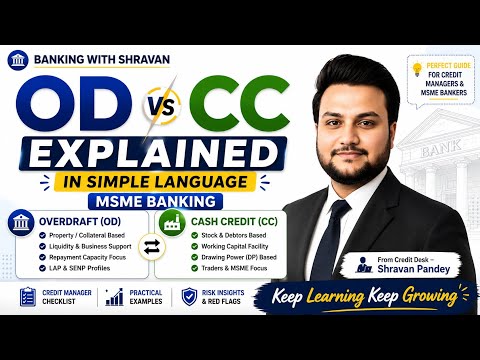
Both are revolving credit facilities where interest is charged strictly on the daily utilized balance (not the total sanctioned limit). Cash Credit (CC) is designed for manufacturing and trading businesses, secured primarily by hypothecation of stock and trade debtors, and your usable balance is dictated by monthly Drawing Power (DP). Overdraft (OD) is a more flexible facility secured against fixed collateral (property, fixed deposits, or shares) without monthly inventory submission requirements.
1. Head-to-Head Comparison Matrix: Cash Credit vs Overdraft
The table below highlights the operational differences across security, monitoring, and compliance requirements:
| Parameter | Cash Credit (CC) Facility | Overdraft (OD) Facility |
|---|---|---|
| Primary Security | Hypothecation of inventory, raw materials & book debts | Fixed deposits, commercial/residential property, gold, shares |
| Target Borrowers | Manufacturers, wholesale distributors, retailers | Service providers, professionals, retail traders, individuals |
| Usable Limit Determinant | Drawing Power (DP) calculated monthly from stock | Fixed Sanctioned Limit throughout the year |
| Monthly Stock Statement | Mandatory by 7th–15th of every month | Not required (Zero monthly paperwork) |
| Annual Stock Audit | Mandatory by empanelled CA for limits ≥ ₹1 Crore | Not required |
| Interest Computation | Daily reducing balance, debited monthly | Daily reducing balance, debited monthly |
| Typical Interest Rate | 8.75% to 11.50% pa | FD+1% (for FD OD) or 9.0% to 12.5% (Property OD) |
| Tenure & Renewal | 1 Year (Annual renewal based on audited financials) | 1 Year or multi-year (Auto-renewed for FD OD) |
2. The Drawing Power (DP) Formula: Why Your CC Balance Drops
Many borrowers mistakenly believe that a ₹1 Crore sanctioned CC limit means they can withdraw ₹1 Crore at any moment. Your actual withdrawable limit is strictly constrained by the Drawing Power (DP):
Suppose your business holds a Sanctioned CC Limit of ₹50,00,000 with a 25% stock margin and 30% debtor margin:
1. Total Physical Stock in Godown: ₹40,00,000
2. Less: Unpaid Trade Creditors (Sundry Creditors): -₹10,00,000
3. Net Paid Stock: ₹30,00,000
4. Less Bank Stock Margin (25%): -₹7,50,000 → Stock DP = ₹22,50,000
5. Eligible Book Debts (<90 days old): ₹20,00,000
6. Less Bank Debtor Margin (30%): -₹6,00,000 → Debtor DP = ₹14,00,000
Total Drawing Power (DP) = Stock DP (₹22.5L) + Debtor DP (₹14L) = ₹36,50,000
Crucial Rule: Despite having a ₹50 Lakh sanction, the bank system will block withdrawals beyond ₹36.50 Lakh until new paid stock or fresh debtor invoices are recorded.
3. Daily Reducing Balance Interest: CC vs Term Loan Savings
Term loans charge interest on the entire outstanding principal regardless of whether the money sits idle in your current account. A Cash Credit or Overdraft line charges interest strictly on actual daily usage:
Full ₹50 Lakh principal sits in account. Interest charged for month:₹50,00,000 × 10% ÷ 12 = ₹41,667
You drew ₹30L for 10 days to pay suppliers, then customer payments arrived and reduced balance to ₹7.5L for 20 days.Monthly Interest Paid = ₹12,500 (Saved ₹29,167!)
4. Stock Audits, Debtor Aging & Bank Compliance
Banks strictly disallow book debts outstanding for more than 90 days (or 120 days for select capital goods industries) from Drawing Power computations.
For CC limits of ₹1 Crore and above, an independent chartered accountant empanelled by the bank conducts physical godown inspections to verify inventory quality.
If the monthly stock statement is not submitted before the 15th, banks levy a 1% to 2% penal interest surcharge on the entire outstanding balance.
5. Decision Blueprint: When to Choose CC vs Overdraft
Choose Cash Credit (CC) If:
You are a manufacturer, wholesale trader, or FMCG distributor whose working capital is tied up in physical inventory, raw materials, and customer credit cycles, and you want to fund growth directly from business assets rather than mortgaging personal property.
Choose Overdraft (OD) If:
You run a service company, software firm, or consultancy with minimal physical inventory, or you have unencumbered property or company fixed deposits and refuse to deal with monthly stock statements and annual stock audits.
Recommended Video Tutorials & Practical Guides

6. Frequently Asked Questions (FAQs)
What is the primary difference between Cash Credit (CC) and Overdraft (OD)?▼
Cash Credit (CC) is a working capital loan secured by hypothecation of current assets (inventory, raw materials, and book debts/receivables) designed specifically for manufacturing and trading businesses. An Overdraft (OD) is a credit line secured against collateral securities like fixed deposits, shares, commercial/residential property, or insurance policies.
How is interest calculated in Cash Credit and Overdraft accounts?▼
Interest in both CC and OD accounts is calculated strictly on the daily end-of-day utilized balance, rather than the total sanctioned limit. If you have a ₹50 Lakh CC limit and use ₹10 Lakh for 5 days, you only pay interest on ₹10 Lakh for those 5 days.
What is Drawing Power (DP) and why is it different from Sanctioned Limit?▼
The Sanctioned Limit is the maximum loan ceiling approved by the bank, while Drawing Power (DP) is the actual usable amount available to withdraw based on your monthly paid inventory and eligible book debts (less unpaid creditors and bank margin). You can only withdraw up to the DP or Sanctioned Limit, whichever is lower.
What happens if a business fails to submit monthly stock statements on time?▼
Banks mandate monthly stock statement submission by the 7th or 15th of every month. Failure to submit leads to penal interest (typically 1% to 2% extra per annum) and the bank freezing or reducing your Drawing Power (DP) to zero until statements are filed and verified.
Automate Inventory Tracking for Bank Audits
Explore our guides on CGTMSE Collateral-Free Loans and Zero Balance Current Accounts.