
How do you export goods or services without paying IGST using an LUT in GST?
To export without paying 18% integrated tax (IGST), any registered Indian exporter can submit an online Letter of Undertaking (LUT) in Form GST RFD-11 on gst.gov.in. The LUT is valid for the entire financial year (April 1 to March 31). Once filed, the portal generates an Application Reference Number (ARN) immediately with zero processing fees. Exporters must quote this ARN on all export invoices and shipping bills with the mandatory declaration: "Supply meant for export of goods/services under Letter of Undertaking without payment of integrated tax". Foreign exchange proceeds must be realized within 9 months for goods or 1 year for services under FEMA rules.
1. What is a Letter of Undertaking (LUT)?
Under Section 16 of the Integrated Goods and Services Tax (IGST) Act, 2017, export of goods or services outside India, as well as supplies to Special Economic Zone (SEZ) developers or units, are classified as "Zero-Rated Supplies".
To ensure Indian goods and software remain globally competitive, the law provides two options: (1) Pay IGST upfront and claim a cash refund upon export, or (2) Furnish a Letter of Undertaking (LUT) in Form GST RFD-11 promising to fulfill export conditions and pay tax only if the export fails. By utilizing an LUT, businesses preserve precious working capital that would otherwise remain locked in government tax escrow.
2. Who Needs an LUT (Goods, Services & SEZ)
- IT, Software & SaaS Exporters: Agencies, tech consulting companies, and SaaS startups billing clients in the US, Europe, or UAE in convertible foreign exchange.
- Physical Goods Manufacturers & Merchant Exporters: Textile, spice, chemical, and engineering firms shipping containers through sea and air customs ports.
- Suppliers to Special Economic Zones (SEZ): Domestic businesses supplying goods or contracting services to SEZ units or developers located within India.
- Freelancers & Independent Consultants: Digital marketers, software developers, and legal advisors earning foreign inward remittances via Upwork, Stripe, or direct wire transfers.
3. Export under LUT vs Export with IGST Payment
Route A: Export under LUT (Zero Upfront Tax)
No integrated tax is charged on the invoice or debited from your electronic cash/credit ledger. You accumulate Input Tax Credit on your raw materials, cloud servers, and office rent, which can be claimed as a cash refund under Rule 89(4).
Route B: Export with Payment of IGST
You pay full 18% IGST on the invoice by debiting your Electronic Credit Ledger or paying cash. For goods, the Customs ICEGATE system processes an automatic refund into your bank account once the shipping bill matches GSTR-1.
4. Annual Filing & Shipping Bill Endorsement
Once an LUT is submitted, the legal mechanism operates seamlessly across customs and tax systems:
Mandatory Invoice Endorsement:
Every export invoice must contain the following statutory text printed prominently:
You must also mention the LUT ARN number and the date of submission on the invoice and shipping bill.
5. Eligibility Criteria & The ₹2.5 Cr Prosecution Bar
While virtually all registered exporters qualify for an LUT, the law establishes one strict disqualification:
The Serious Offence Disqualification:
Under Notification No. 37/2017-Central Tax, any person who has been prosecuted for an offence under the CGST Act, 2017 or the IGST Act, 2017 or any existing indirect tax law, where the amount of tax evaded exceeds ₹250 Lakhs (₹2.5 Crore), is disqualified from furnishing an LUT.
Disqualified exporters must execute an Export Bond on non-judicial stamp paper supported by a Bank Guarantee equal to 15% of the estimated tax liability.
6. Zero Government Fees & Liquidity Alpha
| Parameter | Export under LUT | Export with IGST Payment |
|---|---|---|
| Government Application Fee | ₹0 (100% Free) | ₹0 (Standard Tax Payment) |
| Upfront Working Capital Impact | Zero cash blocked | 18% of export turnover blocked |
| Bank Guarantee Required? | No (Unless prosecuted for ₹2.5 Cr+ fraud) | No |
| Refund Processing Route | File Form RFD-01 for accumulated unutilized ITC | Automated ICEGATE / GSTR-1 refund |
7. Mandatory Information & Witness Declarations
No physical documents need to be uploaded. The online form requires key operational declarations and two witness identities:
- Import Export Code (IEC): Issued by the Directorate General of Foreign Trade (mandatory for goods).
- Primary Authorized Signatory Details: Name, PAN, and designation of director/partner.
- Witness 1 Details: Full Name, Occupation, and residential address (can be employees, accountants, or associates).
- Witness 2 Details: Full Name, Occupation, and residential address.
- Digital Signature Certificate (DSC): Mandatory for Private Limited companies and LLPs; Proprietors can sign with Aadhaar EVC.
8. Step-by-Step Online Filing SOP on gst.gov.in
Step 1: Navigate to User Services
Log into services.gst.gov.in > Click Services > User Services > Furnish Letter of Undertaking (LUT).
Step 2: Select Financial Year
From the drop-down menu, select the upcoming or current Financial Year (e.g., 2026-2027). If you already filed an LUT in the previous year, click "Choose File" to upload the previous year's LUT copy if prompted.
Step 3: Check Mandatory Statutory Declarations
Check all three statutory boxes:
1. To export goods/services within the period specified under Rule 96A(1).
2. To observe all provisions of the GST Acts in respect of export supplies.
3. To pay integrated tax with interest if goods/services are not exported within timelines.
Step 4: Enter Two Independent Witnesses
Fill in the Name, Address, and Occupation of two witnesses. Physical signatures of witnesses are NOT required; only their demographic data is captured.
Step 5: Sign with DSC / EVC & Download ARN
Select the signing authority, enter the place, and sign using DSC or EVC. The portal immediately issues an Acknowledgment Receipt (Form GST RFD-11 ARN). Save this PDF for your compliance files.
9. LUT Route vs IGST Refund Route Matrix
| Feature | Option 1: Export under LUT | Option 2: Export with IGST Payment |
|---|---|---|
| Cash Flow Strain | Zero (No tax deposited) | High (18% tax paid out-of-pocket) |
| Applicability to Services | Highly recommended for IT/Consulting | Cumbersome (Requires manual Form RFD-01) |
| Refund Turnaround | 15–60 days for unutilized ITC claim | 7–15 days via automated ICEGATE (Goods only) |
| GSTR-1 Reporting | Reported in Table 6A as "Export Without Payment" | Reported in Table 6A as "Export With Payment" |
10. Real-World Exporter Case Studies
Case Study 1: SaaS Startup Saves ₹54 Lakh in Annual Working Capital
CloudNova Technologies, a SaaS startup in Bengaluru, invoices US customers \$30,000 (~₹25 Lakh) monthly. Without an LUT, CloudNova would have had to charge 18% IGST (₹4.5 Lakh monthly) or pay it out-of-pocket, blocking ₹54 Lakh annually while waiting for quarterly refunds. By filing Form GST RFD-11 in March, CloudNova bills international customers with zero tax and preserves 100% of its operating liquidity for hiring and AWS server expansion.
Case Study 2: Failure to Realize Export Remittance within 1 Year
An architectural design firm in Jaipur exported 3D CAD plans worth ₹60 Lakh to a German real estate client under an LUT. The German client entered bankruptcy and failed to remit payment. Under Rule 96A(1)(b), because 1 year elapsed without inward foreign remittance in convertible foreign exchange, the Jaipur firm was statutorily required to pay ₹10.8 Lakh (18% IGST) along with ₹1.94 Lakh interest under Section 50.
11. Critical Compliance Blunders & Tax Demands
- Filing the LUT After Invoicing Export Supplies: An LUT operates prospectively. If you issue an export invoice on April 10 but file your LUT on April 25, the tax department can legally demand 18% IGST on that shipment because no active LUT existed on the invoice date.
- Mismatched Shipping Bill Declarations: Entering "Export with payment" on the shipping bill while marking "Export without payment" in GSTR-1 creates an automated error flag, delaying ITC refunds for months.
- Receiving Payments in Domestic INR from Overseas: Unless proceeds are received via a certified Special Rupee Vostro Account (SRVA) approved by RBI, receiving standard domestic INR transfers from abroad does NOT count as an export of service under Section 2(6) of the IGST Act.
12. FEMA 9-Month Remittance Deadlines & BRC Rules
Foreign Exchange Realization Timelines
The legal immunity granted by an LUT is strictly conditioned upon inward foreign exchange realization:
- For Export of Goods: Goods must physically leave India within 3 months from the date of invoice. Foreign proceeds must be realized within 9 months from the shipment date as per RBI Master Directions.
- For Export of Services: Remittance in convertible foreign exchange must be received within 1 year from invoice issuance. Always collect Foreign Inward Remittance Certificates (FIRC) or Electronic Bank Realization Certificates (e-BRC) as audit proof.
13. Section 16 IGST Act & Rule 96A Framework
Key statutory foundations governing zero-rated exports:
- Section 16(1) of IGST Act: Defines "zero-rated supply" as export of goods or services, or supplies made to an SEZ developer or unit.
- Section 16(3) of IGST Act: Authorizes a registered person making zero-rated supply to export under a Letter of Undertaking without payment of integrated tax.
- Rule 96A of CGST Rules: Formulates the conditions, timelines, and bond provisions for exporting under an LUT.
- CBIC Circular No. 125/44/2019-GST: Clarified that substantive export benefits should not be denied due to clerical errors if export realization is established through FIRC.
14. Decision Playbook: When to Choose LUT
Choose Export under LUT When:
- You are exporting software, SaaS, consulting, or digital services
- You want to avoid blocking cash flow in upfront IGST payments
- You have substantial input expenses and plan to file Rule 89(4) ITC refunds
- Your customers demand competitive invoices without foreign tax complications
Choose Export with IGST Payment When:
- You are exporting physical containerized cargo through automated ports
- You have accumulated large electronic credit ledger balances from domestic sales
- You want swift automated bank refunds via Customs ICEGATE within 10 days
- You want to avoid filing detailed Form RFD-01 ITC refund schedules
15. Exporter Annual Compliance Checklist
Recommended Video Tutorials & Practical Walkthroughs
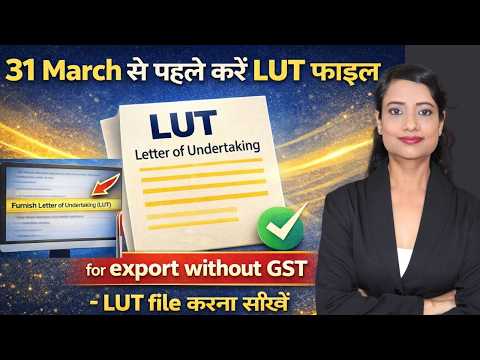
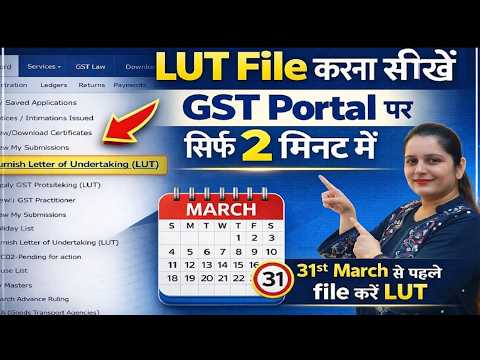
Watch these handpicked, expert video guides covering practical compliance, step-by-step procedures, and real-world implementation:
Recommended Video Tutorials & Practical Guides
16. Frequently Asked Questions
What is a Letter of Undertaking (LUT) in GST?
A Letter of Undertaking (LUT) is a legal declaration submitted online in Form GST RFD-11 under Rule 96A of the CGST Rules. It allows registered exporters of goods and services, as well as suppliers to Special Economic Zones (SEZ), to execute zero-rated exports without paying integrated tax (IGST) upfront, preserving working capital.
What is the validity period of an LUT under GST?
An LUT is valid for one entire financial year (from April 1 to March 31). Exporters must file a fresh Form GST RFD-11 before the start of each new financial year to continue exporting without paying IGST.
Who is eligible to furnish an LUT, and who is disqualified?
Any registered taxpayer exporting goods or services is eligible for an LUT, except taxpayers who have been prosecuted for an offence under the CGST Act, IGST Act, or existing laws where the amount of tax evaded exceeds ₹250 Lakhs. Disqualified taxpayers must furnish an export bond backed by a bank guarantee.
What happens if export proceeds are not realized within the timeline prescribed by RBI?
Under Rule 96A(1), if payment for exported services is not received in convertible foreign exchange (or permissible INR) within 1 year from the date of export invoice, or if goods are not exported within 3 months, the exporter must pay the applicable IGST along with 18% interest under Section 50 within 15 days.
Can an exporter claim a refund of accumulated Input Tax Credit (ITC) under an LUT?
Yes. Under Section 54(3) of the CGST Act read with Rule 89(4), exporters operating under an LUT are fully entitled to claim a cash refund of unutilized Input Tax Credit accumulated on inputs and input services used in making zero-rated export supplies.