
GST Number Search & Verification: Spot Fake Invoices Before Paying
Did you know that under Section 16(2)(c) of the CGST Act, if your supplier fails to deposit the GST they collected from you, the tax department can legally deny your Input Tax Credit (ITC) and demand 18% annual interest?
With fake billing syndicates and circular trading rackets under intense Directorate General of GST Intelligence (DGGI) scrutiny, executing real-time GSTIN validation before disbursing vendor cheques has become the single most critical risk management control in Indian accounting.
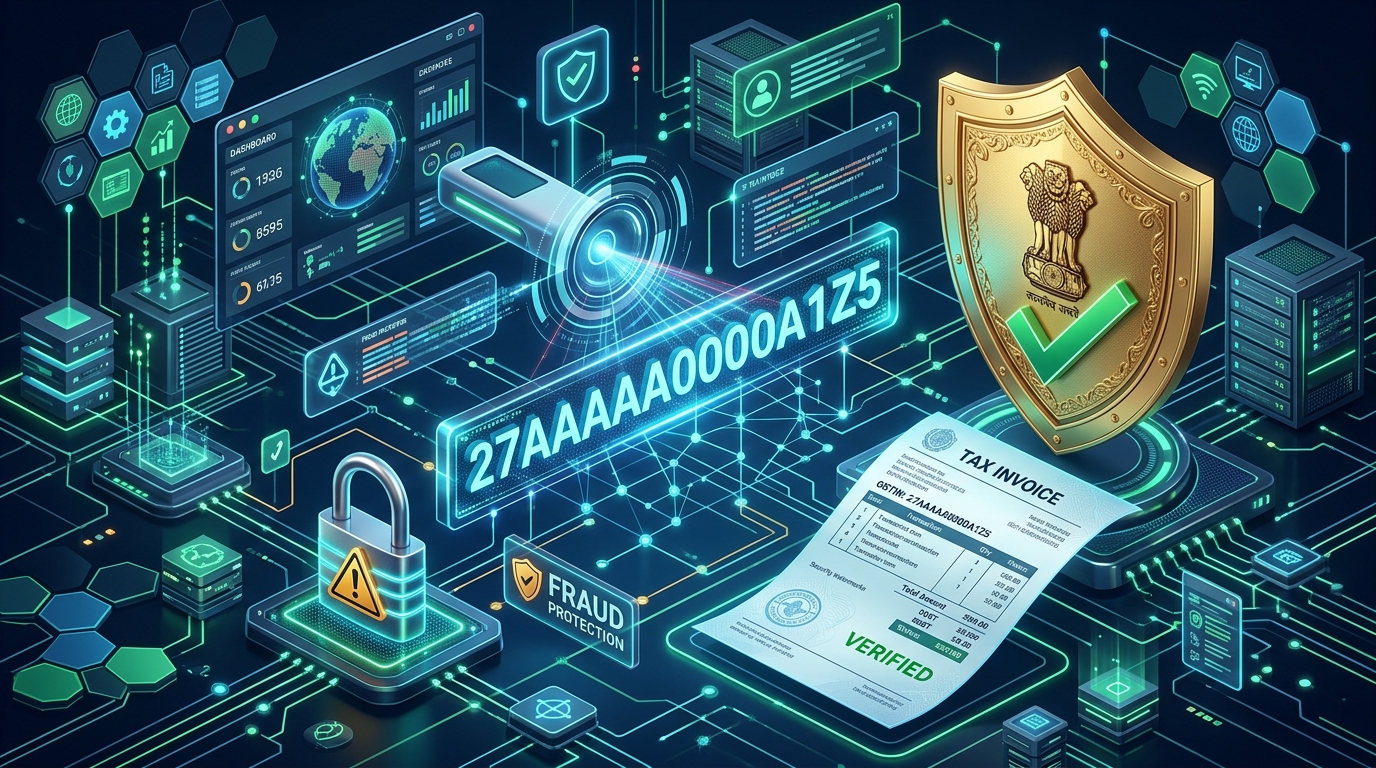
15-Digit Mod-36 Algorithmic Validation
Direct CBIC Taxpayer Search & GSTR-2B Cross-Verification
Holding a printed paper invoice or a PDF with a GSTIN is zero proof of tax legitimacy. Over 45,000 bogus GST registrations were cancelled in nationwide special drives. If a vendor creates a dummy GSTIN or is suspended for non-filing, that invoice will never appear in your GSTR-2B auto-drafted statement. Disbursing vendor payments without matching the GSTIN on the official portal risks total ITC disallowance and 100% penalty under Section 122.
Interactive 15-Digit GSTIN Anatomy & Checksum Validator
Deconstruct any Indian GST number in real time into its State, PAN, Entity count, and Mod-36 check digit.
Checksum Mismatch! Expected 15th character: '3', got '5'. May be mistyped or fabricated.
1The 15-Digit GSTIN Anatomy: How the Algorithm Works
Every Goods and Services Tax Identification Number (GSTIN) issued by the CBIC is a 15-character alphanumeric code assigned under Rule 10 of the CGST Rules 2017. It is not an arbitrary sequence; every character carries legal and geographical significance:
| Character Position | Component Name | Format | Legal Function & Meaning |
|---|---|---|---|
| 1st & 2nd | State Code | 2 Digits (01 to 38) | Identifies state or union territory where business is physically registered (e.g., 27 = Maharashtra, 07 = Delhi, 24 = Gujarat). |
| 3rd to 12th | PAN of Business | 10 Alphanumeric (5 Letters, 4 Digits, 1 Letter) | Direct link to Income Tax PAN. The 4th character reveals entity type (P = Proprietor, C = Company, F = Partnership/LLP). |
| 13th | Entity Serial | 1 Alphanumeric (1-9, A-Z) | Indicates count of active registrations under same PAN within that state (1 = First establishment, 2 = Second vertical, etc.). |
| 14th | Default Code | Alphabet 'Z' | Fixed static character reserved by GSTN for future regulatory expansion. In all normal GSTINs, this must always be 'Z'. |
| 15th | Check Digit | 1 Alphanumeric (0-9, A-Z) | Calculated mathematically using the Luhn Modulo-36 formula on the first 14 characters to prevent human typo errors during data entry. |
2How to Verify Any GSTIN on the Official Government Portal
While algorithmic structure confirms the number is syntactically valid, only the government portal can verify whether the registration is active, legitimate, or enrolled under the regular scheme. Follow this 4-step verification procedure:
Visit the official CBIC portal at services.gst.gov.in/services/searchtp. Navigate to Search Taxpayer > Search by GSTIN / UIN. No login is required.
Ensure the Legal Name of Business and Trade Name match the name on the vendor invoice and the bank account where you are depositing funds. If the invoice says "ABC Enterprises" but the portal displays a completely different entity, halt payment immediately.
Verify whether the supplier is registered as Regular or Composition. Composition dealers are strictly barred from charging GST or issuing Tax Invoices. If a Composition dealer collects 18% GST from you, it is an illegal levy and you will never receive ITC.
Scroll down to the Return Filing Table. Check if the supplier has filed their recent GSTR-1 and GSTR-3B for the preceding 3 months. If they have stopped filing, their registration is ripe for departmental cancellation, jeopardizing your upcoming input tax credits.
3The 5 Red Flags of Fake Tax Invoices & Shell Vendors
Tax intelligence investigations reveal that most victim companies accepted invoices without examining physical business operations. Watch out for these 5 telltale fraud signs:
If your supplier's annual turnover exceeds ₹5 Crore, standard printed invoices are null and void under Rule 48(4). The invoice MUST feature a 64-character Invoice Reference Number (IRN) generated by the Invoice Registration Portal (IRP) and a machine-readable B2B QR Code. Scan it using the official GSTN e-Invoice Verifier app.
DGGI crackdowns frequently find high-turnover steel, scrap, and IT hardware companies registered at single virtual desks, residential apartments, or abandoned godowns with no physical stock holding. Check the Principal Place of Business on the GST portal before executing multi-lakh purchase orders.
Fly-by-night operators upload crores of sales in GSTR-1 (so the invoice temporarily flashes in your GSTR-2A/2B), but declare ₹0 tax liability or fail to file GSTR-3B altogether. Automated DRC-01B notices and Rule 88C trigger suspension, resulting in automatic ITC recovery from buyers.
If the supplier is registered as a "Wholesale Trader of Edible Oils" on the portal, but issues an invoice for "Software Consulting" or "Iron & Steel Ingots", the transaction is a prime candidate for circular billing audit. Verify the registered core goods/services category on the portal.
Legitimate registered entities operate current accounts matching their exact legal entity name. Never disburse vendor payments to a proprietor's personal savings account or unrelated third-party UPI QR codes, as this destroys Section 16(2)(d) payment proof during department audit.
4The Legal Consequences: Section 16(2)(c), 122 Penalties & Section 132 Arrests
The CGST Act places strict liability on the recipient of goods and services. Claiming ITC against non-existent or fake invoices attracts severe statutory consequences:
ITC is legally inadmissible unless the supplier has actually paid the tax to the government. You will be forced to reverse the full ITC amount with 18% annual interest from the date of claim.
Issuing an invoice without supply of goods/services, or availing ITC using such invoices, attracts a mandatory penalty equal to 100% of the tax amount evaded or ₹10,000, whichever is higher.
Fake invoicing exceeding ₹5 Crore is a cognizable and non-bailable criminal offense punishable by up to 5 years rigorous imprisonment plus fine.
5The 3-Way Match Protocol Before Releasing Vendor Payments
To insulate your business from tax disallowances, enforce this mandatory payment release protocol across your accounts department:
- Onboard Vendor with Legal Proof: Collect physical copy of GST Registration Certificate (Form GST REG-06) showing all trade names, registered premises, and partner/director PANs.
- Perform 3-Way Physical Match: Ensure the Purchase Order (PO), Transporter's e-Way Bill, and Physical Material Inward Delivery Challan match the invoice quantities and HSN codes exactly.
- Hold Tax Portion Until GSTR-2B Locks: Adopt modern enterprise terms: pay the base taxable value on credit terms, and release the 18% GST portion only after the invoice appears in your final monthly GSTR-2B statement on the 14th of the subsequent month.
- Automate GSTR-2B Reconciliation: Use automated cloud billing software like GST Munshi to match your Purchase Register against GSTR-2B data automatically, instantly highlighting missing invoices and supplier defaults.
Frequently Asked Questions (FAQ)
Why is it mandatory to verify a supplier's GSTIN before clearing purchase payments?
Under Section 16(2)(c) of the CGST Act 2017, a buyer cannot claim Input Tax Credit (ITC) unless the supplier has physically deposited the collected GST into the government treasury and filed their GSTR-3B return. If your vendor possesses a fake or cancelled GSTIN, their invoice will never reflect in your GSTR-2B, forcing you to repay the full tax amount plus 18% annual interest and potential 100% penalties under Section 122.
What does each segment of a 15-digit GSTIN represent?
The first 2 digits indicate the State Code (e.g. 27 for Maharashtra, 07 for Delhi). Characters 3 to 12 represent the taxpayer's 10-character Permanent Account Number (PAN). The 13th character signifies the entity serial number (1st, 2nd, up to 9th registration within the same state, followed by A-Z). The 14th character is always 'Z' by default. The 15th character is an algorithmic Mod-36 check digit calculated using the Luhn formula.
How can I verify if an e-Invoice issued by a vendor is genuine?
For suppliers with aggregate turnover exceeding ₹5 Crore, B2B invoices must feature a 64-character Invoice Reference Number (IRN) and a signed cryptographically verifiable QR Code. You can verify this in under 5 seconds by scanning the printed QR code using the official government e-Invoice QR Code Verifier mobile app published by the GSTN.
What does 'Suspended' or 'Cancelled Suo Motu' status mean on the GST portal?
'Suspended' means the tax department has initiated cancellation proceedings due to discrepancies in GSTR-1 vs GSTR-3B or continuous non-filing for over 6 months. 'Cancelled Suo Motu' means the proper tax officer has permanently revoked the registration due to suspected fraud or failure to file returns. In both states, any tax invoice issued by the vendor during the suspension period is legally invalid for ITC.
Can a Composition Dealer collect GST or issue a Tax Invoice?
No. Under Section 10 of the CGST Act, dealers enrolled in the Composition Scheme are legally prohibited from collecting GST from customers and cannot issue a Tax Invoice. They must issue a 'Bill of Supply' clearly displaying 'Composition Taxable Person, not eligible to collect tax on supplies'. If a composition dealer charges GST, it is an illegal levy and no ITC can be claimed by the recipient.
Recommended Video Tutorials & Practical Walkthroughs
Watch these handpicked, expert video guides covering practical compliance, step-by-step procedures, and real-world implementation:
Recommended Video Tutorials & Practical Guides

Automate Supplier Verification & 100% GSTR-2B Reconciliation
Stop losing sleep over vendor non-filing and Section 16(2)(c) notices. GST Munshi's multi-device cloud accounting engine auto-validates supplier GSTINs, checks live GSTR-3B filing frequencies, and generates government-compliant GSTR-1 JSON files instantly.