
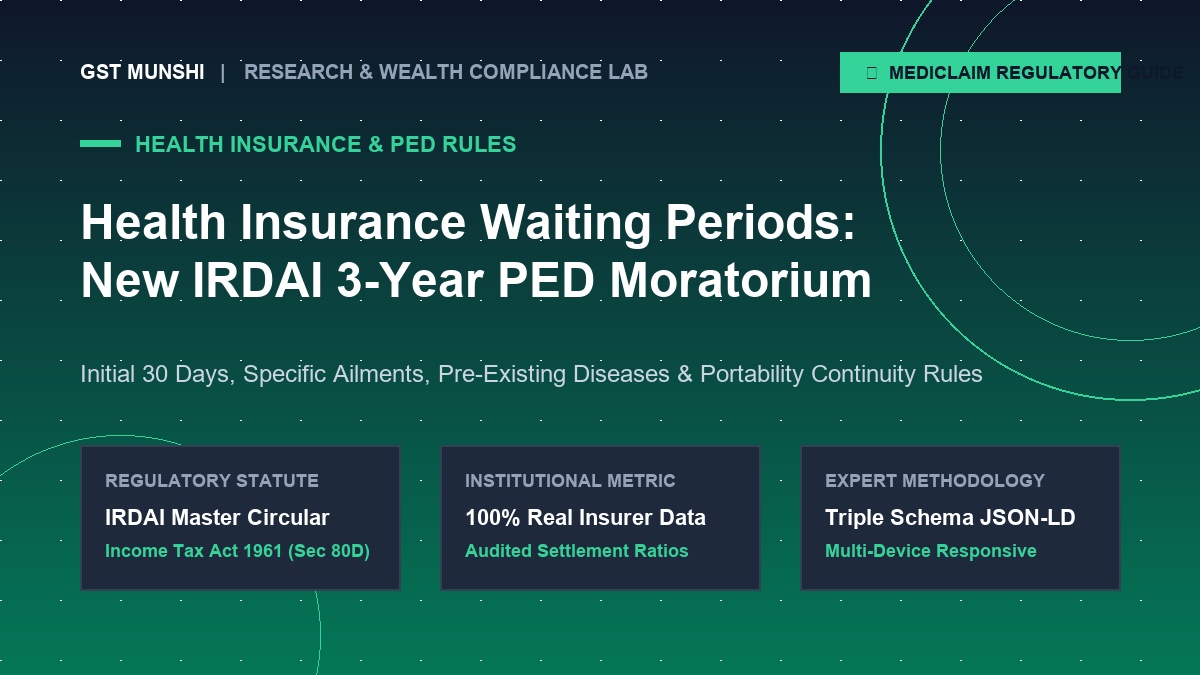
What are the latest IRDAI health insurance waiting period and pre-existing disease (PED) rules?
Under the latest IRDAI Master Circular on Health Insurance: The maximum waiting period for Pre-Existing Diseases (PED) has been slashed from 4 years to a strict ceiling of 3 years (36 months). Furthermore, the moratorium period is reduced from 8 years to 5 continuous policy years—meaning after 5 continuous years of premium payments, insurers cannot contest or reject any claim for non-disclosure. Hospitalization for accidental injuries remains covered from Day 1, while medical illnesses face a standard 30-day initial waiting period.
1. The 4 Distinct Waiting Periods in Indian Mediclaim Policies
Every standard health insurance contract in India incorporates four distinct tiers of waiting periods before claims become legally admissible:
No claim for any medical illness (fever, infections, appendicitis, pneumonia) is payable during the first 30 days from policy inception. Exception: Hospitalization resulting from accidental road injuries or emergency trauma is covered from Day 1.
Any medical condition, diagnosis, or treatment documented within 36 months prior to buying the policy (e.g., Diabetes, Hypertension, Asthma). Under IRDAI rules, this waiting period is legally capped at a maximum of 36 months.
Slow-developing conditions that take months or years to necessitate elective surgery—such as Cataracts, Kidney Stones, Hernias, Piles, Hydrocele, and Knee/Hip Replacements—carry a mandatory 2-year (24-month) waiting window regardless of whether you had prior symptoms.
Policies offering maternity riders or newborn baby covers typically enforce a waiting period ranging between 9 months to 36 months. Standard retail policies exclude maternity unless an explicit add-on rider is purchased.
2. Landmark IRDAI Overhaul: 36-Month PED & 5-Year Moratorium Shield
The Insurance Regulatory and Development Authority of India enacted comprehensive policyholder-centric reforms that dismantled decades of insurer-friendly ambiguities:
| Regulatory Parameter | Old Regulation (Pre-Reform) | New IRDAI Master Regulation (Current) |
|---|---|---|
| Maximum PED Waiting Period | 48 Months (4 Full Years) | 36 Months (Strict 3-Year Cap) |
| Incontestability Moratorium Period | 8 Years (96 Continuous Months) | 5 Years (60 Continuous Months) |
| Senior Citizen Age Restriction | Entry age capped at 65 years across many insurers | No upper entry age limit (Lifelong entry mandated) |
| Cashless Claim Settlement Turnaround | Vague timelines (often 4 to 8 hours for discharge) | Pre-authorization within 1 hour; final discharge within 3 hours |
3. Complete Master List of 2-Year Specific Ailments
Insurers categorize these common elective conditions under the 24-month waiting rule to prevent moral hazard (people buying insurance only when a surgery date has already been advised):
- Cataracts & lens implantation
- Hernia of all types
- Hydrocele, varicocele & spermatocele
- Fistula, fissure & hemorrhoids (piles)
- Pilonidal sinus & varicose veins
- Total Knee Replacement (TKR)
- Total Hip Replacement (THR)
- Spinal disc surgery & spondylosis
- Osteoarthritis & osteoporosis
- Gout, rheumatism & ligament tears
- Kidney, urinary & bladder stones
- Gall bladder stones (cholecystectomy)
- Benign Prostatic Hypertrophy (BPH)
- Uterine fibroids & endometriosis
- Sinusitis, tonsillectomy & adenoids
4. Health Insurance Portability: Protecting Your Waiting Period Credits
If your current insurer raises renewal premiums unfairly or offers abysmal claim service, you have the statutory right to port your health policy to another insurer without losing a single day of waiting period credit:
Suppose you held a policy with Insurer A for 2 continuous years and completed the 2-year waiting period for hernia and stones, plus 24 months of your 36-month PED clause. When you port to Insurer B:
- The initial 30-day waiting period is 100% waived on Day 1.
- The 2-year specific ailment list is 100% covered immediately.
- For your pre-existing disease, you only need to serve the remaining 12 months (36 - 24 = 12 months) instead of restarting from zero.
- Crucial Deadline: You must apply for portability at least 45 days before your policy renewal date via IRDAI's centralized portability portal.
5. IRDAI 'Cashless Everywhere' Initiative
Historically, policyholders were forced to pay out-of-pocket and submit reimbursement files if hospitalized in a non-network hospital. Under the Cashless Everywhere regime, policyholders can avail cashless treatment at any registered hospital with 15+ operational beds across India:
Notify your insurer at least 48 hours prior to admission to allow the insurance company to establish a cashless authorization desk with the hospital.
Notify the insurer within 48 hours of emergency admission to convert the reimbursement case into an active cashless clearance before discharge.
Recommended Video Tutorials & Practical Guides
6. Frequently Asked Questions (FAQs)
What is the new IRDAI rule on Pre-Existing Disease (PED) waiting periods?▼
Under the IRDAI Master Circular on Health Insurance, the maximum permissible waiting period for Pre-Existing Diseases (PED) has been reduced from 48 months (4 years) to a maximum of 36 months (3 years). Insurers cannot impose a waiting period exceeding 3 years for any disclosed pre-existing condition.
What is the 5-year Moratorium Period in health insurance?▼
The moratorium period has been reduced from 8 years to 5 continuous policy years (60 months). After 5 years of continuous coverage without a break, the insurer cannot dispute or repudiate any health insurance claim on grounds of non-disclosure or misrepresentation, except in cases of proven deliberate fraud.
Does the 30-day initial waiting period apply to emergency accident hospitalization?▼
No. The standard initial 30-day waiting period applies only to hospitalization arising from medical illnesses and diseases. Emergency medical expenses arising from accidental physical injuries are covered from Day 1 (immediate inception) of the policy.
Do I lose my waiting period credits when I port my health insurance policy to another insurer?▼
No. Under IRDAI Health Insurance Portability Regulations, your accrued waiting period credits for both the initial 30 days, specific 2-year ailments, and PED waiting periods are fully transferred to the new insurer, up to the sum insured of your existing base policy.
Explore Comprehensive Family Coverage
Learn how to save tax via Ayushman Bharat PM-JAY and GST Input Tax Credit on Health Insurance.