
Quick Summary & Key Takeaways (Featured Snippet)
1. What is Personal Accident Insurance?
In insurance jurisprudence, an accident is defined as an unexpected, unforeseen, involuntary event caused by external, violent, and visible means. A Personal Accident Insurance (PAI) policy is a pure financial shield against the economic catastrophic destruction caused by physical disability or accidental demise.
A common tragedy in Indian financial planning is relying solely on health and life insurance. If a severe road accident causes paralysis or amputation of both legs, medical insurance covers the immediate hospital surgery bills, but stops paying once you are discharged. Because the individual survived, their term life insurance pays ₹0. Yet, the victim can no longer work, losing their entire future income stream while facing recurring medical costs. Personal accident insurance fills this critical blind spot.
2. Target Beneficiaries & Vulnerable Groups
India witnesses over 4.5 lakh road crashes annually. Two-wheeler riders and highway drivers face statistically elevated probabilities of orthopedic trauma, fractures, and severe physical trauma.
Delivery executives, cab drivers, and field technicians whose livelihoods depend directly on physical mobility and face high occupational accident vulnerability on city roads.
Salaried employees with active home loans, car loans, and school fees who cannot survive even a 3-month temporary loss of income resulting from a fracture or bedridden recovery.
3. The 4 Coverage Tiers: AD, PTD, PPD & TTD
Tier 1: Accidental Death (AD) - 100% Payout
If an accident directly causes the death of the policyholder within 12 calendar months of the incident, the insurer pays 100% of the Capital Sum Insured (CSI) to the designated nominee. Most policies also pay additional funeral expenses (up to ₹50,000) and child education grants (10% of CSI).
Tier 2: Permanent Total Disability (PTD) - 100% to 125% Payout
Covers permanent, irreversible disability that completely prevents the insured from engaging in any gainful employment. Payout is typically 100% to 125% of CSI. Examples include: total loss of sight in both eyes, amputation of both hands or both feet, complete paralysis, or traumatic brain injury resulting in permanent vegetative state.
Tier 3: Permanent Partial Disability (PPD) - 5% to 75% Payout
Covers permanent physical impairment that limits functional capability but does not cause complete total paralysis. Insurers follow an IRDAI statutory sliding schedule: Loss of sight in one eye (50%), Loss of one hand or foot (50%), Loss of hearing in both ears (50%), Loss of index finger (10%), Loss of thumb (25%).
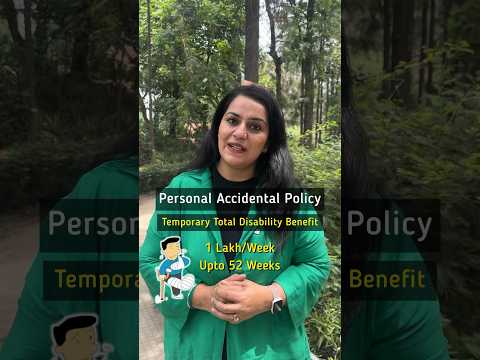
Tier 4: Temporary Total Disability (TTD) - Weekly Cash Benefit
If an accident confines you to home or hospital bed rest, rendering you temporarily incapable of performing your professional duties (e.g., compound femur fracture or severe pelvic injury), the insurer pays a weekly cash replacement of 1% of CSI (up to ₹25,000 to ₹50,000/week) for a maximum period of 100 consecutive weeks.
4. Operating Mechanism: Benefit vs Indemnity
Reimburses actual medical expenses incurred against hospital bills. If your hospital bill is ₹1,80,000, your ₹10 Lakh health policy pays precisely ₹1,80,000. It provides zero financial support for your household rent, EMI payments, or lost salary.
Pays a fixed cash lump sum regardless of actual hospital bills. If you lose a limb in an accident, your ₹50 Lakh policy immediately transfers ₹25 Lakhs (50% PPD) directly into your bank account. You can use this money freely for debt payoff, rehabilitation, home alterations, or living expenses.
5. IRDAI Saral Suraksha Bima Guidelines
To eliminate deceptive marketing and complex policy wording, the Insurance Regulatory and Development Authority of India (IRDAI) introduced Saral Suraksha Bima—a standardized personal accident product mandatory across all general and standalone health insurers:
6. Pricing, Occupational Risk Classes & 18% GST
Unlike health insurance where age determines the premium, personal accident insurance premiums are determined strictly by Occupational Risk Classification:
| Risk Class | Eligible Professions | Indicative Annual Premium per ₹25 Lakh CSI |
|---|---|---|
| Class 1: Low Risk | Desk workers, software engineers, accountants, teachers, doctors, lawyers, corporate executives. | ₹1,800 to ₹2,500 + 18% GST |
| Class 2: Medium Risk | Field sales executives, civil site engineers, plant supervisors, commercial vehicle drivers, veterinary doctors. | ₹2,800 to ₹4,200 + 18% GST |
| Class 3: High Risk | Underground miners, high-voltage line technicians, construction scaffold workers, race car drivers, deep-sea divers. | ₹5,500 to ₹9,000 + 18% GST |
7. Mandatory Claims Documentation & FIR Rules
8. Step-by-Step Claim Settlement Workflow
Step 1: Immediate Claim Intimation (Within 24–48 Hours)
Notify the insurer via their toll-free helpline, mobile app, or registered email. Note down the unique Claim Reference Number.
Step 2: Emergency Hospitalization & Treatment
Secure immediate emergency medical treatment. Preserve all Medico-Legal Case (MLC) papers, diagnostic scans, and discharge summaries.
Step 3: Disability Assessment by Government Medical Board
For PTD or PPD claims, obtain a permanent impairment certificate from a District Civil Hospital specifying anatomical loss percentage.
Step 4: Claims Dossier Submission & Insurer Verification
Submit the filled claim form, FIR, original bills, and disability certificates. Under IRDAI guidelines, the insurer must settle or repudiate the claim within 30 days of receiving complete papers.
9. Comparison: Accident Policy vs Term Life vs Health Insurance
| Key Feature | Personal Accident Policy | Pure Term Life Insurance | Comprehensive Health Insurance |
|---|---|---|---|
| Core Event Covered | Accident causing death or disability | Death due to any cause (natural/accident) | Illness or injury hospitalization |
| Disability Payouts | Comprehensive (PTD, PPD, TTD) | None (Unless specific rider added) | Zero income loss benefit |
| Temporary Bedrest (TTD) | Yes (Weekly cash replacement) | No | No |
| Section 80D Tax Benefit | Not Eligible | Section 80C (Old Regime) | Eligible up to ₹25k–₹50k |
| Annual Cost (₹25L Cover) | ₹2,000 – ₹3,500 | ₹8,000 – ₹15,000 | ₹12,000 – ₹25,000 |
10. Real-Life Case Studies: TTD & PTD Payouts
Case Study A: Temporary Disability (TTD) from a Motorcycle Fracture
Vikram, a marketing executive earning ₹80,000/month, suffered multiple pelvic and leg fractures in an accident. Doctors prescribed 16 weeks of complete bed rest. He exhausted his 15 days of paid sick leave.
Insurer Payout: ₹25,000 × 16 weeks = ₹4,00,000 direct cash credit.
Outcome: Vikram paid his home loan EMI and household expenses smoothly without breaking his investments.
11. Costly Mistakes & Policy Exclusions
Mistake 1: Relying Exclusively on Employer Group Personal Accident (GPA)
Corporate GPA covers lapse the day you resign, switch jobs, or face corporate downsizing. Always maintain an independent retail personal accident policy that stays active throughout your lifetime.
Mistake 2: Failing to Disclose High-Risk Hobby or Profession Changes
If you transition from a desk software job (Class 1) to field site construction (Class 2) and fail to inform the insurer, any future claim may be rejected for non-disclosure of material risk alteration under the Insurance Act.
12. Inherent Exclusions (Drunk Driving & Sports)
- Driving under the influence of alcohol or narcotics (>30mg/100ml BAC)
- Intentional self-injury, suicide, or attempted suicide
- Participation in criminal or unlawful activities
- War, invasion, nuclear radiation, or civil insurrection
Injuries sustained while participating in motor racing, scuba diving, mountaineering with ropes, skydiving, or paragliding are strictly excluded unless an explicit adventure sports rider is endorsed.
13. Income Tax & Legal Aspects: Capital Receipt Status
Claim Payouts: Completely Tax-Exempt Capital Receipts
Compensation received under personal accident insurance for Accidental Death, PTD, or PPD is legally classified as a capital receipt compensating for physical injury or bodily trauma. In landmark judgments (such as CIT v. B.C. Srinivasa Setty and various ITAT rulings), injury compensation is held to be non-taxable as it does not constitute revenue income.
Section 80D Ineligibility
Premiums paid for standalone personal accident insurance do not qualify for deduction under Section 80D. However, because annual premiums are modest (around ₹2,500), the absence of tax deduction should not deter investors from acquiring this foundational protection.
14. Decision Matrix: Sizing Your Ideal Cover
Financial planners recommend sizing your Personal Accident Cover using the following formula:
For example, an individual earning ₹12 Lakhs per annum with a ₹30 Lakh outstanding home loan should secure a minimum personal accident cover of ₹1.5 Crores.
15. Policy Purchase Verification Checklist
Recommended Video Tutorials & Practical Walkthroughs
Watch these handpicked, expert video guides covering practical compliance, step-by-step procedures, and real-world implementation:
Recommended Video Tutorials & Practical Guides
16. Frequently Asked Questions
What is the difference between PTD, PPD, and TTD in personal accident insurance?
Permanent Total Disability (PTD) provides a 100% to 125% lump-sum payout of the sum insured for total irrevocable loss of limbs or sight. Permanent Partial Disability (PPD) pays a predefined percentage (5% to 75%) for partial losses (e.g., loss of a finger or hearing in one ear). Temporary Total Disability (TTD) pays a weekly cash replacement benefit (typically 1% of sum insured up to ₹25,000–₹50,000 per week for up to 100 weeks) when an accident temporarily leaves you bedridden and unable to work.
Are personal accident claim payouts subject to income tax in India?
No. Lump-sum claim payouts for Accidental Death, PTD, and PPD are considered capital receipts compensating for personal injury or loss of life and are 100% exempt from income tax. However, weekly TTD payouts intended as replacement of salary income should technically be declared under 'Income from Other Sources', although court precedents view injury compensations as tax-free capital receipts.
Is standalone personal accident insurance eligible for Section 80D tax deduction?
No. Under Section 80D of the Income Tax Act, tax deductions are permissible exclusively for health insurance and critical illness policies. Standalone personal accident insurance premiums do NOT qualify for Section 80D deductions. However, premiums are exceptionally affordable (₹1,500 to ₹3,500 per year for a ₹25 Lakh cover).
Why is a standalone personal accident policy better than a term insurance accident rider?
Term insurance accidental death riders only pay out if the insured dies. Most riders do not cover Permanent Partial Disability (PPD) and almost never include Temporary Total Disability (TTD) weekly cash benefits. A standalone personal accident policy provides comprehensive coverage for all four disability tiers plus child education grants and home modification expenses.
What are occupational risk classes in personal accident insurance?
Insurers classify professions into three risk tiers: Class 1 (Low Risk - accountants, software engineers, teachers, bankers), Class 2 (Medium Risk - civil site engineers, sales representatives, machine supervisors), and Class 3 (High Risk - industrial miners, underground electricians, commercial truck drivers, construction workers). Class 3 pays significantly higher premiums per lakh of cover.
17. Statutory References & Citations
Insurance Regulatory and Development Authority of India (IRDAI): Guidelines on Standard Personal Accident Insurance Product - "Saral Suraksha Bima" (Ref: IRDAI/HLT/GDL/CIR/044/02/2021).
Insurance Act, 1938: Section 45 (Policy not to be called in question after three years) and General Insurance Business Norms.
Supreme Court of India & High Courts: Judgments on capital receipt classification of personal injury compensation (Non-taxability under Income Tax Act, 1961).