
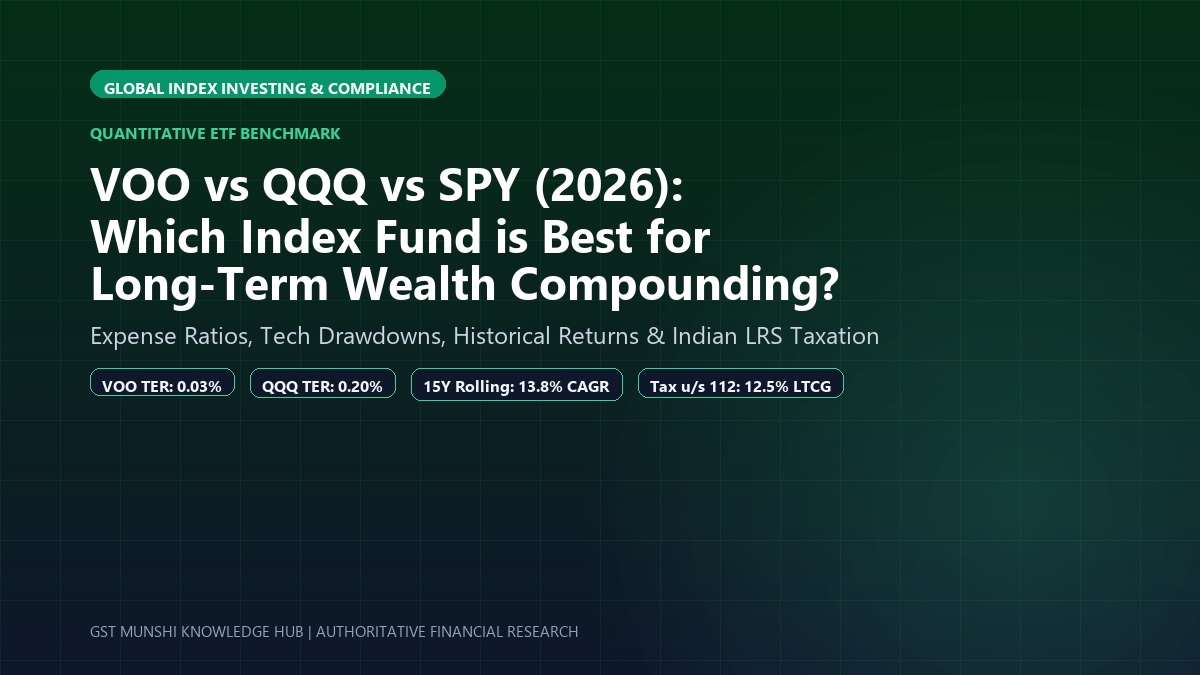
VOO vs QQQ vs SPY: Which ETF should you choose for long-term investing?
For long-term passive investors seeking the lowest possible costs and reliable wealth compounding, VOO (Vanguard S&P 500 ETF) is the unequivocal winner. It charges an ultra-low expense ratio of 0.03%, holds 500 leading US companies across 11 sectors, and minimizes tracking error. SPY tracks the exact same index but charges 0.0945% (over 3x more); it is designed for institutional options traders requiring massive intraday liquidity. QQQ is not an S&P 500 fund—it tracks the Nasdaq-100 with over 50% tech concentration and charges 0.20%; it offers higher historical upside but experiences 2x larger drawdowns during market corrections.
1. Understanding the Titan Trio: VOO, QQQ, and SPY
Index funds and Exchange-Traded Funds (ETFs) represent the backbone of modern global wealth generation. When global and Indian investors look to invest in the US stock market—the engine representing over 60% of total world equity capitalization—three ticker symbols consistently dominate search queries and brokerage inflows: VOO, QQQ, and SPY.
While retail investors frequently conflate them, these three instruments serve fundamentally distinct architectural purposes:
VOO
Launched by Vanguard in 2010 to provide retail and institutional investors with the lowest-cost, most tax-efficient replication of the S&P 500 index. Built specifically for long-term compounders.
QQQ
Launched in 1999, tracking the 100 largest non-financial firms listed on Nasdaq. Heavily dominated by mega-cap technology, cloud, AI, semiconductors, and consumer platforms.
SPY
The original US ETF, created by State Street Global Advisors in 1993. The most liquid financial instrument on Earth, commanding trillion-dollar derivative and options turnover.
2. Comprehensive Head-to-Head Benchmark Matrix
The table below breaks down the foundational operational, financial, and structural differences between VOO, QQQ, and SPY:
| Key Parameter | VOO (Vanguard) | QQQ (Invesco) | SPY (State Street) |
|---|---|---|---|
| Underlying Benchmark | S&P 500 Index (500 US Bluechips) | Nasdaq-100 Index (100 Non-Financials) | S&P 500 Index (500 US Bluechips) |
| Expense Ratio (TER) | 0.03% (Lowest) | 0.20% (Moderate) | 0.0945% (3.15x VOO) |
| Assets Under Management (AUM) | ~$550 Billion+ USD | ~$290 Billion+ USD | ~$580 Billion+ USD |
| Average Daily Trading Volume | ~5 Million shares/day | ~45 Million shares/day | ~65 Million+ shares/day (Highest) |
| Technology Sector Weight | ~31.5% | ~51.8% (Heavy Concentration) | ~31.5% |
| Dividend Yield | ~1.25% - 1.45% | ~0.55% - 0.70% | ~1.20% - 1.40% |
| Fund Legal Structure | Open-End Fund (Reinvests Cash) | Unit Investment Trust | Unit Investment Trust (No Reinvestment) |
| Ideal Investor Profile | Multi-Decade Compounders & SIPs | Growth & Tech-Bullish Investors | Options Hedgers & Day Traders |
3. Expense Ratio Math: The 30-Year Compounding Fee Drag
Many novice investors assume that the difference between 0.03% (VOO) and 0.0945% (SPY) or 0.20% (QQQ) is trivial. In quantitative finance, however, fees do not scale linearly—they compound exponentially over time, dragging down total terminal portfolio wealth.
Real Numerical Simulation: $100,000 Initial Investment over 30 Years (Assumed 10% Gross Annual Return)
*Conclusion:* By choosing VOO over SPY for the exact same S&P 500 basket, you retain over $32,000 in additional wealth per $100,000 invested simply by cutting administrative drag.
4. Sector Allocations: Broad Diversification vs Tech Dominance
The primary driver of divergent returns between S&P 500 funds (VOO/SPY) and Nasdaq-100 (QQQ) is sector weighting.
VOO / SPY: The All-Weather Economy
Holds 500 profitable companies across all 11 GICS sectors. Technology is the largest weighting (~31%), followed by Financial Services (~13%), Healthcare (~12%), Consumer Discretionary (~10%), Industrials (~9%), and Energy/Utilities.
QQQ: Pure Innovation & Tech Engine
Strictly excludes all financial companies (banks, insurers, brokerages). Over 51% is concentrated in Technology, followed by Consumer Services (~20%) and Healthcare (~6%). Zero exposure to traditional heavy energy, banking, or utilities.
5. Historical Performance & Drawdown Stress Testing
While QQQ has outperformed the S&P 500 over the past 15-year secular bull market (propelled by smartphone adoption, cloud migration, and generative AI), it exhibits substantially higher beta (volatility) and severe drawdown vulnerability during downturns:
| Market Crisis / Period | VOO / S&P 500 | QQQ (Nasdaq-100) | Key Takeaway |
|---|---|---|---|
| 2000–2002 Dot-Com Crash | -49.1% Max Drawdown | -82.9% Max Drawdown | QQQ took 15 years (until 2015) to regain its prior high |
| 2008 Great Financial Crisis | -56.8% Max Drawdown | -50.5% Max Drawdown | QQQ held slightly better because it owned zero collapsing banks |
| 2022 Fed Rate Hike Inflation Cycle | -18.1% Annual Return | -32.6% Annual Return | High interest rates compress growth tech multiples severely |
| 15-Year Rolling Return (2011–2026) | ~13.2% Annualized CAGR | ~17.8% Annualized CAGR | QQQ generated massive excess alpha during low-rate tech decade |
6. SPY vs VOO: Why Options Traders Pay More for SPY
If VOO charges only 0.03% and SPY charges 0.0945%, why does SPY remain the world's largest ETF with over $580 Billion in assets?
The answer is derivatives liquidity and transaction execution costs:
- Penny-Tight Bid-Ask Spreads: SPY routinely trades with a spread of exactly $0.01 per share even during volatile economic releases, allowing hedge funds to enter $50M positions without moving the market price.
- Daily Options Expirations (0DTE): SPY features options expiring every single day of the week with multi-million contract open interest. Institutional investors hedging institutional risk require this liquidity.
- For Retail Investors: If you are buying shares to hold for 5, 10, or 25 years via monthly SIP, trading bid-ask spreads do not matter. The lower 0.03% holding expense makes VOO significantly superior.
7. Indian Investor Framework: LRS Route, TCS, and Currency Gains
For investors based in India, investing in US ETFs like VOO, QQQ, or SPY provides a dual-engine compounding advantage: equity capital appreciation plus US Dollar (USD) currency appreciation against the Indian Rupee (INR historically depreciates ~3% to 4% annually against USD).
Statutory RBI & Remittance Parameters:
- LRS Limit: Every Indian resident individual (including minors) can remit up to $250,000 USD per financial year (approx. ₹2.1 Crore) under the RBI Liberalised Remittance Scheme.
- Tax Collected at Source (TCS): Remittances for foreign equity investments attract 0% TCS up to ₹7 Lakh per financial year. Remittances exceeding ₹7 Lakh attract 20% TCS. Note: TCS is not an additional tax; it is fully adjustable against your advance tax liability or refundable in your annual ITR.
- Permitted Platforms: Compliant platforms include INDmoney, Vested Finance, Interactive Brokers (IBKR), or GIFT City IFSC accounts.
8. Taxation for Indian Investors: Section 112 & Schedule FA
Taxation of foreign ETFs like VOO, QQQ, and SPY differs fundamentally from domestic Indian mutual funds:
Holding Period & Tax Slabs
- Long-Term Capital Gains (LTCG): If held for more than 24 months, gains are taxed at 12.5% without indexation under Section 112.
- Short-Term Capital Gains (STCG): If held for 24 months or less, gains are added to your normal taxable income and taxed at your applicable marginal slab rate (up to 39% with surcharge).
- Dividends: US withholding tax of 25% is deducted at source. You can claim a Foreign Tax Credit (FTC) under Form 67 under the Double Tax Avoidance Agreement (DTAA).
CRITICAL: Mandatory Schedule FA Disclosure
Holding even $1 in US ETFs requires filing ITR-2 or ITR-3. You CANNOT use ITR-1 (Sahaj). You MUST disclose your overseas brokerage account and every single US ETF holding under Schedule FA (Foreign Assets). Failure to report carries a mandatory penalty of ₹10 Lakh per year under the Black Money Act, regardless of whether you made a profit.
9. Optimal Portfolio Allocation Blueprints
Rather than choosing an all-or-nothing approach, seasoned asset allocators combine these assets to balance stability with tech-driven expansion:
100% VOO
Maximum safety, zero management anxiety, rock-bottom 0.03% expense ratio. Ideal for passive investors who want steady market returns without excessive tech drawdown volatility.
75% VOO + 25% QQQ
The sweet spot: Anchors 75% of capital in 500 diversified bluechips while allocating 25% to high-octane Nasdaq tech leaders for enhanced long-term capital compounding.
50% VOO + 50% QQQ
For younger investors with high risk tolerance and a 15+ year time horizon who can stomach 30-40% drawdowns in exchange for superior upside during tech bull cycles.
10. Step-by-Step SOP: How an Indian Resident Invests in VOO & QQQ
Sign up on a regulated platform (INDmoney, Vested, or Interactive Brokers). Complete digital video KYC with your PAN card and valid Indian Passport.
Initiate an outward remittance from your Indian bank (HDFC, ICICI, SBI, Axis) under RBI Purpose Code S0001 (Indian Portfolio Investment in Foreign Equities).
Once USD funds settle in your overseas wallet, place limit orders during US market hours (7:00 PM to 1:30 AM IST). You can buy fractional shares (e.g. $50 worth of VOO).
Download your annual foreign holding statement on 31st December. Provide peak account balance, acquisition cost, and dividend receipts to your CA for Schedule FA reporting.
11. Costly Traps & Mistakes to Avoid
- Buying SPY for Long-Term Buy-and-Hold: Paying 0.0945% when VOO delivers identical S&P 500 performance for 0.03% throws thousands of dollars away to administrative drag.
- Ignoring Schedule FA on ITR: Many Indian retail investors invest $500 on app platforms and forget to file ITR-2 with Schedule FA. Income Tax automated systems cross-check LRS remittances with banks, triggering severe Section 43 penalty notices under the Black Money Act.
- Panic Selling QQQ in Rate Hike Cycles: Tech stocks compress violently when interest rates spike. Selling QQQ at the bottom lock in 30% losses; disciplined SIP accumulation during drawdowns is essential.
- High Forex Markup Charges: Some traditional banks charge up to 2.5% forex spread on outward remittances. Always negotiate card rates or use digital neo-banking remittance partners with spreads under 0.8%.
Recommended Video Tutorials & Practical ETF Breakdowns
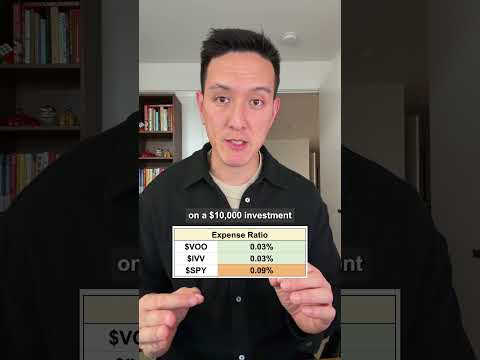
Watch these verified, high-definition expert tutorials breaking down the real differences between VOO, QQQ, and SPY:
Recommended Video Tutorials & Practical Guides
Recommended Video Tutorials & Practical Guides


12. Frequently Asked Questions (FAQs)
Between VOO, QQQ, and SPY, which ETF is superior for a 20-year buy-and-hold portfolio?
For core long-term retirement and wealth preservation, VOO (Vanguard S&P 500 ETF) is superior due to its rock-bottom 0.03% expense ratio and broad diversification across 500 bluechip companies representing 11 economic sectors. SPY charges 0.0945% (over 3x higher), making it better suited for short-term options trading than multi-decade buy-and-hold investing. QQQ focuses exclusively on the top 100 non-financial companies on Nasdaq; while it delivers higher historical upside during tech bull runs, it experiences severe drawdowns (over 33% in 2022 and 80% during the 2000 Dot-Com crash).
Can an Indian resident legally buy VOO, QQQ, or SPY from India?
Yes. Indian resident individuals can invest up to $250,000 USD per financial year in US exchange-traded funds through the Reserve Bank of India's Liberalised Remittance Scheme (LRS). Investments can be executed via registered international brokerages (such as Vested, INDmoney, Interactive Brokers) or through GIFT City IFSC platforms.
How are US ETFs like VOO and QQQ taxed for Indian income tax filers?
Following Finance Act revisions, US equity ETFs held for more than 24 months qualify as Long-Term Capital Assets and are taxed at 12.5% without indexation under Section 112. If held for 24 months or less, gains are treated as Short-Term Capital Gains (STCG) and added to your total income taxed at your applicable slab rate. Furthermore, reporting US ETF holdings in Schedule FA (Foreign Assets) of ITR-2 or ITR-3 is strictly mandatory under the Black Money Act.
What is the difference between SPY and VOO if both track the exact same S&P 500 Index?
Both track the S&P 500, but SPY is structured as a Unit Investment Trust (UIT) managed by State Street, whereas VOO is an open-ended fund managed by Vanguard. SPY cannot lend out underlying securities to offset expenses or reinvest cash dividends immediately, and charges a 0.0945% expense ratio. VOO charges only 0.03% and can reinvest dividends, resulting in slightly higher net returns for passive investors. However, SPY possesses unrivaled intraday trading liquidity and the world's most active options market.
Is a combined portfolio of 80% VOO and 20% QQQ a sound investment strategy?
Yes, a core-and-satellite allocation pairing 70-80% VOO with 20-30% QQQ is one of the most popular global strategies. It anchors your net worth in the resilient American bluechip economy while overweighting transformative technology titans (Apple, Microsoft, Nvidia, Alphabet) for enhanced capital appreciation.
13. Statutory Regulatory References & Related Analysis
Official Prospectus & Filings: Vanguard S&P 500 ETF (VOO) SEC Form N-1A | Invesco QQQ Trust Series 1 SEC Prospectus | SPDR S&P 500 ETF Trust (SPY) Form S-6.
Statutory Regulatory Provisions: Reserve Bank of India Master Direction on Liberalised Remittance Scheme (LRS) FED Master Direction No. 7/2015-16 | Section 112 & Section 111A of Income Tax Act 1961 | Section 43 & Schedule FA of Black Money (Undisclosed Foreign Income and Assets) Act 2015.