
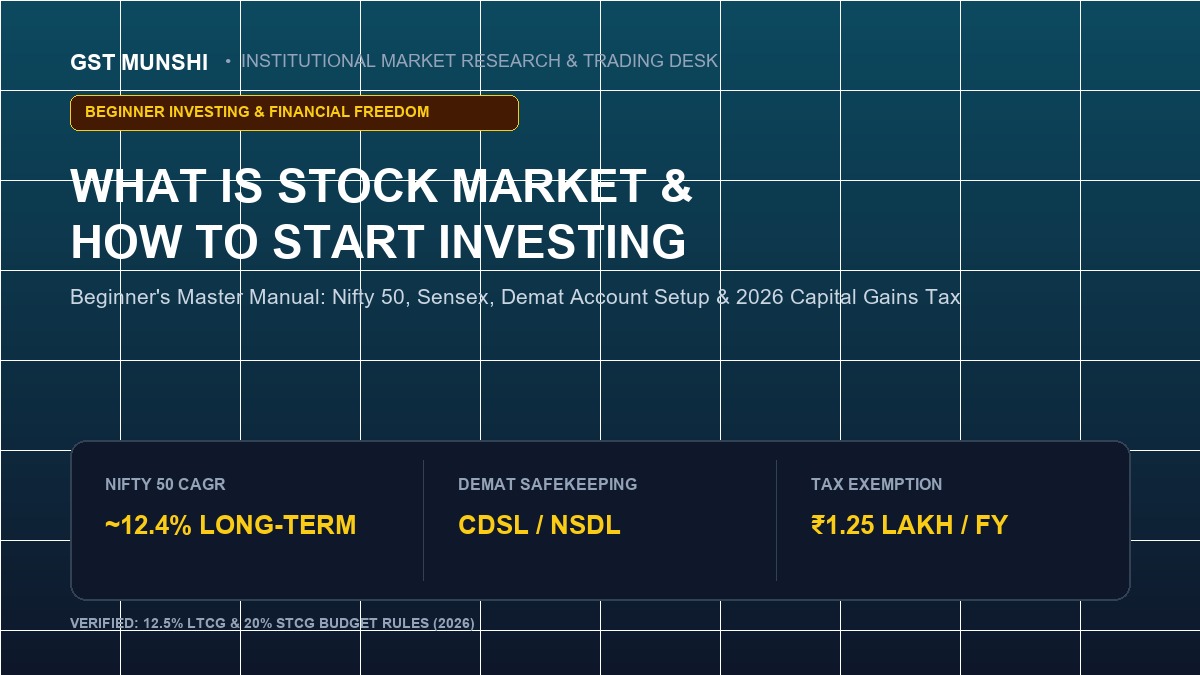
What is the stock market and how can a beginner start investing safely in India?
Nifty 50 SIP vs Bank FD Compounding Calculator
Calculate post-tax wealth generation with Budget 2026 Section 112A rules (12.5% LTCG).
By investing in a diversified Nifty 50 Index Fund instead of a Bank Fixed Deposit, you build +₹12.61 Lakhs in inflation-beating real wealth.
What is the Stock Market? (The Simplified Fruit Market Analogy)
To understand how the share market works, imagine a local fruit wholesale market:
Why Do Companies Sell Shares?
Suppose you start an electric vehicle battery factory. To build 5 new manufacturing plants, you need ₹500 Crore. Instead of taking a massive bank loan with heavy monthly interest, you divide your company into 10 Crore small units called Shares and sell 20% of them to the public through an Initial Public Offering (IPO).
How Do You Make Money as a Shareholder?
As a shareholder, you earn in two distinct ways: (1) Capital Appreciation: As the company sells more batteries and profits surge, other investors will pay ₹150 for a share you bought at ₹100; and (2) Dividends: The company distributes a portion of its net annual profits directly into your linked bank account.
Nifty 50 vs BSE Sensex: How Benchmark Indices Are Calculated
When the evening news reports that "The Stock Market gained 500 points today," they are referring to one of India's two flagship benchmark indices:
| Parameter | Nifty 50 (NSE) | BSE Sensex (BSE) |
|---|---|---|
| Parent Exchange | National Stock Exchange of India (NSE) | Bombay Stock Exchange (BSE, Est. 1875) |
| Number of Companies | Top 50 Bluechip Companies | Top 30 Established Companies |
| Weighting Methodology | Free-Float Market Capitalization | Free-Float Market Capitalization |
| Base Year & Base Value | 1995 (Base Value: 1,000) | 1978-79 (Base Value: 100) |
| Top Sectors | Banking & Finance (34%), IT (13%), Oil & Gas (11%) | Banking & Finance (36%), IT (14%), Oil & Gas (10%) |
The 4 Pillars of the Indian Stock Market System
India's equity infrastructure is recognized worldwide as one of the most technologically advanced and fraud-resistant financial systems, safeguarded by four distinct entities:
The Securities and Exchange Board of India. Statutory watchdog protecting retail investors, curbing insider trading, auditing brokers, and mandating transparent disclosures.
Electronic trading matching engines executing millions of orders per second on a strict price-time priority without human intermediaries.
Central electronic vaults holding your shares. Even if your broker goes bankrupt, your shares remain 100% safe in your government-backed CDSL/NSDL Demat account.
SEBI-registered brokerages (Zerodha, Groww, Angel One, ICICI Direct) providing the mobile apps and web platforms used to place buy/sell orders on the exchange.
Step-by-Step SOP: How to Open a Demat Account & Buy Your First Share
Opening an account in 2026 is 100% paperless and takes under 15 minutes using Aadhaar e-KYC:
Gather Mandatory Documents (PAN & Aadhaar with Mobile Linked)
You will need your PAN card, Aadhaar number (linked to an active mobile phone for OTP verification), bank account details (cheque or passbook for penny-drop verification), and a white paper with your signature.
Complete Digilocker & In-Person Video Verification (IPV)
Install your chosen brokerage app (Zerodha Kite, Groww, or Angel One), authorize Digilocker fetch for your identity records, and complete a 5-second selfie video verification via your smartphone camera.
Complete Aadhaar NSDL e-Sign
Enter your Aadhaar number on the official NSDL e-sign portal and enter the 6-digit OTP received from UIDAI. Your Demat account will be activated within 2 to 24 hours.
Fund Account via UPI & Buy Your First Nifty 50 Index Share / ETF
Transfer ₹500 via instant zero-fee UPI from your linked bank account. Search for NIFTYBEES (Nifty 50 ETF) or setup an auto-debit SIP in a Nifty 50 Index Fund. Click 'Buy' with order type 'Delivery' (CNC). You are now an equity market investor!
2026 Capital Gains Tax Blueprint: STCG & LTCG Rules
Under the landmark Union Budget amendments, Indian stock market capital gains taxation operates under simplified, uniform rules:
Short-Term Capital Gains (STCG) – Section 111A
If you buy a stock and sell it within 365 days, any net profit is taxed at a flat rate of 20% (plus applicable 4% Health & Education Cess), regardless of your personal income tax slab.
Long-Term Capital Gains (LTCG) – Section 112A
If you hold shares or equity mutual funds for over 1 year, the first ₹1.25 Lakh of profit each financial year is 100% Tax-Free. Profits exceeding ₹1.25 Lakh are taxed at a low rate of 12.5%.
Verified Video Masterclasses: Stock Market for Beginners
Watch 4 comprehensive tutorials covering basic terminology, demat setup, index funds, and capital gains taxation:


Frequently Asked Questions (FAQs)
Can I lose all my money in the stock market?
If you gamble in speculative intraday trading, penny stocks, or out-of-the-money F&O options contracts without risk management, you can indeed lose your capital. However, if you invest in diversified broad-market indices (like Nifty 50) and fundamentally sound large-cap companies for the long term, your capital fluctuates with economic cycles but grows consistently over 5 to 10 year periods.
Is a bank account required to open a Demat account?
Yes. SEBI mandates that every Demat and trading account must be linked to a savings or current bank account held in your own name for anti-money laundering (AML) compliance. All fund deposits and dividend payouts move exclusively through this verified bank account.
Can college students or housewives invest in the stock market?
Yes. Any Indian citizen above 18 years of age possessing a valid PAN card, Aadhaar card, and savings bank account can legally open a Demat account and invest, regardless of employment status or salary.
What is an SIP and why is it recommended for beginners?
A Systematic Investment Plan (SIP) is an automated facility that invests a fixed sum of money (e.g. ₹1,000) into a mutual fund or index fund on a predetermined date every month. It instills investing discipline, eliminates the stress of timing the market, and leverages Rupee Cost Averaging.
Related Financial Freedom & Regulatory Manuals
Accelerate your financial literacy with our curated beginner guides: