
Independent Informational Resource: This page is an independent public-information guide, NOT an official Government of India website. Always verify current dates and submit forms strictly on se.census.gov.in or censusindia.gov.in.
Census 2027 Phase I: Houselisting & Housing Census — All 33 Questions Explained
Detailed breakdown of the 33 notified Phase-I questions across House Structure, Household Particulars, Drinking Water & Sanitation Amenities, Household Assets, and Cereal Consumed.
Current National Snapshot: Self Enumeration availability depends on your State/UT and the active Census phase. Phase-I (Houselisting & Housing Census) is largely completed across most States/UTs (with a specific Gazette extension up to 31 October 2026 in Assam's Charaideo and Sivasagar districts), while Phase-II (Population Enumeration — 40 Questions) opens for a 15-day Self Enumeration window ahead of each State/UT's notified field round.
Important Notice: Self Enumeration is available only during the notified window for your area. Check your State/UT schedule before starting.
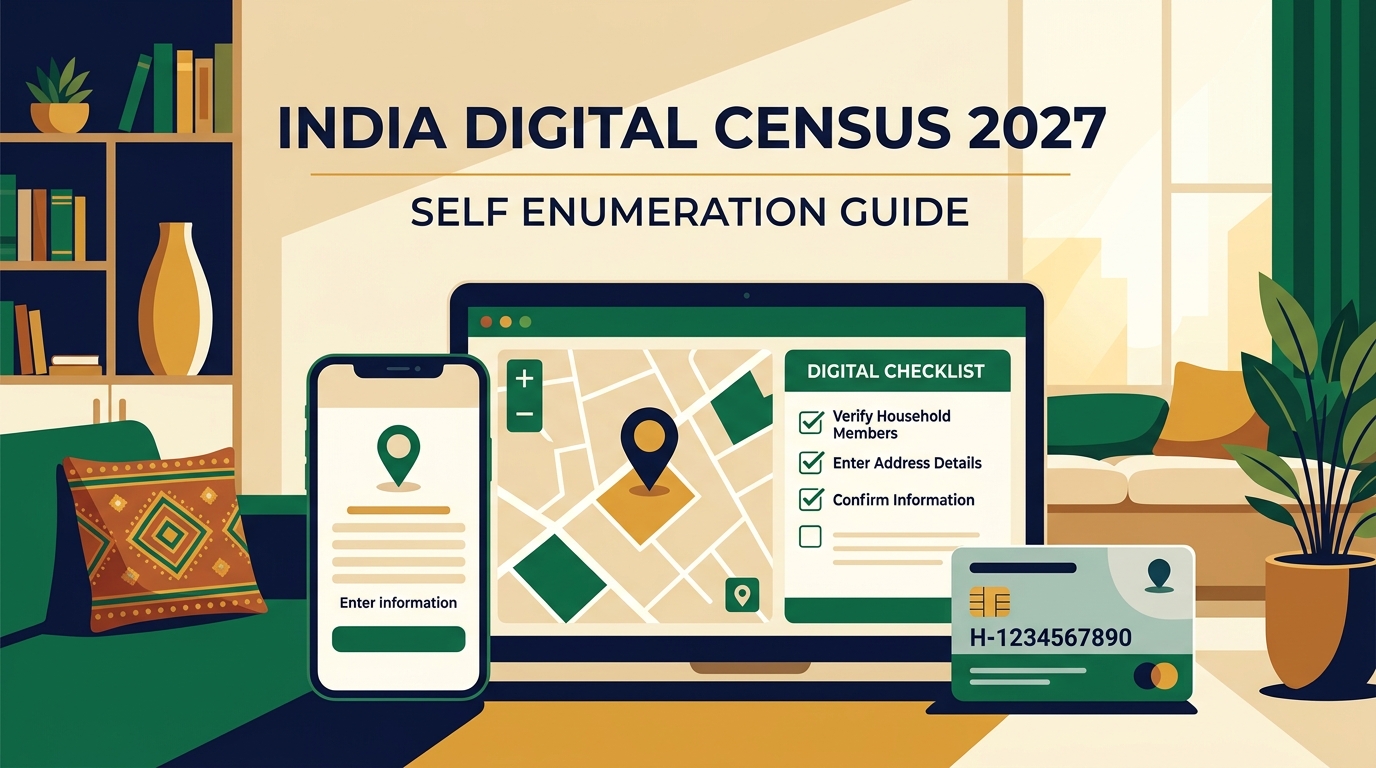
Check Your State / UT Self Enumeration Status, Dates & Questionnaire
Select your State or Union Territory below to view current Phase-I & Phase-II status, Reference Date, official portal link, and notified questions.
Active Track: Phase-I Completed / Phase-II PE Upcoming
SE Window: 15-day window before Phase-II field operation (Notified locally)
Field Window: Phase-I HLO: Completed | Phase-II PE: Feb 2027 (Synchronous Window)
Reference Date: 00:00 hrs of 1st March 2027
Phase-II Population Enumeration (40 questions) will open a 15-day Self Enumeration window ahead of the February 2027 field round.
Jump to 40 Phase-II QuestionsArea Type: Normal Synchronous Area
What is Self Enumeration in Census 2027?
Self Enumeration is the online web-based facility introduced for Census of India 2027 through which eligible residents can enter their household information themselves on the official portal (https://se.census.gov.in/) during the notified 15-day window before the Census enumerator's home visit. After final submission, the portal generates a unique 11-digit Self Enumeration ID (SE ID) prefixed with "H", which you share with the visiting Census Enumerator for household verification.
Start Self Enumeration on the Official Portal
Ready to register your household or log back in to a saved draft? Click the button below to open the official Government of India Self Enumeration portal (https://se.census.gov.in/). We never host login forms or ask for your mobile number, OTP, Aadhaar, or SE ID on our website.
How Self Enumeration Works: Step-by-Step Process (Steps 1 to 10)
Follow the verified 10-step workflow from opening se.census.gov.in to receiving your 11-digit "H"-prefixed SE ID and completing field verification with the visiting Census Enumerator.
Step 1: Open the Official Self Enumeration Portal
Visit the official Government of India Self Enumeration web portal (https://se.census.gov.in/) on your mobile browser, tablet, or desktop computer during your State/UT's notified Self Enumeration window.
Key Action Points & Portal Rules:
- Always verify that the browser address bar shows https://se.census.gov.in/ before entering any details.
- The portal is web-based and works on smartphones as well as laptops/desktops.
- Access is active only during the notified 15-day Self Enumeration window prior to field operations in your State/UT.
Self-Enumeration Flow Chart (Sections 1 to 4)
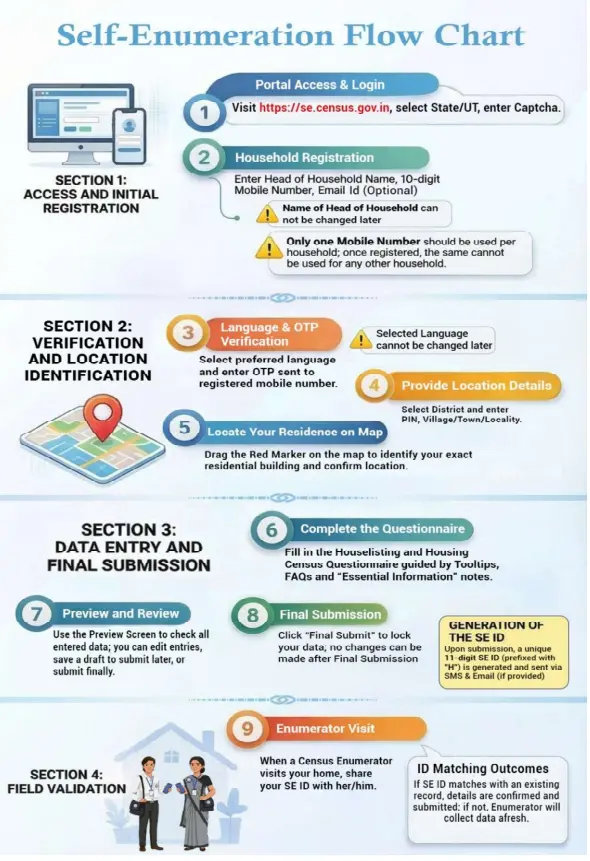
Flowchart Summary: Section 1 covers Portal Access (https://se.census.gov.in) and Household Registration; Section 2 covers Language & OTP Verification and dragging the Red Marker on the map; Section 3 covers completing the questionnaire, Preview & Review, and Final Submission to generate the 11-digit SE ID (prefixed with "H"); Section 4 covers sharing your SE ID during the Census Enumerator's home visit.
Complete 10-Step Summary at a Glance
Open the Official Self Enumeration Portal
Visit the official Government of India Self Enumeration web portal (https://se.census.gov.in/) on your mobile browser, tablet, or desktop computer during your State/UT's notified Self Enumeration window.
Select Your State/UT and Complete CAPTCHA
On the portal landing screen, choose your State or Union Territory from the dropdown menu and enter the security CAPTCHA code displayed on screen.
Register Your Household
Enter the full name of the Head of the Household, an active 10-digit Indian mobile number, and an optional email address to register your household profile.
Warning 1: The Name of the Head of Household CANNOT be changed after registration.
Select Preferred Language and Verify OTP
Choose your preferred language for filling out the Census questionnaire and verify your identity by entering the One-Time Password (OTP) sent to your registered mobile number.
Warning: Choose your preferred language carefully. The selected language CANNOT subsequently be changed once confirmed.
Enter Location Details
Provide your administrative and postal location details so the portal can center the digital map on your residential area.
Locate Your Residence on the Digital Map
Use the interactive digital map to drag and position the Red Marker onto your exact residential building, then click Save & Next.
Complete the Census Questionnaire
Answer the notified Census questionnaire (Phase-I Houselisting & Housing Census or Phase-II Population Enumeration, as active) using the built-in tooltips, notes, and FAQs.
Preview, Review, or Save Draft
Use the Preview Screen to review all entered responses section by section. You can edit any mistake or save your form as a draft to complete later before the deadline.
Final Submit & 11-Digit SE ID Generation
Click 'Final Submit' to permanently lock your questionnaire. The portal immediately generates a unique 11-digit Self Enumeration ID (SE ID) prefixed with the letter 'H'.
Important: No changes can be made online after clicking Final Submit. Verify every field on the Preview Screen first.
Enumerator Visit & Field Verification
During the field operation window, an official Census Enumerator visits your home. Share your 11-digit SE ID so the enumerator can match and confirm your record.
What Do I Need Before Starting Self Enumeration?
Keep the information ready before beginning to save time.
How to Locate Your Residence on the Digital Map (9-Step Guide)
During Step 4 & Step 5 of the official portal workflow, you must pin your exact residential building using the draggable Red Marker.
Select District
Choose your residential District from the official State/UT dropdown list.
Enter PIN Where Applicable
Type your 6-digit postal PIN code to narrow down your administrative area.
Enter Locality / Village / Town
Select or enter your revenue village, municipal town, ward, or residential locality.
Click Search
Click the Search button so the GIS map centers on your selected locality.
Digital Map Opens
An interactive street/satellite map of your neighborhood loads on screen.
Red Marker Appears
A draggable Red Marker pin appears near the center of your searched locality.
Drag Marker to Actual Residence
Drag and drop the Red Marker directly onto your exact residential building roof.
Confirm Location
Verify that the pinned coordinates rest on your house and confirm the placement.
Click Save & Next
Save your mapped residence to link your form with the relevant Houselisting Block.
Why does Self Enumeration ask me to locate my house on a map?
Pinning your exact residential building on the digital map helps associate your online Self Enumeration submission with the appropriate Houselisting Block (HLB) assigned to your area's field enumerator. When the Census Enumerator visits your neighborhood for field verification, your mapped coordinates help match your 11-digit SE ID to the correct building and household list.
What is SE ID in Census 2027?
SE ID (Self Enumeration ID) is the unique acknowledgement code generated immediately after you click "Final Submit" on the official Self Enumeration portal.
Sent via SMS to your registered mobile number & Email (if provided)
- Generated After Final Submission: Created only when you lock and submit your completed questionnaire.
- Keep It Safely & Screenshot It: Save a screenshot on your phone or write it down so any adult family member at home can show it.
- Share with Visiting Enumerator: When the Census Enumerator visits your home, hand over your SE ID for record matching and confirmation.
- Matching Outcomes: If your SE ID matches the existing record, your details are confirmed. If it cannot be matched, the enumerator collects the data afresh.
Census 2027 Phase I: Houselisting & Housing Census Questions
The notified Phase-I Houselisting & Housing Census schedule contains 33 questions grouped into 5 categories. Note that administrative identifiers such as Building Number (Q1), Census House Number (Q2), and Household Number (Q8) are assigned/verified by field enumerators during verification.
| Q.No | Category | Notified Question | What Does This Mean? (Plain-English Explanation) | Handled By |
|---|---|---|---|---|
| #1 | A. House / Structure | Building number (Municipal or local authority or census number) | The official identifier assigned to the physical building by the municipal authority or by the Census enumerator during houselisting field verification. | Field Enumerator / System Identifier |
| #2 | A. House / Structure | Census house number | A unique number assigned to a structure or part of a structure with a separate main entrance used as a dwelling or non-dwelling unit. Handled/verified during field enumeration. | Field Enumerator / System Identifier |
| #3 | A. House / Structure | Predominant material of floor of the census house | The primary material used to construct the floor of the main living rooms (such as mud, wood/bamboo, burnt brick, stone, cement, mosaic/floor tiles, etc.). | Resident (Self Enumeration) |
| #4 | A. House / Structure | Predominant material of wall of the census house | The main material used for the outer walls of the house (such as grass/thatch/bamboo, mud/unburnt brick, wood, stone, G.I./metal sheets, burnt brick, concrete, etc.). | Resident (Self Enumeration) |
| #5 | A. House / Structure | Predominant material of roof of the census house | The primary material forming the outer roof of the house (such as thatch/bamboo/mud, handmade tiles, machine-made tiles, burnt brick, stone/slate, metal/asbestos sheets, or concrete/RBC/RCC). | Resident (Self Enumeration) |
| #6 | A. House / Structure | Ascertain use of census house | How the house is actually being used—for example, exclusively for residence, residence-cum-other use (such as a home shop or workshop), etc. In Self Enumeration, households report residential use. | Resident (Self Enumeration) |
| #7 | A. House / Structure | Condition of this census house | The overall physical state of the residential structure as perceived for living—categorized as Good, Livable, or Dilapidated. | Resident (Self Enumeration) |
| #8 | B. Household | Household number | The sequential serial number given to each household living within a Census house. Assigned/verified by the enumerator during field operations. | Field Enumerator / System Identifier |
| #9 | B. Household | Total number of persons normally residing in this household | The count of all members (males, females, and others) who normally live together and take their meals from a common kitchen in the household. | Resident (Self Enumeration) |
| #10 | B. Household | Name of the head of the household | The person recognized by the household members as the head who generally bears the chief responsibility for managing household affairs. | Resident (Self Enumeration) |
| #11 | B. Household | Sex of the head of the household | Records the gender (Male, Female, or Other) of the person named as the Head of the Household. | Resident (Self Enumeration) |
| #12 | B. Household | Whether head of the household belongs to Scheduled Caste / Scheduled Tribe / Other | Indicates whether the Head of the Household belongs to a Scheduled Caste (SC), Scheduled Tribe (ST), or Other category. | Resident (Self Enumeration) |
| #13 | B. Household | Ownership status of this house | Whether the household lives in an Owned house, a Rented house, or any Other accommodation arrangement (such as employer-provided quarters). | Resident (Self Enumeration) |
| #14 | B. Household | Number of dwelling rooms exclusively in possession of this household | Total rooms used for living/sleeping (including living room, bedroom, dining room, drawing room). Excludes kitchen, bathroom, latrine, store room, passageway, or open verandah. | Resident (Self Enumeration) |
| #15 | B. Household | Number of married couples living in this household | How many currently married couples normally reside together as part of this single household. | Resident (Self Enumeration) |
| #16 | C. Amenities | Main source of drinking water | The primary source from which the household obtains drinking water (such as tap water from treated/untreated source, covered/uncovered well, handpump, tubewell/borehole, bottled water, river/canal, tanker, etc.). | Resident (Self Enumeration) |
| #17 | C. Amenities | Availability of drinking water source | How close the drinking water source is to the home: Within the premises, Near the premises, or Away from the premises. | Resident (Self Enumeration) |
| #18 | C. Amenities | Main source of lighting | The main energy source used for lighting the home (such as electricity, kerosene, solar energy, other oil, any other source, or no lighting). | Resident (Self Enumeration) |
| #19 | C. Amenities | Access to latrine | Whether the household has access to a toilet/latrine facility (exclusively for household use, shared with other households, public/community latrine, or open). | Resident (Self Enumeration) |
| #20 | C. Amenities | Type of latrine | The sanitation system connected to the latrine (such as flush/pour-flush connected to piped sewer system, septic tank, twin pit, single pit, etc.). | Resident (Self Enumeration) |
| #21 | C. Amenities | Waste water outlet connected to | How household greywater/wastewater is drained out—into a closed drainage system, open drainage, or no drainage. | Resident (Self Enumeration) |
| #22 | C. Amenities | Availability of bathing facility within the premises | Whether the home has a bathroom with a roof, an enclosed bathing space without a roof, or no bathing facility within the premises. | Resident (Self Enumeration) |
| #23 | C. Amenities | Availability of kitchen and LPG/PNG connection | Checks whether cooking is done inside a dedicated kitchen or outside/without a separate kitchen, and whether the household has an active LPG cylinder or Piped Natural Gas (PNG) connection. | Resident (Self Enumeration) |
| #24 | C. Amenities | Main fuel used for cooking | The fuel most frequently used by the household for cooking meals (such as LPG/PNG, firewood, crop residue, cowdung cake, coal/charcoal, kerosene, electricity/induction, solar, or biogas). | Resident (Self Enumeration) |
| #25 | D. Household Assets | Radio / Transistor | Whether the household possesses a working standalone Radio or Transistor receiver. | Resident (Self Enumeration) |
| #26 | D. Household Assets | Television | Whether the household owns a Television set (such as LED/Smart TV/CRT/DTH/Cable television). | Resident (Self Enumeration) |
| #27 | D. Household Assets | Access to Internet | Whether members of the household have internet connectivity (via broadband, Wi-Fi fiber, or mobile data). | Resident (Self Enumeration) |
| #28 | D. Household Assets | Laptop / Computer | Whether the household possesses a desktop computer, laptop, notebook, or tablet computing device. | Resident (Self Enumeration) |
| #29 | D. Household Assets | Telephone / Mobile Phone / Smartphone | Whether the household has a landline telephone, basic feature mobile phone, or smartphone. | Resident (Self Enumeration) |
| #30 | D. Household Assets | Bicycle / Scooter / Motorcycle / Moped | Whether the household owns a bicycle or a two-wheeler motorized/electric vehicle for personal transport. | Resident (Self Enumeration) |
| #31 | D. Household Assets | Car / Jeep / Van | Whether the household owns a four-wheeler vehicle (Car, SUV, Jeep, or Van) for personal/family use. | Resident (Self Enumeration) |
| #32 | E. Other | Main cereal consumed in the household | The primary food grain/cereal consumed most regularly by the household in daily meals (such as rice, wheat, jowar, bajra, ragi/millets, maize, etc.). | Resident (Self Enumeration) |
| #33 | E. Other | Mobile number (for Census-related communication only) | A contact mobile number recorded strictly for official Census communication, verification alerts, and SE ID reference. | Resident (Self Enumeration) |
Census 2027 Phase II: Population Enumeration — 40 Questions
Phase II (Population Enumeration) is distinct from Phase I (Houselisting). While Phase I records the physical house and household amenities, the Phase-II Population Enumeration schedule collects individual-level information for each member through the household schedule.
| Q.No | Topic Group | Notified Question | What Does This Mean? (Plain-English Explanation) |
|---|---|---|---|
| #1 | Demographics & Marital Status | Name of the person | The full name of each individual normally residing in the household, starting with the Head of the Household. |
| #2 | Demographics & Marital Status | Relationship to head | How each member is related to the Head of the Household (e.g., Head, spouse, son, daughter, son-in-law, daughter-in-law, father, mother, brother, sister, grandchildren, or unrelated member). |
| #3 | Demographics & Marital Status | Sex | Gender of the individual (Male, Female, or Transgender/Other). |
| #4 | Demographics & Marital Status | Date of birth and age | The individual's date of birth (day, month, year) and completed age in years as on the Census reference date. |
| #5 | Demographics & Marital Status | Current marital status | Whether the person is Never Married, Currently Married, Widowed, Separated, or Divorced. |
| #6 | Demographics & Marital Status | Age at marriage | The completed age (in years) at the time of first marriage, applicable to persons who are currently married, widowed, separated, or divorced. |
| #7 | Demographics & Marital Status | Spouse name | Name of the husband or wife for currently married individuals in the household schedule. |
| #8 | Socio-Cultural & Caste | Nationality as declared | Nationality as declared by the respondent (Indian or other nationality). |
| #9 | Socio-Cultural & Caste | Religion | The religion professed by the individual as declared. |
| #10 | Socio-Cultural & Caste | Scheduled Caste / Scheduled Tribe / Caste | Records whether the individual belongs to a Scheduled Caste (SC), Scheduled Tribe (ST), or other Caste, recorded as declared by the respondent. Note: Statistical declaration only. Does not issue, modify, or verify an official Caste Certificate or reservation eligibility. |
| #11 | Parents & Disability | Father's particulars | Name/serial reference of the person's father in the household schedule. |
| #12 | Parents & Disability | Mother's particulars | Name/serial reference of the person's mother in the household schedule. |
| #13 | Parents & Disability | Disability | Whether the person has any physical, sensory, intellectual, or mental disability as notified in the Census instructions. |
| #14 | Language, Literacy & Education | Mother tongue and other languages known | The language spoken in childhood by the person's mother to the person, plus other Indian or foreign languages the person can speak/understand. |
| #15 | Language, Literacy & Education | Literacy and digital literacy status | Whether the person can both read and write with understanding in any language, along with basic digital literacy capability. |
| #16 | Language, Literacy & Education | Attendance in educational institution | Whether the person is currently attending school, college, vocational institute, literacy center, has attended in the past, or never attended. |
| #17 | Language, Literacy & Education | Highest educational level and stream/discipline | The highest exam or degree successfully completed along with the academic/professional stream or discipline. |
| #18 | Economic Activity & Work | Worked any time during last year | Whether the person engaged in any economically productive work (main worker for 6+ months, marginal worker for less than 6 months, or non-worker) during the preceding one year. |
| #19 | Economic Activity & Work | Category of economic activity | Broad classification of the person's work—such as Cultivator, Agricultural Labourer, Worker in Household Industry, or Other Worker. |
| #20 | Economic Activity & Work | Occupation | The specific kind of work or job role performed by the individual. |
| #21 | Economic Activity & Work | Nature of industry, trade or service | The sector, business activity, manufacturing type, or service where the person works. |
| #22 | Economic Activity & Work | Class of worker | Whether the worker is an Employer, Employee, Single Worker, or Family Worker. |
| #23 | Economic Activity & Work | Non-economic activity | For non-workers or marginal workers, their main activity (such as student, household duties, dependent, pensioner, rentier, etc.). |
| #24 | Economic Activity & Work | Seeking or available for work | Whether a non-worker or marginal worker is actively looking for employment or available to take up work. |
| #25 | Economic Activity & Work | Travel to place of work | The approximate one-way distance traveled and primary mode of transport used to commute to the workplace (for workers other than cultivators/agricultural labourers). |
| #26 | Migration & Address | Birth place | Details of the village/town, district, and state (or country, if born outside India) where the person was born. |
| #27 | Migration & Address | Place of last residence | If the person has moved from another village or town to the current place of enumeration, details of where they lived immediately before moving here. |
| #28 | Migration & Address | Reason for migration | The main reason the person moved from their place of last residence (such as employment/work, business, education, marriage, moved with household, or other applicable reasons). |
| #29 | Migration & Address | Duration of stay in village/town since last migration | How many years the person has been continuously living in the current village or town since moving from their last residence. |
| #30 | Migration & Address | Permanent residential address | The individual's permanent home address details as recorded in the schedule. |
| #31 | Fertility & Children | Number of children surviving at present | Applicable to ever-married women: total number of sons and daughters currently alive (whether living in the same household or elsewhere). |
| #32 | Fertility & Children | Number of children ever born alive | Applicable to ever-married women: total number of children ever born alive to the woman during her lifetime. |
| #33 | Fertility & Children | Number of children born alive during last one year | Applicable to currently married women: number of live births during the 12 months preceding the reference date. |
| #34 | Public Health & Banking | Place of COVID-19 vaccination | Information regarding where the individual received COVID-19 vaccination, as notified in the Phase-II schedule. |
| #35 | Public Health & Banking | Total number of bank accounts | The count of bank accounts held by the individual. It asks ONLY for the total number of accounts—never your account password, PIN, balance, or transaction history. Note: Never share bank passwords, UPI PINs, CVV, or net-banking credentials with anyone. |
| #36 | Contact & Identity Documents | Mobile number, if available | The individual's mobile phone number, if available. |
| #37 | Contact & Identity Documents | Aadhaar number, if available | The individual's Aadhaar number, recorded on an 'if available' voluntary basis as notified in the schedule. |
| #38 | Contact & Identity Documents | Voter ID number, if available | Electors Photo Identity Card (EPIC / Voter ID) number, if available with the individual. |
| #39 | Contact & Identity Documents | Passport number, if Indian passport holder | Passport number, applicable only if the individual holds an Indian passport. |
| #40 | Contact & Identity Documents | Availability of driving licence | Whether the individual possesses a Driving Licence. |
Why is the Caste Question Important in Census 2027?
In the notified 40-question Phase-II (Population Enumeration) schedule, Question 10 covers "Scheduled Caste / Scheduled Tribe / Caste", making Census 2027 a landmark exercise in comprehensive demographic enumeration.
- •Recorded as Declared: Caste information in the Census is recorded as declared by the respondent according to official Census enumeration guidelines.
- •Purely a Statistical Exercise: Census data collection under the Census Act, 1948 is a macro-level statistical and demographic exercise.
- •Does NOT Change Your Caste Certificate: Answering Question 10 in the Census does not issue, alter, verify, or replace an official state-issued Caste Certificate.
- •Does NOT Automatically Determine Reservation Eligibility: Census responses do not automatically grant or modify individual eligibility for educational or employment reservations.
What ID Details Are Asked in Census 2027?
In the Phase-II Population Enumeration schedule, Questions 36 through 40 cover contact and identity document particulars on an "if available" or applicable basis:
- • Q36 — Mobile number, if available: Contact number of the individual where available.
- • Q37 — Aadhaar number, if available: Recorded voluntarily if available with the respondent.
- • Q38 — Voter ID number, if available: EPIC number if the individual holds a Voter ID card.
- • Q39 — Passport number, if Indian passport holder: Applicable only to individuals who hold an Indian passport.
- • Q40 — Availability of driving licence: Records whether the individual possesses a driving licence.
Important Clarification: Submitting Census data does not update, correct, or modify your Aadhaar card, Voter ID card, Passport, or Driving Licence records.
Bank Account Question in Census 2027 (Q35): Count Only, Never Passwords
Question 35 of the Phase-II Population Enumeration schedule asks for the "Total number of bank accounts" held by the person (for example: 0, 1, 2, etc.) to measure financial inclusion across India.
Only the simple numeric count of bank accounts held by the individual.
Never asks for bank passwords, UPI PIN, ATM PIN, CVV, account balance, or transaction history.
Understanding Q28: "Reason for Migration" in Population Enumeration
In Phase-II (Questions 26 to 29), the schedule records Birth Place, Place of Last Residence, Reason for Migration (Q28), and Duration of Stay. If a member has moved from a previous village or town to the current place of residence, Q28 records the primary reason for moving, such as:
Select the exact option applicable to each individual member from the officially notified list displayed on the Self Enumeration portal during Phase-II.
State / UT Self Enumeration Status & Schedule (As of 10 October 2026)
Self Enumeration availability depends on your State/UT and the active Census phase. As of 10 October 2026, Phase-I (Houselisting & Housing Census) is largely completed across India, with a notified Gazette extension in Assam's Charaideo and Sivasagar districts up to 31 October 2026, while Phase-II (Population Enumeration) schedules differ between snow-bound non-synchronous areas and normal synchronous areas.
| State / UT | Phase | Self Enumeration Status | Self Enumeration Window | Field Enumeration Window | Reference Date | Official Notification | Official Portal |
|---|---|---|---|---|---|---|---|
Andaman and Nicobar Islands UT • Normal Synchronous Area | Phase-I Completed / Phase-II PE Upcoming | 🟡 UPCOMING | 15-day window before Phase-II field operation (Check State/UT notification) | Phase-I HLO: Largely Completed | Phase-II PE: Feb 2027 (Synchronous Window) | 00:00 hrs of 1st March 2027 | Check Andaman and Nicobar Islands Census Notification | se.census.gov.in |
Andhra Pradesh State • Normal Synchronous Area | Phase-I Completed / Phase-II PE Upcoming | 🟡 UPCOMING | 15-day window before Phase-II field operation (Check State/UT notification) | Phase-I HLO: Largely Completed | Phase-II PE: Feb 2027 (Synchronous Window) | 00:00 hrs of 1st March 2027 | Check Andhra Pradesh Census Notification | se.census.gov.in |
Arunachal Pradesh State • Normal Synchronous Area | Phase-I Completed / Phase-II PE Upcoming | 🟡 UPCOMING | 15-day window before Phase-II field operation (Check State/UT notification) | Phase-I HLO: Largely Completed | Phase-II PE: Feb 2027 (Synchronous Window) | 00:00 hrs of 1st March 2027 | Check Arunachal Pradesh Census Notification | se.census.gov.in |
Assam State • Normal Synchronous Area | Phase-I (District Extension) / Phase-II (Upcoming) | 🟡 EXTENDED | 15-day window prior to notified field operation | Phase-I HLO extended up to 31 October 2026 in Charaideo & Sivasagar districts; Phase-II per national schedule | 00:00 hrs of 1st March 2027 | Gazette Notification CG-DL-E-17092026-276292 | se.census.gov.in |
Bihar State • Normal Synchronous Area | Phase-I Completed / Phase-II PE Upcoming | 🟡 UPCOMING | 15-day window before Phase-II field operation (Notified locally) | Phase-I HLO: Completed | Phase-II PE: Feb 2027 (Synchronous Window) | 00:00 hrs of 1st March 2027 | Check Bihar Census Notification | se.census.gov.in |
Chandigarh UT • Normal Synchronous Area | Phase-I Completed / Phase-II PE Upcoming | 🟡 UPCOMING | 15-day window before Phase-II field operation (Check State/UT notification) | Phase-I HLO: Largely Completed | Phase-II PE: Feb 2027 (Synchronous Window) | 00:00 hrs of 1st March 2027 | Check Chandigarh Census Notification | se.census.gov.in |
Chhattisgarh State • Normal Synchronous Area | Phase-I Completed / Phase-II PE Upcoming | 🟡 UPCOMING | 15-day window before Phase-II field operation (Check State/UT notification) | Phase-I HLO: Largely Completed | Phase-II PE: Feb 2027 (Synchronous Window) | 00:00 hrs of 1st March 2027 | Check Chhattisgarh Census Notification | se.census.gov.in |
Dadra and Nagar Haveli and Daman and Diu UT • Normal Synchronous Area | Phase-I Completed / Phase-II PE Upcoming | 🟡 UPCOMING | 15-day window before Phase-II field operation (Check State/UT notification) | Phase-I HLO: Largely Completed | Phase-II PE: Feb 2027 (Synchronous Window) | 00:00 hrs of 1st March 2027 | Check Dadra and Nagar Haveli and Daman and Diu Census Notification | se.census.gov.in |
Delhi (NCT) UT • Normal Synchronous Area | Phase-I Completed / Phase-II PE Upcoming | 🟡 UPCOMING | 15-day window before Phase-II field operation (Notified locally) | Phase-I HLO: Completed | Phase-II PE: Feb 2027 (Synchronous Window) | 00:00 hrs of 1st March 2027 | Check Delhi Census Notification | se.census.gov.in |
Goa State • Normal Synchronous Area | Phase-I Completed / Phase-II PE Upcoming | 🟡 UPCOMING | 15-day window before Phase-II field operation (Check State/UT notification) | Phase-I HLO: Largely Completed | Phase-II PE: Feb 2027 (Synchronous Window) | 00:00 hrs of 1st March 2027 | Check Goa Census Notification | se.census.gov.in |
Gujarat State • Normal Synchronous Area | Phase-I Completed / Phase-II PE Upcoming | 🟡 UPCOMING | 15-day window before Phase-II field operation (Check State/UT notification) | Phase-I HLO: Largely Completed | Phase-II PE: Feb 2027 (Synchronous Window) | 00:00 hrs of 1st March 2027 | Check Gujarat Census Notification | se.census.gov.in |
Haryana State • Normal Synchronous Area | Phase-I Completed / Phase-II PE Upcoming | 🟡 UPCOMING | 15-day window before Phase-II field operation (Check State/UT notification) | Phase-I HLO: Largely Completed | Phase-II PE: Feb 2027 (Synchronous Window) | 00:00 hrs of 1st March 2027 | Check Haryana Census Notification | se.census.gov.in |
Himachal Pradesh State • Snow-Bound / Non-Synchronous Area | Phase-II (Snow-Bound vs Normal Area Split) | 🟡 UPCOMING | 15 days prior to notified Phase-II field operation for your block | Snow-bound areas: Sept 2026 | Normal areas: Feb 2027 (Check State Notification) | 1 Oct 2026 (Snow-Bound) / 1 Mar 2027 (Normal Areas) | Check HP State Census Notification | se.census.gov.in |
Jammu and Kashmir UT • Snow-Bound / Non-Synchronous Area | Phase-II (Non-Synchronous Snow-Bound Schedule) | 🟡 UPCOMING | 15 days prior to notified local Phase-II field operation | September 2026 (Snow-Bound Schedule) / Check UT Notification | 00:00 hrs of 1st October 2026 (Snow-Bound Areas) | Check ORGI & J&K UT Census Notification | se.census.gov.in |
Jharkhand State • Normal Synchronous Area | Phase-I Completed / Phase-II PE Upcoming | 🟡 UPCOMING | 15-day window before Phase-II field operation (Check State/UT notification) | Phase-I HLO: Largely Completed | Phase-II PE: Feb 2027 (Synchronous Window) | 00:00 hrs of 1st March 2027 | Check Jharkhand Census Notification | se.census.gov.in |
Karnataka State • Normal Synchronous Area | Phase-I Completed / Phase-II PE Upcoming | 🟡 UPCOMING | 15-day window before Phase-II field operation (Check State/UT notification) | Phase-I HLO: Largely Completed | Phase-II PE: Feb 2027 (Synchronous Window) | 00:00 hrs of 1st March 2027 | Check Karnataka Census Notification | se.census.gov.in |
Kerala State • Normal Synchronous Area | Phase-I Completed / Phase-II PE Upcoming | 🟡 UPCOMING | 15-day window before Phase-II field operation (Check State/UT notification) | Phase-I HLO: Largely Completed | Phase-II PE: Feb 2027 (Synchronous Window) | 00:00 hrs of 1st March 2027 | Check Kerala Census Notification | se.census.gov.in |
Ladakh UT • Snow-Bound / Non-Synchronous Area | Phase-II (Non-Synchronous Snow-Bound Schedule) | 🟡 UPCOMING | 15 days prior to notified local Phase-II field operation | September 2026 (Snow-Bound Schedule) / Check UT Notification | 00:00 hrs of 1st October 2026 (Snow-Bound Areas) | Check ORGI & Ladakh UT Census Notification | se.census.gov.in |
Lakshadweep UT • Normal Synchronous Area | Phase-I Completed / Phase-II PE Upcoming | 🟡 UPCOMING | 15-day window before Phase-II field operation (Check State/UT notification) | Phase-I HLO: Largely Completed | Phase-II PE: Feb 2027 (Synchronous Window) | 00:00 hrs of 1st March 2027 | Check Lakshadweep Census Notification | se.census.gov.in |
Madhya Pradesh State • Normal Synchronous Area | Phase-I Completed / Phase-II PE Upcoming | 🟡 UPCOMING | 15-day window before Phase-II field operation (Check State/UT notification) | Phase-I HLO: Largely Completed | Phase-II PE: Feb 2027 (Synchronous Window) | 00:00 hrs of 1st March 2027 | Check Madhya Pradesh Census Notification | se.census.gov.in |
Maharashtra State • Normal Synchronous Area | Phase-I Completed / Phase-II PE Upcoming | 🟡 UPCOMING | 15-day window before Phase-II field operation (Notified locally) | Phase-I HLO: Completed | Phase-II PE: Feb 2027 (Synchronous Window) | 00:00 hrs of 1st March 2027 | Check Maharashtra Census Notification | se.census.gov.in |
Manipur State • Normal Synchronous Area | Phase-I Completed / Phase-II PE Upcoming | 🟡 UPCOMING | 15-day window before Phase-II field operation (Check State/UT notification) | Phase-I HLO: Largely Completed | Phase-II PE: Feb 2027 (Synchronous Window) | 00:00 hrs of 1st March 2027 | Check Manipur Census Notification | se.census.gov.in |
Meghalaya State • Normal Synchronous Area | Phase-I Completed / Phase-II PE Upcoming | 🟡 UPCOMING | 15-day window before Phase-II field operation (Check State/UT notification) | Phase-I HLO: Largely Completed | Phase-II PE: Feb 2027 (Synchronous Window) | 00:00 hrs of 1st March 2027 | Check Meghalaya Census Notification | se.census.gov.in |
Mizoram State • Normal Synchronous Area | Phase-I Completed / Phase-II PE Upcoming | 🟡 UPCOMING | 15-day window before Phase-II field operation (Check State/UT notification) | Phase-I HLO: Largely Completed | Phase-II PE: Feb 2027 (Synchronous Window) | 00:00 hrs of 1st March 2027 | Check Mizoram Census Notification | se.census.gov.in |
Nagaland State • Normal Synchronous Area | Phase-I Completed / Phase-II PE Upcoming | 🟡 UPCOMING | 15-day window before Phase-II field operation (Check State/UT notification) | Phase-I HLO: Largely Completed | Phase-II PE: Feb 2027 (Synchronous Window) | 00:00 hrs of 1st March 2027 | Check Nagaland Census Notification | se.census.gov.in |
Odisha State • Normal Synchronous Area | Phase-I Completed / Phase-II PE Upcoming | 🟡 UPCOMING | 15-day window before Phase-II field operation (Check State/UT notification) | Phase-I HLO: Largely Completed | Phase-II PE: Feb 2027 (Synchronous Window) | 00:00 hrs of 1st March 2027 | Check Odisha Census Notification | se.census.gov.in |
Puducherry UT • Normal Synchronous Area | Phase-I Completed / Phase-II PE Upcoming | 🟡 UPCOMING | 15-day window before Phase-II field operation (Check State/UT notification) | Phase-I HLO: Largely Completed | Phase-II PE: Feb 2027 (Synchronous Window) | 00:00 hrs of 1st March 2027 | Check Puducherry Census Notification | se.census.gov.in |
Punjab State • Normal Synchronous Area | Phase-I Completed / Phase-II PE Upcoming | 🟡 UPCOMING | 15-day window before Phase-II field operation (Check State/UT notification) | Phase-I HLO: Largely Completed | Phase-II PE: Feb 2027 (Synchronous Window) | 00:00 hrs of 1st March 2027 | Check Punjab Census Notification | se.census.gov.in |
Rajasthan State • Normal Synchronous Area | Phase-I Completed / Phase-II PE Upcoming | 🟡 UPCOMING | 15-day window before Phase-II field operation (Check State/UT notification) | Phase-I HLO: Largely Completed | Phase-II PE: Feb 2027 (Synchronous Window) | 00:00 hrs of 1st March 2027 | Check Rajasthan Census Notification | se.census.gov.in |
Sikkim State • Normal Synchronous Area | Phase-I Completed / Phase-II PE Upcoming | 🟡 UPCOMING | 15-day window before Phase-II field operation (Check State/UT notification) | Phase-I HLO: Largely Completed | Phase-II PE: Feb 2027 (Synchronous Window) | 00:00 hrs of 1st March 2027 | Check Sikkim Census Notification | se.census.gov.in |
Tamil Nadu State • Normal Synchronous Area | Phase-I Completed / Phase-II PE Upcoming | 🟡 UPCOMING | 15-day window before Phase-II field operation (Check State/UT notification) | Phase-I HLO: Largely Completed | Phase-II PE: Feb 2027 (Synchronous Window) | 00:00 hrs of 1st March 2027 | Check Tamil Nadu Census Notification | se.census.gov.in |
Telangana State • Normal Synchronous Area | Phase-I Completed / Phase-II PE Upcoming | 🟡 UPCOMING | 15-day window before Phase-II field operation (Check State/UT notification) | Phase-I HLO: Largely Completed | Phase-II PE: Feb 2027 (Synchronous Window) | 00:00 hrs of 1st March 2027 | Check Telangana Census Notification | se.census.gov.in |
Tripura State • Normal Synchronous Area | Phase-I Completed / Phase-II PE Upcoming | 🟡 UPCOMING | 15-day window before Phase-II field operation (Check State/UT notification) | Phase-I HLO: Largely Completed | Phase-II PE: Feb 2027 (Synchronous Window) | 00:00 hrs of 1st March 2027 | Check Tripura Census Notification | se.census.gov.in |
Uttar Pradesh State • Normal Synchronous Area | Phase-I Completed / Phase-II PE Upcoming | 🟡 UPCOMING | 15-day window before Phase-II field operation (Notified locally) | Phase-I HLO: Completed | Phase-II PE: Feb 2027 (Synchronous Window) | 00:00 hrs of 1st March 2027 | Check UP Directorate of Census Operations | se.census.gov.in |
Uttarakhand State • Snow-Bound / Non-Synchronous Area | Phase-II (Snow-Bound vs Normal Area Split) | 🟡 UPCOMING | 15 days prior to notified Phase-II field operation for your block | Snow-bound areas: Sept 2026 | Normal areas: Feb 2027 (Check State Notification) | 1 Oct 2026 (Snow-Bound) / 1 Mar 2027 (Normal Areas) | Check Uttarakhand Census Notification | se.census.gov.in |
West Bengal State • Normal Synchronous Area | Phase-I / Phase-II State Notification Check | 🔵 NOT YET ANNOUNCED | Check latest State/UT Census Notification | Subject to State & Central Gazette Notification | 00:00 hrs of 1st March 2027 | Check Official Census India Portal | se.census.gov.in |
Census 2027 Phase-I to Phase-II Master Timeline & Reference Dates
Census of India 2027 is conducted in two structured phases. Because high-altitude snow-bound areas become inaccessible during winter, they follow a separate non-synchronous schedule.
Census of India 2027
India's first digital Census notified by the Ministry of Home Affairs & ORGI under the Census Act, 1948, introducing online Self Enumeration (se.census.gov.in) alongside mobile app field enumeration.
Houselisting & Housing Census (HLO)
30-day field operation window chosen by each State/UT, preceded by a 15-day Self Enumeration window. Largely completed across India (with Assam's Charaideo & Sivasagar districts extended up to 31 October 2026).
Population Enumeration (PE)
Collects individual-level particulars via the 40-question household schedule. Snow-bound areas conduct PE in September 2026; most of India conducts PE in February 2027 (preceded by the 15-day Self Enumeration window).
Census Reference Date
Most of India (Normal Areas): 00:00 hours of 1st March 2027.
Snow-Bound Areas (Ladakh, J&K, HP & UK snow blocks): 00:00 hours of 1st October 2026.
Official Census 2027 Portals, Notifications & User Guides
Sources checked: 10 October 2026. Following our strict editorial rule, every card below links directly to genuine official sources or verified Gazette/PIB records.
Census 2027 Official Website (ORGI)
Authority: Office of the Registrar General & Census Commissioner, India (MHA)
Official Government of India portal listing Census 2027 circulars, Phase-I and Phase-II schedules, and latest Gazette notifications.
Official Self Enumeration Portal (se.census.gov.in)
Authority: ORGI / Ministry of Home Affairs, Government of India
The exclusive official web application where eligible households register, verify OTP, pin their house on the map, and generate their 11-digit SE ID.
Official Self Enumeration User Guide (PDF)
Authority: se.census.gov.in Official Documentation
Step-by-step official handbook covering registration, mobile OTP login, district/PIN/locality selection, map marker pinning, preview, draft, final submit, and SE ID verification.
Phase-I HLO 33 Questions Official Release
Authority: Press Information Bureau (PIB), Government of India
Official Press Information Bureau release detailing the 33 notified questions for Phase-I Houselisting and Housing Census (housing, household, amenities, assets, and contact).
Phase-I Gazette Notification & Assam District Extension
Authority: The Gazette of India / Ministry of Home Affairs
Statutory Gazette notification record including the extension of Houselisting Operations (HLO) in Assam's Charaideo and Sivasagar districts up to 31 October 2026.
Phase-II Population Enumeration (40 Questions) Notification Reference
Authority: Ministry of Home Affairs Notification / Hindustan Times Report
Complete reference for the 40 notified questions in Phase-II Population Enumeration covering demographics, caste, education, migration, fertility, bank account count, and IDs.
State / UT Census Notifications Directory
Authority: Directorates of Census Operations (States & UTs)
Check your specific State or Union Territory's notified 30-day Houselisting window, 15-day Self Enumeration window, and local district extensions.
Official Census & Self Enumeration FAQs
Authority: Census of India Portal Helpdesk
Official answers on household head rules, one mobile number per household limit, language selection lock, and enumerator verification of SE ID.
Official Self-Enumeration 4-Section Flow Chart
Authority: ORGI / Census 2027 Citizen Workflow Chart
High-resolution visual diagram showing Section 1 (Access & Registration), Section 2 (OTP & Map Pinning), Section 3 (Questionnaire & 11-Digit 'H' SE ID), and Section 4 (Enumerator Visit).
Watch: Self Enumeration Explained (Step-by-Step Video Guides)
Watch official and credible public-information video walkthroughs covering registration, OTP login, map marker placement, and SE ID verification. Supplementary news explainers are clearly labeled for transparency.
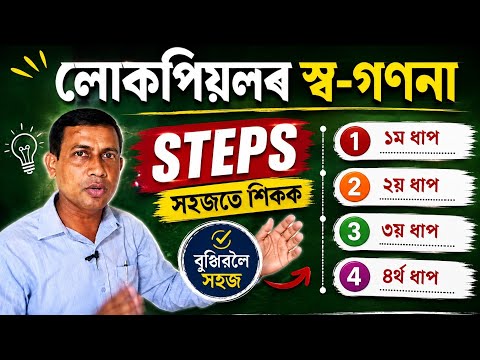
Walkthrough demonstrating how to access https://se.census.gov.in, select your State/UT, register the Head of Household, verify OTP, and pin your house on the digital map.
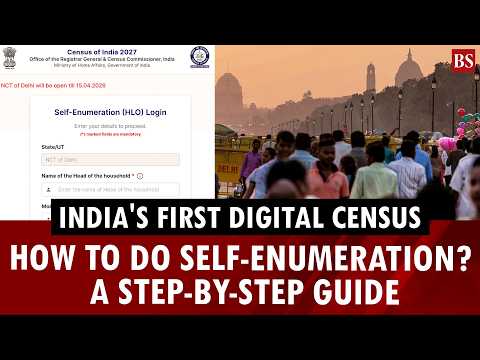
Detailed visual guide explaining how households complete the online questionnaire, preview answers, save drafts, and receive the 11-digit H-prefixed SE ID.
Step-by-step explanation of household registration rules, why one mobile number works for one household only, and how the visiting enumerator verifies your SE ID.
Supplementary news explainer breaking down the 15-day Self Enumeration window, Phase-I 33 questions, Phase-II 40 questions, and field verification rules.
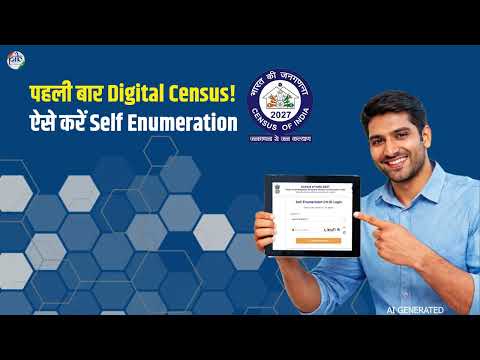
Practical citizen guide covering common questions on residential map markers, draft saving, and mandatory enumerator household verification.
Self Enumeration Census 2027: 45 Frequently Asked Questions
Direct answers to every question about portal eligibility, OTP, language lock, map pinning, draft saving, 11-digit SE ID, enumerator home visit, and Phase-I/II questions.
Beware of Fake Census Websites, APK Links & Fraudulent Callers
The official Self Enumeration portal is strictly the Government of India portal (https://se.census.gov.in/). Our website is only an independent informational guide. Neither our website nor genuine Census officials will ever ask you for financial passwords or banking PINs.
Never Share Any of the Following with Unofficial Websites or Callers Claiming to Be Census Agents:
Explore Specific Self Enumeration & Census 2027 Guides
Master Guide Hub
Portal Login Guide
Household Registration
10-Step Process
SE ID & Verification
All Census Questions
Phase-I (33 Questions)
Phase-II (40 Questions)
State-Wise Dates
45 Verified FAQs
Census 2027 India Complete Guide
Census 2027 33 Questions (Houselisting)
Census 2027 40 Questions (Population)
Ready to Complete Self Enumeration?
Use the quick-action buttons below to verify your State/UT window, review the notified questions, or open the official Government of India Self Enumeration portal.
Remember: Self Enumeration is an additional online facility. Census enumerators may still visit your household for verification.