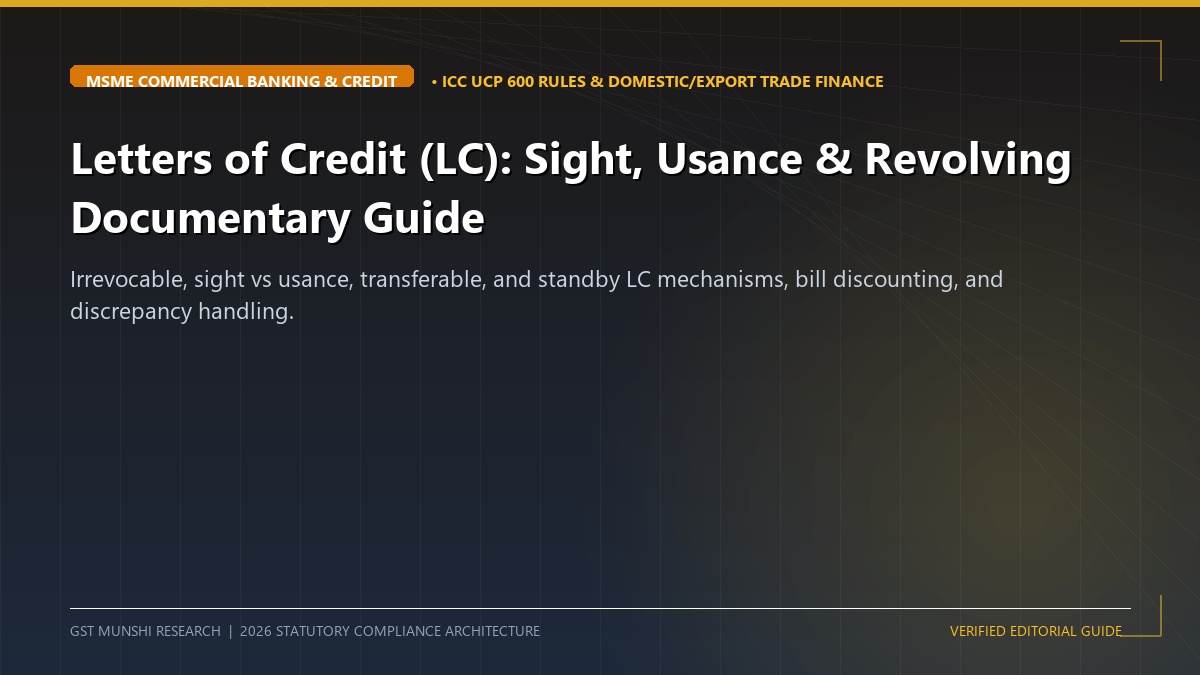
Direct Answer: What is a Letter of Credit and Which Type Should You Use?
What is a Letter of Credit (LC)?
In domestic and international trade, buyers and sellers face conflicting financial objectives: an exporter wants payment upfront before parting with physical merchandise, while an importer wants to inspect the goods before parting with cash. When counterparties operate in different legal jurisdictions or have no established credit history, the risk of non-payment or non-delivery paralyzes commerce.
A Letter of Credit (Documentary Credit) resolves this trade impasse by substituting the buyer's private creditworthiness with the statutory creditworthiness of a regulated commercial bank. The buyer's bank guarantees that if the seller manufactures, ships the goods, and presents authentic transport proofs (such as Bills of Lading or Lorry Receipts) meeting the exact parameters of the credit, payment is unconditionally guaranteed.
The Fundamental Legal Axiom: Independence Principle (UCP 600 Article 4)
An LC is legally completely separate from the underlying commercial sale contract. Banks deal in documents, not in goods. Even if a buyer claims that the delivered goods are defective, the issuing bank cannot withhold payment if the presented documents are strictly compliant on their face.
The 4 Key Parties in an LC Transaction
The purchasing entity that requests their bank to open the credit in favor of the seller, pledging cash margins or sanctioned non-fund-based working capital limits.
The financial institution that establishes the LC, committing its independent balance sheet to honor compliant document presentations by the beneficiary.
The seller's bank in their home country that authenticates the SWIFT MT700 message. If the seller requests a Confirmed LC, this bank adds its own independent payment guarantee.
The manufacturing or trading entity in whose favor the credit is issued, entitled to receive payment upon presenting strictly compliant shipping documents.
Core Types: Sight LC, Usance LC & Revolving LC
1. Sight Letter of Credit (Sight LC)
Under a Sight LC, payment is due "at sight" (immediately upon presentation). Once the beneficiary submits the documents to the nominated bank and they reach the issuing bank, the issuing bank has up to 5 banking days to verify compliance. Once verified, funds are wired immediately via SWIFT or RTGS.
2. Usance / Acceptance Letter of Credit (Deferred Payment LC)
Under a Usance LC, the credit establishes a defined payment tenor—such as 30, 60, 90, or 180 days from the Bill of Lading date (or document presentation date). The issuing bank accepts the bill of exchange (draft) and commits to pay on the specified maturity date. The buyer can take delivery of the goods, process or sell them, and generate cash flow before the payment falls due.
3. Revolving Letter of Credit
Designed for regular, continuous shipments between established trading partners. Instead of issuing separate LCs for each monthly batch, a Revolving LC establishes a fixed credit amount (e.g. ₹1 Crore) that automatically restores its limit upon each shipment settlement or upon a time-elapsed trigger (e.g. monthly) across a 12-month period.
Advanced Variants: Standby LC, Transferable & Back-to-Back
Standby LC (SBLC)
Governed by ISP98 / UCP 600, an SBLC functions like a financial Bank Guarantee. It is an instrument of default: the beneficiary draws on the SBLC only if the buyer fails to pay via standard open account channels.
Transferable LC
Used by trading intermediaries who do not manufacture goods. The middleman transfers a portion of the master LC to the actual secondary manufacturer, keeping their commercial trade margin intact.
Back-to-Back LC
Where the master LC is non-transferable, the intermediary pledges the incoming master LC as collateral to open a completely separate secondary LC in favor of their supplier.
ICC UCP 600 Rules & The 5-Day Examination Standard
Almost all commercial Letters of Credit globally are issued subject to the ICC Uniform Customs and Practice for Documentary Credits (UCP 600). Key articles governing banking conduct include:
- Article 14 (Standard for Examination of Documents): The nominated bank and issuing bank have a maximum of 5 banking days following the day of presentation to examine documents and determine if they are conforming.
- Article 16 (Discrepant Documents & Notice): If a bank refuses payment due to discrepancies, it must give a single formal notice by telecommunication (SWIFT MT734) listing each discrepancy and stating whether it is holding or returning the documents.
- Article 20 (Bills of Lading): Must indicate the name of the carrier, be signed by the master or named agent, show goods loaded on board, and be dated within the credit window.
LC Bill Discounting: Cash Flow Acceleration
Under a 90-day or 180-day Usance LC, an exporter's working capital is tied up until maturity. LC Bill Discounting allows the exporter to convert deferred receivables into immediate liquidity:
For example, on a ₹50,00,000 Usance LC with 90-day tenor discounted at 8.25% p.a. MCLR: Discount charge is ₹1,01,712. The exporter immediately receives ₹48,98,288 upfront, eliminating all counterparty payment delays.
Bank Margins, Commissions & Issuance Costs
| Charge Component | Standard Bank Tariff in India | Payable By |
|---|---|---|
| LC Issuance Commission | 0.25% to 0.75% per quarter (min ₹2,500) | Applicant (Buyer) |
| Cash Margin / FD Lien | 10% to 25% (under sanctioned limit) or 100% (cash LC) | Applicant (Buyer) |
| Advising & SWIFT Charges | ₹1,500 to ₹3,000 per transmission | As per LC terms (usually Beneficiary) |
| Discrepancy Fee | $75 to $150 (approx ₹6,500 to ₹12,500) per set | Deducted from Beneficiary payout |
Mandatory Trade Documents in LC Presentation
Commercial & Fiscal Records
- Commercial Invoice showing exact description, quantity, and unit prices matching LC terms.
- Packing List itemizing gross weight, tare weight, net weight, and packaging dimensions.
- Certificate of Origin issued by an authorized Chamber of Commerce.
- GST E-Way Bill and Tax Invoice (for domestic Inland LCs).
Transport & Insurance Records
- Full set (3/3) of clean "On Board" Ocean Bills of Lading, Air Waybills, or Lorry Receipts.
- Marine / Transit Insurance Certificate covering 110% of CIF invoice value under ICC (A) clauses.
- Third-party Quality Inspection Certificate (e.g. SGS, Bureau Veritas) if mandated in LC.
- Bill of Exchange (Draft) drawn on the issuing bank at sight or usance tenor.
Step-by-Step LC Transaction Lifecycle
Contract Finalization
Buyer and seller conclude a sales contract specifying payment terms as an Irrevocable Letter of Credit.
LC Issuance via SWIFT MT700
Buyer submits the LC application and margins to the Issuing Bank, which transmits the credit via SWIFT MT700 to the Advising Bank.
Shipment of Goods
Seller inspects the LC terms, manufactures goods, ships them before the Latest Shipment Date, and collects Bills of Lading.
Document Presentation & Examination
Seller presents documents to the bank within the 21-day presentation window. Banks examine compliance under UCP 600.
Payment & Document Release
Issuing bank honors the draft, transfers funds to seller's bank, and hands original transport proofs to buyer to clear customs.
Comparison: Sight LC vs Usance LC vs Standby LC (SBLC)
| Feature | Sight LC | Usance LC | Standby LC (SBLC) |
|---|---|---|---|
| Payment Timing | Within 5 banking days of document presentation | At future maturity (e.g. 90/180 days from BL) | Only if buyer defaults under underlying contract |
| Financing Benefit | No trade credit to buyer | Provides working capital credit to buyer | Acts as secondary backstop guarantee |
| Bill Discounting | Not applicable | Highly popular (immediate liquidity for seller) | Not applicable |
Real-World Trade Finance Scenarios
1Textile Exporter to Germany: Usance LC Discounting
A Tirupur garment exporter shipped $200,000 worth of apparel under a 90-day Usance LC issued by Deutsche Bank. Rather than waiting 90 days, the exporter discounted the accepted draft with SBI at SOFR + 1.50%.
2Steel Importer: Stale Bill of Lading Discrepancy
An importer in Mumbai received an LC shipment from South Korea. The seller presented documents to their bank on Day 23 after the Bill of Lading date, exceeding UCP 600 Article 14(c)'s 21-day presentation limit.
Top 7 Fatal LC Document Discrepancies
Risks & Commercial Limitations
- Strict Compliance Trap: Over 60% of original LC document presentations contain clerical errors on the first pass, incurring costly discrepancy fees and delays.
- Working Capital Blockage: The buyer's bank holds 10% to 25% cash margin or blocks equivalent working capital credit lines until the LC is discharged.
- Fraud Exception: While banks cannot stop payment for defective goods, Courts may grant an injunction if clear, established fraud by the seller is proven before payment.
RBI Master Directions & FEMA Regulations
In India, all cross-border Letters of Credit must comply with the Foreign Exchange Management Act (FEMA), 1999 and RBI Master Direction on External Commercial Borrowings, Trade Credits and Structured Obligations:
- Trade Credit Tenor: For import of non-capital goods, Usance LC credit period cannot exceed 1 year or the operating cycle, whichever is lower. For capital goods, credit up to 3 years is permitted under the automatic route.
- IDPMS & EDPMS Tracking: Import and export transactions are monitored on RBI's Import Data Processing and Monitoring System (IDPMS) to ensure physical customs Bill of Entry matches banking remittances within 6 months.
LC Selection Decision Matrix
| Trade Scenario | Recommended LC Type | Strategic Benefit |
|---|---|---|
| New overseas buyer, high political or sovereign risk | Confirmed Sight LC | Zero credit risk; domestic confirming bank guarantees immediate cash on presentation. |
| Buyer requires working capital to process imported goods | Usance LC (60/90 Days) | Buyer gets trade credit; seller can discount the accepted draft for immediate cash. |
| Ongoing annual deliveries under recurring supply agreement | Revolving LC | Re-activates automatically; saves repetitive bank application costs. |
Exporter & Importer LC Pre-Flight Checklist
Scrutinize Draft LC Text Before Issuance: Verify incoterms, latest shipment date, presentation period, and exact goods description.
Check Latest Shipment & Expiry Dates: Ensure shipping lines guarantee vessel departure at least 7 days before Field 44C cutoff.
Ensure Exact Word-for-Word Invoice Match: Avoid synonymous phrasing; match every comma and description under UCP 600 Article 18.
Track Presentation Within 21 Days: Lodge all original documents with your negotiating bank well within the deadline.
Recommended Video Tutorials & Practical Walkthroughs
Watch these handpicked, expert video guides covering practical compliance, step-by-step procedures, and real-world implementation:
Recommended Video Tutorials & Practical Guides
Frequently Asked Questions (FAQs)
What is a Letter of Credit (LC) in banking?
▼
A Letter of Credit (LC), also called Documentary Credit, is a definitive undertaking issued by a bank (Issuing Bank) on behalf of a buyer (Applicant) guaranteeing to pay the seller (Beneficiary) a specified sum, provided the seller presents compliant shipping and commercial documents strictly matching the terms of the credit under ICC UCP 600 rules.
What is the primary difference between a Sight LC and a Usance LC?
▼
Under a Sight LC, the issuing bank must make payment immediately upon receiving and verifying compliant shipping documents (within a maximum of 5 banking days under UCP 600). Under a Usance LC (Deferred Payment LC), the buyer receives a credit period (such as 30, 60, 90, or 180 days after the Bill of Lading date), and payment is made by the bank on the predetermined future maturity date.
Can a seller get immediate cash under a Usance LC before the maturity date?
▼
Yes. Through LC Bill Discounting (or Bill Purchase), the seller's bank discounts the accepted draft/bill and disburses immediate liquidity to the seller at a nominal discount interest rate (linked to MCLR or SOFR), while collecting the full face amount from the issuing bank upon final maturity.
What are UCP 600 rules governing Letters of Credit?
▼
UCP 600 refers to the Uniform Customs and Practice for Documentary Credits (Publication No. 600) codified by the International Chamber of Commerce (ICC). It provides standardized global legal rules governing documentary verification, examination timelines (5 banking days), bank obligations, and handling of discrepancies.
How much margin money does an Indian bank require to open a Letter of Credit?
▼
For businesses with an approved non-fund-based banking limit, banks typically require a cash margin of 10% to 25% in the form of Fixed Deposits or collateral liens. For companies without an approved credit line, banks require 100% to 110% cash margin (FD lien) to issue the LC.
What happens if there is a discrepancy in the LC documents presented by the seller?
▼
If the submitted documents contain discrepancies (such as spelling mismatches, late shipment dates, missing signatures, or inconsistent weights), the issuing bank has the legal right to refuse payment. The bank issues a formal discrepancy notice under UCP 600 Article 16, and payment will only proceed if the buyer provides a formal written discrepancy waiver.
Statutory Sources & Regulatory References
- International Chamber of Commerce (ICC) – Uniform Customs and Practice for Documentary Credits (UCP 600).
- Reserve Bank of India (RBI) – Master Direction on External Commercial Borrowings, Trade Credits and Structured Obligations.
- Foreign Exchange Management Act, 1999 (FEMA) – Regulations on Import and Export Settlements.
- FEDAI (Foreign Exchange Dealers’ Association of India) Rules for Documentary Credits.