GST on Corporate Guarantee: Rule 28(2) Valuation & Circular 204/225 Guide
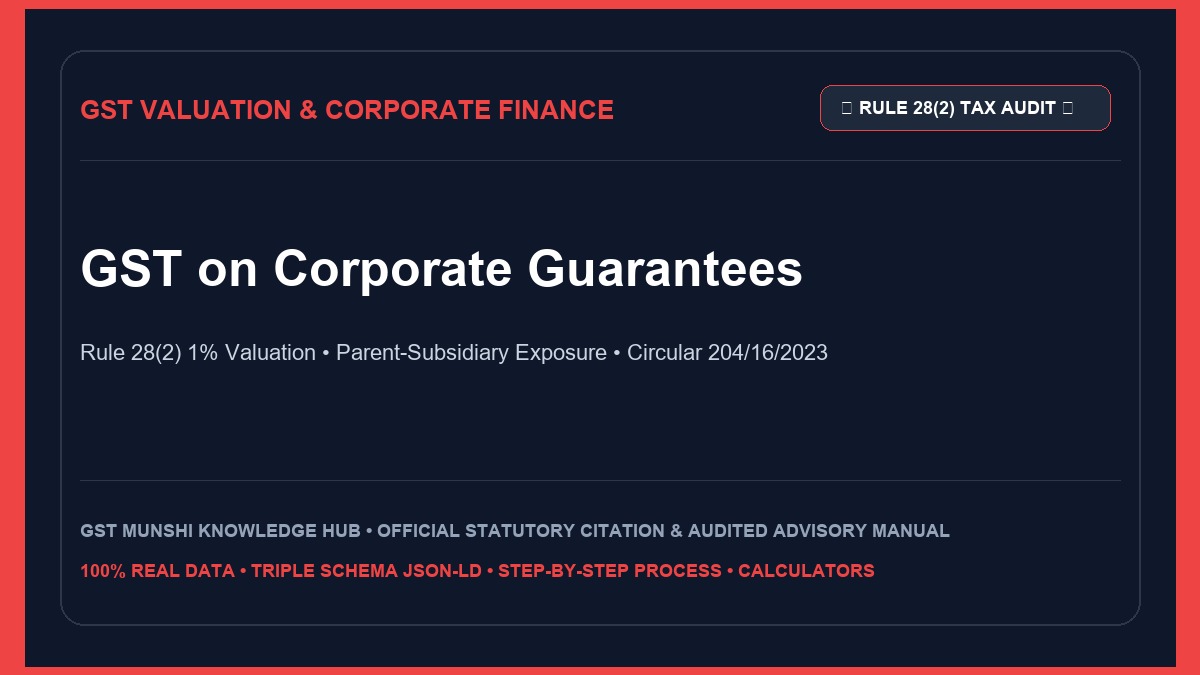
The definitive corporate tax guide to navigating GST on intra-group corporate guarantees. Master the 1% statutory annual deeming valuation under Rule 28(2), Reverse Charge Mechanism (RCM) liabilities on cross-border guarantees from foreign parent entities, director personal guarantee exemptions, and revenue-neutral ITC pass-through mechanics.
Direct Answer: How is GST Calculated and Levied on Corporate Guarantees?
1. Overview & Legislative Background of Corporate Guarantee Taxation
In modern corporate finance, holding companies frequently provide corporate guarantees to commercial banks, NBFCs, and overseas consortium lenders to facilitate credit lines, working capital facilities, or project loans for their subsidiary companies and joint ventures. Historically, Indian parent entities provided these guarantees without levying any guarantee commission.
Under Section 7(1)(c) read with Schedule I, Paragraph 2 of the CGST Act, supplies of goods or services between related persons in the course or furtherance of business are treated as taxable supplies even when made without consideration. Following conflicting advance rulings and extensive audit demands, the GST Council in its 52nd meeting recommended a standardized valuation rule, leading to the enactment of Rule 28(2) of the CGST Rules via Notification No. 52/2023-Central Tax on October 26, 2023.
2. The Rule 28(2) Statutory Valuation Architecture
Rule 28(2) introduced an overriding valuation rule specifically for corporate guarantees, departing from normal open market value principles:
Statutory Valuation Formula under Rule 28(2)
(a) 1.0% per annum of the guaranteed amount, OR
(b) Actual consideration charged by the guarantor to the recipient.
At the standard service tax rate of 18%, this deemed 1% valuation imposes a gross tax liability of 0.18% per year on the principal loan amount guaranteed.
3. Key Clarifications under Circular No. 204 & Circular No. 225
Following corporate representations regarding multi-year loans and overlapping facilities, the CBIC issued Circular No. 204/16/2023-GST (Oct 2023) and Circular No. 225/19/2024-GST (July 2024), establishing four vital operational principles:
1. Annual Pro-Rata Application
The 1% valuation is strictly an annual rate ("per annum"). If a guarantee is issued or invoked for a fraction of a year (e.g., 6 months for a seasonal working capital limit), the taxable value is apportioned proportionately (0.50% for 6 months).
2. Actual Sanctioned / Disbursed Value
Circular 225 clarified that the 1% fee applies to the actual credit facility sanctioned and made available to the subsidiary, rather than hypothetical or open-ended legal exposures.
3. Timing of Tax Invoice
Under Section 13 read with Section 31(5) of the CGST Act, the continuous supply of guarantee services requires the parent entity to issue an annual tax invoice at the commencement or renewal of each guarantee year.
4. Consortium Joint Guarantees
Where multiple group entities jointly guarantee a single credit facility, the aggregate deemed valuation across all co-guarantors cannot exceed 1% per annum of the guaranteed amount.
4. Domestic Parent Company vs Foreign Holding Entity (RCM)
| Parameter | Domestic Parent Guarantee | Foreign Holding Company Guarantee |
|---|---|---|
| Location of Supplier | India (Holding Co) | Outside India (Foreign Parent) |
| Tax Mechanism | Forward Charge (Parent invoices subsidiary) | Reverse Charge Mechanism (RCM u/s 5(3) IGST) |
| Applicable Tax | CGST + SGST (intra-state) or IGST (inter-state) | 18% IGST under RCM |
| Tax Invoicing Protocol | Parent issues Tax Invoice under Section 31 | Indian subsidiary issues Self-Invoice under Section 31(3)(f) |
| ITC Availability | 100% ITC via GSTR-2B | 100% ITC upon cash ledger RCM payment |
5. Corporate Guarantees vs Director Personal Guarantees
One of the most consequential clarifications in Circular No. 204/16/2023-GST was the complete tax exclusion granted to personal guarantees provided by company directors:
Director Personal Guarantee: 0% GST
RBI Master Circular DBOD.No.Dir.BC.14/13.03.00/2014-15 mandates that banks cannot permit any consideration, commission, or fee to be paid to promoters/directors for executing personal guarantees. Because no consideration is paid and RBI rules legally prohibit consideration, the Open Market Value is Nil. No GST is payable.
Corporate Guarantee: 18% GST on 1%
Corporate guarantees between legal entities are governed by commercial corporate law, not personal promoter mandates. Rule 28(2) strictly applies its 1% per annum statutory deeming fiction regardless of whether the holding company charged zero fees.
6. Full ITC Eligibility & Revenue Neutrality Mechanics
In standard corporate holding structures where the operating subsidiary manufactures taxable goods or renders taxable services, the imposition of GST on corporate guarantees is substantively revenue-neutral:
The Second Proviso to Rule 28 / Rule 28(2):
Where the recipient subsidiary is eligible for full Input Tax Credit under Section 16(1), the GST paid by the subsidiary (either reimbursed to the parent or discharged under RCM) is immediately available as an offset against its outward GST liabilities in Form GSTR-3B.
Crucial Caveat: The transaction becomes a real cash cost ONLY when the recipient entity makes exempt supplies (e.g. real estate residential construction, electricity, or healthcare), where ITC is blocked or apportioned under Rule 42.
7. Real-World Corporate Guarantee Calculation Scenarios
Parent: Alpha Corp Ltd (Mumbai)
Subsidiary: Alpha Infra Ltd (Pune)
Guarantee Provided: ₹100 Crore term loan to State Bank of India
Commission Charged: Nil
Deemed Taxable Value (1%): ₹1,00,00,000 / year
GST Payable (18% CGST+SGST): ₹18,00,000 / year
ITC Claimed by Alpha Infra: ₹18,00,000 (Full Offset)
Parent: Global Holdings Inc (Delaware, USA)
Subsidiary: Global Tech India Pvt Ltd (Bengaluru)
Guarantee Provided: $10 Million (~₹83 Crore) working capital facility
Commission Charged: Nil
Deemed Taxable Value (1%): ₹83,00,000 / year
IGST under RCM (18%): ₹14,94,000 / year (Paid via Cash Ledger)
ITC Claimed in Table 4(A)(3): ₹14,94,000
8. High Court Constitutional Challenges & Writ Petitions
Rule 28(2) has been challenged across several High Courts (Delhi, Punjab & Haryana, and Madras) on substantive constitutional grounds:
Ultra Vires Section 15 of CGST Act
Section 15(4) mandates that valuation rules must approximate the transaction value or open market value. Petitioners argue that fixing an arbitrary, rigid 1% rate by delegated legislation is arbitrary and unconstitutional.
Delhi High Court Interim Orders
In cases such as Sterlite Power Transmission Ltd and M/s Bharti Airtel Ltd, the Delhi High Court granted interim protection, directing that while tax proceedings may continue, no coercive recovery action shall be taken pending final constitutional determination.
9. Audit Defenses for Pre-October 2023 Corporate Guarantees
Tax authorities frequently issue SCNs demanding 18% GST on corporate guarantees executed during financial years 2017-18 through 2022-23 (prior to the notification of Rule 28(2) on October 26, 2023). Key legal defenses include:
- Prospective Operation: Notification No. 52/2023-CT contains no retrospective clause. Under settled Supreme Court jurisprudence, substantive valuation rules altering tax liabilities operate prospectively from October 26, 2023 onwards.
- Second Proviso to Rule 28 Protection: For periods prior to Rule 28(2), taxpayers can rely on the second proviso to Rule 28, which states that where the recipient is eligible for full ITC, the value declared in the invoice (even if Nil) is deemed to be the open market value.
- CESTAT Precedents: Landmark decisions in Edelweiss Financial Services (Supreme Court upheld) established that providing a corporate guarantee without consideration does not constitute a taxable service.
10. Corporate Treasury Action Checklist
Recommended Video Tutorials & Practical Walkthroughs
Watch these handpicked, expert video guides covering practical compliance, step-by-step procedures, and real-world implementation:
Recommended Video Tutorials & Practical Guides
11. Frequently Asked Questions
What is Rule 28(2) of the CGST Rules regarding corporate guarantees?↓
Inserted via Notification No. 52/2023-Central Tax dated October 26, 2023, Rule 28(2) prescribes that the value of supply of services between related persons by way of providing a corporate guarantee to any banking company or financial institution on behalf of the recipient shall be deemed to be 1% of the amount of such guarantee offered per annum, or the actual consideration, whichever is higher.
Is GST payable if a parent company provides a corporate guarantee without charging any consideration?↓
Yes. Under Section 7(1)(c) read with Schedule I, Paragraph 2 of the CGST Act, supplies between related persons (parent and subsidiary) in the course or furtherance of business are taxable even if made without consideration. Under Rule 28(2), the transaction is deemed to have a taxable value of 1% per annum of the guaranteed amount, attracting 18% GST.
How does GST apply when a foreign parent company guarantees an Indian subsidiary's loan?↓
When a foreign holding entity provides a guarantee to an Indian or international bank for credit facilities extended to its Indian subsidiary, the transaction constitutes an import of service between related persons. Under Notification No. 10/2017-Integrated Tax (Rate), the Indian subsidiary must pay 18% IGST under the Reverse Charge Mechanism (RCM) on 1% per annum of the guaranteed amount.
Can the recipient subsidiary claim full Input Tax Credit (ITC) of the GST paid on corporate guarantee?↓
Yes. Provided the subsidiary is engaged in making taxable outward supplies, the corporate guarantee is an inward business service eligible for 100% ITC under Section 16(1). Circular No. 225/19/2024-GST confirmed that where the recipient is eligible for full ITC, the invoice value can be accepted as open market value under the second proviso to Rule 28 for domestic transactions.
Is GST applicable on personal guarantees provided by directors to banks for company loans?↓
No, provided no consideration is paid to the director. CBIC Circular No. 204/16/2023-GST clarified that as per RBI Master Circular guidelines, promoters and directors cannot be paid any commission, brokerage, or remuneration for executing personal guarantees. Therefore, the open market value of a personal guarantee without consideration is treated as zero, and NO GST is payable.
What did Circular No. 225/19/2024-GST clarify regarding guarantee duration and co-guarantors?↓
Circular 225 clarified that the 1% annual valuation under Rule 28(2) applies proportionally for the exact duration the guarantee is active, and is calculated on the actual sanctioned/disbursed loan amount rather than the outer theoretical limit. Furthermore, if multiple group entities provide a joint corporate guarantee, the total aggregate valuation remains capped at 1% per annum across all co-guarantors.
12. Official Statutory Circulars & Related Guides
Official statutory references: Rule 28(2) of the CGST Rules, 2017 (Notification No. 52/2023-Central Tax); CBIC Circular No. 204/16/2023-GST dated October 27, 2023; CBIC Circular No. 225/19/2024-GST dated July 11, 2024; and Section 7(1)(c) read with Schedule I of the Central Goods and Services Tax Act, 2017.