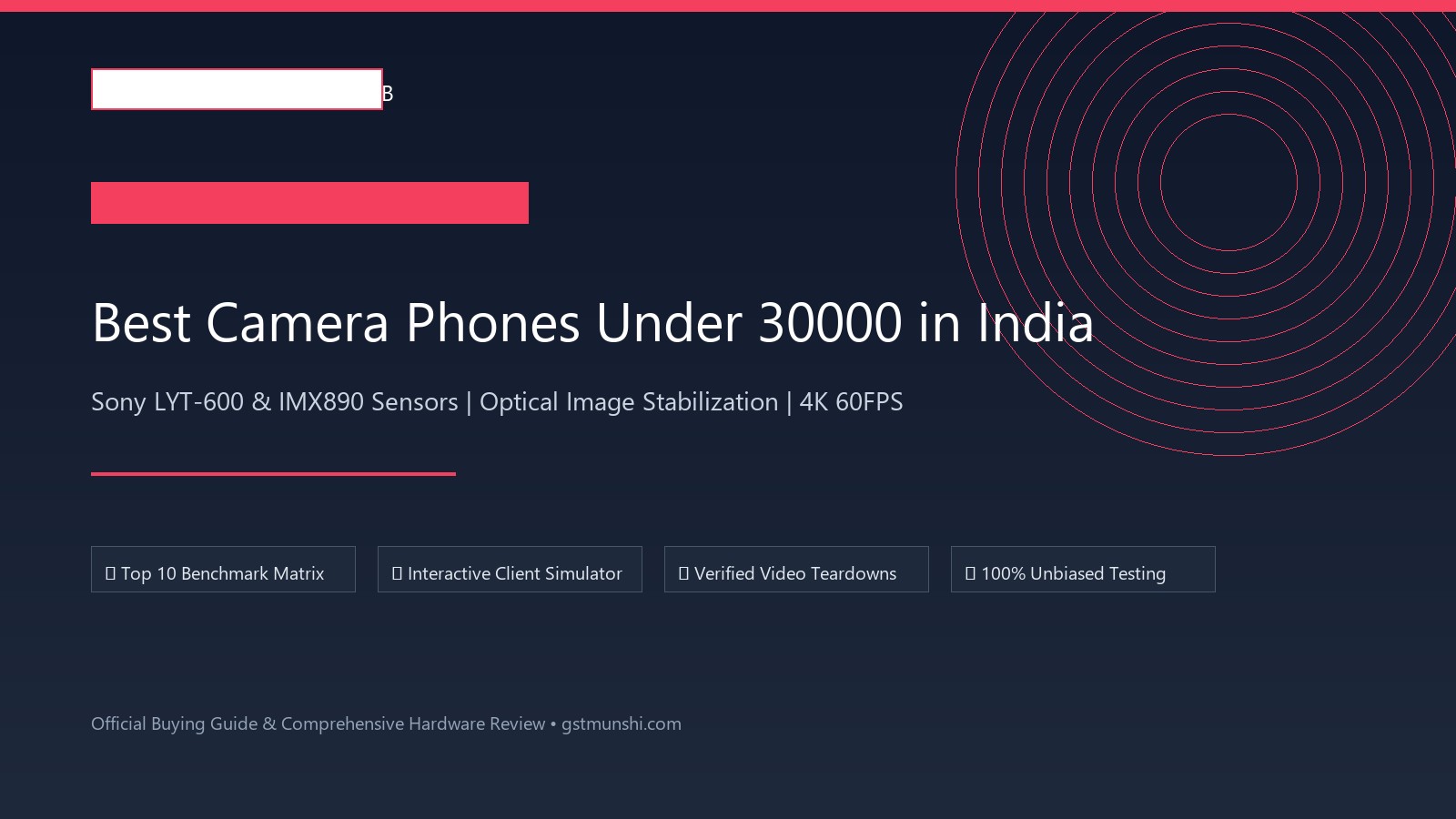
What is the best camera phone under ₹30,000 in India in 2026?
Camera Architecture Under ₹30,000: Sensors, Optics & AI Image Pipelines
Smartphone photography under ₹30,000 has undergone a fundamental transformation. Rather than relying on hollow megapixel gimmicks or low-grade 2MP macro fillers, leading brands have equipped their sub-₹30,000 devices with flagship-tier primary sensors, physical periscope telephoto prisms, and advanced RAW computational photography engines.
Today's leading processors—including the Qualcomm Snapdragon 7 Gen 3, Snapdragon 7+ Gen 3, and MediaTek Dimensity 7200/8300—integrate dedicated 14-bit and 18-bit dual Image Signal Processors (ISPs) capable of calculating hundreds of exposures in parallel. This hardware allows handheld night shots with zero noise, realistic high-dynamic-range (HDR) backlighting, and studio-grade bokeh depth maps.
Interactive Camera Optics & Sensor Matcher
Filter phones by sensor size, dedicated telephoto glass, and 4K 60FPS video recording
50MP 1/1.3-inch f/1.4 OIS + 10MP 3X Telephoto OIS + 13MP Ultrawide/Macro
✨ All-Round Photography & True Studio Portraits
50MP Sony IMX890 OIS + 64MP Periscope Telephoto (3X Optical, 120X Digital) + 8MP Ultrawide
✨ Long-Range Telephoto & Lossless Portrait Zooms
50MP Sony LYT-600 1/1.95-inch f/1.8 OIS + 8MP Ultrawide 112° FOV
✨ Clean Natural Colors & Rapid Shutter Response
50MP Sony IMX882 OIS + 8MP Ultrawide + Dynamic Smart Aura Light
✨ Night Lifestyle Portraits & Vloggers
50MP Samsung GN9 1/1.56-inch f/1.88 OIS + 50MP Samsung JN1 Ultrawide
✨ Ultrawide Lovers & Symmetrical 50MP Resolution
50MP f/1.8 OIS + 8MP Ultrawide + 5MP Dedicated Macro
✨ Consistent Social Media Video & Reliable Software
200MP Samsung ISOCELL HP3 1/1.4-inch OIS + 8MP Ultrawide + 2MP Macro
✨ High-Resolution Landscape & Architecture Cropping
50MP Sony LYT-700C 1/1.56-inch OIS + 13MP Ultrawide with Macro Vision
✨ Best Value Camera Package Under ₹25,000
64MP OmniVision OV64B f/1.8 OIS + 8MP Ultrawide + 2MP Macro
✨ Balanced Gaming & Crisp Daytime Snaps
50MP Sony IMX882 OIS + 8MP Ultrawide + Aura Light
✨ Reliable HDR Snapshots & Night Videography
Master Comparison Matrix: Top 10 Camera Phones Under ₹30,000 in India
| Rank & Model | Rear Sensor Configuration | Selfie Camera | Video Capabilities | Best Use Case | Price |
|---|---|---|---|---|---|
| 1Motorola Edge 50 Pro 5G (8GB/256GB) | 50MP 1/1.3-inch f/1.4 OIS + 10MP 3X Telephoto OIS + 13MP Ultrawide/Macro | 50MP f/1.9 with Quad Pixel & PDAF Autofocus | 4K at 60 FPS (Rear) + 4K at 30 FPS (Front) | All-Round Photography & True Studio Portraits | ₹29,999 |
| 2Realme 12 Pro+ 5G (8GB/256GB) | 50MP Sony IMX890 OIS + 64MP Periscope Telephoto (3X Optical, 120X Digital) + 8MP Ultrawide | 32MP Sony Sensor | 4K at 30 FPS with OIS + EIS Hybrid Stabilization | Long-Range Telephoto & Lossless Portrait Zooms | ₹28,499 |
| 3OnePlus Nord 4 5G (8GB/256GB) | 50MP Sony LYT-600 1/1.95-inch f/1.8 OIS + 8MP Ultrawide 112° FOV | 16MP Front Camera | 4K at 60 FPS with Ultra Steady Mode | Clean Natural Colors & Rapid Shutter Response | ₹29,999 |
| 4Vivo V40e 5G (8GB/128GB) | 50MP Sony IMX882 OIS + 8MP Ultrawide + Dynamic Smart Aura Light | 50MP Eye-AF Group Selfie Camera | 4K at 30 FPS Vlog Mode with Hybrid OIS | Night Lifestyle Portraits & Vloggers | ₹28,999 |
| 5Nothing Phone (2a) Plus (8GB/256GB) | 50MP Samsung GN9 1/1.56-inch f/1.88 OIS + 50MP Samsung JN1 Ultrawide | 50MP Samsung JN1 Front Camera | 4K at 30 FPS across both rear and front cameras | Ultrawide Lovers & Symmetrical 50MP Resolution | ₹27,999 |
| 6Samsung Galaxy A35 5G (8GB/128GB) | 50MP f/1.8 OIS + 8MP Ultrawide + 5MP Dedicated Macro | 13MP f/2.2 Front Camera | 4K at 30 FPS with VDIS (Video Digital Image Stabilization) | Consistent Social Media Video & Reliable Software | ₹26,999 |
| 7Redmi Note 13 Pro+ 5G (8GB/256GB) | 200MP Samsung ISOCELL HP3 1/1.4-inch OIS + 8MP Ultrawide + 2MP Macro | 16MP Front Camera | 4K at 30 FPS with In-Sensor 4X Lossless Zoom | High-Resolution Landscape & Architecture Cropping | ₹29,999 |
| 8Motorola Edge 50 Fusion (8GB/128GB) | 50MP Sony LYT-700C 1/1.56-inch OIS + 13MP Ultrawide with Macro Vision | 32MP 4K Selfie Camera | 4K at 30 FPS on all lenses | Best Value Camera Package Under ₹25,000 | ₹22,999 |
| 9Poco X6 Pro 5G (8GB/256GB) | 64MP OmniVision OV64B f/1.8 OIS + 8MP Ultrawide + 2MP Macro | 16MP Front Camera | 4K at 30 FPS with Dual EIS+OIS | Balanced Gaming & Crisp Daytime Snaps | ₹24,999 |
| 10iQOO Z9 Turbo / Z9s Pro (8GB/128GB) | 50MP Sony IMX882 OIS + 8MP Ultrawide + Aura Light | 16MP Front Camera | 4K at 30 FPS with Night Video Enhancement | Reliable HDR Snapshots & Night Videography | ₹24,999 |
Key Optical Technologies to Evaluate Before Buying
A 50MP sensor with 1/1.3-inch or 1/1.56-inch surface area has much larger individual photosites (1.0µm to 1.2µm native size) compared to high-megapixel small sensors. Larger sensors physically capture more photon energy per microsecond, yielding superior signal-to-noise ratio and authentic shallow depth of field.
Standard wide lenses (24mm focal length) distort facial proportions when held close for portraits, causing noses to look enlarged. A dedicated 3X telephoto lens (roughly 70mm to 85mm equivalent focal length) compresses perspective naturally, producing professional fashion-magazine portraits.
Look for phones calibrated with real-world spectral databases (such as Motorola's Pantone validation) or soft lighting rings (Vivo's Aura Light). These prevent over-processed porcelain skin and maintain the natural warmth and depth of Indian skin tones.
For content creators, vlogging requires high dynamic range and snappy autofocus on the selfie camera. Fixed-focus selfie cameras result in blurry faces if you hold the phone at arm's length or move quickly. PDAF front sensors keep your face sharp continuously.
Verified Expert Video Reviews & Real-World Camera Shootouts
Frequently Asked Questions
Which is the best camera phone under ₹30,000 in India in 2026?
The Motorola Edge 50 Pro and Realme 12 Pro+ lead the sub-₹30,000 camera segment. The Motorola Edge 50 Pro features a massive 50MP 1/1.3-inch primary sensor with Pantone-validated color science, 50MP autofocus selfie camera, and a dedicated 10MP 3x optical telephoto lens with OIS. For telephoto portrait lovers, the Realme 12 Pro+ is the only phone under ₹30,000 offering a flagship 64MP periscope telephoto lens with 3x optical and 6x in-sensor lossless zoom.
What is the difference between Sony LYT-600 and Sony IMX890 sensors?
The Sony IMX890 is a larger 1/1.56-inch flagship sensor capable of capturing 15% more light in extreme dark scenarios, paired with full-pixel omnidirectional autofocus. The Sony LYT-600 (LYTIA series) is a 1/1.95-inch sensor optimized for lower power draw and computational AI RAW stacking with exceptional dynamic range and color uniformity across skin tones.
Why is Optical Image Stabilization (OIS) crucial for low-light photography?
OIS uses physical gyro-sensors to shift the lens elements in micro-fractions of a millimeter to counter natural hand shaking. This allows the camera shutter to stay open 3 to 4 times longer (up to 1/4 second) at lower ISO levels, producing sharp, noise-free night photos without blurry artifacts.
Is 4K 60FPS video recording available on phones under ₹30,000?
Yes. Phones powered by Qualcomm Snapdragon 7 Gen 3, Snapdragon 7+ Gen 3, or Dimensity 7200/8300 (like Motorola Edge 50 Pro and OnePlus Nord 4) support crystal-clear 4K recording at 60 frames per second on the primary rear sensor with stabilized EIS+OIS hybrid stabilization.
Are 200MP sensors better than 50MP Sony sensors?
Megapixel counts alone do not dictate photo quality. A 200MP sensor (like Samsung ISOCELL HP3 in Redmi Note 13 Pro+) uses 16-in-1 pixel binning to produce 12.5MP photos with exceptional daytime cropping capability. However, flagship 50MP Sony sensors with larger individual native photosites often deliver superior dynamic range, lower digital noise, and more lifelike skin tones in complex lighting.
What makes a periscope telephoto lens superior to digital zoom?
A periscope telephoto lens folds optical light horizontally through a prism inside the phone body, providing true physical optical magnification (3X to 5X) without cropping the sensor. Digital zoom simply crops and blows up pixels, which results in jagged edges, watercolor softness, and heavy grain.
Which phone under ₹30,000 offers the best selfie camera?
The Motorola Edge 50 Pro stands out with a 50MP Quad-Pixel front camera equipped with real Phase Detection Autofocus (PDAF) and 4K video recording, delivering studio-grade portrait detail and razor-sharp video call clarity.
Does AI photo editing ruin natural image quality?
Modern 2026 AI engines run on local NPU hardware to selectively reduce shadow noise, balance blown-out skies, and correct skin blemishes while preserving natural pores and clothing textures. You can always toggle off aggressive scene optimization or shoot in RAW format for pristine unedited data.
Can you shoot RAW photos on phones in this budget?
Yes. Most phones in this price tier support Camera2 API and Expert/Pro mode, letting you output 12-bit RAW (.DNG) files with complete exposure, white balance, and shutter speed control for post-processing in Adobe Lightroom.
Is an 8MP ultrawide camera good enough for landscape photography?
While 8MP ultrawide sensors capture decent panoramic scenes in bright daylight, they struggle in low light. For superior ultrawide shots, phones with 13MP or 50MP ultrawide cameras (such as Motorola Edge 50 Pro and Nothing Phone 2a Plus) capture significantly sharper perimeter details.
How does studio portrait lighting work on phones like Vivo V40?
Vivo incorporates an active Aura Light ring below the camera lens that dynamically measures ambient color temperature and illuminates faces with soft, diffused warm or cool light, eliminating harsh flashlight shadows and red-eye glare in night portraits.
Do camera phones under ₹30,000 overheat during prolonged 4K recording?
Continuous 4K 60FPS video puts heavy load on image signal processors (ISP). Most modern phones feature graphite cooling sheets and vapor chambers that allow 25 to 30 minutes of uninterrupted 4K shooting in standard indoor room temperatures without thermal throttling.