Quick Summary & Key Takeaways (Featured Snippet)
Referral Income, Daily Payout & Section 194R TDS Simulator
Calculate your monthly gross referral earnings, net bank payout, and mandatory Section 194R TDS deductions.
Under Section 206AA, non-furnishing of PAN increases statutory TDS rate from 10% to 20% on perquisites above ₹20,000/year.
Annual Net Earnings: ₹72,900
The State of Referral Earning in India (2026–2027)
Customer acquisition dynamics across India's digital ecosystem have shifted dramatically. As digital advertising costs on Meta and Google continue to escalate, leading FinTech institutions, discount brokers, e-commerce platforms, and payments apps reallocate massive marketing budgets directly into customer referral programs.
Unlike fraudulent "task-based" or "video-watching" pyramid scams that demand upfront entry fees, legitimate refer-and-earn applications require ₹0 investment. They pay verified commissions funded directly by Customer Acquisition Cost (CAC) savings when invited friends complete real-world financial activities: opening a Demat account, taking a personal loan, purchasing mutual funds, or transacting via UPI.
| App Name | Industry Category | Referrer Reward | Referee Benefit | Payout Method | Min Withdrawal | KYC Mandate |
|---|---|---|---|---|---|---|
| ZerodhaTop Pick | Stock Broker (Demat) | 300 Reward Points + 10% Lifetime Brokerage Share | Free 30-day brokerage credit (equity) | Points redeemable for subscriptions / tools | 500 Points | Strict SEBI / PAN KYC |
| GrowwTop Pick | Investments & Mutual Funds | ₹100 to ₹300 per funded account | ₹100 welcome investment reward | Groww Wallet ➔ Direct Bank NEFT | ₹100 | Full PAN & Aadhaar KYC |
| Angel OneTop Pick | Full-Service Broker (Demat) | ₹300 to ₹750 Amazon / Flipkart Vouchers | Zero brokerage for 30 days up to ₹500 | Instant Gift Vouchers via SMS/Email | No minimum (instant) | SEBI Compliance KYC |
| NaviTop Pick | Digital Lending & Mutual Funds | Up to ₹850 (₹100 on Gold, ₹750 on Loan) | Free digital gold allocation worth ₹10–₹50 | Instant UPI Direct Bank Credit | ₹10 (Instant UPI) | PAN & Bank Account Link |
| CashKaroTop Pick | Cashback & Affiliate Shopping | 10% Lifetime Cashback on all friend purchases | ₹25 welcome cashback bonus | Direct NEFT Bank Transfer / Amazon Pay | ₹250 confirmed cashback | Bank Details & Phone OTP |
| Gromo | Financial Products Reseller | ₹500 to ₹2,500 per Credit Card / Loan sold | Training & instant distributor license | Direct Bank Transfer every week | ₹100 | Full PAN, Aadhaar & Bank KYC |
| Google PayTop Pick | UPI Payments | ₹101 to ₹201 on friend's first payment | ₹21 cashback on first transaction | Instant Direct Bank Account Credit | Instant (Direct to Bank) | Bank account linked with mobile number |
| PhonePeTop Pick | UPI Payments | ₹100 to ₹200 on first UPI money transfer | Merchant discount coupons worth ₹500+ | PhonePe Wallet / Direct Bank | Instant to Wallet/Bank | UPI Mobile Authentication |
| Upstox | Discount Brokerage | ₹300 to ₹600 per successful account opening | Zero brokerage on equity delivery | Upstox Wallet ➔ Bank Account | ₹100 | SEBI Compliant Demat KYC |
| EarnKaro | Affiliate Link Sharing | 10% of friend's monthly earned profit | Free tools & affiliate shortener | Direct Bank NEFT | ₹10 | Bank Details & PAN Card |
One-Time Referral Bounties vs Passive Recurring Royalties
Not all referral programs function identically. Discerning participants distinguish between instant one-time bounties and recurring passive revenue shares to maximize both immediate cash flow and sustained long-term earnings.
One-Time Action Bounties
You receive a predetermined lump-sum reward immediately after your referee registers and executes their first qualifying event.
- Examples: Navi (₹100–₹850 on loan/gold), Angel One (₹500 voucher), Google Pay (₹101 on first payment).
- Pros: Predictable payouts, fast settlement (under 24–48 hours), high absolute payout per conversion.
- Cons: Linear effort; when you stop inviting new users, your income drops to zero immediately.
Lifetime Passive Royalties
You receive a perpetual percentage cut of the revenue or cashback generated by your referee as long as they remain active customers.
- Examples: Zerodha (10% lifetime brokerage share), CashKaro (10% lifetime referral cashback on all online shopping).
- Pros: True automated passive income; 50 active traders or regular shoppers generate continuous monthly payouts.
- Cons: Slower initial earnings; relies entirely on the long-term engagement habits of your invitees.
Statutory Taxation: Section 194R & ITR Reporting
Many casual online earners mistakenly assume that referral rewards credited to digital wallets or bank accounts are "tax-free gifts". Under the Indian Income Tax Act 1961, all promotional incentives, affiliate commissions, and referral perquisites are legally classified as taxable income.
Key Provisions of Section 194R (Finance Act 2022)
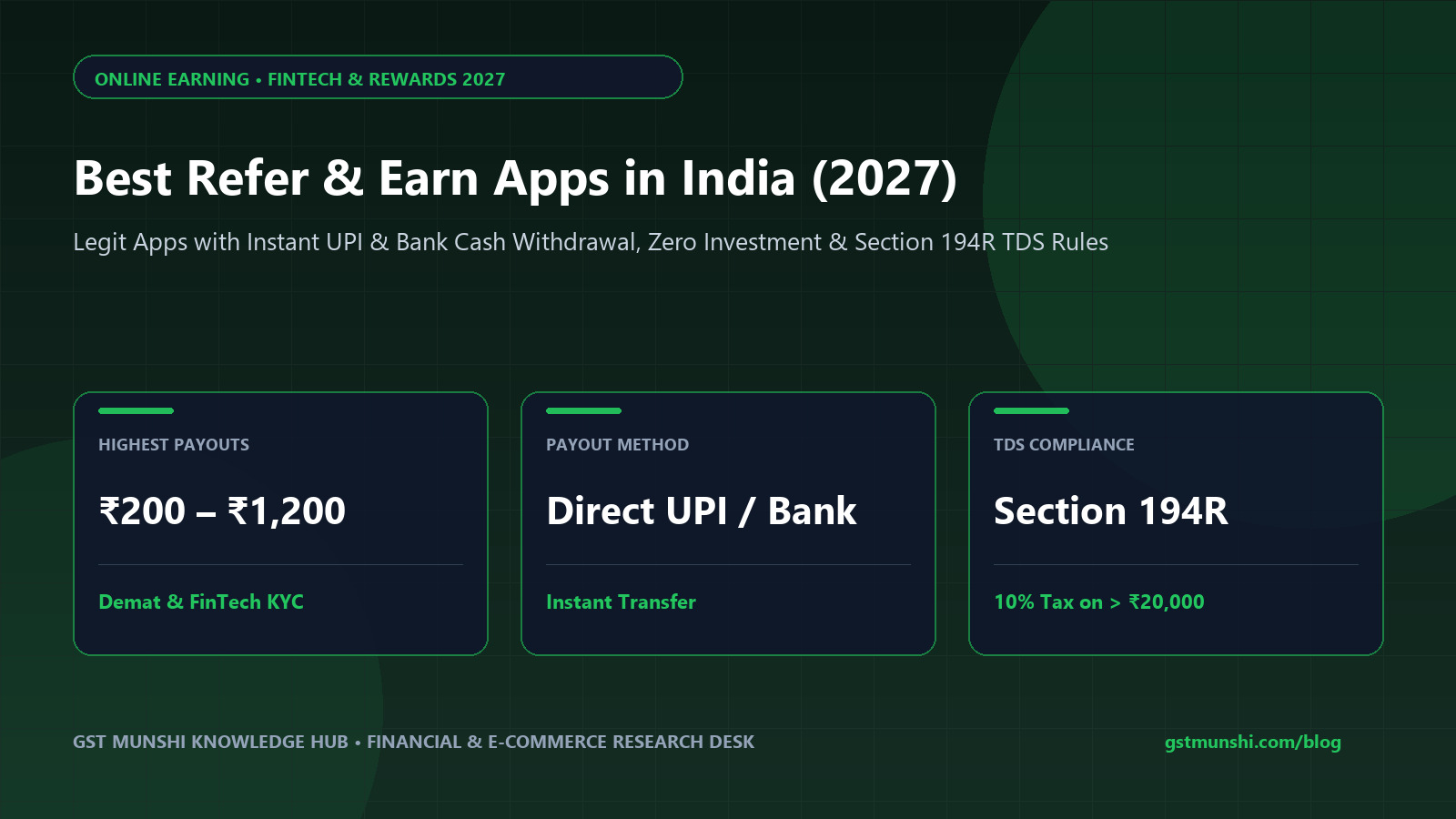
- ₹20,000 Annual Threshold: Any corporate entity (e.g., Zerodha, Navi, CashKaro, Gromo) providing benefits, cash incentives, or perquisites exceeding ₹20,000 in a financial year to a resident individual is statutorily required to deduct 10% TDS before disbursing payment.
- Non-PAN Penalty Rate (Section 206AA): If you do not provide your linked PAN card to the referral platform, the company must withhold tax at a punitive rate of 20% TDS.
- Reporting in ITR: Referral income should be reported in your annual income tax return under Income from Other Sources (for casual participants) or Profits and Gains of Business or Profession (PGBP) (for professional creators/affiliates claiming business expenses).
- Form 26AS & AIS Reconciliation: The TDS deducted by platforms reflects directly under Section 194R in your Form 26AS and Annual Information Statement (AIS). You can claim this TDS credit against your final tax liability or claim a refund if your total taxable income is below the basic exemption limit.
Verified Video Walkthroughs: Top Apps, Payment Proofs & Tax Compliance
Watch comprehensive tutorials covering daily cash app tests, payout proofs, and expert legal analysis of Section 194R tax deductions.
The Red-Flag Checklist: How to Spot Fake Earning Apps
Red Flag 1: Demanding Upfront "Registration Fees"
Legitimate referral programs never charge you a single rupee to participate. If an app requires buying a "VIP membership" or deposit before allowing referrals, it is a Ponzi pyramid scheme.
Red Flag 2: Unrealistic Guaranteed Returns
Claims like "Earn ₹5,000 every hour by clicking links" are mathematically impossible. Genuine rewards are bounded by standard customer acquisition economics (₹100 to ₹1,500 per customer).
Red Flag 3: Lack of Google Play / App Store Presence
Never install third-party `.apk` files sent through Telegram or WhatsApp. Only download apps vetted and hosted on Google Play Store or Apple App Store.
Red Flag 4: Shifting Minimum Withdrawal Thresholds
Scam apps constantly increase the minimum withdrawal limit (e.g. from ₹500 to ₹2,000) right when your balance approaches payout, preventing you from ever withdrawing funds.
Verified Practitioner Perspectives: FinTech Growth & Taxation
"Ever since the introduction of Section 194R in the Finance Act, referral benefits, whether paid in direct bank cash, gift cards, or crypto vouchers, are legally classified as perquisites. If you receive more than ₹20,000 annually from any corporate entity (e.g., CashKaro, Navi, Angel One), they must deduct 10% TDS and issue Form 16A. Always verify that these credits mirror in your Annual Information Statement (AIS) before filing ITR."
"FinTech platforms spend ₹1,200 to ₹2,500 acquiring a funded trading user via Google and Meta ads. Paying ₹500 to ₹750 to existing customers through referral bounties is significantly more capital efficient and generates higher 90-day retention rates. That is why genuine Demat and UPI apps maintain uncapped referral budgets for active promoters."
"Navi and CashKaro remain the two cleanest daily cash apps in India. With Navi, once your friend verifies digital gold or takes an instant loan, payout hits your linked UPI VPA within 120 seconds. Zero coin redemption gimmicks, zero game playing requirements."
"One-time ₹200 bonuses are good for quick pocket money, but the true wealth generator is Zerodha's 10% lifetime brokerage share and CashKaro's 10% lifetime shopping cashback. If you refer 50 active traders or regular shoppers, you create an automated monthly dividend stream without sending new links."
People Also Ask: Refer and Earn Apps in India (2026–2027)
Which refer and earn apps offer direct UPI cash withdrawal in 2027?
Apps providing direct bank or UPI transfer include Navi (up to ₹850 per referral for personal loans/mutual funds), CashKaro (10% lifetime referral cashback directly to bank account), Gromo (financial services resale offering ₹500–₹1,500 per credit card or savings account conversion), and PhonePe / Google Pay for scratch cards and direct bank cashback.
Are refer and earn app earnings taxable in India under the Income Tax Act?
Yes. Referral earnings, affiliate commissions, and promotional perquisites are classified as taxable income under 'Income from Other Sources' or 'Profits and Gains of Business or Profession' (PGBP). Under Section 194R of the Income Tax Act 1961, businesses must deduct 10% TDS if the value of benefits or perks exceeds ₹20,000 in a financial year.
What is the difference between lifetime passive referral earnings and one-time bounties?
One-time bounties pay a fixed lump-sum reward (e.g., ₹200 to ₹1,000) when a referee completes registration and their first transaction (like opening a Demat account on Angel One or taking a Navi loan). Lifetime passive programs (like Zerodha 10% brokerage sharing or CashKaro 10% lifetime cashback) pay recurring commissions every time your referee trades or shops online.
How much money can a beginner realistically make daily through referral programs?
An active user referring 1 to 2 qualified friends or network contacts daily can realistically generate ₹300 to ₹1,500 per day (₹10,000 to ₹45,000 per month). Demat account and credit card distribution apps (Angel One, Gromo, Upstox) pay the highest payouts per successful KYC verification.
Do I need to complete full KYC to withdraw referral earnings?
Yes. Under RBI guidelines and SEBI regulatory compliance, legitimate financial apps require PAN verification, Aadhaar-based OTP verification, and bank account linking before enabling cash withdrawals. This prevents bot manipulation, fraud, and money laundering.
Why do some referral bonuses show as pending or get rejected?
Referral bonuses remain pending until the invited user completes the mandatory qualifying action (such as placing a first stock trade, funding their Demat wallet, taking a minimum loan, or making an e-commerce purchase that passes the 30-day return window). Referrals are rejected if the referee previously had an active account, used the same device ID/IP, or failed KYC.
Is it illegal to spam referral links on social media or Telegram groups?
While sharing referral links with your personal network is legal, automated spamming, bulk bot messaging, using misleading clickbait ('Free iPhone on sign up'), or purchasing fake downloads violates both platform terms of service and consumer protection regulations. Violations lead to permanent account termination and forfeiture of accrued wallet balances.
What happens if I earn over ₹20,000 and do not provide my PAN card?
If you earn more than ₹20,000 in referral benefits and fail to provide a valid linked PAN, companies are legally obligated under Section 206AA of the Income Tax Act to deduct TDS at a punitive rate of 20% instead of the standard 10%. Furthermore, non-reporting in ITR can invite scrutiny notices for undisclosed income.
Related Personal Finance & Credit Card Guides
Explore more verified finance manuals and tax compliance strategies across GST Munshi.