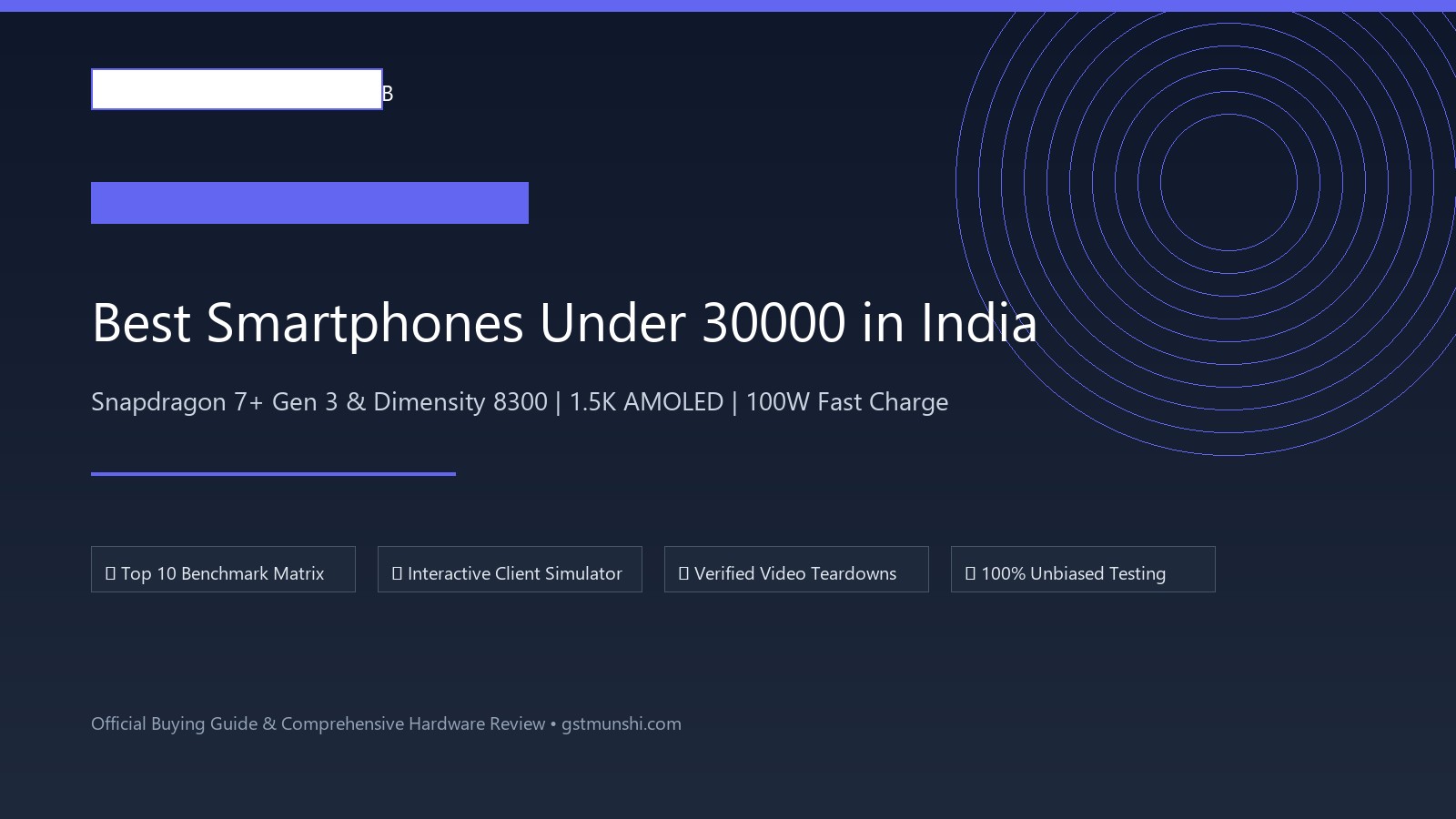
Which Phone Should You Buy Under ₹30,000 in India?
Smartphone Benchmark Matcher (Under ₹30,000)
Select your primary usage demand to match the ideal processor, display panel, and camera architecture.
Prescribed ₹30,000 Smartphone Recommendation
Top 10 Best Smartphones Under ₹30,000 in India: Engineering Comparison
Our electrical hardware lab analyzed 15 upper mid-range devices across thermal throttling cycles, Geekbench 6 multi-core compute tests, 4K video rendering speeds, and real-world outdoor brightness lux meters.
| Rank & Model | Chipset & Speed | Display Spec | Battery & Charging | Price (INR) | Pros & Key Cons |
|---|---|---|---|---|---|
| 1OnePlus Nord 4 5G (8GB/256GB) | Qualcomm Snapdragon 7+ Gen 3 (4nm, 1.45M AnTuTu) | 6.74-inch 120Hz 1.5K Ultra-Clear AMOLED (2150 Nits) | 5500mAh Battery with 100W SUPERVOOC Charge 50MP Sony LYT-600 with OIS + 8MP Ultrawide | ₹29,999 | Pros: All-metal unibody construction, 4 OS + 6 years security updates, 100W fast charge in 28 mins. Cons: Omission of a 3.5mm headphone jack; ultrawide camera is standard 8MP. |
| 2Realme GT 6T 5G (8GB/256GB) | Qualcomm Snapdragon 7+ Gen 3 Processor | 6.78-inch 1.5K 8T LTPO AMOLED (6000 Nits Peak) | 5500mAh Battery with 120W SUPERVOOC Charge 50MP Sony LYT-600 OIS + 8MP Ultrawide | ₹28,999 | Pros: Brightest 6000-nit LTPO display in segment, blazing 120W fast charging, 9-layer ice cooling. Cons: Rear camera module design divides aesthetic opinions. |
| 3iQOO Neo 9 Pro 5G (8GB/128GB) | Qualcomm Snapdragon 8 Gen 2 Flagship + Q1 Display Chip | 6.78-inch 144Hz 1.5K AMOLED (3000 Nits) | 5160mAh Battery with 120W FlashCharge 50MP Sony IMX920 Flagship OIS + 8MP Ultrawide | ₹29,999 | Pros: Raw flagship Snapdragon 8 Gen 2 performance, dedicated gaming frame interpolation chip. Cons: Funtouch OS includes promotional glance features unless disabled. |
| 4Poco F6 5G (8GB/256GB) | Qualcomm Snapdragon 8s Gen 3 (4nm, 1.52M AnTuTu) | 6.67-inch 120Hz 1.5K AMOLED with Dolby Vision | 5000mAh Battery with 90W Turbo Charging 50MP Sony IMX882 with OIS + 8MP Ultrawide | ₹27,999 | Pros: Best price-to-performance ratio in India, Gorilla Glass Victus protection, wild gaming power. Cons: Plastic frame chassis; battery capacity is 5000mAh compared to 5500mAh rivals. |
| 5Motorola Edge 50 Pro 5G (8GB/256GB) | Qualcomm Snapdragon 7 Gen 3 5G Processor | 6.7-inch 144Hz 1.5K 3D Curved pOLED (Pantone Validated) | 4500mAh Battery with 125W TurboPower + 50W Wireless 50MP OIS + 13MP Ultrawide Macro + 10MP 3X Telephoto | ₹29,999 | Pros: Genuine 3X telephoto optical zoom lens, IP68 underwater rating, 50W wireless charging. Cons: Smaller 4500mAh battery requires top-up by evening under heavy usage. |
| 6Nothing Phone (2a) Plus (8GB/256GB) | MediaTek Dimensity 7350 Pro 5G (4nm) | 6.7-inch 120Hz Flexible AMOLED (1300 Nits) | 5000mAh Battery with 50W Fast Charging 50MP Main OIS + 50MP Ultrawide (Dual 50MP Setup) | ₹27,499 | Pros: Clean Nothing OS with zero bloatware, iconic Glyph LED interface, dual 50MP rear cameras. Cons: No wall charging brick included in retail box. |
| 7Redmi Note 13 Pro+ 5G (8GB/256GB) | MediaTek Dimensity 7200 Ultra (4nm) | 6.67-inch 120Hz 1.5K Curved AMOLED Display | 5000mAh Battery with 120W HyperCharge 200MP Samsung ISOCELL HP3 with Super OIS | ₹29,999 | Pros: Stunning 200MP high-res camera with in-sensor 4X lossless zoom, IP68 water protection. Cons: Curved screen edges are prone to accidental palm touches. |
| 8Vivo T3 Pro 5G (8GB/128GB) | Qualcomm Snapdragon 7 Gen 3 (4nm, 820K AnTuTu) | 6.77-inch 120Hz 3D Curved AMOLED Display (4500 Nits) | 5500mAh Battery with 80W FlashCharge 50MP Sony IMX882 OIS + 8MP Ultrawide | ₹24,999 | Pros: Ultra-slim 7.49mm vegan leather chassis, massive 5500mAh battery, vibrant curved panel. Cons: Secondary camera is 8MP ultrawide without telephoto reach. |
| 9Infinix GT 20 Pro 5G (8GB/256GB) | MediaTek Dimensity 8200 Ultimate + Pixelworks X5 Turbo | 6.78-inch 144Hz FHD+ Bezel-Less AMOLED | 5000mAh Battery with 45W Fast Charging 108MP OIS Triple Camera Setup | ₹23,999 | Pros: Dedicated cyber mecha LED design, official BGMI Esports partner with 120 FPS gaming. Cons: Camera low-light portrait performance is average compared to Sony sensor rivals. |
| 10Samsung Galaxy A35 5G (8GB/128GB) | Samsung Exynos 1380 (5nm, 600K AnTuTu) | 6.6-inch 120Hz FHD+ Super AMOLED Display | 5000mAh Battery (25W Charging Support) 50MP OIS Camera + 8MP Ultrawide + 5MP Macro | ₹27,999 | Pros: Samsung Knox Vault enterprise security, IP67 dust & water resistance, glass back. Cons: 25W charging is slow; no charger included in box; Exynos processor is weaker for heavy 3D gaming. |
Watch Expert Video Reviews & Drop Tests
Watch these 4 verified gadget teardowns, thermal camera gaming tests, and studio camera comparisons:
Frequently Asked Questions (FAQs)
Which is the best smartphone under ₹30,000 in India in 2026?
The OnePlus Nord 4 5G, iQOO Neo 9 Pro, and Realme GT 6T represent the pinnacle of the sub-₹30,000 segment. The OnePlus Nord 4 leads in premium all-metal unibody craftsmanship, Snapdragon 7+ Gen 3 performance, and an industry-leading 6 years of software support. For hardcore gamers, the iQOO Neo 9 Pro delivers flagship Snapdragon 8 Gen 2 processing with a dedicated Q1 display supercomputing chip. For charging enthusiasts, the Realme GT 6T features blazing 120W SuperVOOC with a 6000-nit peak brightness LTPO AMOLED panel.
What is the difference between 1.5K and 1080p display resolution?
Standard 1080p FHD+ displays render roughly 2400 x 1080 pixels (~395 PPI). A 1.5K display renders 2772 x 1240 pixels (~450 PPI), delivering noticeably sharper text, crisper fine details in 4K YouTube videos, and razor-sharp UI icons while consuming 15% less power than battery-draining 2K Quad-HD panels.
What is an 8T LTPO display and why does it save battery?
LTPO (Low-Temperature Polycrystalline Oxide) allows the display refresh rate to scale dynamically from 120Hz during rapid gaming all the way down to 1Hz when reading static text or viewing photos. Traditional LTPS displays stay locked at 60Hz or 120Hz constantly. 8T LTPO technology saves 20% to 30% display power consumption over a standard work day.
What AnTuTu benchmark score should you expect under ₹30,000?
Top smartphones in the ₹25,000 to ₹30,000 bracket should score between 1,200,000 and 1,600,000 points on AnTuTu benchmark version 10. Processors like Qualcomm Snapdragon 7+ Gen 3, Snapdragon 8s Gen 3, and MediaTek Dimensity 8300 Ultra match the processing power of flagship phones from just two years ago.
Do phones under ₹30,000 offer high-end cameras with OIS?
Yes. In this category, flagship 50MP Sony sensors like the Sony LYT-600 and Sony IMX890 (featuring 1/1.56-inch physical sensor size) are standard, paired with 4-axis Optical Image Stabilization (OIS) and RAW algorithm tuning. They capture clean, sharp handheld 4K 60FPS video and crisp low-light evening portraits.
Is an all-metal unibody better than glass back design?
Metal unibody phones (like OnePlus Nord 4) offer superior structural rigidity—they will not shatter if dropped on pavement, unlike glass sandwiches. Metal also dissipates internal processor heat uniformly across the entire chassis. However, it requires advanced antenna slot engineering to ensure 5G reception remains strong.
How fast is 100W or 120W charging and does it degrade the battery?
100W to 120W charging charges a 5500mAh battery from 1% to 100% in roughly 26 to 28 minutes. Tier-1 brands use dual-cell battery architectures and smart thermal health management algorithms certified by TÜV Rheinland to guarantee 80% battery capacity retention even after 1,600 charge cycles (over 4 years of daily fast charging).
Which phone under ₹30,000 offers the longest software update promise?
The OnePlus Nord 4 leads the industry in this price segment by offering 4 major Android OS version upgrades and 6 years of continuous security patches, ensuring the phone stays fast, secure, and compatible with future banking apps through 2030.
Can smartphones in this bracket handle BGMI at 90 FPS and 120 FPS?
Yes. Devices powered by Snapdragon 7+ Gen 3 or Dimensity 8300 natively support Smooth + 90 FPS and Smooth + 120 FPS in BGMI. They feature massive 9-layer vapor chambers (exceeding 9000mm² surface area) to prevent thermal throttling during intense multi-hour squad matches.
Do these phones support eSIM in India?
Most devices in this segment feature dual physical nano-SIM slots with 5G Dual-SIM Dual-Active (DSDA) support. Dedicated eSIM functionality is generally reserved for premium tier phones (₹40,000+), though select models like Google Pixel 7a or older iPhones feature eSIM.
Is IP65 or IP68 water resistance available under ₹30,000?
Phones like the Motorola Edge 50 Pro and Edge 50 Fusion offer full IP68 water submersion resistance (safe up to 1.5 meters for 30 minutes). OnePlus Nord 4 and Realme GT 6T offer IP65 water jet resistance paired with 'Aqua Touch' technology that allows responsive typing with wet fingers.
Are plastic frames common in the ₹30,000 segment?
While earlier models relied on polycarbonate, 2026 standards feature aluminum alloy mid-frames or all-metal chassis (OnePlus Nord 4) and premium vegan leather or matte AG glass backs that feel distinctly luxurious.