Quick Summary & Key Takeaways (Featured Snippet)
JEE Main 2027 Score, Percentile & Eligibility Calculator
Estimate your projected NTA percentile across Physics, Chemistry, and Mathematics out of 300 total marks. The engine incorporates normalized difficulty distributions from previous January shifts and checks your compliance against the mandatory 75% Class 12 board criterion for JoSAA seat allocation.
JEE Main 2027 Score, Percentile & 75% Eligibility Simulator
Calculates estimated NTA percentile based on historical January shift curves and checks JEE Advanced & NIT eligibility.
Official JEE Main 2027 Session 1 Schedule & Deadlines
The National Testing Agency coordinates the Joint Entrance Examination under the oversight of the Joint Admission Board (JAB). Below is the comprehensive milestone tracker from the initial information brochure to the declaration of Session 1 scorecards.
| Milestone Event | Expected / Official Schedule | Official Authority & Mode |
|---|---|---|
| Information Bulletin & Public Notice | Late October 2026 | Official portal download (`jeemain.nta.nic.in`) |
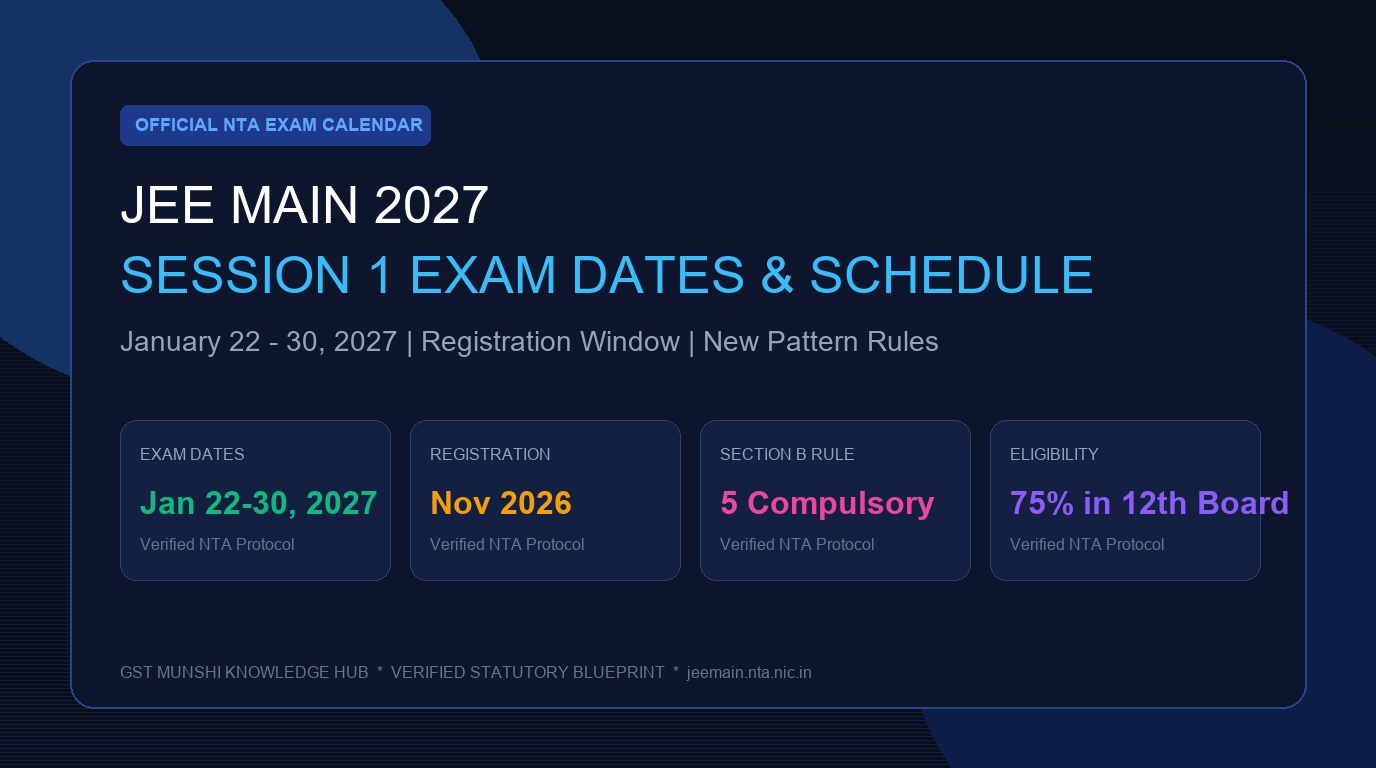
| Session 1 Online Registration Window | First Week of November 2026 | NTA Web Application Gateway |
| Last Date for Application & Fee Payment | First Week of December 2026 | Online Payment (UPI, Net Banking, Cards) |
| Application Correction Facility | Second Week of December 2026 | Candidate Login Dashboard |
| Advance Intimation of Exam City Slip | Second Week of January 2027 | Online Slip (No Hall Ticket required) |
| NTA Hall Ticket (Admit Card) Release | 3 Days Prior to Exam Day | Barcode-Enabled PDF with Center SOPs |
| JEE Main 2027 Session 1 Examination | January 22, 23, 24, 28, 29, 30, 2027 | CBT Mode (Shift 1: 9 AM-12 PM | Shift 2: 3-6 PM) |
| Session 1 Buffer Date | January 31, 2027 | Reserved for technical / overflow sessions |
| Provisional Answer Key & Challenges | First Week of February 2027 | ₹200 per challenged question (Non-refundable) |
| Final NTA Scorecard Declaration | By February 12, 2027 | Multi-shift normalized NTA percentile score |
Step-by-Step DigiLocker & Aadhaar Registration Guide
The National Testing Agency utilizes digital identity integration to prevent proxy registrations. Completing the online form correctly ensures that your academic records match your JoSAA counselling profile.
Identity Authentication
Log into `jeemain.nta.nic.in` and select candidate registration. Choose DigiLocker or Academic Bank of Credits (ABC ID) for instant identity fetching. Alternatively, use your 12-digit Aadhaar number with mobile OTP verification.
Zero Document Upload FrictionAcademic Details & Cities
Provide Class 10 roll numbers, Class 12 board registration details, and permanent state eligibility code. Select four test cities in order of preference based on your current or permanent address pincodes.
Strict Pincode City MappingPhoto, Signature & Fee
Upload a recent passport photo (10–200 KB, white background, 80% face coverage) and signature (4–30 KB). Pay the category fee through Net Banking, UPI, or Credit/Debit Card. Download the confirmation page.
Preserve 4 Confirmation Copies| Category | Male (In India) | Female (In India) | Centres Outside India |
|---|---|---|---|
| General / Gen-EWS / OBC-NCL | ₹1,000 | ₹800 | ₹5,000 |
| SC / ST / PwD / Third Gender | ₹500 | ₹500 | ₹2,500 |
Eligibility Criteria & The 75% Board Rule Explained
Understanding the distinction between qualifying to sit for JEE Main and qualifying for admission into NITs, IIITs, and CFTIs is essential for every candidate.
Exam Appearance Eligibility (NTA Rule)
- No Age Limit: Candidates of any age who have passed Class 12 or equivalent can appear.
- Qualifying Exam Year: Passed Class 12 in 2025, 2026, or appearing in 2027.
- Mandatory Subjects: Physics and Mathematics along with Chemistry, Biotechnology, Biology, or technical vocational subject for B.E./B.Tech.
- Attempt Limit: Candidates can appear in JEE Main for a maximum of 3 consecutive academic years.
JoSAA Admission Eligibility (75% / Top 20% Rule)
To secure a seat in NITs, IIITs, or CFTIs through Centralized JoSAA counselling, candidates must meet one of the following criteria:
- 75% Aggregate: Minimum 75% total marks in Class 12 board examination (65% for SC, ST, and PwD candidates).
- Top 20 Percentile: Placement within the top 20 percentile category cutoff of your specific State or Central education board for the passing year.
New Exam Pattern: Discontinuation of Optional Questions in Section B
During the COVID-19 pandemic, NTA introduced 10 numerical questions in Section B with candidates required to attempt only 5. Following regulatory reviews by the Joint Admission Board, this flexibility has been withdrawn. In JEE Main 2027, **all 5 numerical questions per subject are compulsory**, restoring the pre-COVID standard.
| Subject | Section A (Multiple Choice) | Section B (Numerical Value) | Total Questions | Total Marks |
|---|---|---|---|---|
| Physics | 20 MCQs | 5 Numericals (All Compulsory) | 25 | 100 Marks |
| Chemistry | 20 MCQs | 5 Numericals (All Compulsory) | 25 | 100 Marks |
| Mathematics | 20 MCQs | 5 Numericals (All Compulsory) | 25 | 100 Marks |
| Overall Total | 60 MCQs | 15 Numericals | 75 Questions | 300 Marks |
High-Weightage Chapters Blueprint for Session 1
Targeting topics with historical question density enables aspirants to secure a 99-percentile baseline score without getting overwhelmed by the vast combined Class 11 and 12 curriculum.
Physics (High Yield)~14-16 Questions
- Modern Physics (Photoelectric, Atoms, Nuclei)
- Current Electricity & Instruments
- Electrostatics & Capacitance
- Thermodynamics & Kinetic Theory
- Ray & Wave Optics
- Rotational Motion & Work-Energy
- Semiconductors & Logic Gates
Chemistry (High Yield)~15-17 Questions
- Coordination Compounds & d-Block
- Chemical Bonding & Molecular Structure
- Solutions & Electrochemistry
- Organic Name Reactions & Mechanisms
- Aldehydes, Ketones & Carboxylic Acids
- Chemical Kinetics & Thermodynamics
- General Principles of Metallurgy / p-Block
Mathematics (High Yield)~13-15 Questions
- Vectors & 3D Geometry
- Matrices & Determinants
- Coordinate Geometry (Circles, Conics)
- Sequence & Series (AP, GP, Special Series)
- Definite Integrals & Area Under Curves
- Differential Equations
- Permutations & Combinations / Probability
90-Day January Session Study & Revision Roadmap
Securing top percentiles in Session 1 allows students to focus entirely on Board examinations in February-March and JEE Advanced in May.
Syllabus Completion & Core Concept Consolidation
Complete remaining Class 12 chapters while revising high-weightage Class 11 units. Ensure formula sheets and reaction maps are prepared.
Intensive Previous Year Questions (PYQs) & Chapter Tests
Solve chapter-wise PYQs from 2023, 2024, 2025, and 2026. Practice numerical integer-type calculations without calculator aids.
Full-Length CBT Mock Tests in Exact Shift Timings
Attempt 3-hour mock tests strictly in 9:00 AM – 12:00 PM or 3:00 PM – 6:00 PM slots. Analyze error logs to eliminate recurring calculation mistakes.
Formula Review & Sleep Schedule Regulation
Cease learning new topics. Review formula summaries, inorganic NCERT tables, and verify admit cards and exam center locations.
Curated Video Walkthroughs: Strategy & Problem Solving
Review these verified tutorial sessions from premier Indian engineering faculty covering shift management, high-yield question patterns, and speed mastery for Session 1.
Session 1 Shift Strategy & Marks vs Percentile Analysis
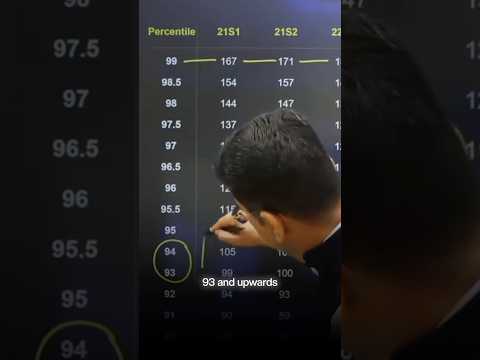

JEE Main 2027 Strategic Roadmap & Topper Blueprint


Frequently Asked Questions (FAQs)
Verified answers to common queries regarding registration dates, admit cards, Section B rules, and eligibility criteria.
Official Sources & Regulatory References
All information in this master guide is cross-verified against official government circulars and published exam calendars: