When are CBSE Practical Exams 2027 and what are the key statutory rules?
The Central Board of Secondary Education (CBSE) administers one of the largest school examination frameworks in the world, catering to over 3.9 million students across more than 29,000 affiliated institutions in India and 26 foreign nations. For the 2026–2027 academic session, the Board has harmonized its laboratory evaluation protocols, digital marks upload frameworks, and passing criteria with the competency-based curriculum directives mandated by the National Education Policy (NEP 2020).
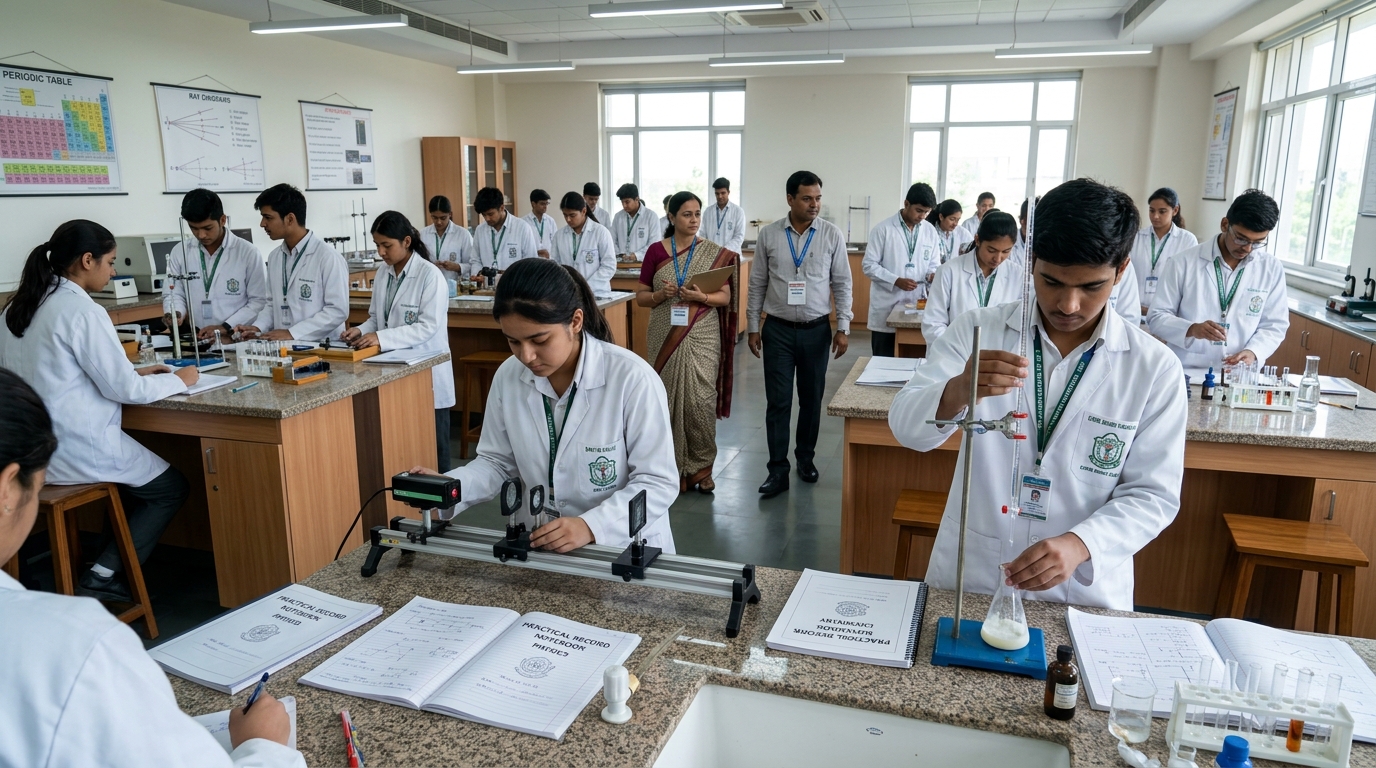
Practical examinations and continuous internal assessments represent between 20% to 70% of a candidate's composite subject score. To eliminate regional evaluation bias, prevent proxy attendance, and preserve statutory integrity, CBSE enforces standardized Operating Procedures (SOPs). These mandates require the central appointment of external examiners for Senior Secondary evaluations, strict daily quota ceilings on batch examinations, and mandatory geo-tagged laboratory photographs uploaded directly to the Board's digital portal on the very day of assessment.
CBSE Practical & Internal Assessment Marks Simulator (2027)
Select your class and subject stream, then adjust your anticipated Theory and Practical/Internal scores. The simulator immediately computes your composite percentage, evaluates component cutoffs under CBSE Bye-Laws, flags potential Compartment risks, and estimates your projected 9-point CBSE relative grade.
CBSE Practical & Internal Assessment Passing Criteria Simulator (2027)
Simulates exact CBSE Examination Bye-Laws: Class 10 Combined 33% Rule vs Class 12 Independent Separate Minimum Rule
CBSE 2026–2027 Official Examination Master Calendar
Detailed statutory timeline spanning List of Candidates (LOC) finalization, winter-bound regional practicals, Senior Secondary external evaluations, private candidate application cycles, and main theory board dates.
CBSE 2026–2027 Official Examination Target Countdown & Readiness Tracker
Track official timelines and check off essential preparation benchmarks before laboratory evaluations begin
Private Candidate Form (No Late Fee)
Target Date: October 23, 2026
Private Candidate Form (₹2,000 Late Fee)
Target Date: October 30, 2026
Winter-Bound Schools Practical Exams
Target Date: November 15, 2026
Regular Affiliated Schools Practical Window
Target Date: January 1, 2027
CBSE Board Theory Examination Day 1
Target Date: February 15, 2027
NEP 2020 Biannual Phase 2 (Improvement)
Target Date: May 15, 2027
Practical Exam Readiness Checklist (Click to track progress):
| Milestone Event | Eligible Cohort | Statutory Window | Official Portal / Platform |
|---|---|---|---|
| List of Candidates (LOC) Submission | Regular Affiliated Schools | August – October 2026 | Pariksha Sangam (cbse.gov.in) |
| Private Candidate Application Form | Repeaters, Compartment, Improvement | October 8 – October 23, 2026 (Normal) October 24 – October 30, 2026 (Late Fee) | CBSE Individual Portal |
| Winter-Bound Practical Examinations | Schools in Cold Mountainous Regions | November 15 – December 15, 2026 | Regional Office Supervision |
| Official Theory Date Sheet Release | Class 10 and Class 12 Regular & Private | Late November / Early December 2026 | cbse.gov.in Circular Desk |
| Regular Practical & Internal Exams | All Pan-India & International Schools | January 1 – Mid-February 2027 | SARAS OASIS Portal Uploads |
| Theory Board Examinations (Phase 1) | All Registered Candidates | February 15 – April 2027 | Designated Center Examination |
| NEP 2020 Biannual Phase 2 Exam | Class 10 Optional Improvement Candidates | May 2027 | Phase 2 Registration Window |
Class 10 vs Class 12 Passing Rules: The 33% Law Decoded
One of the most persistent sources of confusion among candidates and parents is the legal interpretation of the 33% passing rule. While both tiers mandate an overall 33% score to earn the senior secondary certificate, the operational mechanics governing theory and practical marks differ fundamentally between Class 10 and Class 12 under the CBSE Examination Bye-Laws.
The Class 10 Combined Passing Framework: For Secondary School Examinations (Class 10), CBSE mandates an overall combined score of 33% in each subject. This means that a student's 80-mark theoretical paper and 20-mark internal assessment are merged into a single 100-mark composite. A candidate who secures 18 marks in internal assessment and 15 marks in the theory paper scores a total of 33 marks out of 100 and is declared to have passed that subject. There is no independent cutoff requiring 26.4 marks in the theory paper alone.
The Class 12 Independent Separate Minimum Framework: For Senior School Certificate Examinations (Class 12), the Board enforces an unyielding independent dual-cutoff rule. Candidates must score at least 33% marks separately in the theory examination and at least 33% marks separately in the practical evaluation or internal project assessment. A candidate who scores 30 out of 30 in Physics practicals but secures 20 out of 70 in the theory paper fails the theory component and is declared eligible for Compartment in Theory, even though their combined total of 50 out of 100 exceeds 33%.
| Assessment Criterion | CBSE Class 10 (Secondary) | CBSE Class 12 (Senior Secondary) |
|---|---|---|
| Passing Threshold Rule | 33% Combined (Theory + Internal Assessment) | 33% Separately in Theory AND 33% in Practical |
| Theory Passing Cutoff | No independent theoretical cutoff | ≥23.1 / 70 marks (Sciences) ≥26.4 / 80 marks (Commerce & Humanities) ≥9.9 / 30 marks (Fine Arts) |
| Practical / IA Passing Cutoff | No independent practical cutoff | ≥9.9 / 30 marks (Lab Sciences) ≥6.6 / 20 marks (Projects & Viva) ≥23.1 / 70 marks (Fine Arts) |
| Can High Practical Marks Save Theory? | Yes. Strong internal marks bridge theory gaps. | No. Deficit in theory results in Compartment. |
| Compartment Examination Rule | Eligible if failing in up to 2 subjects | Eligible if failing in 1 subject (Theory or Practical component) |
NEP 2020 Biannual Board Exams: The "Best-of-Two" Reform Explained
In alignment with the National Education Policy (NEP 2020) vision to dismantle the high-stakes, anxiety-driven culture of single-sitting board examinations, the Ministry of Education has institutionalized a Biannual Board Examination System for CBSE Class 10 students, beginning systematically with the 2026 academic cycle and expanding into full maturity for 2027.
Under this structural reform, students are no longer judged solely on a single three-hour theoretical performance. The academic assessment cycle is bifurcated into two distinct phases:
Main Annual Examination (February / March 2027)
All registered Class 10 candidates must appear in this foundational examination. Comprehensive syllabus coverage evaluates core competencies, problem-solving, and analytical capabilities across all enrolled subjects.
Improvement & Rectification Window (May 2027)
Candidates who wish to upgrade their performance in one, several, or all subjects may register for Phase 2. The Board applies the Best-of-Two Rule, certifying the higher of the two scores on the final marksheet.
Crucially, practical and internal assessment scores secured during the primary session in January 2027 are retained for Phase 2 evaluations. Students appearing in the May session are evaluated solely on the theoretical component, shielding them from the logistical burden of repeating laboratory experiments or viva voce sessions.
Official Laboratory SOPs & Mandatory Geo-Tagged Photography
To guarantee absolute parity across all affiliated institutions, CBSE has enacted rigorous Standard Operating Procedures (SOPs) governing the administration of practical examinations. School administrations and laboratory instructors must adhere to five mandatory procedural stages:
Central External Examiner Verification
External examiners for Class 12 are appointed directly by the CBSE Regional Office. Schools cannot hire, swap, or accept substitute teachers locally. The external examiner conducts an on-site laboratory inspection 24 hours prior to testing.
Strict Batch Size Ceilings
Examinations are conducted in strict batches of 20 to 30 candidates per laboratory session. Schools with larger cohorts must organize multiple staggered shifts to ensure individual workstation access and fair viva evaluation.
App-Based Geo-Tagged Group Photos
For each batch, schools must capture a high-resolution photograph inside the active laboratory showing all candidates, internal examiner, external examiner, and observer with embedded GPS coordinates and date-time stamps.
Same-Day Digital Marks Upload
Practical marks must be entered and finalized on the SARAS / OASIS portal on the very day of the examination. Once submitted, marks are cryptographically locked; zero offline corrections or amendments are permitted.
Physical Answer Sheet Dispatch
Class 12 practical answer booklets, signed laboratory award lists, and examiner undertakings must be sealed in tamper-evident envelopes and dispatched to the designated CBSE Regional Office within 48 hours.
Zero-Tolerance Unfair Means (UFM)
Any attempt to forge experiment data, present unverified project files, or influence external examiners is reported under CBSE Examination Bye-Laws Rule 36, leading to candidate debarment and school de-affiliation.
Subject-Wise Practical & Project Marks Blueprint (Class 12)
Understanding how marks are distributed within each subject enables candidates to focus their laboratory preparation strategically. The evaluation rubrics mandated by the CBSE Curriculum Division divide the 30-mark and 20-mark practical components into distinct, objective parameters:
| Subject & Total Marks | Laboratory Experiments | Investigatory Project | Practical Record & Activities | Viva-Voce |
|---|---|---|---|---|
| Physics (042) 30 Marks Practical | 14 Marks (2 Experiments, 7 Marks each from Section A & B) | 3 Marks (Investigatory Project File) | 8 Marks (5 Marks Record + 3 Marks Activities) | 5 Marks (Based on experiments & activities) |
| Chemistry (043) 30 Marks Practical | 16 Marks (Volumetric Analysis 8 + Salt Analysis 8) | 4 Marks (Scientific Investigatory Project) | 4 Marks (Content-Based Experiment / Record) | 6 Marks (Thorough conceptual viva) |
| Biology (044) 30 Marks Practical | 12 Marks (Major Exp 5 + Minor Exp 4 + Slide Prep 5) | 4 Marks (Project & Presentation) | 7 Marks (Spotting 7 specimens) | 4 Marks (Viva on spots & project) |
| Computer Science / IP (083 / 065) 30 Marks Practical | 12 Marks (Python Coding 8 + SQL Queries 4) | 8 Marks (Term Project with real-world DB connectivity) | 7 Marks (Practical Record with min 15 programs) | 3 Marks (Code explanation & debugging) |
| Accountancy / Economics / BST 20 Marks Project | N/A (Theoretical Stream) | 12 Marks (Comprehensive Comprehensive/Specific Project) | Included in project portfolio | 8 Marks (External examiner viva on file content) |
CBSE Private Candidates 2026–2027: Eligibility, Fees & Form SOP
The Central Board of Secondary Education has formally activated the online portal for Private Candidates appearing in the 2026–2027 board examinations. The application cycle commenced on October 8, 2026. Candidates who fall under any of the following statutory categories are eligible to apply:
- Essential Repeat: Candidates declared as "Essential Repeat" in the 2026 main board examinations.
- Compartment: Students placed in "Compartment" in the main 2026 examination or the July 2026 supplementary exams.
- Failures from 2021 to 2025: Candidates who failed in previous board cycles who wish to clear all subjects afresh.
- Improvement of Performance: Passed candidates from 2026 who wish to improve their scores in one or more subjects.
- Additional Subject: Female candidates or physically challenged candidates seeking certification in an additional elective.
Standard fee: ₹1,500 for 5 subjects (Class 10 & 12), plus ₹300 per additional subject. Practical evaluation fee: ₹150 per subject.
Strict statutory late surcharge of ₹2,000 per candidate is levied in addition to standard subject examination fees.
Candidates who previously passed practicals (≥33%) retain their scores automatically. Only students who failed practicals must re-test.
Topper Answer Sheet Decoded: Step-Wise Marking & Presentation Strategy
CBSE evaluation is strictly step-wise. Examiners follow an exhaustive marking scheme provided by the Head Examiner that assigns fractionated marks (0.5 mark, 1 mark) to specific keywords, formula statements, diagrammatic labels, and concluding units. Even if a numerical final answer is correct, an omitted formula or missing unit incurs a penalty. Conversely, an incorrect final calculation can still earn 80% to 90% of total marks if earlier steps and formulas are impeccably structured.
Analysis of 100/100 scoring answer booklets published on cbseacademic.nic.in reveals five consistent habits deployed by top scorers:
- The 15-Minute Reading Window Triage: Toppers never begin writing immediately. During the mandatory 15-minute question paper reading time, they identify the internal choice questions they will attempt, cross-check numerical problem values, and sequence sections from highest confidence to lowest confidence.
- Keyword Underlining & Selective Highlighting: Examiners review hundreds of scripts daily. Highlighting central scientific laws (e.g., "Faraday's Second Law of Electrolysis" or "Principle of Conservation of Momentum") with a single horizontal pencil stroke draws immediate attention to scoring keywords.
- Pencil Diagrams with Symmetrical Labels: In Physics, Biology, and Geography, diagrams are drawn exclusively with sharpened HB pencils, enclosed within neat rectangular bounding boxes, with labels aligned strictly on the right side using horizontal arrows.
- Step-Wise Formula Substitution: In Mathematics and Physics, every numerical begins with a formal "Given" section, followed by the statutory formula, value substitution, arithmetic progression, and a clearly boxed final answer containing SI units (e.g.,
[Ans: 4.8 × 10⁻¹⁹ C]). - Final 10-Minute Sanity Audit: Reserving the final ten minutes prevents catastrophic clerical mistakes, such as missing question numbering, un-attempted sub-parts, or misplaced supplementary answer booklet thread knots.
Verified CBSE Practical & Examination Video Masterclasses
Watch comprehensive visual breakdowns covering laboratory SOPs, viva-voce questions, passing criteria mechanics, and topper answer sheet layout techniques.
CBSE Practical Exams SOPs & Laboratory Preparation
CBSE Passing Criteria & Topper Presentation Masterclasses
Frequently Asked Questions (FAQs) on CBSE Exams 2027
QWhen will the CBSE Practical Exams 2027 be held for Class 10 and Class 12?
For regular CBSE-affiliated schools across India and abroad, practical examinations, project evaluations, and internal assessments are scheduled to commence on January 1, 2027, and conclude around mid-February 2027. For winter-bound schools (located in cold mountainous regions), practicals are held between November 15 and December 15, 2026, ahead of seasonal winter closures.
QWhat is the passing criteria difference between CBSE Class 10 and Class 12?
In CBSE Class 10, students must secure a combined aggregate of 33% marks (theory examination plus internal assessment combined, i.e., minimum 33 marks out of 100). In CBSE Class 12, students must strictly score a minimum of 33% marks separately in the theory examination (e.g., 23.1 out of 70, or 26.4 out of 80) and 33% marks separately in the practical or project evaluation (e.g., 9.9 out of 30, or 6.6 out of 20), along with 33% aggregate.
QCan a school appoint an external examiner locally for Class 12 practicals?
No. Under statutory CBSE Examination Bye-Laws, the Central Board appoints external examiners centrally for every subject in Class 12. Schools are strictly prohibited from hiring or swapping examiners locally. If an appointed external examiner fails to report, the school principal must contact the respective CBSE Regional Office to obtain an official replacement order.
QWhy are geo-tagged and time-stamped group photographs mandatory during practicals?
To prevent proxy attendance and fictitious marking, CBSE mandates that schools take high-resolution group photographs of every examination batch inside the laboratory. The photograph must clearly show all candidates, the internal examiner, the appointed external examiner, and the board observer with embedded GPS coordinates and date-time stamps, uploaded to the SARAS/OASIS portal on the examination day itself.
QHow does the NEP 2020 biannual board exam system work for CBSE 2027?
Under the Ministry of Education's National Education Policy (NEP 2020) framework, CBSE conducts board examinations in two phases for Class 10: Phase 1 (mandatory primary board exam in February/March) and Phase 2 (optional improvement exam in May). If a student appears in both phases, the Best-of-Two score rule applies, allowing students to retain their highest mark in each subject without academic penalty.
QWhat happens if a student misses their practical exam due to illness or medical emergency?
If a candidate is genuinely absent on medical grounds, the candidate is marked as 'Re-scheduled' on the portal rather than 'Absent', provided the school receives an authentic medical certificate and prior approval from the External Examiner and CBSE Regional Office. The practical examination must be re-conducted before the official portal marks closing deadline.
QWho is eligible to register as a CBSE Private Candidate for the 2026-2027 exams?
Candidates declared as 'Essential Repeat' or placed in 'Compartment' in 2026, students who failed in academic sessions from 2021 to 2025, candidates seeking 'Improvement of Performance' in one or more subjects, and candidates appearing for an additional subject can apply online at cbse.gov.in from October 8, 2026 to October 23, 2026 without late fee, or until October 30, 2026 with a ₹2,000 late fee.
QDo CBSE Private Candidates have to re-appear for practical exams?
If a private candidate previously passed their practical examination (securing ≥33% in practicals) during their regular board appearance, their previous practical marks are carried forward and credited pro-rata. However, if they failed the practical exam or were absent, they must appear for a fresh practical test at an allocated examination center.
Official Examination Verification Desk
Always cross-verify school laboratory schedules, roll number slips, and sample question paper blueprints directly on official CBSE portals: cbse.gov.in and cbseacademic.nic.in.