
What is the RTE 25% quota and how can eligible children get free private school admission?
RTE Section 12(1)(c) Eligibility & Priority Analyzer
Check age qualification, income compliance, and neighborhood lottery priority tier for private school entry.
- Birth Certificate (Municipal / Hospital / Anganwadi record)
- Parent Aadhaar Card & Valid Residential Proof (Voter ID / Electricity bill)
- Tehsildar Income Certificate (less than 3 years old) for EWS
- Caste Certificate issued by Revenue Authority for DG candidates
The Legal Right: Section 12(1)(c) & Supreme Court Precedents
The 86th Constitutional Amendment introduced Article 21A into the Constitution of India, establishing education as a fundamental right for all children aged 6 to 14. To operationalize this guarantee, Parliament enacted the Right of Children to Free and Compulsory Education Act 2009.
In the historic constitutional bench judgment Society for Unaided Private Schools of Rajasthan vs. Union of India (2012), the Supreme Court of India upheld the validity of Section 12(1)(c), ruling that:
- Universal Private School Mandate: Private unaided schools (excluding minority institutions protected under Article 30) must admit at least 25% disadvantaged students into Class 1 or pre-school classes without discrimination.
- Zero Screening Tests / Interviews: Section 13 strictly prohibits schools from subjecting children or parents to interviews, screening tests, or charging capitation fees. Violations attract statutory fines of up to ₹25,000 for the first contravention and ₹50,000 subsequently.
- Direct State Reimbursement: The government reimburses private schools based on per-child expenditure incurred by the state in government schools or actual school fees, whichever is lower.
State RTE Portals & Income Thresholds Overview
Each state operates an official centralized web portal where parent registration, school selection, document upload, and lottery execution are performed:
| State | Official Portal | EWS Income Limit | Rounds Conducted | Disadvantaged Groups (DG) |
|---|---|---|---|---|
| Uttar Pradesh | rte25.upsdc.gov.in | ₹1,00,000 / year | 3 to 4 Lottery Phases | SC, ST, OBC non-creamy, CWSN, Orphan |
| Maharashtra | student.maharashtra.gov.in | ₹1,00,000 / year | Regular + Waiting Lists | SC, ST, VJNT, NT, SBC, CWSN |
| Delhi (DoE) | edudel.nic.in | ₹1,00,000 / year | Centralized Computerized Draw | SC, ST, OBC (NCL), Transgender, Orphans |
| Rajasthan | rajpsp.nic.in | ₹2,50,000 / year | Automated Lottery System | SC, ST, BPL ration card, War widows |
| Madhya Pradesh | educationportal.mp.gov.in | BPL Card Basis | 2 Online Rounds | SC, ST, Forest Dwellers, Differently Abled |
Step-by-Step SOP: Online Registration, School Preference & Allotment
To successfully secure admission in your desired private neighborhood school, follow this standard operating procedure:
Online Registration & Mobile OTP Verification
Access your state portal, select 'New Student Registration', input the parent mobile number, Aadhaar number, district, urban ward/gram panchayat, and generate your application registration ID.
Document Upload & GPS Neighborhood Verification
Upload clear scanned copies (under 100 KB PDF/JPEG) of the child's birth certificate, residential proof, income certificate, and category certificate. Ensure your GPS location matches the residential address on documents.
School Choice Filling in Order of Preference
The portal lists all private unaided schools mapped to your ward. Select your preferred schools in prioritized order (Rank 1 to 5). Giving priority to schools within 1 km maximizes lottery selection probability.
Lottery Results, Allotment Letter & School Reporting
On the scheduled lottery date, download the official Allotment Letter signed by the District Basic Education Officer (BSA / DEO). Report to the allotted private school within 10 to 15 days with original documents for final enrollment.
Verified Video Guides: Online Form Walkthrough & Document Verification
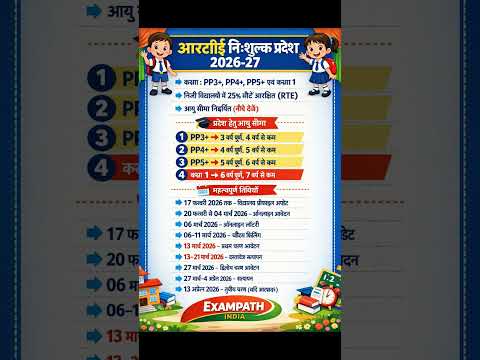
Step-by-step video tutorials demonstrating live portal form-filling, lottery status verification, and reporting protocols:

Related Student & Citizen Welfare Guides
Connect your education rights with scholarships, financial benefits, and government schemes: