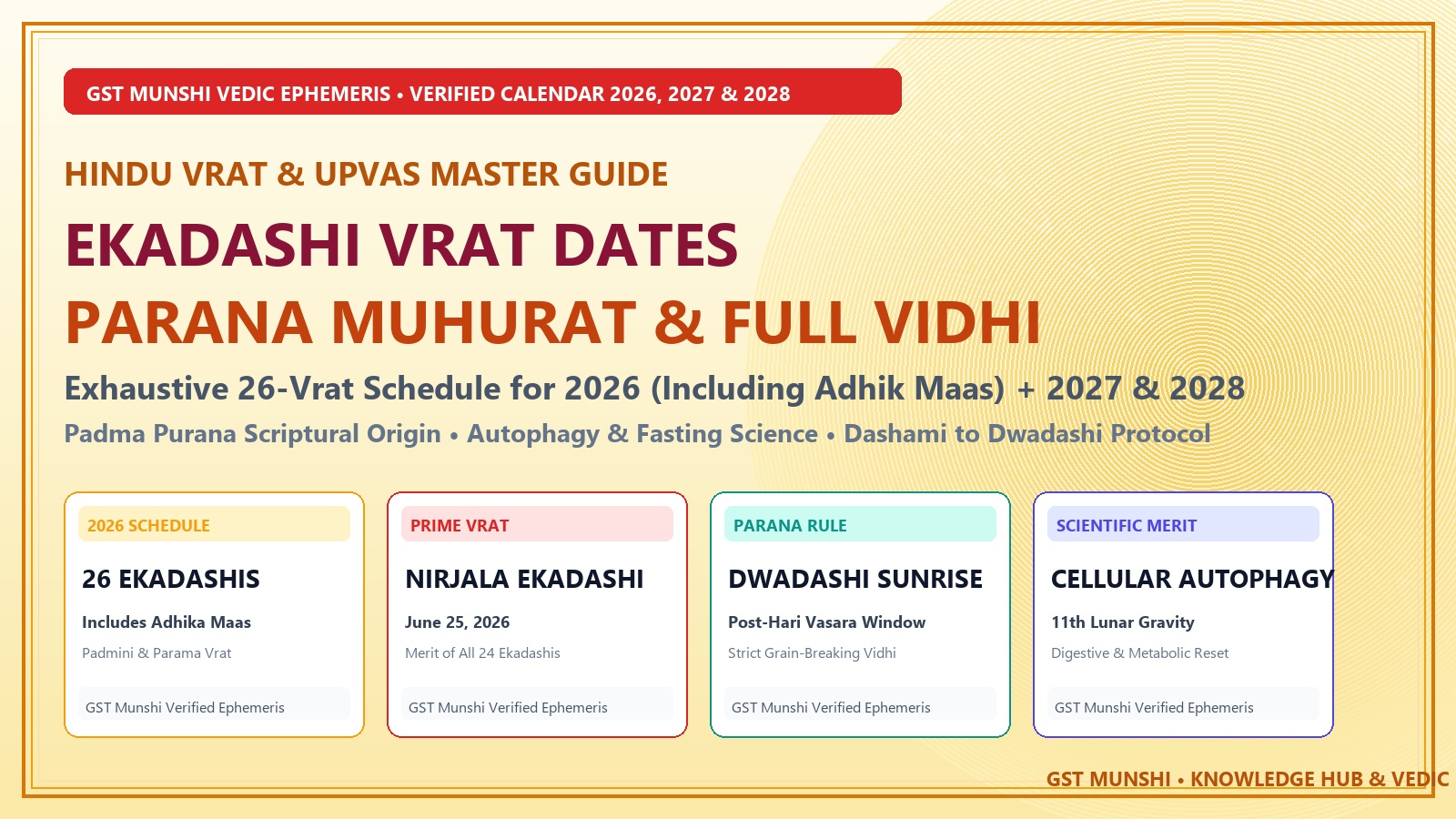
What is Ekadashi, how many fasts occur annually, and what are the essential rules?
Ekadashi Vrat Calendar & Parana Schedule (2026)
Color-coded monthly matrix with precise tithi timings, presiding Vishnu deities, and fast-breaking windows.
| Month | Ekadashi Name | Calendar Date & Day | Vedic Month & Paksha | Tithi Timing | Parana Muhurat (Fast Break) | Presiding Deity | Spiritual Fruit & Significance |
|---|---|---|---|---|---|---|---|
| January | Saphala Ekadashi | January 14, 2026 Wednesday | Pausha Krishna Paksha | Jan 13, 05:48 PM – Jan 14, 07:10 PM | Jan 15, 07:15 AM to 09:21 AM | Lord Narayana | Success in career, removal of financial inertia, and spiritual purification.Expounded in the Bhavishya Purana to King Yudhishthira, observing Saphala Ekadashi removes stag... |
| January | Pausha Putrada Ekadashi | January 30, 2026 Friday | Pausha Shukla Paksha | Jan 29, 08:35 PM – Jan 30, 09:40 PM | Jan 31, 07:10 AM to 09:20 AM | Lord Narayana | Blessings of worthy children, protection of family lineage, and divine harmony.Dedicated to couples desiring noble, healthy, and devoted progeny. King Suketuman and Queen Sha... |
| February | Shattila Ekadashi | February 13, 2026 Friday | Magha Krishna Paksha | Feb 12, 10:20 AM – Feb 13, 11:45 AM | Feb 14, 07:01 AM to 09:16 AM | Lord Vishnu | Deep cellular detoxification, eradication of planetary afflictions, and boundless heavenly merit.Observed using sesame seeds (Til) in six sacred ways: bathing with sesame water, applying sesam... |
| February | Jaya Ekadashi (Bhaimi Ekadashi) | February 28, 2026 Saturday | Magha Shukla Paksha | Feb 27, 12:15 PM – Feb 28, 01:25 PM | Mar 01, 06:48 AM to 09:07 AM | Lord Madhava | Liberation from haunting past karma, freedom from lower species rebirth, and peace of mind.Expounded by Lord Krishna in Padma Purana. Liberates the soul from ghostly (Pishacha) or tormen... |
| March | Vijaya Ekadashi | March 15, 2026 Sunday | Phalguna Krishna Paksha | Mar 14, 01:30 AM – Mar 15, 02:40 AM | Mar 16, 06:31 AM to 08:53 AM | Lord Vijaya Vishnu | Triumph over insurmountable obstacles, legal victories, vanquishing adversaries, and inner clarity.Observed by Maryada Purushottama Lord Sri Rama with His vanara army on the shores of the southe... |
| March | Amalaki Ekadashi | March 30, 2026 Monday | Phalguna Shukla Paksha | Mar 29, 04:10 AM – Mar 30, 05:20 AM | Mar 31, 06:14 AM to 08:38 AM | Lord Parashurama & Amla Tree | Physical vitality, radiant complexion, immense spiritual longevity, and erasure of grave sins.Dedicated to the holy Indian gooseberry (Amla) tree, which emerged directly from Lord Vishnu's ... |
| April | Papmochani Ekadashi | April 14, 2026 Tuesday | Chaitra Krishna Paksha | Apr 13, 03:15 PM – Apr 14, 04:20 PM | Apr 15, 05:57 AM to 08:24 AM | Lord Vishnu | Relief from intense guilt, spiritual absolution, release from moral transgressions, and rebirth of virtues.The fast that liberates (Mochana) from sins (Papa). Sage Medhavi, misled by apsara Manjughosha,... |
| April | Kamada Ekadashi | April 28, 2026 Tuesday | Chaitra Shukla Paksha | Apr 27, 07:05 PM – Apr 28, 08:15 PM | Apr 29, 05:44 AM to 08:12 AM | Lord Vasudeva | Manifestation of pure desires, protection against unforeseen calamities, and family peace.First Ekadashi of the Hindu new year (after Chaitra Navratri). Granted the power to fulfill all... |
| May | Varuthini Ekadashi | May 13, 2026 Wednesday | Vaishakha Krishna Paksha | May 12, 05:20 AM – May 13, 06:30 AM | May 14, 05:32 AM to 08:02 AM | Lord Madhusudana (Vamana Avatar) | Shield against untimely demise, spiritual elevation, and destruction of accumulated generational negative karma.Varuthini signifies 'armour' or 'impenetrable shield'. Bestows fortune equal to donating gold, ... |
| May | Padmini Ekadashi (Adhik Maas Special)Adhik Maas | May 27, 2026 Wednesday | Adhika Jyeshtha Shukla Paksha | May 26, 09:40 PM – May 27, 10:55 PM | May 28, 05:25 AM to 07:56 AM | Lord Radha-Krishna / Purushottama | Direct entry to Goloka/Vaikuntha, total karmic erasure, and supreme spiritual ecstasy.Occurs only during an intercalary leap month (Mala Masa / Adhika Masa) every 32 to 35 months. E... |
| June | Parama Ekadashi (Adhik Maas Special)Adhik Maas | June 11, 2026 Thursday | Adhika Jyeshtha Krishna Paksha | Jun 10, 08:15 AM – Jun 11, 09:25 AM | Jun 12, 05:23 AM to 07:54 AM | Lord Purushottama | Elimination of chronic poverty, financial upliftment, fulfillment of vows, and moksha.The concluding fast of Adhika Masa. Observed by pious Brahmin Sumedha and his virtuous wife Pav... |
| June | Apara Ekadashi (Achala Ekadashi) | June 10, 2026 Wednesday | Jyeshtha Krishna Paksha | Jun 09, 06:40 PM – Jun 10, 08:00 PM | Jun 11, 05:23 AM to 07:54 AM | Lord Trivikrama | Unlimited spiritual merits, protection from public disgrace, and redemption of promises.Apara means 'limitless'. Washing away heavy offenses such as false testimony, breach of trust, ... |
| June | Nirjala Ekadashi (Pandava Nirjala / Bhimseni)Nirjala | June 25, 2026 Thursday | Jyeshtha Shukla Paksha | Jun 24, 11:35 PM – Jun 25, 12:45 AM (Jun 26) | Jun 26, 05:25 AM to 07:58 AM | Lord Vishnu | Complete redemption of missed annual fasts, extreme metabolic cleanse, and direct Vaikuntha attainment.The undisputed king of all Ekadashi fasts. Sage Vedavyasa instructed Bhima—who had an insatiabl... |
| July | Yogini Ekadashi | July 10, 2026 Friday | Ashadha Krishna Paksha | Jul 09, 09:10 AM – Jul 10, 10:20 AM | Jul 11, 05:31 AM to 08:04 AM | Lord Narayana | Healing from chronic physical afflictions, mental clarity, and liberation from ancestral curses.Observed to cure intractable physical ailments and incurable diseases. Hemamali, gardener of Ya... |
| July | Devshayani Ekadashi (Hari Shayani / Ashadhi Ekadashi) | July 25, 2026 Saturday | Ashadha Shukla Paksha | Jul 24, 02:45 PM – Jul 25, 03:55 PM | Jul 26, 05:39 AM to 08:12 AM | Lord Vishnu in Yoga Nidra | Initiation of high spiritual vows, peace of mind, family welfare, and deep meditative communion.Marks the sacred beginning of the 4-month Chaturmas period. Lord Vishnu retires to cosmic yogic... |
| August | Kamika Ekadashi | August 9, 2026 Sunday | Shravana Krishna Paksha | Aug 08, 08:45 PM – Aug 09, 09:55 PM | Aug 10, 05:47 AM to 08:21 AM | Lord Shridhara | Freedom from fear of Yamadutas, blessing of ancestral peace, and absolute mental tranquility.Occurring during holy Shravana month. Brahma told Narada that worshiping Lord Vishnu with fresh... |
| August | Shravana Putrada Ekadashi (Pavitropana Ekadashi) | August 23, 2026 Sunday | Shravana Shukla Paksha | Aug 22, 06:15 AM – Aug 23, 07:25 AM | Aug 24, 05:55 AM to 08:28 AM | Lord Damodara | Parental joy, pacification of Pitr-dosha, and preservation of family legacy.Also known as Pavitra Ekadashi. Bestows worthy offspring and preserves ancestral lines. King Ma... |
| September | Aja Ekadashi (Ananda Ekadashi) | September 7, 2026 Monday | Bhadrapada Krishna Paksha | Sep 06, 07:15 AM – Sep 07, 08:20 AM | Sep 08, 06:03 AM to 08:34 AM | Lord Hrishikesha | Restoration of lost status, destruction of unforeseen tribulations, and unwavering integrity.King Harishchandra, tested by Sage Vishvamitra to the extreme limits of truth and duty, lost hi... |
| September | Parsva Ekadashi (Parivartini / Vamana Ekadashi) | September 22, 2026 Tuesday | Bhadrapada Shukla Paksha | Sep 21, 09:30 PM – Sep 22, 10:40 PM | Sep 23, 06:10 AM to 08:38 AM | Lord Vamana | Transformation of personal destiny, liberation from pride, and divine protection from King Bali's realm.During His cosmic slumber, Lord Vishnu turns from His left flank to His right flank (Parsva Par... |
| October | Indira Ekadashi | October 6, 2026 Tuesday | Ashwin Krishna Paksha | Oct 05, 04:55 PM – Oct 06, 06:05 PM | Oct 07, 06:17 AM to 08:42 AM | Lord Padmanabha | Immediate salvation of ancestors, resolution of Pitru dosha, and ancestral peace.Falls during sacred Pitru Paksha. Dedicated solely to the liberation of departed ancestors suff... |
| October | Papankusha Ekadashi | October 21, 2026 Wednesday | Ashwin Shukla Paksha | Oct 20, 12:20 PM – Oct 21, 01:30 PM | Oct 22, 06:26 AM to 08:48 AM | Lord Padmanabha | Control over restless senses, bodily rejuvenation, freedom from impending afflictions.Acts as an Ankusha (sharp elephant goad) that curbs and subdues the wild, uncontrolled senses t... |
| November | Rama Ekadashi | November 5, 2026 Thursday | Kartik Krishna Paksha | Nov 04, 02:30 AM – Nov 05, 03:40 AM | Nov 06, 06:36 AM to 08:55 AM | Lord Keshava & Goddess Lakshmi (Rama) | Unfailing prosperity, eradication of financial liabilities, and grace of Goddess Mahalakshmi.Precedes the festival of Diwali. Named after Rama (another name of Goddess Lakshmi). Princess C... |
| November | Devutthana Ekadashi (Prabodhini / Dev Uthani) | November 20, 2026 Friday | Kartik Shukla Paksha | Nov 19, 02:40 AM – Nov 20, 03:50 AM | Nov 21, 06:48 AM to 09:04 AM | Lord Vishnu Awakening | Auspicious beginnings, blossoming of matrimonial prospects, and universal spiritual celebration.Concludes the 4-month Chaturmas. Lord Vishnu awakens from Yoga Nidra. Auspicious ceremonial Tul... |
| December | Utpanna Ekadashi | December 5, 2026 Saturday | Margashirsha Krishna Paksha | Dec 04, 11:20 AM – Dec 05, 12:30 PM | Dec 06, 07:00 AM to 09:13 AM | Ekadashi Devi & Lord Vishnu | Initiation into Ekadashi sadhana, divine protection from hidden enemies, and ultimate liberation.The divine birthday of Ekadashi Devi. When demon Mura attempted to slay sleeping Lord Vishnu in... |
| December | Mokshada Ekadashi (Gita Jayanti / Vaikuntha Ekadashi) | December 20, 2026 Sunday | Margashirsha Shukla Paksha | Dec 19, 04:30 PM – Dec 20, 05:40 PM | Dec 21, 07:09 AM to 09:20 AM | Lord Damodara & Sri Krishna | Unconditional liberation (Moksha), intellectual illumination, and spiritual realization.Celebrated as Gita Jayanti—the day Bhagavan Sri Krishna imparted the Srimad Bhagavad Gita to Ar... |
The Divine Scriptural Origin: Appearance of Goddess Ekadashi
The sacred tradition of Ekadashi fasting finds its authoritative genesis in the Uttara Khanda of the Padma Purana during a dialogue between Lord Sri Krishna and King Yudhishthira. In the Satya Yuga, a fierce demon named Mura terrorized all three realms, dethroning Lord Indra and banishing the demigods from the heavens.
Lord Vishnu engaged in a prolonged celestial battle against Mura that lasted a thousand years. To rest His transcendental body, Lord Vishnu entered a cave named Himavati in Badarikashrama (modern-day Badrinath) and entered deep mystical slumber (Yoga Nidra). Seizing the moment, demon Mura crept into the cave intending to strike the sleeping Lord.
At that critical instant, an extraordinary, radiant maiden endowed with divine weapons and blinding luster emanated directly from Lord Vishnu's transcendental energy. She engaged Mura in combat, shattered his weapons, and severed his head with a divine sword. When Lord Vishnu awoke, He beheld the vanquished demon and the luminous goddess standing humbly before Him.
Modern Biological & Scientific Cleansing: Lunar Gravity and Autophagy
While Ekadashi has been observed as a devotional ritual for millennia, modern astrophysics and medical physiology provide striking empirical validations for periodic 24-hour calorie restriction on the 11th lunar day:
Just as the gravitational alignment of the moon and sun induces high oceanic tides (Spring Tides) during Purnima (Full Moon) and Amavasya (New Moon), this gravitational pull builds significantly starting 4 days prior on the 11th lunar day (Ekadashi).
The human body consists of approximately 60% to 70% water. During the 11th lunar day, biological fluids, cellular hydration, and blood pressure experience subtle gravitational fluctuations. By fasting or consuming light liquid phalahar, the body prevents excessive water retention, stabilizes metabolic strain, and avoids mental agitation caused by neurotransmitter fluid imbalance.
Japanese cell biologist Dr. Yoshinori Ohsumi was awarded the 2016 Nobel Prize in Physiology or Medicine for deciphering the mechanisms of autophagy (cellular self-cleaning). When the human body undergoes fasting for 16 to 24 hours, glucose and glycogen stores are depleted.
In response, cells initiate an internal recycling process where intracellular lysosomes break down and recycle misfolded proteins, dysfunctional mitochondria, and damaged cellular debris. Fasting on Ekadashi every 15 days allows the gastrointestinal tract complete metabolic rest, reduces systemic inflammation, and enhances insulin sensitivity.
The Forbidden Rice Mystery: Why Rice is Strictly Prohibited on Ekadashi
The prohibition against consuming rice (Chawal) on Ekadashi is one of the most prominent observances in Hindu tradition, upheld strictly even by those who are unable to observe a full fast. The reasons are two-fold:
Vedic Scriptural Allegory (Pap-Purusha in Grains)
According to the Mahabharata and Vishnu Smriti, when Lord Vishnu vanquished the personification of sin (Pap-Purusha), He sought a place for these negative karmic seeds to reside without corrupting the righteous. Lord Vishnu granted the Pap-Purusha dwelling in all food grains, especially rice, solely on the eleventh lunar day. Thus, eating rice on Ekadashi is scripturally regarded as consuming the energetic essence of sins.
High Water-Retention & Digestive Sluggishness
From an Ayurvedic and nutritional standpoint, rice is a carbohydrate rich in hydrophilic starches that absorb and retain multiple times their dry weight in water. Consuming rice on the 11th lunar day—when lunar gravitational tides are pulling body fluids—causes severe abdominal bloating, drowsiness, lethargy (Tamas), and reduced mental focus, directly contradicting the purpose of spiritual meditation.
- ✓Rock Salt (Sendha Namak): Only natural mineral salt is allowed; regular table salt is avoided.
- ✓Non-Grain Flours: Kuttu (buckwheat), Singhara (water chestnut), and Rajgira (amaranth) flours.
- ✓Sabudana & Samak: Tapioca sago and Barnyard millet (Samak ke chawal).
- ✓Dairy Products: Pure cow milk, homemade yogurt (curd), fresh paneer, and pure desi ghee.
- ✓Fresh Fruits & Nuts: Apples, bananas, papaya, pomegranate, makhana (fox nuts), almonds, and walnuts.
- ✕All Grains & Cereals: Rice, wheat, barley, corn, oats, maida, and suji.
- ✕All Pulses & Legumes: Dal (moong, toor, chana, urad), beans, peas, and chickpeas.
- ✕Tamasic Ingredients: Onion, garlic, leeks, mushrooms, mustard seeds, and asafoetida (hing).
- ✕Table Salt & Spices: Standard iodized table salt, mustard oil, and packaged spice mixes.
- ✕Intoxicants & Non-Veg: Meat, fish, eggs, alcohol, tobacco, and dining in brass/bronze utensils.
Who Can Observe Ekadashi? Gender Inclusivity & Medical Exemptions
The scriptures state with unequivocal clarity: Ekadashi fasting is universal and democratic. Unlike certain Vedic rituals restricted by initiation, Ekadashi can be observed by any human being regardless of gender, age (above 8 years), marital status, or caste. Both men and women (unmarried girls, married women, and widows) derive identical spiritual fruits.
Compassionate Medical Exemptions (Sharira Madhyam Khalu Dharma Sadhanam)
The ancient sage Charaka reminds us that the physical body is the primary vehicle for performing dharma. Scriptures explicitly grant dispensations for individuals whose physiological health would be jeopardized by fasting:
Pregnant women and lactating mothers must NEVER observe waterless or calorie-deficient fasts. Normal satvik nutrition should be continued with mental prayer.
Children under 8 years of age and elderly persons with frailty are completely exempt from fasting. They are encouraged to simply abstain from rice and non-vegetarian food.
Patients with Type 1 diabetes, severe peptic ulcer disease, kidney disorders, or post-surgical recovery must adhere strictly to prescribed medicines and doctor-guided nutrition.
The Complete 3-Day Vrat Protocol: Dashami, Ekadashi & Dwadashi Parana
In Vedic science, Ekadashi is not an isolated 24-hour fast; it is an integrated 3-day spiritual discipline comprising preparation, peak austerity, and structured conclusion:
Step 1: Physical & Mental Purification on Dashami
Devotees consume only one pure satvik meal on Dashami day, strictly before sunset. Avoid heavy spices, onion, garlic, lentils, and restaurant food. Maintain celibacy (Brahmacharya) and retire to sleep early after evening prayers to prepare the mind and digestive tract for the sacred fast next morning.
Step 2: Brahma Muhurat Sankalp, Puja & Sadhana
1. Morning Holy Bath: Rise during Brahma Muhurat (between 4:00 AM and 5:30 AM). Bathe with clean water containing a few drops of Ganga Jal or sesame seeds. Wear clean yellow or white traditional clothing.
2. Sacred Sankalp (Vow): Stand before Lord Vishnu's idol or portrait holding clean water, yellow flowers, akshat, and a Tulsi leaf. Recite the formal intention to observe the fast with sincerity.
3. Worship & Recitation: Offer yellow sandalwood paste, yellow marigold flowers, incense, ghee lamp, and Tulsi leaves. Chant the supreme twelve-syllable mantra: "Om Namo Bhagavate Vasudevaya" or recite the Vishnu Sahasranama and Bhagavad Gita.
4. Strict Prohibitions: Avoid daytime sleeping, anger, speaking untruths, shaving, cutting hair, plucking Tulsi leaves on Ekadashi (pluck them on Dashami), and negative worldly chatter.
Step 3: Parana Muhurat & The Critical Hari Vasara Rule
The Hari Vasara Restriction: The fast must NEVER be broken during the first one-fourth duration of Dwadashi Tithi (known as Hari Vasara). Breaking the fast during Hari Vasara nullifies the merit of the entire fast. Always consult the exact Parana timing given in our table above.
Charity & Annadaan: Before breaking the fast, perform morning puja, feed a cow (Gau Seva), and offer food or dakshina to a pious Brahmin or the needy.
Fast-Breaking Meal: Break the fast by taking a Tulsi leaf with Charanamrit or pure water. Follow with a gentle, non-spicy satvik meal to ensure comfortable digestive resumption.
Verified Ekadashi Video Tutorials & Katha Guides
5 Curated Video GuidesWatch authoritative video discourses from venerated spiritual scholars on Ekadashi rules, puja vidhi, and fasting schedules.
Verified Expert Insights & Cultural Practitioner Disclosures
Perspectives from Vedic ephemeris researchers and lifestyle medicine practitioners on modern Ekadashi fasting:
"The most widespread mistake devotees commit is breaking the fast too early during Hari Vasara or skipping Parana altogether on Dwadashi. Observing Ekadashi for 36 hours without Parana does NOT yield double merit; rather, it contravenes the Padma Purana injunction. Dwadashi Parana within the calculated muhurat is indispensable for the fast's completion."
"Bi-monthly 24-hour intermittent fasting, exactly mirroring the Ekadashi cadence (every 14–15 days), promotes robust cellular autophagy without triggering chronic starvation stress. Patients who observe satvik phalahar on these days exhibit noticeable reductions in HbA1c fluctuations and systemic inflammation markers."
"Remember: In 2026, we have 26 Ekadashis due to the Adhika Jyeshtha leap month! Padmini Ekadashi (May 27) and Parama Ekadashi (June 11) occur only once every 3 years. Fasting during Purushottama Maas is celebrated as the most auspicious opportunity for ancestral and personal karmic purification."
"If you cannot do a waterless Nirjala fast, do NOT feel guilty. In Ayurveda, Langhana (fasting) is meant to generate Agni (digestive fire), not extinguish it. Drinking lukewarm water, coconut water, or enjoying a small bowl of roasted makhana with rock salt preserves health while keeping your sacred vow intact."
Frequently Asked Questions (FAQ) on Ekadashi Vrat
1What is Ekadashi and why is it considered the most sacred Hindu fast?
Ekadashi is the 11th lunar day (Tithi) of each fortnight in the Hindu lunar calendar, dedicated to Lord Vishnu and Goddess Ekadashi. Expounded in the Padma Purana, observing Ekadashi cleanses accumulated sins, purifies bodily tissues through natural cellular autophagy, balances water retention affected by lunar gravitational pulls, and bestows spiritual elevation towards Vaikuntha (Moksha).
2Why is eating rice strictly prohibited on Ekadashi?
Scripturally, according to the Vishnu Smriti and Padma Purana, sins (Pap-Purusha) take refuge in grains, particularly rice, on Ekadashi day. Scientifically, the 11th lunar day witnesses peak gravitational pull from the moon, affecting water levels in both oceans and the human body. Because rice has a high water absorption capacity, eating rice leads to excessive water retention, digestive heaviness, lethargy, and mental restlessness, which hinders spiritual meditation and physical detox.
3How many Ekadashis occur in 2026, 2027, and 2028?
In a regular calendar year, there are exactly 24 Ekadashis (2 per month: Shukla Paksha and Krishna Paksha). However, in 2026 there are 26 Ekadashis due to the occurrence of Adhika Maas (intercalary leap month in Adhika Jyeshtha), which adds Padmini Ekadashi and Parama Ekadashi. In 2027 and 2028, there are 24 canonical Ekadashis each.
4What is Nirjala Ekadashi and why does it have special significance?
Nirjala Ekadashi (observed on Jyeshtha Shukla Paksha) is the most rigorous fast of the entire year, undertaken without consuming even a single drop of water for 24 continuous hours (from sunrise on Ekadashi to sunrise on Dwadashi). Sage Vedavyasa expounded to Bhimasena that observing this single waterless fast with complete sincerity yields the cumulative spiritual merit of observing all 24 annual Ekadashis.
5What are the rules for breaking the Ekadashi fast (Parana Muhurat)?
Parana must strictly be performed on the next morning (Dwadashi Tithi) after sunrise and before Dwadashi Tithi ends. Furthermore, the fast must NEVER be broken during Hari Vasara (the first one-fourth duration of Dwadashi Tithi). Devotees break the fast by first offering prayers to Lord Vishnu, offering water to a Tulsi plant, sipping holy water (Charanamrit) with a Tulsi leaf, and feeding a cow or Brahmin before consuming their light satvik meal.
6Who is eligible to keep the Ekadashi fast, and what are the medical exemptions?
Ekadashi fasting is universally open to everyone—men, women (unmarried, married, or widowed), and individuals of all ashramas from age 8 to 80. However, pregnant women, lactating mothers, the elderly, growing children, and individuals suffering from acute medical conditions (such as diabetes, severe peptic ulcers, or renal illness) should not keep strict Nirjala or waterless fasts. They are scripturally permitted Phalahar (fruits, milk, sabudana, samak rice) or simple prayer without endangering physical health.