What is the best way to invest in silver in India, and how is silver taxed?
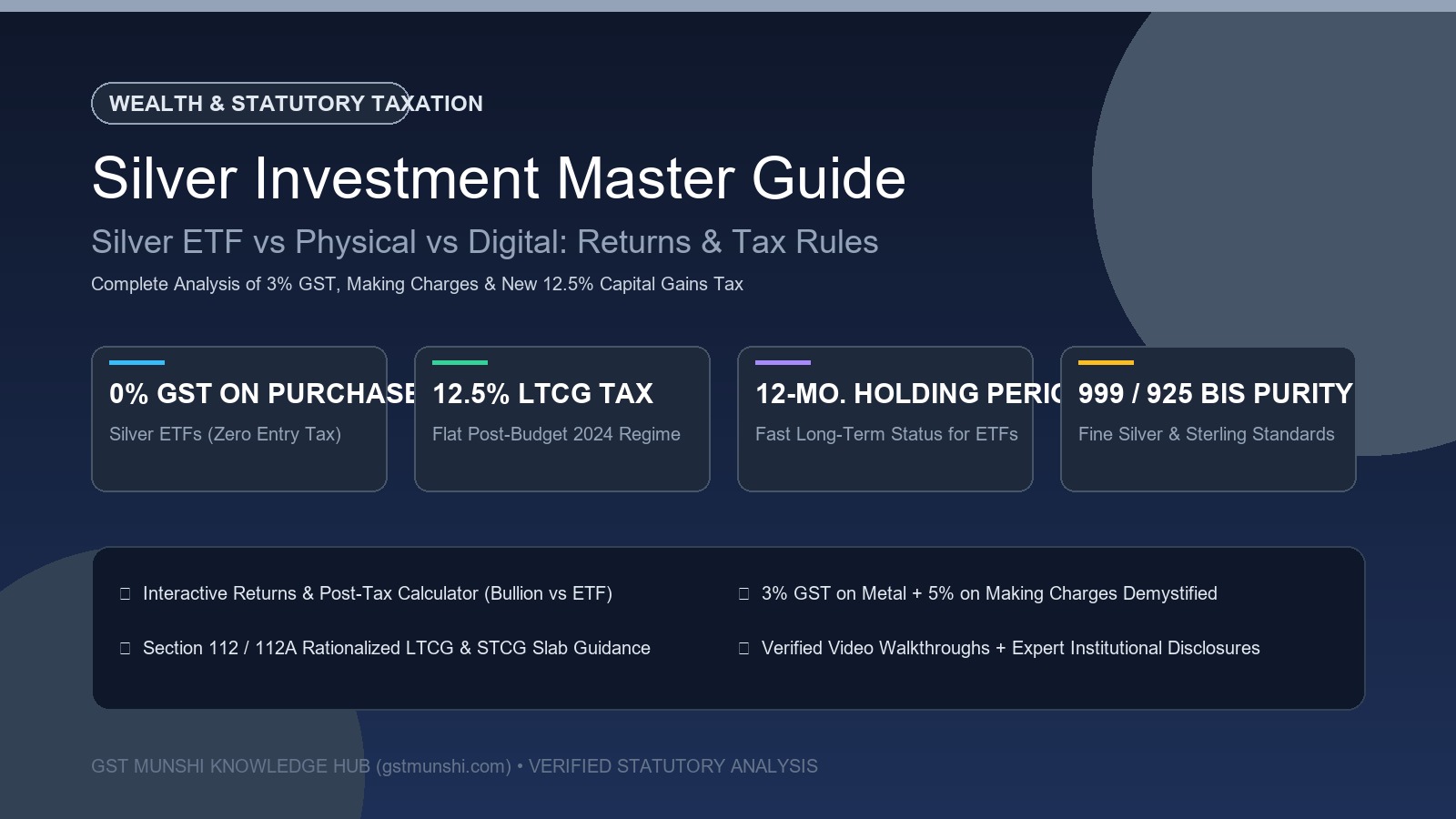
For pure investment, Silver ETFs are mathematically and operationally superior to Physical and Digital Silver. Under the rationalized Finance Act tax regime, Silver ETFs attract 0% GST on purchase and qualify for a flat 12.5% Long-Term Capital Gains (LTCG) tax after just 12 months. In contrast, Physical Silver incurs 3% upfront GST, requires a longer 24-month holding period for LTCG, and suffers from a 5% to 15% melting deduction and spread upon resale to jewellers.
Zero purchase tax on exchange-traded units vs 3% on physical metal
Harmonized long-term capital gains tax rate without indexation
Listed Silver ETFs qualify for LTCG in 1 year (physical requires 2 years)
Fine silver for bars/ETFs; 92.5% sterling silver for jewellery
1. Interactive Silver Investment Returns & Tax Simulator
Simulate real-world post-tax returns across all major silver investment formats. Toggle holding periods, investment sums, and income tax brackets to observe the exact compounding differential created by GST avoidance and 12-month LTCG timing:
Silver Investment Returns & Capital Gains Tax Simulator (2026–2027)
Evaluate real in-hand returns after 3% GST, making charges, locker costs, and 12.5% LTCG vs slab STCG
2. Master Comparison Matrix: Silver ETF vs Physical vs Digital Silver
Indian investors have five distinct pathways to acquire exposure to silver. The operational, statutory, and cost mechanics vary substantially across each format:
| Feature | Silver ETF | Physical Bullion (999) | Silver Jewellery (925) | Digital Silver | Silver FoF (Mutual Fund) |
|---|---|---|---|---|---|
| Purchase GST | 0% (Nil) | 3% on Value | 3% Metal + 5% Making | 3% on Value | 0% (Nil) |
| LTCG Holding Period | > 12 Months | > 24 Months | > 24 Months | > 24 Months | > 24 Months |
| LTCG Tax Rate | 12.5% Flat | 12.5% Flat | 12.5% Flat | 12.5% Flat | 12.5% Flat |
| STCG Tax Rate | Income Tax Slab | Income Tax Slab | Income Tax Slab | Income Tax Slab | Income Tax Slab |
| Storage & Theft Risk | Zero (Demat) | High (Bank Locker) | High (Home/Locker) | Third-Party Vault | Zero (Folio) |
| Purity Guarantee | 99.9% LBMA Bars | 99.9% BIS Hallmark | 92.5% (Sterling) | 99.9% Vaulted | 99.9% Underlying |
| Resale Deduction / Spread | 0.05% - 0.15% | 2% - 5% Haircut | 10% - 25% Loss | 3% - 6% Spread | 0% (NAV) |
| Regulatory Authority | SEBI | BIS / Consumer Affairs | BIS | Unregulated | SEBI |
3. Rationalized Capital Gains Taxation (Budget 2024–2026 Framework)
The Union Budget 2024 instituted the most comprehensive restructuring of capital gains taxation in two decades. For silver and gold investors, the reforms replaced a fractured matrix of holding periods and indexation benefits with a unified two-tier classification:
Listed Silver ETFs (> 12 Months LTCG)
Because Silver ETFs are securities listed on recognized stock exchanges (NSE and BSE), they benefit from the shortened 12-month threshold to achieve long-term capital asset status.
- Short-Term (≤ 12 Months): Gains added to taxable income; taxed at marginal slab rates (up to 39% including surcharge).
- Long-Term (> 12 Months): Taxed at a flat rate of 12.5% without indexation under Section 112.
- Zero Annual Exemption: Unlike equities, Section 112A's ₹1.25 Lakh exemption does not apply to commodity ETFs.
Physical Silver & Digital Silver (> 24 Months LTCG)
Unlisted physical assets—including bullion bars, silver coins, jewellery, and app-based digital silver—now require a 24-month holding period (reduced from the legacy 36-month threshold).
- Short-Term (≤ 24 Months): Profits added to taxable income and taxed according to your applicable slab rate.
- Long-Term (> 24 Months): Taxed at a flat rate of 12.5% without indexation for purchases made on or after July 23, 2024.
- End of Indexation: The legacy 20% tax rate with Cost Inflation Index (CII) adjustments has been removed for fresh acquisitions.
4. The Hidden Cost Trap of Physical Silver
While physical silver offers psychological comfort, its financial efficiency is severely compromised by entry leakages, recurring custodial friction, and exit discounts:
1. Non-Recoverable GST Leakage
Every purchase of physical bullion incurs a 3% GST (HSN 7106). If you invest ₹5,00,000 in silver bars, ₹15,000 is consumed by GST immediately. When you sell the silver back to a dealer, the GST is not refunded, meaning the metal must rise 3.1% just to break even.
2. Making Charges on Jewellery
Silver jewellery carries making charges between 10% and 25%, plus 5% GST on the making component. Jewellers do not pay for making charges upon buyback, resulting in an immediate 15% to 30% capital destruction upon liquidation.
3. Resale Haircuts & Purity Tests
Local jewellers routinely apply a 2% to 5% melting loss deduction even on 999 hallmarked bars unless sold back to the exact same jeweller with the original invoice. In contrast, Silver ETFs execute at tight exchange spreads of 0.05% to 0.10%.
5. BIS Hallmarking & Silver Purity Standards (IS 2112:2014)
If you choose to purchase physical silver for ceremonial, cultural, or ornamental purposes, verifying official Bureau of Indian Standards (BIS) hallmarking is critical to avoid adulteration:
The 3 Compulsory Marks on Hallmarked Silver in India
Certifies that the precious metal testing and hallmarking center is accredited and licensed by the Bureau of Indian Standards.
Indicates parts-per-thousand purity: 999 (99.9% fine silver), 990 (99.0%), 925 (Sterling silver), or 900 (Coin silver).
Hallmark Unique Identification code laser-stamped on the item. Can be scanned on the BIS Care App to view the jeweler registration and hallmarking date.
6. Section 54F Strategy: Rolling Silver Capital Gains into Residential Property
Investors who have accrued substantial capital gains on long-held physical silver or silver ETFs can legally eliminate their entire 12.5% LTCG tax liability using statutory reinvestment provisions under Section 54F of the Income Tax Act, 1961:
Statutory Conditions for 100% Capital Gains Exemption
- Asset Eligibility: The silver (ETF or physical bullion) must have been held for more than the qualifying long-term threshold (> 12 months for ETFs; > 24 months for physical).
- Full Net Consideration Reinvestment: Unlike Section 54 (which requires reinvesting only capital gains from residential house sales), Section 54F requires the entire net sale consideration to be reinvested into residential house property.
- Timelines: Purchase a residential house within 1 year before or 2 years after the silver sale date, OR construct a residential house within 3 years after the sale date.
- Single House Property Restriction: On the date of the silver sale, the taxpayer must not own more than one residential house (excluding the new property being acquired).
7. Verified Practitioner Insights & Market Disclosures
Curated strategic briefs from institutional wealth advisors and chartered accountants regarding portfolio allocation and taxation in silver:
Anand Rathi Wealth Management
Commodities & Portfolio Strategy Desk"Silver exhibits double the volatility of gold because more than 50% of global silver demand stems from industrial applications—including solar photovoltaic panels, electric vehicles, and semiconductors. Investors should cap silver allocation at 5% to 10% of their liquid portfolio and utilize Silver ETFs to capture clean spot returns without 3% GST friction."
CA Nitesh Buddhadev
Chartered Accountant & Direct Tax Specialist"Post-July 2024, the elimination of indexation means physical silver investors in the 30% tax bracket benefit from a predictable 12.5% LTCG rate after 24 months. However, remember to maintain strict purchase vouchers and hallmark invoices; failure to prove acquisition cost can trigger penal assessments under Section 69A at 60% plus surcharge."
@FinTaxIndia
Capital Markets Analyst"Huge arbitrage: Silver ETF units qualify as LTCG in 12 months vs 24 months for physical coins. If silver rallies 30% in year one, ETF holders pay 12.5% flat after 366 days. Physical silver sellers pay full 30% slab rate! ETFs win on both entry GST and exit timeline."
@BullionTrackerIN
Precious Metals Desk"Stop buying digital silver on UPI apps! You are paying 3% GST on purchase, losing 4%–5% on the bid-ask spread, and trusting private vault companies. Open a free Demat account and buy Silver BeES or ICICI Silver ETF. Zero GST, 0.05% spread, regulated by SEBI."
8. Verified Video Tutorials: Silver ETF vs Physical Silver Analysis
Watch comprehensive institutional video walkthroughs analyzing silver investment fundamentals, capital gains tax computation, and digital silver comparisons:
9. Frequently Asked Questions (FAQ)
Which is better for investment: Silver ETF or Physical Silver?
Silver ETFs are mathematically and operationally superior for pure investment. Silver ETFs attract 0% GST on purchase, require only 12 months of holding to qualify for a flat 12.5% Long-Term Capital Gains (LTCG) tax, and eliminate storage, theft, locker fees, and non-recoverable making charges. Conversely, Physical Silver incurs a 3% upfront GST, requires 24 months to qualify for LTCG, and suffers from a 5% to 15% melting deduction and buy-sell bid-ask spread when reselling to jewellers.
What is the new capital gains tax on Silver ETFs following the Finance Act amendments?
Under the rationalized capital gains tax regime effective July 23, 2024, listed Silver ETFs qualify as Long-Term Capital Assets if held for more than 12 months. Long-Term Capital Gains (LTCG) are taxed at a flat rate of 12.5% without indexation under Section 112. If sold within 12 months, Short-Term Capital Gains (STCG) are added to your total income and taxed at your applicable personal income tax slab rate.
What is the holding period for Physical Silver to qualify for Long-Term Capital Gains?
The holding period for unlisted Physical Silver (bars, coins, utensils, and jewellery) to qualify for LTCG has been standardized to more than 24 months (reduced from the previous 36-month threshold). Profits from selling physical silver held for over 24 months are taxed at a flat 12.5% without indexation for purchases made after July 23, 2024. If held for 24 months or less, gains are taxed at slab rates.
Do Silver ETFs get the ₹1.25 Lakh annual LTCG tax exemption?
No. The ₹1.25 Lakh annual LTCG tax exemption under Section 112A applies exclusively to equity shares and equity-oriented mutual funds. Silver ETFs and Gold ETFs are classified as commodity-based financial assets, meaning every single rupee of net long-term capital gain is taxed at 12.5% without any threshold exemption.
What is the GST rate on buying physical silver and silver jewellery in India?
Physical silver bars and mint coins attract a flat 3% GST on the entire metal value (HSN Code 7106). When purchasing silver jewellery or ornamental silverware, you pay 3% GST on the silver value plus an additional 5% GST on the making charges. These GST amounts are non-recoverable upon resale.
What is the difference between 999 Fine Silver and 925 Sterling Silver?
999 Fine Silver contains 99.9% pure silver and is the official standard for investment bullion bars, government mint coins, and institutional ETF custody reserves. 925 Sterling Silver contains 92.5% pure silver alloyed with 7.5% other metals (usually copper) to provide structural strength and hardness, making it the worldwide standard for jewellery, silverware, and decorative articles.
How can I verify authentic silver through BIS Hallmarking in India?
Under BIS Standard IS 2112:2014, hallmarked silver articles carry three mandatory laser-engraved marks: 1) The triangular BIS logo, 2) The purity grade mark (such as 999 for 99.9% purity, 990 for 99%, 925 for sterling silver, or 900 for coin silver), and 3) A 6-digit alphanumeric Hallmarking Unique Identification (HUID) code that can be verified in real time on the BIS Care mobile app.
Can I save capital gains tax on selling physical silver by buying a house under Section 54F?
Yes. Under Section 54F of the Income Tax Act 1961, if you sell physical silver held for more than 24 months and invest the entire net sale consideration into purchasing a residential house (within 1 year before or 2 years after the sale date) or constructing a residential house (within 3 years), the long-term capital gains are completely exempt, provided you do not own more than one residential house on the date of transfer.
What is the risk and tax trap of investing in Digital Silver through mobile apps?
Digital Silver carries three major disadvantages: 1) An upfront non-recoverable 3% GST on purchase, 2) A massive 3% to 6% spread between the buy quote and sell quote charged by private platform vendors, and 3) Lack of direct regulation by SEBI or RBI. Unlike Silver ETFs which are held in your Demat account under strict depository participant oversight, digital silver is held with private wallet entities.
Can I invest in Silver ETFs through monthly SIP without a Demat account?
Yes. If you do not have a Demat account, you can invest in a Silver Fund of Funds (Silver FoF) offered by asset management companies (such as Nippon India, ICICI Prudential, or HDFC Mutual Fund). The FoF invests directly into the underlying Silver ETF. You can set up a monthly auto-debit SIP starting from ₹100 through any standard mutual fund platform.
Is there any Wealth Tax on holding physical silver in India?
No. The Wealth Tax Act, 1957 was abolished by the Finance Act, 2015 with effect from Assessment Year 2016–17. There is no annual wealth tax liability on holding physical silver, gold, or jewellery. However, you must be able to prove the legitimate source of funds used to purchase the silver during income tax assessments under Section 69A.
What are the expense ratios and tracking errors of Indian Silver ETFs?
Indian Silver ETFs typically carry an annual total expense ratio (TER) ranging between 0.35% and 0.55%. In accordance with SEBI guidelines, fund houses must hold at least 95% of their net assets in physical silver of 99.9% purity (LBMA-approved bars), ensuring tracking errors generally remain under 0.50% over a rolling 1-year period.