What is MSP in India, how is it calculated, and what is the A2+FL vs C2 controversy?
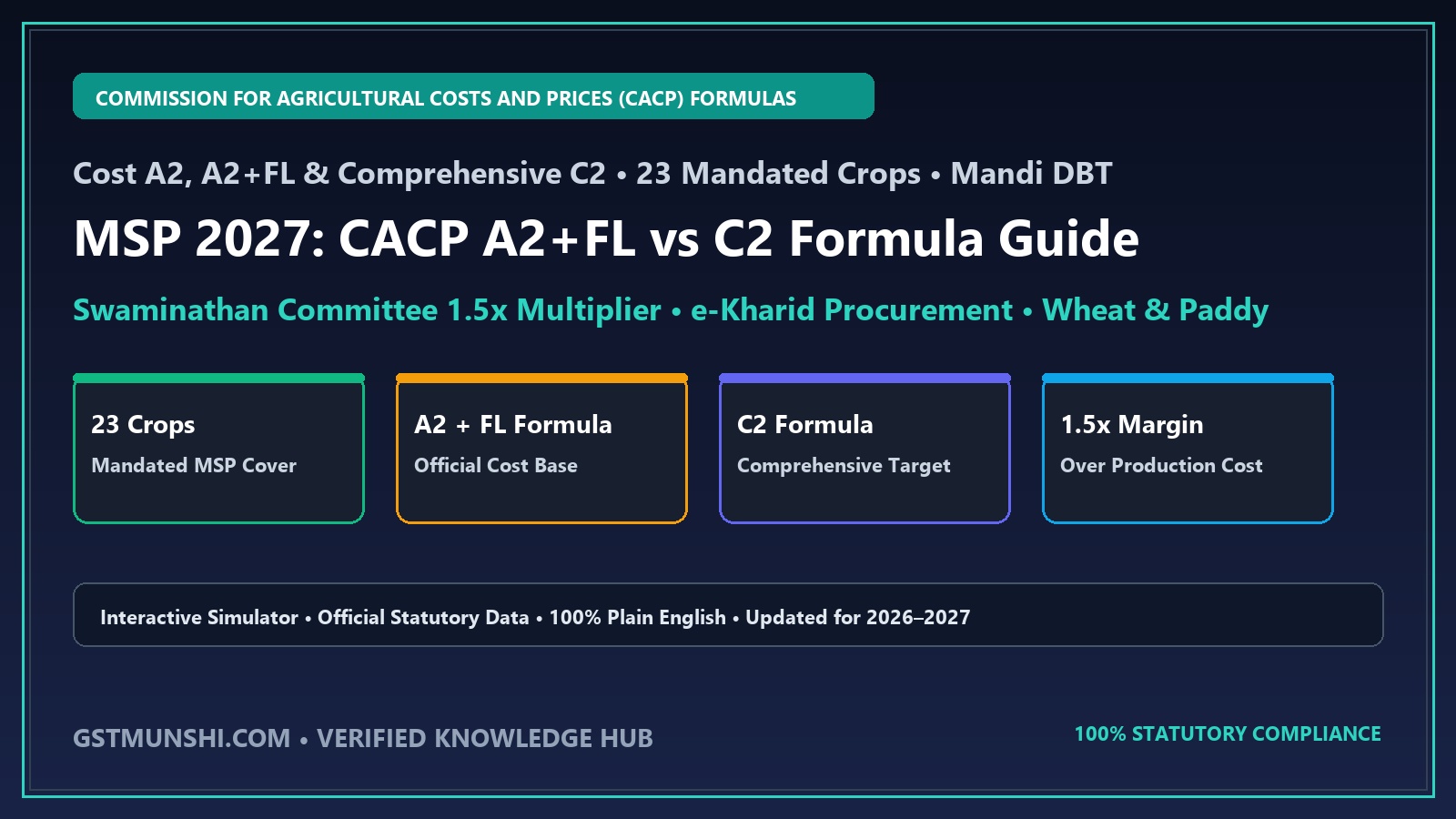
Minimum Support Price (MSP) is the guaranteed price floor at which government agencies (FCI, NAFED, CCI) purchase 22 mandated crops plus sugarcane FRP from farmers. It is recommended by the Commission for Agricultural Costs and Prices (CACP) and approved by the CCEA. Since 2018-19, the government fixes MSP at minimum 1.5 times (Cost + 50%) of Cost A2+FL (paid-out expenses plus unpaid family labor). Farm organizations demand the Swaminathan Commission formula of Comprehensive C2 + 50%, which adds the rental value of owned land and fixed capital interest, resulting in 20% to 35% higher support prices.
22 MSP crops + Sugarcane Fair & Remunerative Price (FRP)
150% return over paid-out expenses and family labor
Comprehensive cost factoring land rental & asset depreciation
Electronic J-Form to Aadhaar-seeded bank account credit
2. Interactive CACP A2+FL vs C2 Cost Calculator
Adjust crop input expenses, family labor hours, and land rental rates to calculate government benchmark MSP versus the Swaminathan Commission C2+50% recommendation:
CACP Agricultural Cost & MSP Benchmark Simulator (Per Quintal)
Simulate Cost A2, Cost A2+FL, and Comprehensive C2 benchmarks against Swaminathan Formula
Swaminathan C2+50% yields an additional ₹675 per quintal because it factors in the opportunity cost of owned agricultural land and depreciation on farm implements.
3. CACP Institutional Mandate & Price Determination Methodology
The Commission for Agricultural Costs and Prices (CACP), established in 1965 as the Agricultural Prices Commission, is the statutory advisory body tasked with recommending price policy for major farm commodities. CACP submits comprehensive annual Price Policy Reports for Kharif and Rabi crops.
While calculating MSP, the CACP does not look merely at production expenses. Under its terms of reference, it analyzes seven dynamic economic variables:
Granular field data collected by agricultural universities across states covering seeds, fertilizers, fuel, and labor.
Evaluating inflation in diesel, electricity tariffs, machinery lease rates, and fertilizer retail costs.
Ensuring farmers have balanced financial incentives to grow water-efficient pulses and oilseeds over water-intensive paddy.
Balancing the prices received by the agricultural sector against the prices paid by farmers for non-farm consumer goods.
4. The 3 Cost Formulas Explained: Cost A2, Cost A2+FL & Comprehensive Cost C2
To understand agricultural price debates in India, one must master the three cost concepts defined under the Directorate of Economics and Statistics (DES) farm accounting system:
1. Cost A2 (Paid-Out Cash & Kind Expenses)
Direct CostCost A2 represents all actual expenses directly incurred in cash and kind by the farmer for crop production:
- Purchased seeds and farm-saved seed replacement costs
- Chemical fertilizers, manures, bio-fertilizers, and micronutrients
- Insecticides, fungicides, herbicides, and weed management sprays
- Hired human labor (casual and permanent agricultural workers)
- Hired bullock labor and tractor/harvester machinery lease expenses
- Fuel, electricity, and diesel pump irrigation operation charges
- Rent paid for leased-in land (if tenant farming)
2. Cost A2+FL (Cost A2 + Imputed Family Labor)
Govt BaselineCost A2+FL takes Cost A2 and adds the imputed monetary value of unpaid family labor (FL). In smallholder farming, family members work long hours in weeding, irrigation, guarding crops from wild animals, and harvest transport without receiving formal cash wages. CACP imputes this labor using statutory agricultural minimum wage rates.
3. Comprehensive Cost C2 (Total Economic Cost)
Full Economic ValueCost C2 is the complete economic cost of production. It includes Cost A2+FL plus:
- Imputed Rental Value of Owned Land: The income the farmer could have earned by renting out their farmland instead of cultivating it.
- Interest on Fixed Capital Assets: Interest on capital invested in tractors, borewells, solar pumps, farm ponds, storage sheds, and livestock (excluding land).
- Depreciation: Wear and tear depreciation on agricultural machinery and farm structures.
5. Swaminathan C2+50% vs Current Govt A2+FL+50% Policy
The core ideological and economic dispute in Indian agricultural policy centers on whether the 50% profit margin should be applied over Cost A2+FL or Comprehensive Cost C2:
Government Perspective (A2+FL + 50%)
The Central Government argues that fixing MSP at C2 + 50% would lead to runaway food inflation, heavily burden low-income urban consumers, distort market forces, and render Indian agricultural exports uncompetitive globally.
Furthermore, since land rental values vary wildly across states (e.g. ₹60,000/acre in Punjab vs ₹15,000/acre in Bundelkhand), factoring land rent creates massive regional procurement distortions.
Farmer Unions' Perspective (C2 + 50%)
Farm unions contend that excluding land rent and fixed asset capital interest penalizes farmers who have invested heavy capital into tractors, borewells, and micro-irrigation systems.
Without C2+50%, farming provides subsistence returns that fail to generate surplus capital for modernization, leaving farming families permanently vulnerable to debt shocks.
6. The Complete 23 Mandated Crops & Statutory FRP Roster
The 23 crops covered under the sovereign price support mechanism span Kharif, Rabi, and commercial agricultural cycles:
| Category | Number | Mandated Crops | Procuring Sovereign Agency |
|---|---|---|---|
| Cereals | 7 | Paddy (Common & Grade A), Wheat, Barley, Jowar (Hybrid & Maldandi), Bajra, Maize, Ragi | FCI & State Civil Supplies |
| Pulses | 5 | Gram (Chana), Arhar / Tur, Moong, Urad, Masur (Lentil) | NAFED & SFAC |
| Oilseeds | 7 | Groundnut, Rapeseed/Mustard, Soyabean, Sesamum, Sunflower Seed, Safflower, Nigerseed | NAFED (PSS Scheme) |
| Commercial | 4 | Raw Cotton (Medium & Long Staple), Raw Jute, Copra (Milling & Ball), Sugarcane (FRP) | CCI, JCI & Sugar Mills |
7. APMC Mandi Procurement SOP & Fair Average Quality (FAQ) Standards
Selling grain at MSP requires farmers to navigate strict digital registration and quality checks:
Step-by-Step Mandi Procurement Protocol
- Pre-Harvest Crop Sowing Registration: Register crop details and estimated acreage on your state's digital portal (e.g. Meri Fasal Mera Byora in Haryana, e-Kharid, or e-Uparjan in MP).
- Mandi Gate Pass & Slot Booking: Once procurement opens, book an arrival slot on the portal to receive a digital Gate Pass with date and APMC market yard allotment.
- Fair Average Quality (FAQ) Testing: Mandi inspectors extract representative grain samples to test moisture meters. Moisture must be strictly within limits (e.g. 17% for Paddy, 12% for Wheat). Grain with excess moisture must be sun-dried.
- Digital Weighment & Electronic J-Form: Certified weighbridge captures loaded and tare weights, automatically generating an electronic J-Form / Procurement Receipt.
- DBT Bank Credit: Procurement funds are cleared through the Public Financial Management System (PFMS), hitting the farmer's Aadhaar-linked bank account within 48 to 72 hours.
8. State Procurement Disparities & The Legal Guarantee Debate
The biggest practical limitation of MSP is that announcement does not equal procurement. Over 85% of wheat and paddy procurement happens across just 5 states:
High-Procurement States
Punjab, Haryana, Madhya Pradesh, Chhattisgarh, and Telangana possess dense APMC networks, extensive FCI godowns, and organized state civil supplies corporations. Here, over 70% to 90% of marketable surplus is purchased at MSP.
Low-Procurement States
In states like Bihar (where APMCs were repealed in 2006), Uttar Pradesh (eastern belts), West Bengal, and Assam, government procurement centers are sparse. Farmers are forced to sell to local middlemen at 20% to 40% below MSP.
9. Verified Agricultural Economists & Farm Policy Disclosures
Expert analysis from agricultural policy advisors and former CACP directors on pricing formulas and market realities:
Dr. Ashok Gulati, Eminent Agri Economist
Former Chairman, CACP"A legal guarantee for MSP without expanding private market demand risks creating fiscal unviability. The sustainable path is expanding Price Deficiency Payment systems (like Bhavantar Bhugtan Yojana), improving warehouse receipt financing, and establishing competitive e-NAM electronic trading corridors so open-market bids naturally converge toward MSP."
Prof. Ramesh Chand, Member (Agriculture)
NITI Aayog Policy Advisory"The A2+FL+50% formula adopted in 2018 represents a substantial improvement over historical pricing, delivering guaranteed returns above paid-out expenses. Our focus must now shift to oilseeds and pulses procurement to reduce India's $15 billion edible oil import bill while rebalancing agricultural water usage."
@AgriPolicyIndia
National Mandi Rates & CACP Price Watch"Crucial tip for farmers bringing wheat or paddy to government mandis: Test your grain moisture at the mandi entrance before unloading. If moisture exceeds 17% for paddy or 12% for wheat, mandi agents reject the lot. Sun-dry your grain on tarpaulins for 24 hours to avoid private trader deductions."
@KisanVoiceJournal
Rural Agrarian Economy & Farm Union Watch"The gap between A2+FL and C2+50% is not academic; it represents roughly ₹400 to ₹700 per quintal in lost income for wheat and paddy growers who own their land. Until comprehensive land and capital costs are factored into MSP, agricultural indebtedness will remain a structural challenge."
10. Official Educational Video Masterclasses & Farm Economics Lectures
Watch structured video masterclasses from verified agricultural scientists and economists explaining MSP formulas and procurement:
11. Frequently Asked Questions (FAQs)
What is Minimum Support Price (MSP) in India, and who fixes it?▼
Minimum Support Price (MSP) is the guaranteed agricultural price floor set by the Government of India to protect agricultural producers against sharp crashes in market prices. MSP is recommended by the Commission for Agricultural Costs and Prices (CACP), a statutory advisory body under the Ministry of Agriculture, and formally approved and notified by the Cabinet Committee on Economic Affairs (CCEA) chaired by the Prime Minister.
How many agricultural crops are covered under the MSP framework?▼
The Government of India notifies MSP for 22 mandated agricultural crops, plus Fair and Remunerative Price (FRP) for Sugarcane, making a total of 23 crops. These comprise: 7 Cereals (Paddy, Wheat, Maize, Bajra, Jowar, Ragi, Barley); 5 Pulses (Gram, Arhar/Tur, Moong, Urad, Masur/Lentil); 7 Oilseeds (Groundnut, Rapeseed/Mustard, Soyabean, Sesamum, Sunflower Seed, Safflower, Nigerseed); and 4 Commercial Crops (Raw Cotton, Raw Jute, Copra, Sugarcane).
What is the difference between Cost A2, Cost A2+FL, and Comprehensive Cost C2?▼
1) Cost A2 covers all direct out-of-pocket expenses incurred by the farmer in cash and kind (seeds, chemical fertilizers, pesticides, hired labor, tractor fuel, irrigation charges, and leased-in land rent). 2) Cost A2+FL equals Cost A2 plus an imputed monetary value for unpaid Family Labor (FL). 3) Cost C2 is the comprehensive economic cost, covering A2+FL plus the imputed rental value of owned agricultural land and interest on owned fixed capital assets.
What was the Swaminathan Commission formula for MSP?▼
The National Commission on Farmers, headed by eminent agricultural scientist Dr. M.S. Swaminathan, recommended in 2006 that MSP should be fixed at a minimum of 50% over and above the Comprehensive Cost of production (C2 + 50%). This ensures farmers receive a net return factoring in both family labor and the opportunity cost of owned land and fixed farm machinery.
Which cost formula does the Central Government currently use to fix MSP?▼
Since the Union Budget 2018-19, the Central Government has implemented the statutory principle of fixing MSP at a minimum of 1.5 times (Cost + 50%) of the Cost A2+FL benchmark. While this guarantees 50% profit over paid-out expenses and family labor, farm organizations continue to demand the adoption of the full Swaminathan C2+50% formula.
Is there a statutory legal guarantee for MSP in India?▼
Currently, MSP does not carry an explicit statutory backing under an Act of Parliament. While government procurement agencies (FCI, NAFED, Cotton Corporation of India) purchase crops at MSP in regulated APMC mandis, private traders are not legally barred by central law from buying produce below MSP in open markets.
What is FRP for sugarcane, and how does it differ from MSP?▼
For sugarcane, the government fixes the Fair and Remunerative Price (FRP) under the Sugarcane (Control) Order, 1966. Unlike MSP, which is voluntary for private traders, FRP is statutorily binding on sugar mills by law. Every sugar mill is legally obligated to pay cane growers the notified FRP within 14 days of cane delivery.
How does government procurement at MSP operate in practice?▼
Procurement is executed through state and central agencies like the Food Corporation of India (FCI) for wheat and paddy, NAFED for pulses and oilseeds, and the Cotton Corporation of India (CCI) for raw cotton. Farmers register on state e-procurement portals (e.g. Meri Fasal Mera Byora, e-Kharid, e-Uparjan) and bring their produce to designated APMC procurement centers where grain moisture and quality are inspected before issuing payment vouchers.
What are Fair Average Quality (FAQ) standards for MSP procurement?▼
Government procurement agencies only accept grain meeting strict Fair Average Quality (FAQ) parameters. For example, paddy moisture must not exceed 17%, foreign organic matter must be below 1%, damaged/discolored grains must be within specified tolerances, and weeviled grains must not exceed 1%. Grain failing FAQ standards must be cleaned or dried by the farmer before weighment.
How quickly is payment credited to farmers after selling at MSP?▼
Under the Direct Benefit Transfer (DBT) mandate via the Public Financial Management System (PFMS), procurement payments are directly credited into the farmer's Aadhaar-seeded bank account within 48 to 72 hours of generate electronic J-Form / weighment slips.
What happens if a state announces a State Advised Price (SAP) above FRP or MSP?▼
Certain states (like Uttar Pradesh, Punjab, and Haryana) announce a State Advised Price (SAP) for sugarcane that is higher than the central FRP, taking into account higher regional cultivation costs. Sugar mills in those states are statutorily required to settle accounts at the higher SAP rate.
Why does market price often drop below MSP in non-procurement states?▼
FCI and NAFED procurement infrastructure is heavily concentrated in certain states (such as Punjab, Haryana, Madhya Pradesh, Chhattisgarh, and Telangana). In states with limited government purchasing centers or storage capacity, private traders dominate the mandis, causing open-market prices to crash below MSP during peak harvest gluts.