
What is the 8th Pay Commission Fitment Factor and how will it calculate revised basic salaries?
8th CPC Salary & Fitment Factor Calculator
Simulate your revised basic pay, HRA, gross salary hike, and pension revision across all fitment factors.
The Constitutional Mandate & The 10-Year Revision Cycle
Under Article 309 of the Constitution of India, the Union Government periodically establishes a Central Pay Commission (CPC) to evaluate, streamline, and recalibrate compensation packages, allowances, and retirement benefits for approximately 49 lakh central government employees and over 68 lakh pensioners.
Historically, Central Pay Commissions follow a strict decennial (10-year) cadence:
Established a minimum basic pay of ₹2,550 with an average wage hike of ~20%.
Introduced Pay Bands and Grade Pay systems; fitment factor of 1.86; minimum wage ₹7,000.
Abolished Grade Pay; established the 18-Level Pay Matrix with a fitment factor of 2.57; minimum wage ₹18,000.
Fitment Factor Scenarios: 1.92 vs 2.28 vs 2.86
The fitment factor is the critical multiplier applied across all cells of the Pay Matrix. The table below illustrates the projected revised basic pay and salary hikes across common pay levels under the three prevailing economic scenarios:
| Pay Level | Representative Post | 7th CPC Basic | 1.92x (Conservative) | 2.28x (Moderate) | 2.86x (Union Demand) |
|---|---|---|---|---|---|
| Level 1 | MTS, Peon, Helper | ₹18,000 | ₹34,560 | ₹41,040 | ₹51,480 |
| Level 2 | Lower Division Clerk (LDC) | ₹19,900 | ₹38,208 | ₹45,372 | ₹56,914 |
| Level 4 | Upper Division Clerk (UDC) | ₹25,500 | ₹48,960 | ₹58,140 | ₹72,930 |
| Level 7 | Inspector (Income Tax, GST, CBI) | ₹44,900 | ₹86,208 | ₹1,02,372 | ₹1,28,414 |
| Level 10 | Assistant Commissioner, SDM | ₹56,100 | ₹1,07,712 | ₹1,27,908 | ₹1,60,446 |
| Level 14 | Joint Secretary to Govt of India | ₹1,44,200 | ₹2,76,864 | ₹3,28,776 | ₹4,12,412 |
| Level 18 | Cabinet Secretary of India | ₹2,50,000 | ₹4,80,000 | ₹5,70,000 | ₹7,15,000 |
Dearness Allowance (DA) 50% Threshold & Allowance Revision
When Dearness Allowance breaches the statutory benchmark of 50%, specific key allowances undergo automatic upward revisions under 7th Pay Commission recommendations:
House Rent Allowance (HRA) Revision
Once DA crossed 50%, HRA rates automatically escalated from 27%, 18%, and 9% to 30% (X class), 20% (Y class), and 10% (Z class) of basic pay. Under 8th CPC, this higher percentage structure remains the starting baseline.
Children Education Allowance & Gratuity
CEA rose by 25% to ₹2,812.50 per child per month (hostel subsidy ₹8,437.50). Concurrently, the maximum tax-free gratuity ceiling was raised by 25% from ₹20 Lakh to ₹25 Lakh under the Payment of Gratuity Act.
Administrative Implementation Roadmap & Gazette Procedure
The establishment and enforcement of a Central Pay Commission proceeds through four distinct statutory milestones:
Cabinet Approval & Terms of Reference (ToR)
The Union Cabinet formally approves the formation of the Commission, appointing a retired Supreme Court Justice as Chairperson along with economic experts, defining the official Terms of Reference (ToR).
Stakeholder Consultations & JCM Staff Submissions
The Commission conducts public hearings, receiving detailed memorandums from employee federations, defence service chiefs, and the National Council of JCM.
Report Submission & Empowered Committee of Secretaries (E-CoS)
The Commission delivers its multi-volume recommendations to the Union Finance Minister. An Empowered Committee of Secretaries screens the fiscal implications before final Cabinet endorsement.
Gazette Notification & Retrospective Arrears Disbursement
The Department of Expenditure (Ministry of Finance) issues the official Extraordinary Gazette Notification. Salary disbursing authorities re-fix payslips, and retrospective arrears are credited via DBT.
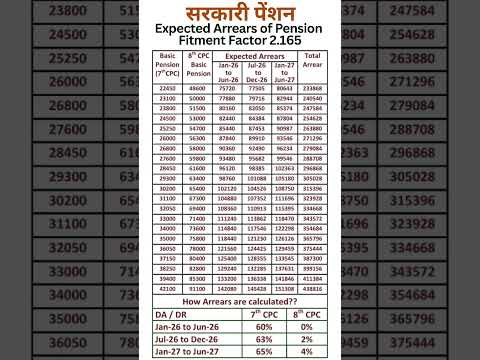
Verified Video Guides: Fitment Factor, Pay Matrix & Pension Analysis
Watch comprehensive analytical walkthroughs by public finance experts detailing salary matrices, pension formulas, and fitment factor negotiations:



Related Financial & Statutory Guides
Explore interconnected analyses on tax savings, welfare schemes, and investment planning: