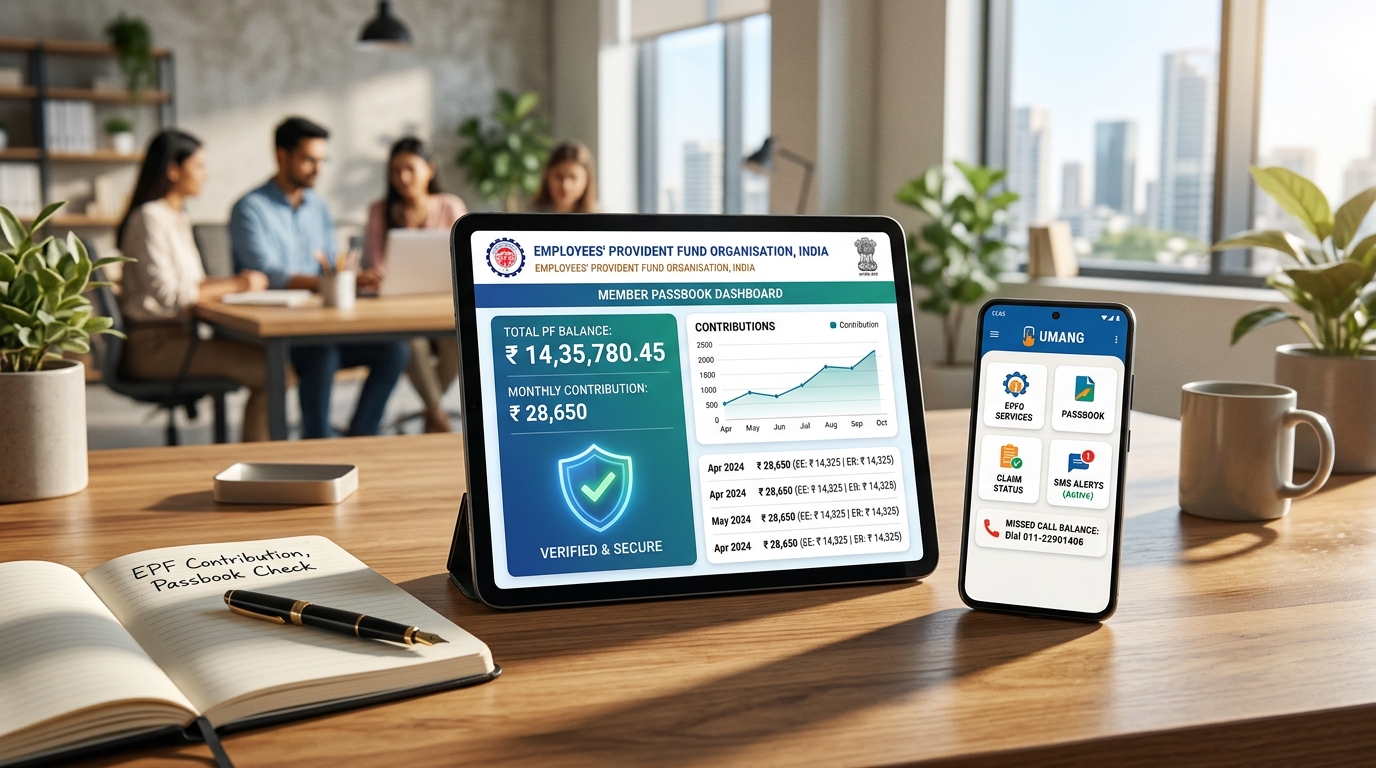
How do I check my EPF balance online and offline?
Check EPF Balance in 10 Seconds Without Password
Give a missed call from your Aadhaar/UAN registered mobile number. Call auto-disconnects after 2 rings.
EPFOHO UAN ENGSend SMS to 7738299899 from your registered SIM to get instant balance breakdown.
Open UMANG > Search EPFO > Click 'View Passbook' > Enter UAN & verify OTP.
Official portal to download complete year-by-year PDF passbook with employer contributions.
EPF Corpus Growth & Retirement Simulator
Calculate the future value of your Provident Fund based on the official 8.25% interest rate and monthly salary splits.
Includes your contributions, employer contributions, and tax-exempt compound interest.
The Anatomy of Your Provident Fund: Understanding Monthly Splits
The Employees' Provident Funds and Miscellaneous Provisions Act, 1952 governs retirement savings for millions of organized sector workers across India. When an employee earns basic pay plus dearness allowance (DA), a mandatory 12% deduction is made from their monthly gross salary. What many working professionals overlook is the statutory bifurcation of their employer's matching 12% contribution.
While the entire 12% deducted from your salary is credited directly into your EPF account balance, the employer's matching 12% is divided into two separate statutory pools. Exactly 3.67% goes into your EPF savings fund, where it earns compound interest. The remaining 8.33% is directed into the Employees' Pension Scheme (EPS) 1995 to fund lifelong post-retirement pensions, subject to a statutory wage ceiling cap of ₹1,250 per month (computed on basic pay up to ₹15,000).
In addition, the employer bears 0.50% toward the Employees' Deposit Linked Insurance (EDLI) scheme (which provides life insurance coverage up to ₹7,00,000 to the employee's family) and 0.50% toward EPFO administrative charges. Understanding this exact formula prevents confusion when viewing your monthly electronic passbook ledger.
Master Comparison: 4 Methods to Check EPF Balance
Compare speed, internet dependency, password requirements, and depth of information across all official EPFO inquiry methods.
| Method | Access Channel | Password Needed? | Internet Needed? | Speed | Information Provided | Best For |
|---|---|---|---|---|---|---|
| Missed Call | 9966044425 | No (Zero-Password) | No (Works Offline) | 10-30 Seconds | Total balance, last monthly credit, Member ID | Quick verification without computer or internet |
| Official SMS | 7738299899 | No (Zero-Password) | No (Works Offline) | 30-60 Seconds | UAN, member balance, Aadhaar status, last deposit | Checking in regional languages (Hindi, Tamil, etc.) |
| UMANG App | Mobile Application | OTP-Based | Yes | 1-2 Minutes | Full passbook, claim tracking, employer history | Smartphone users tracking claims & passbooks |
| Member Passbook Portal | passbook.epfindia.gov.in | Yes (UAN + Password) | Yes | 2-3 Minutes | Exhaustive year-wise PDF passbook with interest ledger | Downloading official PDF for home loan/visa proof |
Step-by-Step Blueprint: How to Download Your Official EPF PDF Passbook
Navigate to Official Member Passbook Portal
Open your browser and visit passbook.epfindia.gov.in. Enter your 12-digit Universal Account Number (UAN), your password, and solve the mathematical captcha security challenge.
Select Active Establishment Member ID
If you have switched organizations during your career, the dashboard will display multiple Member IDs linked under your single UAN. Select your current employer's Member ID from the drop-down selector to view the latest active ledger.
Verify Monthly Employee & Employer Deposits
Examine the table displaying your monthly basic pay, employee share (12%), employer share (3.67%), and EPS share (8.33%). Cross-reference these figures against your monthly salary pay slips to confirm zero deposit omissions.
Download Digitally Signed Statement
Click the green "Download Passbook" button located on the top right. Save the official PDF document, which contains the complete running financial year statement suitable for bank loan verifications and visa financial backing.
Verified Video Tutorials & Grievance Walkthroughs
Watch official portal login walkthroughs, UMANG app setups, and grievance filing guides for delayed employer contributions.
Practitioner Insights & Statutory Disclosures
Verified perspectives from former EPFO commissioners, corporate payroll directors, and certified financial planners.
Harish Chandra Joshi
Retired Assistant PF Commissioner & Labour Law Advocate
"Every salaried employee must audit their EPF passbook at least once a quarter. Under Section 14B and Rule 38 of the EPF Scheme 1952, employers must deposit collected contributions by the 15th of the following month. If your passbook exhibits missing monthly entries despite salary slip deductions, file an EPFiGMS grievance promptly to trigger automatic penalty proceedings against the defaulting establishment."
Shalini Venugopal
Corporate Payroll & Statutory Compliance Director
"Many employees incorrectly assume that their employer's full 12% contribution is accumulating with 8.25% interest in their EPF passbook. Remember that 8.33% of basic wages (subject to the ₹15,000 statutory wage ceiling, i.e., ₹1,250/month) is diverted into the EPS Pension pool. Your visible EPF accumulation only reflects the 3.67% employer share alongside your own 12% deduction."
Nikhil Rastogi
Certified Financial Planner & Wealth Architect
"At 8.25% sovereign-backed guaranteed yield with compounding interest, the EPF is India's most powerful fixed-income wealth builder. If your annual employee EPF contribution remains under ₹2,50,000, your entire interest payout enjoys triple-exempt (EEE) status under the Income Tax Act."
Deepak Agrawal
Digital India Citizen Portals Specialist
"If the EPFO passbook website shows server maintenance errors, immediately switch to the government UMANG mobile app. UMANG connects via dedicated government API gateways that frequently remain operational even when the primary web portal undergoes routine server maintenance."
Frequently Asked Questions
Direct statutory answers regarding EPFO passbook logins, UAN errors, pension splits, and tax rules.