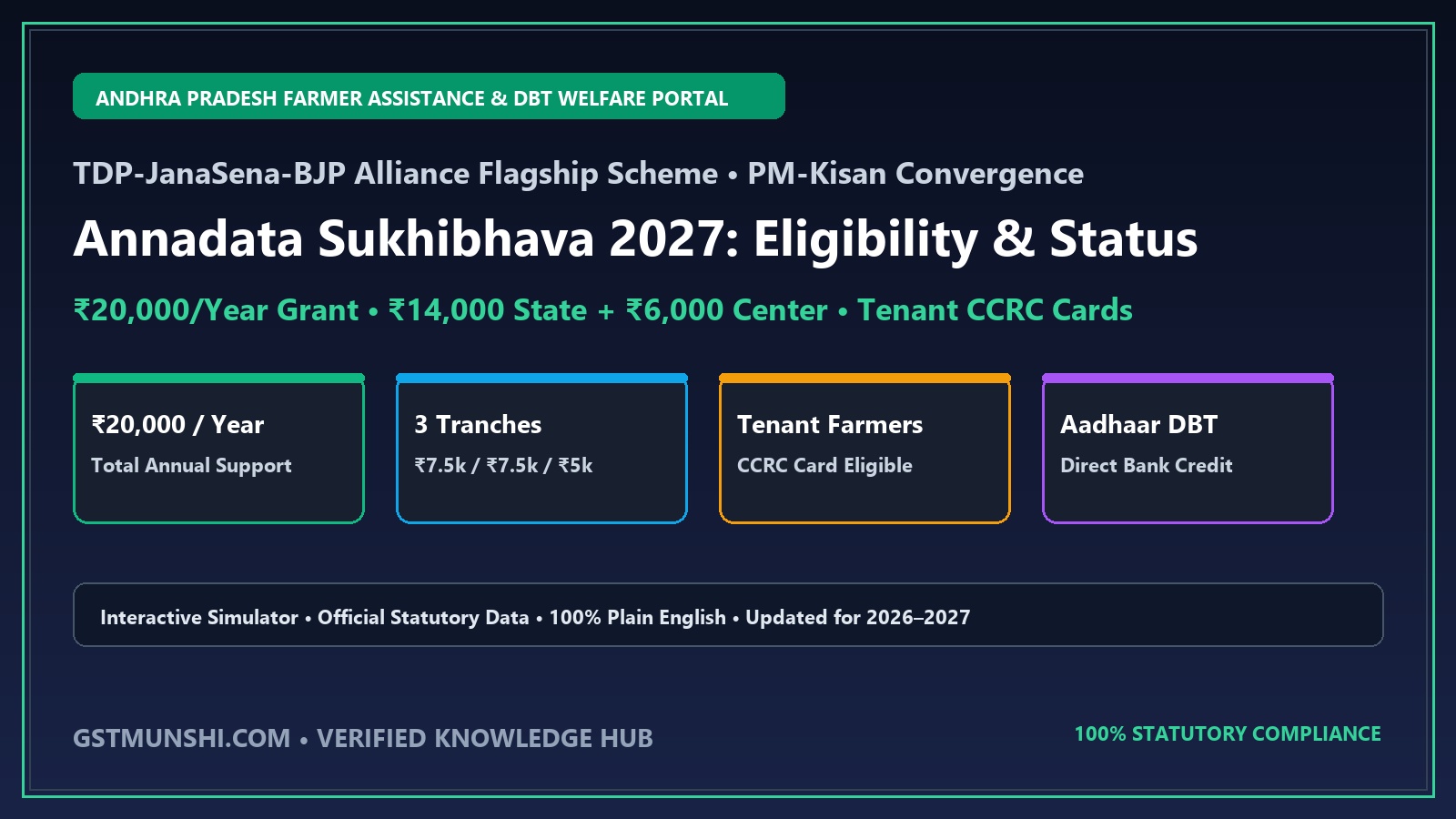
How much financial assistance is provided under Annadata Sukhibhava, and how do I check my status?
The Government of Andhra Pradesh provides a total financial grant of ₹20,000 per year to eligible farmer households under the Annadata Sukhibhava initiative. This is delivered in three installments: ₹7,000 in May/June (Kharif sowing), ₹7,000 in October/November (Rabi season), and ₹6,000 in January (Sankranti harvest). For land-owning farmers, this combines ₹14,000 from the State with ₹6,000 from PM-Kisan. Crucially, landless tenant farmers holding a CCRC card are also covered directly. Status can be checked online at the official portal or via your local Rythu Bharosa Kendra (RBK).
Total sovereign agricultural working capital support per family
₹7,000 (May) + ₹7,000 (Oct) + ₹6,000 (Jan Sankranti)
Crop Cultivator Rights Card holders receive full state grant
Rythu Bharosa Kendras handle e-KYC, biometric auth & grievances
2. Farmer Entitlement & Installment Simulator
Check your exact seasonal disbursement schedule, state versus central funding breakdown, and banking e-KYC verification:
Annadata Sukhibhava ₹20,000 Entitlement & Installment Simulator
Calculate Kharif, Rabi & Sankranti installment distribution and DBT readiness
All Eligibility Criteria & Banking Links Complete — Ready for Direct Benefit Transfer
3. ₹20,000 Financial Fund Architecture & Seasonal Agricultural Calendar
The Annadata Sukhibhava welfare scheme was instituted to insulate farmers from debt cycles by timing liquid capital injections with critical crop lifecycle stages. Rather than a lump-sum handout, the funds are disbursed when capital demand peaks:
| Installment Stage | Disbursement Window | Tranche Amount | Primary Agricultural Purpose | Funding Structure |
|---|---|---|---|---|
| 1st Installment (Kharif) | May – June | ₹7,000 | Land preparation, certified seed procurement, organic fertilizers & nursery raising | ₹5,000 State + ₹2,000 PM-Kisan |
| 2nd Installment (Rabi) | October – November | ₹7,000 | Kharif harvesting expenses, Rabi season tillage, micro-irrigation & winter inputs | ₹5,000 State + ₹2,000 PM-Kisan |
| 3rd Installment (Sankranti) | January | ₹6,000 | Post-harvest marketing support, festival buffer, and farm equipment servicing | ₹4,000 State + ₹2,000 PM-Kisan |
| Total Annual Sovereign Grant | Across Agricultural FY | ₹20,000 | 100% Direct Benefit Transfer (Zero Intermediaries) | |
4. Tenant Farmer Inclusion: The Crop Cultivator Rights Card (CCRC)
In many Indian states, tenant farmers who actually till the soil are excluded from agricultural subsidies because land titles reside with absentee landlords. Andhra Pradesh resolves this dilemma through the Andhra Pradesh Crop Cultivator Rights Act:
What is a CCRC Agreement?
A Crop Cultivator Rights Card (CCRC) is an 11-month agreement executed between the actual landholder and the tenant cultivator. It is verified and recorded by the Village Revenue Officer (VRO) and Village Agriculture Assistant (VAA) at the Village Secretariat.
The card legally establishes the tenant as the bona fide cultivator for that agricultural season, unlocking direct access to Annadata Sukhibhava, institutional crop loans at zero interest, and free crop insurance (YSR Bima / State Crop Insurance).
Landowner Title Protection Guarantee
Section 6 of the CCRC Act provides an iron-clad statutory guarantee that signing a CCRC card never creates any tenancy rights, adverse possession, or permanent lien over the landowner's property.
The card expires automatically after 11 months. The landowner's title in Webland and the 1B Adangal remains 100% untouched. This legal separation ensures landlords can safely sign CCRC agreements without risking land loss.
5. Step-by-Step Status Check: Online Portal & WhatsApp Bot
Beneficiaries can verify their payment credit, installment UTR numbers, and village social audit rankings using two digital pathways:
Method 1: Online Portal Verification via Aadhaar
- Visit the official AP Agriculture / Annadata Sukhibhava portal or access through ap.gov.in.
- Click on the 'Payment Status / Farmer Search' tab on the homepage navigation bar.
- Select your search parameter: Aadhaar Number (recommended) or Pattadar Passbook (PPB) Number.
- Enter the 12-digit Aadhaar number and the security captcha code shown on the screen, then click 'Submit'.
- The system displays your complete profile: District, Mandal, Village Secretariat name, Land extent (in acres), Bank Account (last 4 digits), NPCI mapping status, and Tranche-wise payment dates with Bank Transaction IDs.
Method 2: WhatsApp Chatbot Query
Send a WhatsApp message saying "Hi" to the official Andhra Pradesh Citizen Services helpline. Select "Farmer Welfare & Agriculture Services" > "Annadata Sukhibhava Status", and type your Aadhaar number to get an instant automated reply showing your current payment status.
6. Statutory Disqualifications & Exclusion Ceilings
To maintain fiscal integrity and prevent leakage to affluent households, the scheme applies statutory exclusion criteria aligned with central Direct Benefit Transfer standards:
Any farm family where one or more members paid Income Tax in the previous assessment year is statutorily disqualified.
Serving or retired regular employees of Central, State, or Local bodies (excluding Class IV / Multi-Tasking Staff).
All retired persons receiving a monthly pension of ₹10,000 or more are excluded from claiming benefits.
Agricultural land held by trusts, religious institutions, corporate farms, or cooperative societies is excluded.
Former and sitting Ministers, Members of Parliament (MPs), MLAs, MLCs, Mayors, and Zilla Parishad Chairpersons.
Practicing Doctors, Engineers, Chartered Accountants, Architects, and Advocates registered with professional bodies.
7. Resolving Rejection Codes: NPCI Unseeded & e-KYC Pending
Over 92% of payment delays in Annadata Sukhibhava are not due to ineligibility, but due to operational banking mismatches. Follow this resolution checklist:
Issue 1: "NPCI Inactive / Aadhaar Not Mapped to Bank Account"
Root Cause: Having your Aadhaar card linked for KYC is not the same as having it mapped to NPCI for Direct Benefit Transfer. If your account is not registered on the NPCI mapper, PFMS automated payments bounce back.
Step-by-Step Fix: 1) Visit your bank branch in person; 2) Submit a physical 'Application for Linking / Seeding Aadhaar Number and Receiving DBT Benefits into NPCI mapper'; 3) Request the teller to ensure the flag is marked 'ACTIVE' on the Core Banking Server; 4) Check status after 48 hours on the UIDAI portal under 'Bank Seeding Status'.
Issue 2: "Biometric e-KYC Pending"
Step-by-Step Fix: Walk into your local Rythu Bharosa Kendra (RBK) or Meeseva center. Provide your Aadhaar number to the Village Agriculture Assistant (VAA) and complete fingerprint or Iris authentication. The portal updates within 24 hours.
8. Sovereign Agricultural Subsidy Comparison Matrix
Compare Annadata Sukhibhava against other state and central farmer income support programs across India:
| Parameter | Annadata Sukhibhava (AP) | PM-Kisan (Central) | Rythu Bharosa (Telangana) | KALIA (Odisha) |
|---|---|---|---|---|
| Annual Aid per Family | ₹20,000 / Year | ₹6,000 / Year | ₹15,000 / Acre / Yr | ₹10,000 / Year |
| Tenant Farmers Included? | Yes (via CCRC Agreement) | No (Landowners Only) | Under verification | Yes (Landless Labours) |
| Tranche Schedule | ₹7,000 + ₹7,000 + ₹6,000 | ₹2,000 x 3 Tranches | Kharif & Rabi Sowing | Kharif & Rabi Sowing |
| Land Ceiling Restrictions | No minimum ceiling | No minimum ceiling | Acreage based | Small / marginal farmers |
| Verification Node | Rythu Bharosa Kendra (RBK) | State Nodal Officers / PM-Kisan Portal | Agriculture Extension Officers (AEO) | Panchayat Nodal Centers |
9. Verified Agricultural Economists & Administrative Disclosures
Official perspectives from agricultural economists and rural governance directors on Andhra Pradesh farmer subsidy execution:
Dr. K. Seshagiri Rao, Agricultural Economist
Institute for Agricultural Policy Research"By scaling annual farm transfers to ₹20,000, Andhra Pradesh directly addresses the initial cash-flow crunch that drives small farmers toward non-institutional moneylenders charging 24% to 36% interest. Timing the first ₹7,000 tranche in May/June right when seeds, fertilizers, and diesel tractor leasing demand cash is the most effective poverty alleviation mechanism."
V. Narayana Reddy, Ex-Director of Agriculture
AP Rural Development Advisory"The biggest administrative hurdle in tenant farmer inclusion has been landowner fear that signing cards will jeopardize land titles. Our outreach programs consistently clarify that the CCRC agreement under Section 6 of the Act provides complete statutory immunity against any tenancy claims, safeguarding the landlord's title in full."
@APFarmersHub
Andhra Pradesh Rural Welfare & Agriculture Tracker"Important advisory for Annadata Sukhibhava beneficiaries: When your bank changes its IFSC due to mergers or you open a secondary account, NPCI mapping does NOT transfer automatically. Verify your active Aadhaar-mapped bank on the UIDAI portal before the tranche release date to avoid payment failure bounces."
@KisanPolicyDesk
Indian Farm Policy & Direct Benefit Transfer Watch"If your name is missing from the social audit list displayed at your Grama Sachivalayam, lodge a formal grievance on the 1902 helpline or directly through the Village Agriculture Assistant within 15 days of list publication. Re-verification happens at the Rythu Bharosa Kendra within 7 working days."
10. Official Scheme Walkthroughs & Status Tutorials
Watch verified video tutorials explaining Annadata Sukhibhava installment dates, status verification, and tenant farmer guidelines:
11. Frequently Asked Questions (FAQs)
What is the total annual financial assistance under Annadata Sukhibhava?▼
Eligible farmer families in Andhra Pradesh receive a total sovereign assistance of ₹20,000 per agricultural year. This is structured as ₹14,000 funded directly from the Andhra Pradesh State Budget, combined with the ₹6,000 annual grant from the Central Government's PM-Kisan Samman Nidhi scheme.
How are the Annadata Sukhibhava installments distributed throughout the year?▼
The ₹20,000 annual financial aid is disbursed in three major agricultural tranches: 1) First Installment of ₹7,000 in May/June for Kharif season preparatory cultivation and seed procurement; 2) Second Installment of ₹7,000 in October/November coinciding with Kharif harvest and Rabi sowing; 3) Third Installment of ₹6,000 in January coinciding with the Sankranti harvest festival.
Are tenant farmers eligible to receive Annadata Sukhibhava benefits?▼
Yes. In a landmark welfare provision, landless tenant farmers cultivating agricultural land under a valid Crop Cultivator Rights Card (CCRC) for a minimum 11-month agreement are fully eligible to receive the financial assistance, ensuring tenant cultivators receive direct working capital support without landlord interference.
What are the key landholding and document requirements for land-owning farmers?▼
Land-owning farmers must possess a verified Webland Adangal or ROR 1B passbook in their own name, an active Aadhaar number seeded with NPCI for Direct Benefit Transfer (DBT), and a single-operated bank account. There is no minimum land holding restriction; even marginal farmers owning less than 1 acre qualify.
How can I check my Annadata Sukhibhava payment status online?▼
Farmers can check status through the official portal or village Rythu Bharosa Kendras (RBKs). Enter your 12-digit Aadhaar number or Patta Passbook number on the portal to view bank account verification status, installment credit transaction reference numbers (UTR), and e-KYC validation logs.
Can I check Annadata Sukhibhava status via WhatsApp?▼
Yes. The Andhra Pradesh Agriculture Department provides a dedicated citizen grievance WhatsApp chatbot service. By sending 'Hi' or your Aadhaar number to the official department WhatsApp helpline number, farmers can receive real-time automated updates regarding their payment approval and installment credit.
Who is disqualified from receiving Annadata Sukhibhava benefits?▼
Disqualifications include: 1) Institutional landholders; 2) Farmer families where any member is a current or former MP, MLA, MLC, Mayor, or ZP Chairperson; 3) Serving or retired officers and employees of central/state government departments and public sector undertakings; 4) Retired pensioners with monthly pensions exceeding ₹10,000; 5) Individuals who paid Income Tax in the preceding assessment year; 6) Professionals such as doctors, engineers, chartered accountants, and registered advocates.
What should I do if my payment status displays 'NPCI Inactive' or 'e-KYC Pending'?▼
If the status displays 'NPCI Inactive', visit your bank branch immediately with your Aadhaar card and submit a physical 'Aadhaar Seeding / NPCI Mapping Consent Form' to link your primary savings account. If e-KYC is pending, visit your nearest Rythu Bharosa Kendra (RBK) or Meeseva center for instant biometric or Iris authentication.
Are RoFR (Recognition of Forest Rights) tribal farmers eligible?▼
Yes. Tribal farmers who have been granted title deeds (Patta) over forest lands under the Scheduled Tribes and Other Traditional Forest Dwellers (Recognition of Forest Rights) Act, 2006 (RoFR Act) are eligible for the full ₹20,000 annual entitlement.
What is a Crop Cultivator Rights Card (CCRC) and how do tenant farmers obtain it?▼
A CCRC is a statutory 11-month agreement executed between the landowner and the tenant cultivator under the AP Crop Cultivator Rights Act. It gives the tenant statutory rights to crop insurance, zero-interest loans, and government welfare schemes like Annadata Sukhibhava without impacting the landowner's permanent land title.
If a farmer family already receives PM-Kisan ₹6,000, do they get ₹20,000 extra?▼
No. The total sovereign financial support provided across both Central and State schemes is ₹20,000 per family. Farmers receiving PM-Kisan receive ₹14,000 from the State Government, making the combined net receipt ₹20,000. Tenant farmers who are ineligible for central PM-Kisan receive the full entitlement from the state.
Where can farmers lodge complaints regarding missing names in the beneficiary list?▼
Grievances can be registered at your local Village Secretariat (Grama Sachivalayam) through the Village Agriculture Assistant (VAA), at the local Rythu Bharosa Kendra (RBK), or by dialling the AP Agriculture Toll-Free Helpline at 155251 or 1902.