What is Restitution of Conjugal Rights under Section 9 HMA, and can the court force a spouse to return?
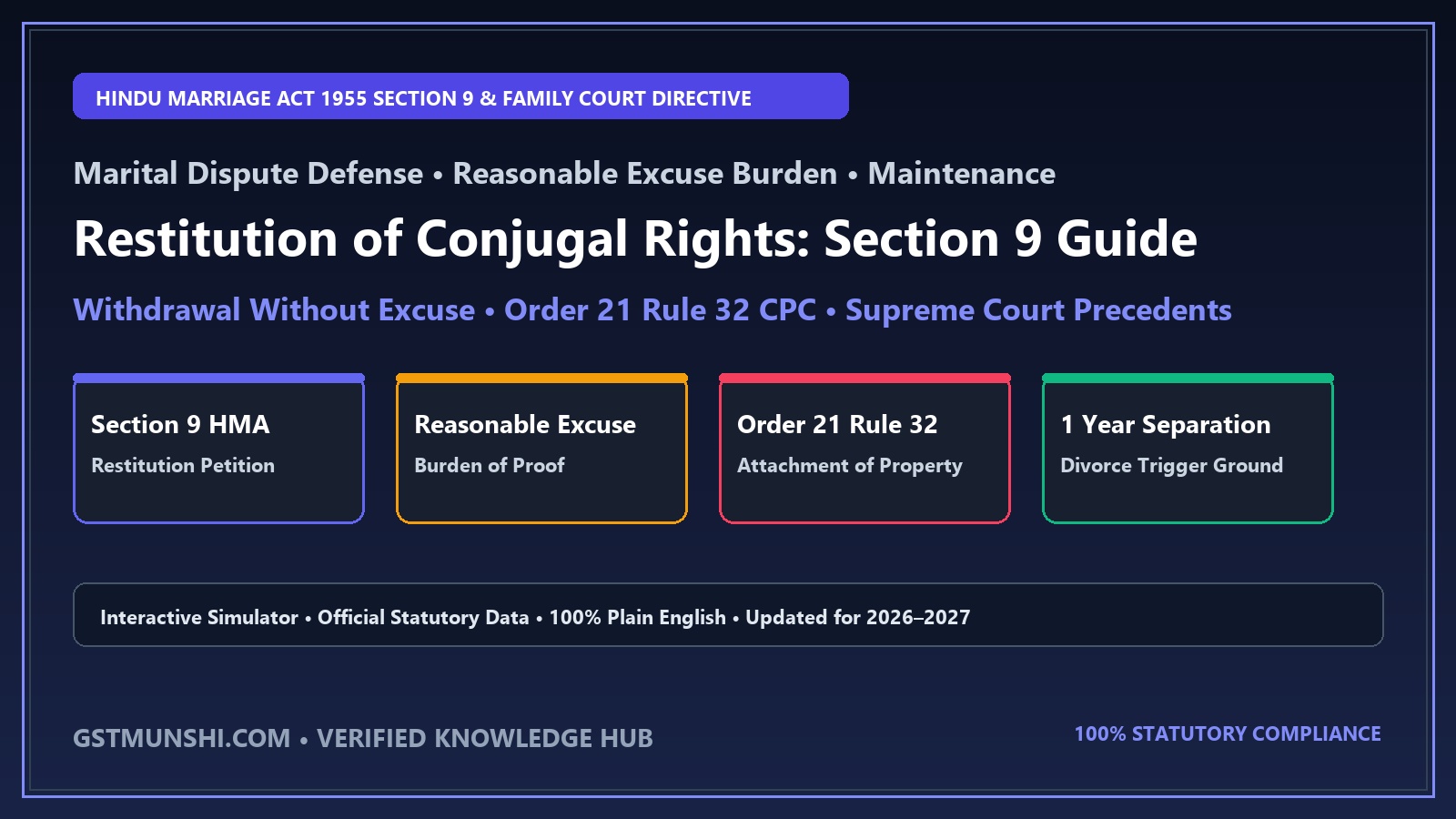
Section 9 of the Hindu Marriage Act, 1955 permits an aggrieved spouse to petition the Family Court for Restitution of Conjugal Rights (RCR) when the other spouse has withdrawn from their society without reasonable excuse. However, the court cannot physically force a spouse to return or cohabit. Under Order XXI Rule 32 of the CPC, an RCR decree can only be enforced through financial attachment of property, never through arrest or physical coercion. If cohabitation is not resumed for one year after the decree, either spouse can petition for absolute divorce under Section 13(1A)(ii).
Aims to restore marital consortium and save valid Hindu marriages
Unrepaired separation 12 months post-decree creates ground for divorce
Strictly property attachment; zero bodily compulsion allowed
Wife can claim interim maintenance even during Section 9 litigation
2. Petition Strength & Defense Feasibility Evaluator
Test whether your marital circumstances satisfy the statutory standard of withdrawal without reasonable excuse, or whether the respondent holds valid legal grounds to contest:
Interactive Section 9 HMA Petition & Defense Feasibility Evaluator
Simulate Family Court evidentiary standards, reasonable excuse defenses, and maintenance risks
Judicial Diagnostic Analysis
- Separation is currently 8 months: Court will mandate conciliation before addressing decree.
- Respondent can counter-claim interim maintenance under Section 24 HMA irrespective of Section 9 merits.
3. Section 9 Statutory Architecture & The Two-Pronged Burden of Proof
The concept of Restitution of Conjugal Rights traces its roots to English ecclesiastical law and was codified into Indian jurisprudence under Section 9 of the Hindu Marriage Act, 1955. The statute provides that when either the husband or the wife has, without reasonable excuse, withdrawn from the society of the other, the aggrieved party may apply, by petition to the district court, for restitution of conjugal rights.
The court, on being satisfied of the truth of the statements made in such petition and that there is no legal ground why the application should not be granted, may decree restitution of conjugal rights accordingly.
The Statutory Explanation: Evidentiary Shifting of Burden
A critical amendment added the Explanation to Section 9, which governs the evidentiary trial:
In practice, this creates a strict two-stage judicial inquiry:
- Primary Burden on Petitioner: The filing spouse must prove through contemporaneous evidence that a valid marriage exists and that the respondent has intentionally withdrawn from marital cohabitation without consent.
- Secondary Burden on Respondent: Once withdrawal from the shared household is proven, the legal burden shifts to the respondent spouse to demonstrate on a balance of probabilities that their living apart is grounded in a legally recognized "reasonable excuse."
4. Recognized "Reasonable Excuses" Under Indian Matrimonial Law
Indian Family Courts do not treat every dispute as a withdrawal without excuse. Over decades of High Court and Supreme Court rulings, specific circumstances have been firmly established as valid reasons for living separately:
1. Physical or Mental Cruelty
Verbal abuses, physical violence, humiliation in front of relatives, false accusations of unchastity, or psychological harassment create a reasonable apprehension in the respondent's mind that cohabitation is unsafe. Such cruelty is a complete defense against Section 9.
2. Dowry Demands & Criminal Complaints
Persistent unlawful demands for dowry, cash, property, or vehicles by the petitioner or in-laws justify the wife leaving the matrimonial home. Filing of FIRs under Section 498A IPC or Section 85 BNS establishes clear reasonable excuse.
3. Adultery & Bigamy
If the petitioner maintains an extramarital relationship, keeps a second wife, or engages in promiscuous behavior, the respondent spouse has an absolute, non-negotiable right to withdraw from cohabitation without losing legal rights.
4. Bona Fide Employment Relocation
When an educated working spouse resides in another city purely due to employment commitments while continuing to visit and maintain communication, courts hold that professional employment alone does not constitute withdrawal from society.
5. Court Jurisdiction, Petition Drafting & Mandatory Conciliation
Filing a Section 9 petition involves procedural safeguards under the Family Courts Act, 1984, designed to facilitate reconciliation before entering adversarial litigation:
Where Can the Section 9 Petition Be Filed? (Section 19 HMA)
The petition must be presented before the Principal Judge of the Family Court or District Court within whose local limits:
Mandatory Mediation & Family Court Conciliation (Section 23(2) HMA)
Unlike commercial or ordinary civil litigation, the Family Court is statutorily commanded by Section 23(2) of the Hindu Marriage Act to explore every possibility of conciliation. Upon the respondent's appearance, the case is immediately referred to trained court mediators or marriage counselors. Only when confidential mediation reports confirm an irreconcilable breakdown does the court proceed to record evidence and examine witnesses.
6. Decree Execution Under Order XXI CPC & The Constitutional Bodily Privacy Precedents
The most widespread misconception among litigants is that obtaining a Section 9 decree allows police assistance to escort an estranged spouse back into the matrimonial home. The law explicitly forbids this.
Enforcement Under Order XXI Rules 32 & 33 of CPC
Order XXI Rule 32 of the Code of Civil Procedure (1908) dictates how a decree for restitution of conjugal rights may be executed. The court may enforce compliance solely by attachment of the respondent's property. The law strictly prohibits detention in civil prison or physical force to enforce cohabitation.
Furthermore, under Rule 33, where the decree is against the husband, the court may order him to make periodic payments to the wife in lieu of compliance, functionally operating as alimony.
The Constitutional Debate: T. Sareetha vs Saroj Rani
| Landmark Case | Court / Year | Key Legal Doctrine | Ruling on Section 9 |
|---|---|---|---|
| T. Sareetha v. T. Venkata Subbaiah | Andhra Pradesh HC (1983) | Right to bodily autonomy and sexual privacy under Article 21 | Held Section 9 Unconstitutional |
| Harvinder Kaur v. Harmander Singh | Delhi High Court (1984) | Distinguished cohabitation from forced sexual relations; focus on consortium | Upheld Section 9 Validity |
| Saroj Rani v. Sudarshan Kumar | Supreme Court (1984) | Section 9 serves social purpose of saving marriage; does not enforce sexual acts | Affirmed Constitutional Validity (Current Law) |
Note: Following the Supreme Court's 9-judge bench decision in Justice K.S. Puttaswamy (Retd.) v. Union of India (2017) recognizing privacy and bodily integrity as fundamental rights, fresh writ petitions challenging Section 9 have been referred to a larger Constitution Bench of the Supreme Court.
7. Interplay with Maintenance Rights & The 1-Year Divorce Pathway
Strategic litigants frequently invoke Section 9 as either a shield against maintenance claims or a stepping stone toward faultless divorce. Understanding how judicial scrutiny operates is vital:
Impact on Maintenance Claims
Husbands frequently file Section 9 to argue that since they are willing to cohabit, the wife is living apart without cause and should be denied maintenance under Section 125(4) CrPC (or Section 144 BNSS).
However, courts have consistently held that the mere pendency of a Section 9 petition does not automatically disentitle the wife. If she establishes that she was driven out or subjected to harassment, her maintenance will be granted. Moreover, Section 24 of the HMA allows the wife to claim interim maintenance and litigation expenses directly within the Section 9 proceedings.
The Section 13(1A)(ii) 1-Year Divorce Rule
Under Section 13(1A)(ii) of the Hindu Marriage Act, either party to a marriage—whether the petitioner who won the decree or the respondent against whom it was passed—may petition for dissolution of the marriage by a decree of divorce on the ground that there has been no resumption of cohabitation for a period of one year or upwards after the passing of a decree for restitution of conjugal rights.
Critical Exception (Section 23(1)(a)): If the petitioner spouse obtained the Section 9 decree in bad faith and subsequently locked the house or refused entry to the respondent who genuinely attempted to resume cohabitation, the court will refuse divorce under the doctrine that no party may take advantage of their own wrong.
8. Comprehensive Matrimonial Remedy Comparison Matrix
Evaluate how Section 9 Restitution of Conjugal Rights compares against Judicial Separation, Contested Divorce, and Mutual Consent Divorce:
| Parameter | Restitution (Sec 9) | Judicial Separation (Sec 10) | Contested Divorce (Sec 13) | Mutual Consent (Sec 13B) |
|---|---|---|---|---|
| Primary Objective | Reconcile & Cohabit | Suspend cohabitation duty | Dissolve marriage permanently | Amicable dissolution |
| Marital Status | Subsisting | Subsisting (Cannot remarry) | Dissolved (Can remarry) | Dissolved (Can remarry) |
| Burden of Proof | Withdrawal without excuse | Cruelty, desertion, adultery | Strict proof of statutory faults | Mutual consent & 1 yr separation |
| Enforcement Mechanism | Property attachment (CPC O.21) | Exemption from cohabiting | Decree absolute | Settlement deed execution |
| Post-Decree Divorce Ground | 1 Year under Sec 13(1A)(ii) | 1 Year under Sec 13(1A)(i) | Already divorced | Already divorced |
9. Verified Family Court Practitioner & Legal Insights
Practical litigation perspectives from senior matrimonial advocates and family counselors on handling Section 9 proceedings:
Adv. Rajeshwar Sharma, Senior Family Counsel
Delhi High Court Matrimonial Bar"Litigants often believe Section 9 is a magic bullet to stop maintenance or forcibly compel a spouse's return. In reality, Family Courts treat Section 9 as a diagnostic lens. If the petitioner refuses genuine mediation or files it merely as a defensive tactical reply to a domestic violence or Section 125 petition, judges routinely order substantial Section 24 interim maintenance while the petition stays pending."
Meenakshi Swaminathan, Family Mediator
National Family Court Mediation Panel"More than 40% of Section 9 cases resolve successfully at the court-annexed mediation stage when ego clashes and parental interference are decoupled from real marital disputes. However, where genuine physical cruelty or repeated dowry demands exist, mediation fails quickly, and the court transitions into formal trial where cruelty stands as an iron-clad defense."
@IndianLegalWatch
Supreme Court & High Court Legal Updates"The ongoing constitutional challenge against Section 9 HMA at the Supreme Court tests whether state-mandated marital cohabitation violates Article 21 privacy. While Saroj Rani (1984) remains valid precedent today, post-Puttaswamy jurisprudence makes clear that neither husband nor wife can be forced into emotional or physical intimacy."
@MatrimonialLawIn
Civil & Criminal Matrimonial Insights"Warning for husbands filing Section 9 to trigger Section 13(1A)(ii) divorce after 1 year: If the wife proves by email, registered letter, or WhatsApp that she attempted to return and you refused entry or changed locks, the court will dismiss your divorce under Section 23(1)(a) for taking advantage of your own wrong."
10. Official Legal Masterclasses & Judicial Lectures
Watch structured legal tutorials from verified advocates and judiciary educators explaining Section 9 petitions, trial defenses, and execution procedures:
11. Frequently Asked Questions (FAQs)
What is Restitution of Conjugal Rights (RCR) under Section 9 of the Hindu Marriage Act?▼
Section 9 of the Hindu Marriage Act, 1955 provides a legal remedy when either spouse has withdrawn from the society of the other without reasonable excuse. The aggrieved husband or wife can file a petition in the District Family Court seeking a decree ordering the estranged spouse to resume cohabitation and restore marital co-living.
Can the court physically force a spouse to return home after an RCR decree?▼
No. Indian courts cannot physically compel or force a spouse to return or engage in conjugal relations against their will. Under Order XXI (21) Rule 32 of the Code of Civil Procedure (CPC), an RCR decree cannot be enforced by civil imprisonment or bodily coercion. The only legal sanction available is the financial attachment of the non-complying spouse's property.
Who bears the burden of proof in a Section 9 HMA petition?▼
Under the statutory Explanation to Section 9, there is a two-step burden of proof: First, the petitioner must prove that the respondent spouse has withdrawn from their society. Once withdrawal is established, the burden of proof shifts entirely onto the respondent to prove that they had a 'reasonable excuse' to live separately.
What constitutes a 'reasonable excuse' for a wife or husband to live separately?▼
Courts recognize multiple valid reasonable excuses, including: physical or mental cruelty; persistent demands for dowry; adultery or illicit relationships; second marriage; living in a hostile joint family environment with safety threats; serious communicable diseases; or mutual separation agreements. If any of these are proven, the court will dismiss the Section 9 petition.
Can a wife still claim maintenance under Section 125 CrPC / BNSS if the husband files Section 9?▼
Yes. Simply filing a Section 9 petition by the husband does not cancel the wife's right to maintenance. If the wife can establish a reasonable excuse for residing apart (such as harassment or cruelty), the court will grant maintenance under Section 125 CrPC (Section 144 of Bharatiya Nagarik Suraksha Sanhita - BNSS) and interim litigation maintenance under Section 24 of the HMA.
What happens if a Section 9 decree is not complied with for 1 year?▼
Under Section 13(1A)(ii) of the Hindu Marriage Act, if there has been no resumption of cohabitation between the spouses for a continuous period of one year or more after the passing of a Section 9 decree, either party can file for divorce on this ground alone.
Can a husband file Section 9 to obtain a divorce later?▼
While litigants often use Section 9 strategically to establish a foundation for divorce under Section 13(1A)(ii), Section 23(1)(a) of the HMA prevents a party from taking advantage of their own wrong. If the respondent proves that the petitioner deliberately prevented cohabitation after obtaining the decree, the court may refuse to grant divorce.
Which court has jurisdiction to entertain a Section 9 HMA petition?▼
Under Section 19 of the HMA, the petition can be filed before the Principal Family Court / District Judge where: 1) the marriage was solemnized; 2) the respondent resides at the time of petition; 3) the parties last resided together; or 4) where the wife resides on the date of presentation (if she is the petitioner).
Is conciliation mandatory in Section 9 proceedings?▼
Yes. Under Section 23(2) of the Hindu Marriage Act and the Family Courts Act 1984, the court is statutorily mandated to make an endeavor to bring about a reconciliation between the parties before adjudicating on merits. The court routinely refers the couple to the Family Court Mediation Centre for confidential sessions.
What is the constitutional controversy surrounding Section 9 and bodily autonomy?▼
In T. Sareetha v. T. Venkata Subbaiah (1983), the Andhra Pradesh High Court held Section 9 unconstitutional as a savage violation of bodily privacy and Article 21. However, in Saroj Rani v. Sudarshan Kumar Chadha (1984), the Supreme Court upheld Section 9, ruling that its aim is cohabitation and preserving the marital consortium, not forcing sexual intercourse. The provision is currently under fresh constitutional challenge post-Puttaswamy (Right to Privacy).
What documents are required to file a Section 9 petition?▼
Mandatory documents include: 1) Original marriage certificate or wedding invitation card with photographs; 2) Proof of marriage solemnization; 3) Identity and address proof of the petitioner; 4) Chronological statement of facts detailing withdrawal from society; 5) Prior legal notice sent demanding resumption of cohabitation (if any) and reply received; 6) Affidavit in support of the petition.
How long does a Section 9 court case typically take in Indian Family Courts?▼
Although civil procedural norms aim for expedited settlement, contested Section 9 petitions typically take between 12 to 24 months, accounting for notice service, mandatory mediation sessions, written statements, cross-examination, and final arguments.