Quick Summary & Key Takeaways (Featured Snippet)
Interactive CIBIL Score 60-to-90 Day Recovery Simulator
Model the exact mathematical impact of utilization reduction, dispute resolution, and secured credit lines.
The 4 Pillars of CIBIL Scoring: Mathematical Weightage Architecture
The TransUnion CIBIL scoring model evaluates consumer credit risk on a scale of 300 to 900 points. Credit risk algorithms deployed across scheduled commercial banks, non-banking financial companies (NBFCs), and housing finance corporations rely on four mathematical pillars. Knowing the exact percentage weighting of each factor allows borrowers to execute precision repairs rather than relying on guesswork.
| CIBIL Component | Algorithm Weight | Dangerous Triggers | Immediate Remedial Action |
|---|---|---|---|
| Payment History (DPD) | 35% | 30+ Days Past Due (DPD), missed EMIs | Clear past arrears; request goodwill deletion if bank error |
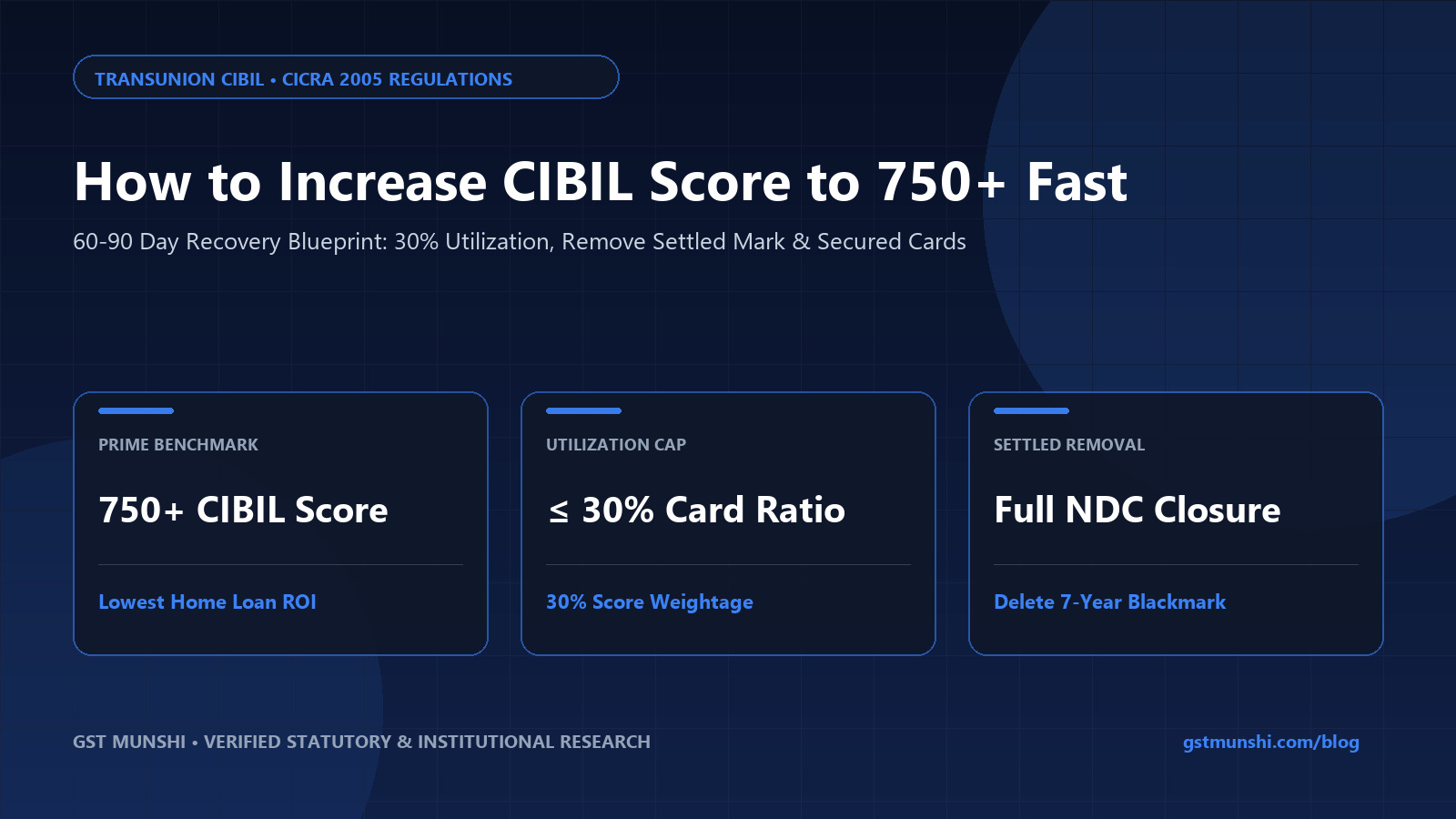
| Credit Utilization Ratio (CUR) | 30% | Revolving credit balances >50% of limit | Repay before billing statement date; hold utilization ≤30% |
| Credit Mix & Duration | 25% | 100% unsecured personal/BNPL debt; closed old cards | Preserve oldest credit card account; add secured credit line |
| Hard Credit Inquiries | 10% | Applying across 5 loan apps in 30 days | Cease loan applications for 90 days; use soft eligibility checkers |
The Macro 2027 Perspective: Why 750+ Is Your Capital Survival Buffer
In periods of macroeconomic volatility, global capital tightening, and asset market drawdowns, commercial banks drastically recalibrate internal automated underwriting scorecards. While during speculative bull cycles banks routinely approve personal loans and balance transfers for applicants with scores between 680 and 710, a systemic credit squeeze shifts approval floors upward.
Borrowers below 750 face immediate interest rate surcharges ranging from 1.50% to 3.75% over the repo rate, lower credit card limits, and automated rejection flags for home loan balance transfers. Maintaining an unblemished 750+ score preserves instant liquidity through pre-approved personal overdrafts and emergency liquidity buffers when equity or real estate liquidity dries up.
Step-by-Step 60-to-90 Day CIBIL Restoration SOP
Download Your Comprehensive Multi-Bureau Credit Information Report (CIR)
Under RBI statutory guidelines, Indian citizens are entitled to one free full credit report per calendar year from each of the four registered credit bureaus: TransUnion CIBIL, Experian India, CRIF High Mark, and Equifax. Download all four reports to cross-check inconsistencies, as some lenders report defaults to only one or two bureaus.
Audit for Identity Overlaps and Clerical Errors (File Online Dispute)
Examine the "Account Information" section carefully. If you discover an unfamiliar loan account (frequent due to PAN typographical errors by NBFCs) or a payment recorded as 30 DPD despite on-time clearance, raise an online dispute through CIBIL's Consumer Dispute Resolution portal. Under Section 21 of CICRA 2005, the bureau and lender must investigate and rectify errors within 30 days.
Execute the "Pre-Statement Date" Card Balance Liquidation Trick
Credit card institutions report your balance to CIBIL on the statement generation date, NOT on the payment due date. If your total credit limit is ₹2,00,000 and you carry ₹1,40,000 in monthly expenses, paying on the due date still logs a 70% utilization ratio. By paying ₹1,20,000 three days prior to statement generation, your reported utilization plummets to 10%, adding up to 30 points in a single cycle.
Open an FD-Backed Secured Credit Card as a High-Velocity Recovery Anchor
If your score has fallen below 650 or you have zero credit history ("NH" or "-1"), unsecured credit applications will be rejected. Open a ₹20,000 to ₹50,000 fixed deposit with banks such as IDFC First (WOW Card), Kotak (811 DreamDifferent), or State Bank of India. Use 10% of this limit for routine utility bill payments and settle them automatically. This injects positive 0-DPD reporting into your file every single month.
Eliminate Derogatory "Settled" Status by Paying the Remainder
If past loans were settled via debt relief or one-time settlement (OTS), approach the branch or recovery nodal officer. Request a statement of the write-off principal and uncharged interest. Pay the remaining sum, secure a stamped No Dues Certificate, and ensure the bank transmits a status update to CIBIL converting "Settled" to "Closed / Zero Dues".