
DigiLocker Legal Validity & Document Issuance: IT Act Rule 9A Guide
The definitive statutory guide to electronic document validity under Rule 9A of the IT Rules 2016. Learn how DigiLocker "Issued Documents" hold complete legal parity with physical originals across traffic enforcement, airport security, banking KYC, and court proceedings.
Quick Summary & Key Takeaways (Featured Snippet)
1. What is DigiLocker & IT Act Rule 9A?
DigiLocker is the flagship digital documentation initiative of the Ministry of Electronics and Information Technology (MeitY) under the Digital India corporation. It provides Indian citizens with a cloud-based electronic repository linked to their unique 12-digit Aadhaar number to store, share, and digitally verify statutory certificates and identity credentials.
Statutory Text of Rule 9A (Notified February 8, 2017)
"The issued documents in Digital Locker system shall be deemed to be at par with original physical documents issued by the issuing authority and shall be accepted as valid documents for all official purposes."
— Notification G.S.R. 111(E), published in the Gazette of India Extraordinary, Part II, Section 3, Sub-section (i), amending the Information Technology (Preservation and Retention of Information by Intermediaries Providing Digital Locker Facilities) Rules, 2016.
This legislative provision eliminates the historic administrative hurdle where citizens were forced to carry physical original papers (such as laminated driving licenses, vehicle RC smart cards, or educational degrees) out of fear that government officials would reject digital versions.
2. Key Stakeholders & Regulatory Acceptance Directives
Subsequent to Rule 9A, key central ministries and statutory regulators issued formal operational directives mandating subordinate enforcement officers to accept DigiLocker issued documents without exception:
MoRTH (Traffic Police & RTOs)
Circular RT-11036/64/2017-MVL dated August 8, 2018 and November 19, 2018 instructed all State DGP/Transport Commissioners that Driving Licences, Registration Certificates, Fitness, and Insurance certificates presented via DigiLocker or mParivahan apps are legally valid under Section 139 of CMVR, 1989.
RBI (Banks, NBFCs & Fintechs)
Under the RBI Master Direction – Know Your Customer (KYC) Direction, 2016 (updated periodically), Regulated Entities (REs) are authorized to accept Officially Valid Documents (OVDs) downloaded from the DigiLocker repository for customer onboarding and Video KYC (V-CIP).
BCAS (Airport Security & CISF)
The Bureau of Civil Aviation Security issued an office order directing CISF personnel deployed at airport departure entry gates to treat digital identity documents (Aadhaar, DL, Voter ID) displayed in the DigiLocker application as valid photo ID proof for boarding pass issuance.
UGC & AICTE (Universities & Colleges)
The University Grants Commission issued circular D.O.No.F.1-46/2020 (NAD/DigiLocker) directing all Higher Educational Institutions (HEIs) to accept academic awards, degree certificates, and marksheets fetched through the National Academic Depository (NAD) via DigiLocker during admissions.
3. "Issued Documents" vs "Uploaded Documents": Crucial Legal Boundary
The most common point of confusion among citizens and law enforcement officers is the fundamental technical and statutory distinction between the two folders inside DigiLocker:
- Source: Fetched directly via electronic URI link from the database of the issuer (e.g. Parivahan, UIDAI, Income Tax Department, CBSE).
- Authentication: Encrypted with SHA-256 digital signature of the issuer authority and embeds a verifiable dynamic QR code.
- Legal Status: Protected under Rule 9A. Authorities cannot legally refuse or insist on physical originals.
- Source: Scanned images, camera photos, or PDF documents manually uploaded by the citizen to their 1 GB personal cloud drive.
- Authentication: No cryptographic verification. The system cannot guarantee whether the document is genuine or digitally altered.
- Legal Status: NOT protected by Rule 9A. Traffic police, banks, and border security have full legal discretion to reject them.
4. Cryptographic Handshake & PKI Verification Architecture
DigiLocker does not simply store static PDF copies of your documents. Its architecture operates on a modern Public Key Infrastructure (PKI) model with real-time electronic URI handshakes:
How Verification Works Under the Hood:
- Electronic Uniform Resource Identifier (URI): Each issued document is assigned a unique digital URI conforming to the schema
in.gov.issuer.doctype.docid. - Direct API Query: When a user clicks to view or verify an issued document, the DigiLocker system executes an authenticated REST API call to the issuing organization's secure repository (e.g. Parivahan Sarathi/Vahan).
- Digital Signature Generation: The document payload is digitally signed with the issuer's private key using RSA 2048-bit or ECDSA encryption, embedding standard X.509 digital certificates.
- Dynamic QR Code: Every document rendered displays a secure QR code that any inspecting officer can scan using the free DigiLocker Scanner app to verify the authentic source payload directly from MeitY servers without relying on the phone screen display.
5. Legal Provisions: IT Act 2000 & Indian Evidence Act
Section 4, Information Technology Act, 2000
Provides legal recognition of electronic records. Wherever any law provides that information or any other matter shall be in writing or in typewritten or printed form, then, notwithstanding anything contained in such law, such requirement is satisfied if rendered or made available in an electronic form.
Section 65B, Indian Evidence Act / BSA 2023
Computer outputs and digitally signed repository records produced by DigiLocker are admissible in court as primary documentary evidence without the necessity of producing original physical documents, provided cryptographic authenticity is intact.
6. Major Document Types Supported in DigiLocker
| Category | Issuing Authority | Key Issued Documents | Primary Use Case |
|---|---|---|---|
| Transport | MoRTH / State RTOs | Driving Licence (DL), Registration Certificate (RC), Fitness, PUC | Traffic police stops, RTO ownership transfer, vehicle claims |
| Identity & Tax | UIDAI & CBDT | Aadhaar Card, e-PAN Verification Record | Bank accounts, hotel check-in, sim activation, airport entry |
| Academic | CBSE, CISCE, State Boards, Universities | 10th / 12th Marksheets, Migration Certificates, Degree Parchments | College admissions, government job recruitment, visa verification |
| Social Welfare | State Food & Civil Supplies, NHA | Ration Card, Ayushman Bharat PM-JAY Golden Card, Caste Certificates | Cashless hospital admissions, food grain subsidy, reservation quota |
| Insurance | LIC, General & Health Insurers via IIB | Motor Insurance, Life Insurance, Mediclaim Policy Documents | Hospitalization claims, accidental motor claims, renewal tracking |
7. Step-by-Step Guide: How to Fetch an "Issued Document"
Step 1: Download Official DigiLocker App or Visit Portal
Install the official DigiLocker app from Google Play Store or Apple App Store, or visit digilocker.gov.in. Ensure you avoid third-party imitation apps.
Step 2: Sign In Using Aadhaar & Security PIN
Authenticate using your 12-digit Aadhaar number (or registered mobile) and 6-digit Security PIN. Complete verification via 6-digit OTP received on your UIDAI-registered mobile number.
Step 3: Navigate to 'Search Documents' Section
Tap on 'Search' and browse by Category (e.g., 'Ministry of Road Transport and Highways', 'Income Tax Department', or 'Central Board of Secondary Education').
Step 4: Enter Document Identifier Parameters
Input the required statutory identifier (e.g., Driving Licence Number and Date of Birth for DL, Vehicle Registration Number and Chassis Number for RC, or PAN and Name for PAN).
Step 5: Consent to Fetch & Digital Signing
Check the consent box allowing DigiLocker to query the issuer's repository. Click 'Get Document'. The system executes a real-time handshake and downloads the cryptographically signed record.
Step 6: Access Anytime Under 'Issued Documents'
The fetched document is now permanently linked under your 'Issued Documents' tab. It can be opened, viewed offline, and shared via QR code verification at any inspection checkpoint.
8. Comprehensive Comparison: DigiLocker vs Alternatives
| Parameter | DigiLocker Issued Doc | DigiLocker Uploaded Doc | Smartphone Photo / PDF | Physical Hardcopy |
|---|---|---|---|---|
| Statutory Parity | 100% (Rule 9A) | None | None | 100% (Traditional) |
| Traffic Police Acceptance | Mandatory (MoRTH Circular) | Can be Challaned | Can be Challaned | Accepted |
| Airport CISF Entry | Mandatory (BCAS Order) | Rejected | Rejected | Accepted |
| Tamper-Proof Security | Cryptographic SHA-256 + QR | Unverified scan | Easily photoshopped | Subject to physical forgery |
| Risk of Physical Loss / Theft | Zero (Cloud Backed) | Zero | Phone dependent | High (Theft, damage, fading) |
9. Real-World Practical Enforcement Scenarios
Scenario 1: Traffic Police Checkpoint
When an officer demands your Driving Licence and Vehicle RC, open the DigiLocker app and navigate to Issued Documents. Display the DL card screen with the embedded QR code. If the officer attempts to issue a challan under Section 130 of the Motor Vehicles Act for non-possession of physical documents, show MoRTH circular RT-11036/64/2017-MVL. The officer can scan the QR code to verify validity on the spot.
Scenario 2: Airport Terminal Entry
When entering an Indian commercial airport (Delhi, Mumbai, Bengaluru, etc.), CISF guards at the terminal gate verify photo identity against your boarding pass. Displaying your issued Aadhaar, Voter ID, or DL directly from the DigiLocker app satisfies BCAS security circulars. Screenshots are not accepted; you must present the live app interface.
Scenario 3: Banking & Demat KYC
When opening a savings account or Demat brokerage account, fintechs and banks utilize DigiLocker's OAuth 2.0 API gateway. You log into DigiLocker within the bank's secure onboarding flow to share your digitally signed Aadhaar XML and PAN record directly. This satisfies RBI KYC guidelines without paper copies.
10. Common Verification Pitfalls & Mistakes
Displaying a Screenshot or Gallery Image
Law enforcement officers and airport security are explicitly trained to reject static screenshots of DigiLocker cards. You must unlock the live DigiLocker app and display the active issued record.
Relying on Manually Uploaded PDFs in the 'Drive' Tab
Uploading a scanned PDF of your RC book or Aadhaar into your personal DigiLocker drive does not grant it Rule 9A legal immunity. It will be treated as an unverified photo and can be rejected.
Mismatch in Name or Date of Birth Between Records
If your name on Aadhaar is 'Rajesh Kumar Sharma' but your Driving Licence lists 'Rajesh Sharma', the automated API query will fail to fetch the issued document. Name harmonization across government databases is required.
Expired Mobile Number on UIDAI Database
Because DigiLocker requires an Aadhaar OTP for login and document retrieval, losing access to your Aadhaar-linked mobile number locks you out of the system until updated at an Aadhaar Seva Kendra.
11. Limitations & Practical Operational Boundaries
Zero International Acceptance
DigiLocker's legal backing under the IT Act, 2000 is restricted entirely to the sovereign territory of the Republic of India. Foreign immigration authorities, overseas police, and international embassies do not accept DigiLocker; original physical passports and apostilled certificates remain mandatory.
Vehicle Impounding Circumstances
Under Section 206 of the Motor Vehicles (Amendment) Act, 2019, if a driver is caught committing serious compoundable offences (drunken driving, overspeeding causing death, dangerous driving), police are empowered to seize the physical licence. If physical seizure is statutorily mandated, the electronic DL is digitally seized via the Parivahan e-Challan terminal.
12. Legal Remedies: What to Do if an Authority Refuses DigiLocker
If an enforcement officer, bank branch manager, or university admissions desk unlawfully refuses an Issued Document from DigiLocker, follow this sequential escalation protocol:
Open the document in the DigiLocker app and point out the text: "This is a digitally signed document issued under Rule 9A of the IT Rules 2016." Invite the official to scan the dynamic QR code using any camera or DigiLocker verifier app.
Politely inform the officer: "Sir, under MoRTH Circular RT-11036/64/2017-MVL / RBI Master Direction, this document has statutory parity. If you decline to accept it, please provide your refusal and officer badge number in writing on the receipt or challan memo." In 95% of cases, officers withdraw unreasonable demands upon this request.
If an unjust challan or refusal memo is issued, submit a complaint on the Central Government Public Grievance Portal (pgportal.gov.in) attaching the challan copy, officer name/badge, and screenshot of the issued DigiLocker record. Departments are mandated to resolve CPGRAMS grievances within 30 days.
13. Mandatory Acceptance Decision Matrix
| Institution / Context | DigiLocker Issued Doc Valid? | Statutory / Regulatory Authority |
|---|---|---|
| Traffic Police Checkpost | 100% Mandatory | MoRTH Circular RT-11036/64/2017-MVL |
| Commercial Airport CISF Entry | 100% Mandatory | BCAS Order for Photo ID Proof |
| Indian Railways (TTE Verification) | 100% Mandatory | Railway Board Commercial Circular No. 33 of 2018 |
| Bank Account / Demat KYC | 100% Mandatory | RBI Master Direction – KYC (Updated 2023) |
| University Admissions / Degree Verification | 100% Mandatory | UGC Circular D.O.No.F.1-46/2020 (NAD) |
| Passport Seva Kendra (PSK) In-Person Verification | Hybrid / DigiLocker Accepted for Proof of Address/DOB; Original Physical Documents Required for Final Physical Sighting | Ministry of External Affairs Passport Rules |
| International Border / Visa Processing | Not Valid | International Civil Aviation Organization (ICAO) / Foreign Consulates |
14. DigiLocker Citizen Readiness Checklist
Recommended Video Tutorials & Practical Walkthroughs
Watch these handpicked, expert video guides covering practical compliance, step-by-step procedures, and real-world implementation:
Recommended Video Tutorials & Practical Guides
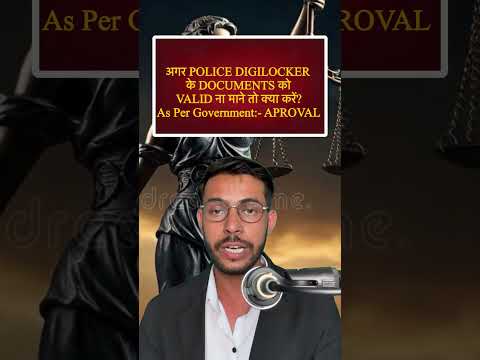

15. Frequently Asked Questions
What is Rule 9A of the Information Technology Rules, 2016?↓
Rule 9A of the Information Technology (Preservation and Retention of Information by Intermediaries Providing Digital Locker Facilities) Rules, 2016, explicitly provides that documents and certificates issued through the Digital Locker system directly from the issuer's electronic repository shall be treated at par with the original physical documents issued by the authority.
Can traffic police refuse a Driving Licence or Registration Certificate shown in DigiLocker?↓
No. Under the Ministry of Road Transport and Highways (MoRTH) circulars (RT-11036/64/2017-MVL and RT-11028/15/2017-MVL) and Rule 139 of the Central Motor Vehicles Rules, 1989, Driving Licences and RC certificates available in the 'Issued Documents' section of DigiLocker or mParivahan are legally valid proof of compliance and cannot be refused by traffic enforcement agencies.
What is the legal difference between 'Issued Documents' and 'Uploaded Documents' in DigiLocker?↓
'Issued Documents' are fetched directly from the issuer's statutory database (UIDAI, CBSE, MoRTH, Income Tax) via secure API and carry a cryptographic digital signature and verification QR code; these hold 100% legal parity under Rule 9A. In contrast, 'Uploaded Documents' are scanned images or PDFs manually uploaded by the user, which carry no statutory authentication and do not qualify for mandatory legal acceptance.
Is DigiLocker accepted for airport entry by CISF in India?↓
Yes. The Bureau of Civil Aviation Security (BCAS) order circular explicitly recognizes DigiLocker 'Issued Documents' (such as Aadhaar, Driving Licence, or Voter ID) displayed on the passenger's mobile app as valid official photo identification for airport terminal entry across all commercial airports in India.
What should you do if an official or bank refuses to accept a DigiLocker issued document?↓
Show the official QR verification screen in the DigiLocker app and cite Rule 9A of the IT Rules 2016 along with relevant sector circulars (MoRTH for traffic, RBI Master Direction on KYC for banks, or BCAS for airports). If the official persists, ask for written grounds of refusal and lodge a formal grievance on the Central Government CPGRAMS portal (pgportal.gov.in) or Sector Ombudsman.
Are DigiLocker documents admissible as evidence in Indian courts?↓
Yes. DigiLocker issued documents satisfy the requirements of electronic records under Section 4 and Section 65B of the Indian Evidence Act, 1872 (now Section 63 of Bharatiya Sakshya Adhiniyam, 2023), because they originate from verified government digital repositories with verifiable cryptographic hash signatures.
16. Official Statutory Notifications & Related High-Authority Guides
Official statutory references: Information Technology Act, 2000 (Section 4 & Section 7); Information Technology (Preservation and Retention of Information by Intermediaries Providing Digital Locker Facilities) Rules, 2016 (Rule 9A); MoRTH Notification RT-11036/64/2017-MVL; and RBI Master Direction – Know Your Customer (KYC) Direction, 2016.