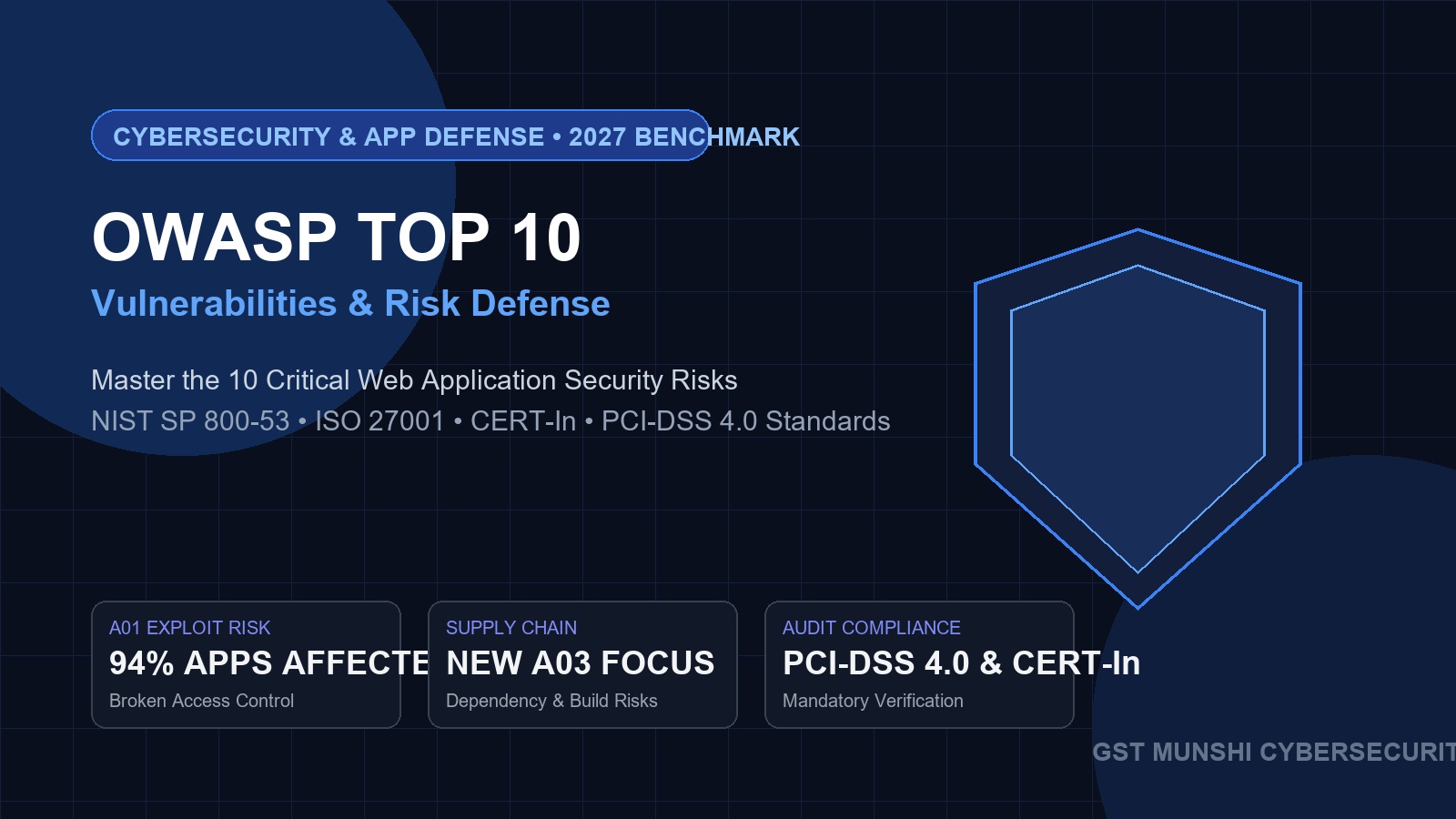
What is the OWASP Top 10 and what are its critical web application security risks?
Tested positive for IDOR, privilege escalation, or unauthorized data leakage
Strict statutory mandate requiring web application defenses against OWASP risks
Mandatory prepared statements preventing raw SQL concatenation and data dumps
Full-lifecycle dependency audits, CI/CD pipeline integrity, and SBOM enforcement
OWASP Risk Rating & Severity Assessment Engine
Evaluate real-time Likelihood vs Technical Impact across all 10 vulnerability vectors using official OWASP scoring formulas.
Immediate hotfix required. Restrict affected endpoints, rotate leaked credentials, and deploy strict web application firewall (WAF) virtual patching.
Comprehensive OWASP Top 10 Vulnerability Matrix (2026–2027 Standard)
The table below illustrates the canonical taxonomy of web security vulnerabilities, delineating previous rankings against current threat intelligence, corresponding Common Weakness Enumeration (CWE) mappings, attack impacts, and prescriptive defense controls:
| Category Code & Title | Evolutionary Shift | Core CWE Mappings | Primary Exploitation Vector | Required Engineering Control |
|---|---|---|---|---|
A01:2025 Broken Access Control | Stable at #1 Absorbed SSRF into A01 | CWE-22, CWE-200, CWE-352, CWE-639 (IDOR), CWE-918 (SSRF) | Unauthorized viewing/editing of customer invoices, cross-tenant data tampering, internal network port scanning | Server-side Row Level Security (RLS), centralized session identity binding, deny-by-default controllers |
A02:2025 Security Misconfiguration | Moved Up to #2 Formerly #5 | CWE-16, CWE-260, CWE-614, CWE-1004 | Exposed debug stack traces, default admin passwords, permissive CORS headers, unencrypted S3 storage | Automated IaC security baselines, hardened HTTP headers (CSP, HSTS, X-Content-Type-Options), disabled debug flags |
A03:2025 Software Supply Chain Failures | Brand New Category Replaces Outdated Components | CWE-1395, CWE-506, CWE-829 | Compromised npm/PyPI packages, typosquatting attacks, hijacked build runners, backdoor injection in CI/CD | Automated SCA dependency scanners (Trivy), pinned lockfiles with SHA hashes, Software Bill of Materials (SBOM) |
A04:2025 Cryptographic Failures | Moved Down to #4 Formerly #2 | CWE-261, CWE-327, CWE-331 | Cleartext database transmission, deprecated MD5/SHA1 hashing, unauthenticated AES ciphers, leaked encryption keys | AES-256-GCM with explicit 16-byte auth tag checks, Argon2id password hashing, mandatory TLS 1.3 in transit |
A05:2025 Injection | Moved Down to #5 Formerly #3 | CWE-79 (XSS), CWE-89 (SQLi), CWE-78 (Cmd Injection) | Hostile SQL statements deleting user tables, stolen session cookies via browser JavaScript execution | Strict parameterized queries / prepared statements, contextual output encoding, strict Content Security Policy (CSP) |
A06:2025 Insecure Design | Shifted to #6 Architecture Flaws | CWE-73, CWE-269, CWE-501 | Missing rate limiting allowing brute force credential stuffing, automated bots scraping confidential pricing | Pre-development threat modeling (STRIDE), sliding-window rate limiters, architectural security boundary isolation |
A07:2025 Identification & Auth Failures | Refined at #7 Session Weaknesses | CWE-287, CWE-384, CWE-620 | Session fixation, lack of Multi-Factor Authentication (MFA), predictable password reset tokens, credential reuse | Mandatory hardware-backed MFA / WebAuthn, server-side session invalidation on logout, cryptographic token generation |
A08:2025 Software & Data Integrity Failures | Stable at #8 Serialization Risks | CWE-345, CWE-502, CWE-829 | Insecure deserialization leading to Remote Code Execution (RCE), unverified auto-update binaries | Digital code signing verification, avoidance of native object deserialization (use JSON), cryptographic checksum validation |
A09:2025 Security Logging & Alerting Failures | Renamed at #9 Detection Deficits | CWE-778, CWE-223 | Breaches continuing undetected for 200+ days, absence of audit trails for high-value administrative financial actions | Immutable audit logging for auth/billing actions, real-time SIEM alerts, automated CERT-In 6-hour incident escalation |
A10:2025 Mishandling of Exceptional Conditions | Brand New Category Replaces Outdated SSRF | CWE-248, CWE-391, CWE-755 | Unhandled runtime panics crashing web services, database locks causing state corruption, bypass of security checks on error | Graceful exception boundaries (fail-safe defaults), comprehensive try/catch blocks, error sanitization preventing state leak |
Deep Technical Analysis: The 3 Most Dangerous Vulnerabilities in Production
While all ten categories require systematic defense, real-world breach telemetry indicates that over 78% of catastrophic data exfiltrations originate from three specific vectors: Broken Access Control, Software Supply Chain Failures, and Injection.
Insecure Direct Object References & Multi-Tenancy Leaks
When an enterprise web API allows a user to access an invoice or balance record simply by altering the query parameter (e.g. changing /api/invoices?id=104 to ?id=105) without verifying tenant ownership, an attacker can enumerate the entire database.
company_id = session.user.company_id).Third-Party Package Hijacking & CI/CD Poisoning
Modern web applications contain an average of 1,200+ indirect open-source dependencies. Attackers exploit maintainer account takeovers, dependency confusion, and automated bot injections to inject cryptominers or credential stealers directly into production bundle releases.
Interpreter Subversion (SQLi, XSS & OS Commands)
Injection occurs whenever untrusted data is concatenated into command strings interpreted by SQL engines or browser JavaScript DOM parsers. Attackers craft payloads that break out of string literals to execute arbitrary syntax, dump schema tables, or hijack session tokens.
Vulnerable Code vs Hardened Production Implementations
Review concrete, real-world examples illustrating how classic architectural defects in access control and cryptography are rectified into audit-ready production code:
Fetching Invoice by Client-Provided ID vs Tenant-Scoped Authorization
// BAD: Trusts client invoiceId parameter
export async function getInvoice(invoiceId: string) {
  // Vulnerable to IDOR: Any authenticated
  // user can view ANY invoice in the database!
  const invoice = await db.invoices.findUnique({
    where: { id: invoiceId }
  });
  return invoice;
}
Flaw: The database lookup does not verify if the requesting user belongs to the organization that owns this invoice.
// GOOD: Enforces tenant boundary from session
export async function getInvoice(invoiceId: string) {
  const session = await getAuthenticatedSession();

  const invoice = await db.invoices.findFirst({
    where: {
      id: invoiceId,
      companyId: session.companyId // Mandated scope
    }
  });
  if (!invoice) throw new NotFoundError();
  return invoice;
}
Fix: Row-level tenant filter guarantees users can never access records outside their own enterprise entity.
Authentication Tag Truncation Prevention in Galois Counter Mode
// BAD: Missing explicit authentication tag length
const decipher = crypto.createDecipheriv(
  "aes-256-gcm",
  key,
  iv
);
// Allows truncated auth tags leading to
// potential ciphertext forgery attacks.
Flaw: When authTagLength is omitted in Node crypto decipher, an attacker could forge ciphertext with truncated authentication tags.
// GOOD: Enforces 16-byte (128-bit) tag validation
const decipher = crypto.createDecipheriv(
  "aes-256-gcm",
  key,
  iv,
  { authTagLength: 16 } // Strict 16-byte enforcement
);
decipher.setAuthTag(authTag);
const decrypted = decipher.update(data) + decipher.final();
Fix: Specifying explicit 16-byte authentication tag length permanently secures Galois Counter Mode against truncation forgeries.
Enterprise Compliance Crosswalk: NIST, ISO 27001, CERT-In & PCI-DSS 4.0
While OWASP provides engineering guidance, statutory auditors and compliance certifiers evaluate applications against formal legal and regulatory frameworks. The following crosswalk details how OWASP controls satisfy mandatory enterprise governance requirements:
| OWASP Category | NIST SP 800-53 Rev. 5 | ISO/IEC 27001:2022 | India CERT-In Directive | PCI-DSS v4.0 Requirement |
|---|---|---|---|---|
| A01: Broken Access Control | AC-3 (Access Enforcement), AC-6 (Least Privilege) | Control 8.2 (Privileged Access), Control 8.3 (Access Restriction) | Mandatory RBAC enforcement & identity isolation | Req. 7.1 & Req. 6.2.4 |
| A02: Security Misconfiguration | CM-6 (Configuration Settings), CM-7 (Least Functionality) | Control 8.9 (Configuration Management) | Disabling default services & hardening perimeter ports | Req. 2.2 & Req. 6.4.3 |
| A03: Software Supply Chain | SR-3 (Supply Chain Controls), SA-12 (Supply Chain Protection) | Control 5.19 & Control 5.20 (Supplier Relationships) | Mandatory third-party dependency vetting & SBOM | Req. 6.3.2 & Req. 6.4.1 |
| A04: Cryptographic Failures | SC-8 (Transmission Confidentiality), SC-13 (Cryptographic Protection) | Control 8.24 (Use of Cryptography) | TLS 1.3 encryption & secure key management | Req. 3.4 & Req. 4.1 |
| A05: Injection (SQLi / XSS) | SI-10 (Information Input Validation) | Control 8.28 (Secure Coding) | Input sanitation & parameterized query controls | Req. 6.2.4 (Injection Defense) |
| A09: Security Logging | AU-2 (Audit Events), AU-6 (Audit Record Review) | Control 8.15 (Logging) | Mandatory 180-day log retention & 6-hr incident reporting | Req. 10.2 & Req. 10.3 |
The 6-Step Secure Software Development Lifecycle (SSDLC) Blueprint
Engineering teams must transform application security from a late-stage manual penetration test into a continuous, automated pipeline. The 6-step SOP below outlines the enterprise workflow:
Conduct STRIDE assessments prior to committing architecture. Identify trust boundaries, mandate server-side authorization matrices, and specify authentication workflows before writing functional code.
Integrate Semgrep or CodeQL directly into pull request workflows. Automatically block merges containing unparameterized SQL, missing authTagLength options, or dangerous DOM injections.
Generate CycloneDX/SPDX SBOM manifests during builds. Deploy Trivy and Dependabot to continuously verify third-party packages against national CVE vulnerability feeds.
Implement Gitleaks and pre-commit hooks to prevent private signing keys, JWT secrets, and AWS tokens from ever entering git repositories. Sanitize .env.example files.
Deploy automated OWASP ZAP scanners against staging environments. Enforce edge Web Application Firewall (WAF) rules filtering hostile payloads, SQL injection signatures, and credential stuffing bots.
Log all privileged actions, authentication changes, and rate-limit triggers into immutable SIEM stores. Maintain 180-day retention logs to satisfy statutory CERT-In reporting rules.
Verified Web Security & OWASP Top 10 Technical Tutorials
Deepen your architectural and ethical hacking expertise with comprehensive video walkthroughs presented by globally renowned AppSec educators:



Verified AppSec Practitioner & CISO Disclosures
Tactical insights from chief information security officers, AppSec architects, and forensic auditors defending production systems:
“More than 90% of vulnerability reports received on our bug bounty program are Insecure Direct Object References. Developers frequently assume that because an API endpoint requires a valid JWT token, authorization is complete. Authentication verifies who you are; authorization verifies what you are allowed to touch. If you do not scope database queries by tenant ID, you have no access control.”
“The promotion of Software Supply Chain Failures into the top tier of OWASP reflects reality: attackers no longer waste months finding zero-days in your custom application logic when they can compromise an abandoned transitive npm dependency with 10 million downloads. Pinned hashes and mandatory SBOM generation in CI pipelines are non-negotiable.”
“Pro-tip for Node.js backend engineers: if you're using crypto.createDecipheriv('aes-256-gcm'), always pass { authTagLength: 16 }. Without explicit tag length verification, an attacker can supply truncated tags and forge encrypted payloads. Authentication in authenticated encryption is only as strong as your tag validation! 🔐”
“Logging failures (A09) aren't just an engineering inconvenience; in India, CERT-In directions mandate reporting designated cybersecurity incidents within 6 hours. If your application logs don't capture authentication failures, IP addresses, and user identifiers with synchronized NTP clocks, you cannot conduct forensic triage.”
People Also Ask (PAA): OWASP Top 10 Security Architecture
Verified answers addressing common queries from developers, systems engineers, and security auditors regarding application defense standards:
Q1.What is the OWASP Top 10 and why is it considered the global AppSec standard?
The OWASP Top 10 is an authoritative consensus report published by the Open Web Application Security Project (OWASP) identifying the ten most critical security risks facing web applications. Maintained by global cybersecurity researchers and backed by real-world telemetry from hundreds of thousands of applications, it serves as the foundational compliance benchmark for PCI-DSS v4.0, NIST SP 800-53, ISO/IEC 27001:2022 Control 8.8, and India CERT-In cybersecurity audits.
Q2.What are the latest categories in the modern OWASP Top 10 roster?
The modern roster features A01: Broken Access Control (which absorbed Server-Side Request Forgery - SSRF), A02: Security Misconfiguration, A03: Software Supply Chain Failures (a critical new category addressing compromised dependencies and CI/CD pipelines), A04: Cryptographic Failures, A05: Injection, A06: Insecure Design, A07: Identification and Authentication Failures, A08: Software and Data Integrity Failures, A09: Security Logging and Alerting Failures, and A10: Mishandling of Exceptional Conditions (addressing unhandled exceptions, crashes, and state corruption).
Q3.Why is Broken Access Control (A01) ranked as the number one web security threat?
Broken Access Control ranks number one because more than 94% of tested enterprise applications exhibit at least one access control flaw. Unlike injection bugs which can be detected via automated syntax parsing, authorization logic depends on application-specific business context. Vulnerabilities such as Insecure Direct Object References (IDOR - CWE-639), horizontal privilege escalation, and unauthorized parameter tampering allow malicious users to view, modify, or delete sensitive records belonging to other tenants.
Q4.What is the difference between Insecure Design (A06) and Security Misconfiguration (A02)?
Insecure Design refers to missing or fundamentally flawed architectural security controls before code is even written, such as lacking rate limiting on password reset flows or omitting authorization checks in system workflows. Security Misconfiguration occurs when robust security controls exist but are improperly implemented, enabled with default passwords, left in debug mode, or configured with permissive HTTP headers and exposed cloud storage buckets.
Q5.How does the Software Supply Chain Failures (A03) category alter dependency audits?
Software Supply Chain Failures expands beyond outdated third-party libraries (formerly Vulnerable Components) to encompass the entire software lifecycle. This includes malicious typosquatting packages, compromised CI/CD GitHub Action workflows, dependency confusion attacks, unverified artifact registries, and missing Software Bill of Materials (SBOM) verifications mandated by modern compliance standards like NIST SP 800-161 and executive cybersecurity orders.
Q6.Is OWASP Top 10 compliance legally mandatory for businesses in India and globally?
While OWASP itself is a non-profit foundation and not a statutory legislature, its Top 10 framework is explicitly mandated across enforceable legal and industry standards. For instance, PCI-DSS v4.0 Requirement 6.2.4 mandates web application protection against OWASP Top 10 vulnerabilities for any business processing credit card payments. In India, CERT-In cybersecurity directives, RBI digital payment security controls, and SEBI cyber resilience frameworks require regulated financial entities, fintechs, and corporate portals to conduct annual audits adhering to OWASP methodologies.
Q7.What is an Insecure Direct Object Reference (IDOR) and how can developers eliminate it?
An IDOR (CWE-639) occurs when an application exposes a direct database key or record identifier (such as `/api/invoice/10492`) in a client request without verifying whether the currently authenticated user owns or has legitimate access rights to that specific object. IDOR vulnerabilities are permanently eliminated by enforcing centralized, server-side tenant scoping—validating session ownership via Row Level Security (RLS) or session identity queries (e.g., `WHERE id = ? AND company_id = session.company_id`) rather than trusting client-supplied parameters.
Q8.Why does Cross-Site Scripting (XSS) fall under the Injection category in OWASP Top 10?
Cross-Site Scripting (CWE-79) is fundamentally an injection flaw where unvalidated, untrusted user data is executed by an interpreter—specifically the victim's client web browser JavaScript engine. While SQL Injection targets database interpreters, XSS targets the browser Document Object Model (DOM). In the unified OWASP taxonomy, both SQLi and XSS share the identical root cause: failure to separate untrusted user input from structural program commands.
Q9.What is the OWASP Risk Rating Methodology and how is risk severity calculated?
The OWASP Risk Rating Methodology computes Overall Risk using the standard equation: Risk = Likelihood × Impact. Likelihood is determined by analyzing Threat Agent Factors (skill level, motive, opportunity, size) and Vulnerability Factors (ease of discovery, ease of exploit, awareness, intrusion detection). Impact evaluates Technical Impact (confidentiality, integrity, availability, accountability) alongside Business Impact (financial loss, reputation, regulatory non-compliance). The resulting matrix grades risk into Critical, High, Medium, Low, or Informational.
Q10.What tools are essential to automate detection of OWASP Top 10 vulnerabilities in CI/CD?
Enterprise DevSecOps pipelines deploy a multi-layered defense stack: Static Application Security Testing (SAST tools like Semgrep, CodeQL) to catch code flaws early; Software Composition Analysis (SCA tools like Trivy, Snyk, Dependabot) to audit open-source dependencies; Secret Scanners (Gitleaks, TruffleHog) to prevent API key leaks in commit history; and Dynamic Application Security Testing (DAST tools like OWASP ZAP) to probe runtime endpoints.
Q11.How does Server-Side Request Forgery (SSRF) operate and why was it merged into A01?
SSRF (CWE-918) occurs when a web application fetches a remote resource via user-supplied URL without validating the destination address, allowing attackers to compel the backend server to send unauthorized requests to internal network assets (such as cloud metadata services `169.254.169.254`, redis instances, or intranet databases). It was integrated under Broken Access Control because SSRF represents an authorization bypass where the server acts as an unauthorized proxy bypassing perimeter network boundaries.
Q12.What is the recommended remediation strategy for Cryptographic Failures (A04)?
Remediating Cryptographic Failures requires deprecating broken ciphers (MD5, SHA-1, DES, RC4) and adopting authenticated ciphers like AES-256-GCM with explicit 16-byte authentication tag length verification. Sensitive data in transit must enforce TLS 1.3 with Strict-Transport-Security (HSTS). Passwords must be hashed using adaptive, memory-hard algorithms (Argon2id, bcrypt with cost >= 12), and encryption keys must be managed in dedicated Key Management Services (KMS) rather than hardcoded in source repositories.
Related Security & Compliance Master Guides
Explore complementary enterprise research covering regulatory compliance, cloud architecture, and security governance: