Quick Summary & Key Takeaways (Featured Snippet)
Care Supreme & AB Activ One compound ₹10L cover to ₹60L
HDFC Optima Secure doubles base protection immediately
Claim Shield Plus & Safeguard+ preserve accrued bonus
Waiting periods waived across Base + Accrued Bonus
Interactive No Claim Bonus & Multiplier Growth Simulator
Simulate cumulative cover compounding, super riders, and hospital claim clawback penalties in real time.
Guaranteed 2X cover from Day 1 plus 50% year 1 & 50% year 2 guaranteed loyalty bonus with zero clawback on claims.
Simulates clawback penalty applied at renewal.
Already zero-clawback by design.

1. What is a No Claim Bonus in Health Insurance?
In consumer personal finance, the term No Claim Bonus (NCB) frequently generates confusion because it operates completely differently in health insurance compared to motor vehicle insurance. When insuring a car or motorcycle, maintaining a claim-free year earns you a percentage discount on your own-damage renewal premium—scaling from 20% up to 50% across five claim-free years.
In Indian retail health insurance, a No Claim Bonus is overwhelmingly structured as a Cumulative Bonus. Instead of lowering your renewal premium, the insurance company rewards you for remaining claim-free by expanding your base Sum Insured at renewal without increasing the premium charged for that additional coverage. For example, if you purchase a policy with a ₹10 Lakh base cover and the contract offers a 20% annual cumulative bonus, a claim-free year expands your effective hospital coverage to ₹12 Lakh upon renewal, while your baseline policy rate remains pegged to your ₹10 Lakh tier.
With medical inflation in Indian tier-1 private healthcare hospitals compounding at 12% to 14% annually, a robust cumulative bonus serves as a critical automatic hedge. It steadily expands an insured family’s financial safety net against major surgical procedures, advanced robotic therapies, and prolonged intensive care stays without forcing them to purchase expensive supplemental policies every year.
2. The 4 Structural NCB Models in the Indian Market
Health insurance policies in India do not follow a single uniform bonus blueprint. When evaluating the top 5 health insurance plans with no claim bonus benefits, buyers must determine which of four distinct structural models governs their policy wording.
The policy increases the sum insured strictly during consecutive claim-free renewal years (typically 10% to 50% per year, capping at 50% to 100%). If a hospitalization claim is filed, the bonus is subject to proportionate reduction or complete reset at the subsequent renewal. Best suited for young, healthy, low-frequency hospital users.
Found in flagship products such as HDFC ERGO Optima Secure Plus and Aditya Birla Activ One MAX. Coverage increases contractually at each annual renewal regardless of whether hospitalization claims occurred in the prior policy year. Past bonuses are never penalized, offering complete immunity against claim erosion.
Offered as specialized plan variants or paid riders (such as Care Supreme Cumulative Bonus Super). These accelerate annual growth to 50% or 100% per year and dramatically expand the maximum accumulation ceiling up to 500% (6X total cover). Policyholders turn a ₹10 Lakh base cover into ₹60 Lakh within five claim-free years.
Pioneered by Niva Bupa ReAssure 2.0. Rather than calculating an arbitrary percentage, the insurer rolls forward 100% of whatever base sum insured remained unspent at policy year-end. This unutilized sum compounds up to 5X (500%) or 10X (1,000%), building an extensive multi-crore medical pool over time.
3. Detailed Breakdown of the Top 5 Health Insurance Plans with NCB
Compare official company credentials, claim settlement rates, bonus multipliers, and access direct insurer purchase portals.
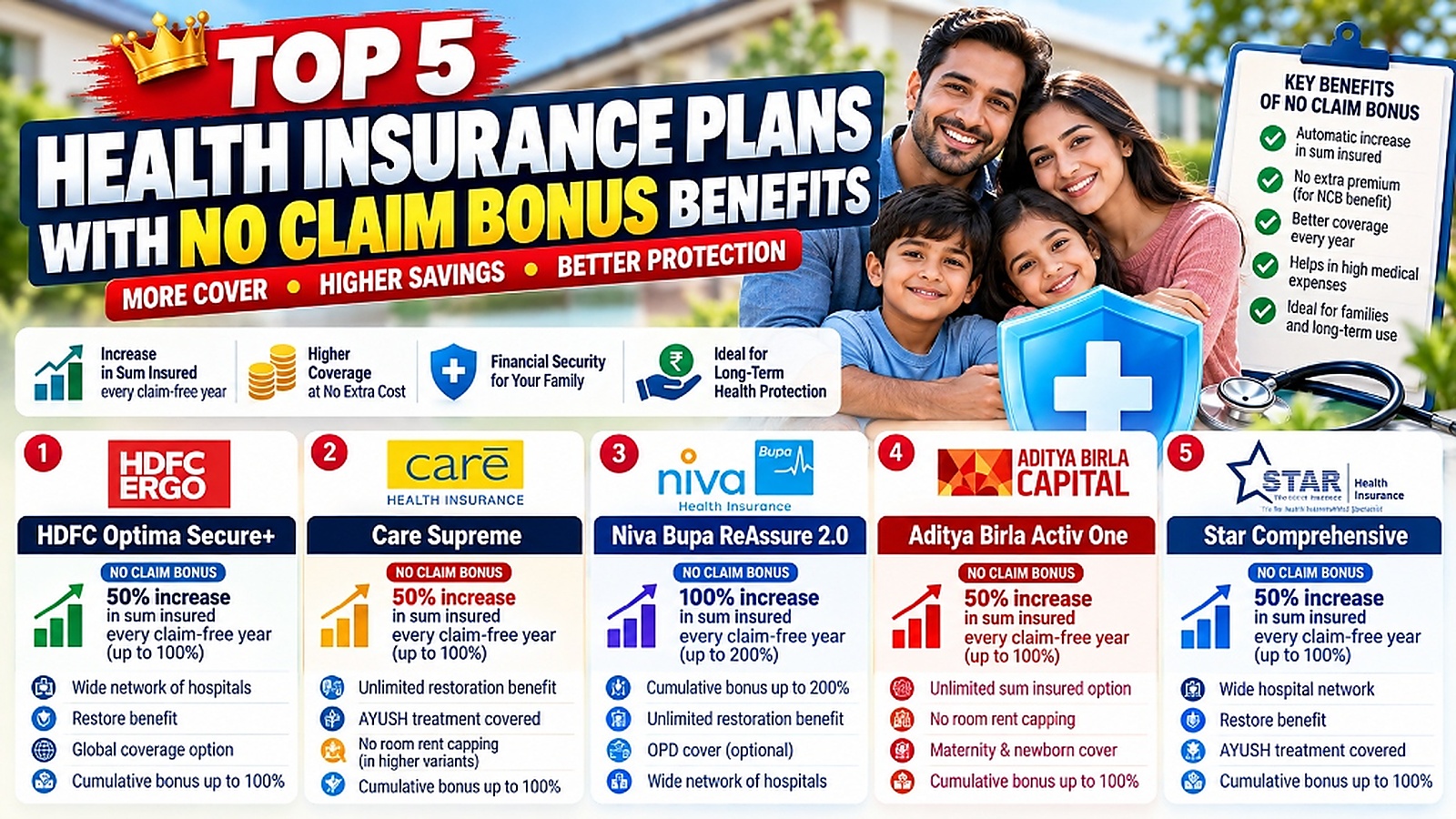
HDFC ERGO Optima Secure+
Guaranteed Zero ClawbackHDFC ERGO Optima Secure represents the gold standard for policyholders who despise the uncertainty of traditional claim-linked bonuses. Instead of forcing you to wait for claim-free years and risking clawback penalties, the policy bundles two proprietary mechanisms: the Secure Benefit and the Plus Benefit.
Doubles your base sum insured from the very day you purchase the policy. A ₹10 Lakh policy provides ₹20 Lakh coverage immediately for any hospitalization.
Adds 50% after Year 1 and 50% after Year 2 regardless of claims. By end of Year 2, combined coverage reaches 4X base cover (₹40 Lakh on a ₹10 Lakh policy).
In the Optima Secure Plus variant, 100% of the base sum insured is added at every annual renewal with no upper ceiling cap, compounding indefinitely.
The Verdict: Backed by over 16,000 cashless network hospitals and an industry-lowest grievance ratio of 8.87 per 10,000 claims, HDFC ERGO Optima Secure is the premier choice for buyers seeking absolute claim security without worrying that a minor hospital bill will erase years of accumulated bonus.

Care Health Insurance – Care Supreme
Up to 500% Super NCBCare Supreme from Care Health Insurance is engineered for consumers who want the fastest path to multi-crore hospitalization protection at an affordable baseline premium. While the base plan provides a standard 50% cumulative bonus per claim-free year (capping at 100%), opting for the Cumulative Bonus Super (CB Super) rider unlocks aggressive cover expansion.
Adds 100% of the base sum insured for every claim-free renewal, maxing out at 500% (Total 6X cover) in just five consecutive years.
A vital protection add-on that completely immunizes your accumulated 500% bonus against clawback reduction, while covering non-payable consumable items.
Restores base coverage an unlimited number of times for both related and unrelated illnesses throughout the policy term.
The Verdict: If you start with a modest ₹10 Lakh or ₹15 Lakh base sum insured, Care Supreme allows your policy to scale rapidly into a ₹60 Lakh to ₹90 Lakh powerhouse. Always pair it with the Claim Shield Plus rider to prevent a single claim from undoing your accumulated cover.

Niva Bupa Health Insurance – ReAssure 2.0 (Platinum+)
Booster+ RolloverNiva Bupa ReAssure 2.0 Platinum+ reimagined the traditional bonus concept with its Booster+ rollover framework. Instead of arbitrary percentage additions, 100% of your unutilized base sum insured automatically carries forward into the subsequent year, building an extensive coverage reservoir.
Booster+ allows unused cover to compound up to 5X (500%) in ReAssure 2.0 Platinum+ and up to 10X (1,000%) in ReAssure 3.0, amassing up to ₹1 Crore on a ₹10 Lakh policy.
Hospital claims up to ₹50,000 to ₹1,00,000 in a policy year do not trigger any deduction or loss of your accumulated Booster+ rollover.
Freezes your entry age for premium calculation, protecting you from age-slab price hikes until your very first claim is approved.
The Verdict: Excellent for families and young buyers who want their unused insurance premiums to yield cumulative tangible protection. Ensure you include the Safeguard+ rider to protect your rollover pool against minor hospitalizations.

Aditya Birla Health Insurance – Activ One MAX
6X Cover by Year 6Aditya Birla Activ One MAX is a dynamic modern policy that pairs contractual sum insured multiplication with fitness-driven premium savings. Under the MAX variant, coverage expansion operates as a guaranteed loyalty benefit rather than a restrictive claim-free perk.
Adds 100% of base sum insured every year up to a 500% cap (Total 6X base cover by Year 6, capped at ₹3 Crore) regardless of claims in the MAX variant.
Through HealthReturns™, logging 10,000 steps daily or maintaining fitness metrics earns monthly cashbacks totaling up to 100% of renewal premiums.
Waives pre-existing disease waiting periods from Day 1 for major lifestyle conditions like diabetes, hypertension, and asthma.
The Verdict: The ideal choice for health-conscious professionals who want aggressive coverage scaling while lowering their net out-of-pocket costs through active wellness tracking.

Star Health Insurance – Comprehensive / Assure
Accelerated 2-Year 100% BonusStar Health Insurance commands the largest proprietary cashless hospital network in India, making it exceptionally reliable in tier-2, tier-3, and rural cities where private network coverage is limited. The Star Comprehensive policy provides an accelerated cumulative bonus ladder.
Star Comprehensive increases sum insured by 50% in Year 1 and 50% in Year 2, allowing policyholders to achieve a full 2X cover in just two claim-free years.
Provides comprehensive bonus protection against clawbacks, while extending consumables coverage and room rent upgrade flexibilities.
Covers all modern daycare procedures with zero room rent capping, supported by in-house medical claims desks across major hospital networks.
The Verdict: While its claim settlement ratio sits slightly below HDFC ERGO and Aditya Birla, Star Comprehensive remains a sturdy, dependable option for families located outside major metropolitan hubs who require immediate cashless hospital access.
4. Master Comparison Matrix: Top 5 Health Plans with NCB
The table below evaluates the top five health insurance plans across ten critical parameters, distinguishing contractual loyalty multipliers from traditional claim-linked bonuses:
| Evaluation Parameter | HDFC Optima Secure+ | Care Supreme | Niva Bupa ReAssure 2.0 | Aditya Birla Activ One | Star Comprehensive |
|---|---|---|---|---|---|
| Base Sum Insured | ₹10 L to ₹2 Cr | ₹5 L to ₹1 Cr | ₹5 L to ₹1 Cr | ₹5 L to ₹2 Cr | ₹5 L to ₹1 Cr |
| Annual Bonus Rate | 50% (Yr 1), 50% (Yr 2) | 100%/yr (Super NCB) | 100% Unused Rollover | 100% per year | 50% (Yr 1), 50% (Yr 2) |
| Max Bonus Ceiling | Uncapped (Infinity) | 500% (6X Cover) | 500% to 1,000% | 500% (6X Cover) | 100% (2X Cover) |
| Bonus Architecture | Guaranteed Loyalty | Claim-Linked (Super) | Unused Rollover | Guaranteed Loyalty (MAX) | Claim-Linked |
| Clawback on Claim | 0% (Zero Clawback) | Proportionate (-33% to -50%) | Unused portion rolls over | 0% (In MAX variant) | Proportionate (-50%) |
| Protection Rider | Inbuilt (Plus Benefit) | Claim Shield Plus | Safeguard+ Rider | Claim Protect | Star Extra Protect |
| Room Rent Capping | No Cap (Single AC) | No Cap (Single AC) | No Cap (Single AC) | No Cap (Any Category) | No Cap (Single AC) |
| 3-Yr Average CSR | 97.61% | 95.45% | 92.92% | 96.25% | 90.10% |
| Grievance per 10k | 8.87 (Lowest) | 42.67 | 37.13 | 18.67 | 31.20 |
| Cashless Network | 16,000+ Hospitals | 21,000+ Hospitals | 10,000+ Hospitals | 11,000+ Hospitals | 14,000+ Hospitals |
| Official Direct Buy | Buy Policy | Buy Policy | Buy Policy | Buy Policy | Buy Policy |
5. IRDAI Master Circular (2024–2026) Statutory Mandates
For years, health insurers in India operated with minimal regulatory standardization on cumulative bonuses, leaving consumers at the mercy of opaque policy wordings, surprise clawbacks, and forfeited continuity during portability. This landscape was overhauled by the Insurance Regulatory and Development Authority of India (IRDAI) through its landmark Master Circular on Health Insurance Business (Ref: IRDAI/HLT/CIR/PRO/84/5/2024 dated May 29, 2024) and the consolidated Master Circular on Protection of Policyholders' Interests.
Insurers offering a No Claim Bonus are legally barred from unilaterally forcing policyholders into receiving their reward solely as a sum insured increase. At every annual renewal, the insurer must provide the policyholder with an explicit choice to receive the reward as either: (a) a Cumulative Bonus expanding the Sum Insured without premium hikes, or (b) a direct percentage discount applied to the renewal premium while retaining the existing base Sum Insured.
When a policyholder ports from one insurance company to another (or migrates between plan tiers), IRDAI legally mandates that the acquiring insurer must recognize and grant waiting period continuity credit to the extent of the cumulative sum insured (Base Sum Insured plus accrued Cumulative Bonus). Pre-existing disease (PED) moratoriums and 2-year specific illness waiting periods are credited across the entire enhanced cover.
Insurers cannot cancel, refuse renewal, or arbitrarily levy individual underwriting loadings on a policy simply because the policyholder filed high-value claims in preceding policy years. All retail health policies are guaranteed renewable for life by law.
Policyholders enjoy a statutory 30-day grace period for annual renewals (15 days for monthly mode). Provided renewal premium is paid within the grace window, all accrued cumulative bonus additions and waiting period credits are preserved without forfeiture.
6. Hospital Claim Clawback Mathematics: What Actually Happens
The single most traumatic moment for policyholders is discovering at annual renewal that their accumulated coverage has been slashed because they filed a hospital claim. To illustrate the true financial impact of claim clawbacks, consider a real-world scenario of a policyholder with a ₹10 Lakh base policy who accumulated a 40% bonus (+₹4 Lakh) over two claim-free years, reaching ₹14 Lakh coverage. In Year 3, a hospital claim of ₹1,50,000 is paid for dengue fever.
| Policy Architecture | Cover at Admission | Claim Paid | Year 4 Renewal Cover | Net Bonus Penalty |
|---|---|---|---|---|
| Model A: Proportionate (e.g. Tata AIG / Star) | ₹14,00,000 | ₹1,50,000 | ₹12,00,000 | -₹2,00,000 (1 year bonus lost) |
| Model B: Legacy Zero Reset (Older PSU Mediclaim) | ₹14,00,000 | ₹1,50,000 | ₹10,00,000 | -₹4,00,000 (Entire bonus wiped out) |
| Model C: Guaranteed Loyalty (HDFC Optima Secure) | ₹14,00,000 | ₹1,50,000 | ₹15,00,000 | ₹0 (Zero Clawback + Scheduled Bonus) |
| Model D: Shielded Rider (Care + Claim Shield Plus) | ₹14,00,000 | ₹1,50,000 | ₹14,00,000 | ₹0 (Bonus 100% Preserved) |
This mathematical reality explains why paying a modest 8% to 12% extra premium for an NCB Protection rider (or selecting a guaranteed loyalty plan like HDFC Optima Secure) is an essential financial investment for long-term health stability.
7. Critical Fine Print & Room Rent Sub-Limit Traps
Aggregators and telesales agents frequently pitch cumulative bonuses as pure financial gain. In practice, several fine-print traps can render an accumulated bonus virtually ineffective during a real hospital admission:
If your policy contains a 1% room rent cap, the daily room allowance is almost universally calculated on your Base Sum Insured only, ignoring all cumulative bonus additions. If you have a ₹5 Lakh Base SI and ₹5 Lakh bonus (Total ₹10 Lakh), your room limit remains locked at ₹5,000 per day. Choosing an ₹8,000 room triggers proportionate deduction penalties across doctor, surgeon, and operation theatre fees despite having ₹10 Lakh in total cover.
In a family floater covering 2 adults and 2 children, cumulative bonuses belong to the shared family pool. A minor ₹25,000 hospital admission by one child resets or decrements the entire family's bonus for that year. For families with senior parents with high claim probabilities, buying separate individual policies protects the family floater bonus.
Traditional policies with a 10% annual bonus capped at 50% max cannot keep pace with private healthcare inflation compounding at 12% to 14% annually in metropolitan cities. Plans with 500% multipliers or uncapped Infinity benefits provide realistic long-term inflation buffers.
Buying a weak ₹5 Lakh base cover with the expectation that it will compound to ₹25 Lakh leaves you dangerously underinsured in Years 1 and 2. If a serious illness strikes early before the bonus accumulates, you face catastrophic out-of-pocket hospital bills. Always start with an adequate base cover (minimum ₹10 Lakh to ₹15 Lakh).
8. Step-by-Step SOP: Porting Accumulated Cumulative Bonus
Switching health insurance providers does not mean sacrificing years of earned cumulative bonus credits. Follow this five-step standard operating procedure to port your policy while locking in full continuity benefits under IRDAI guidelines:
Initiate Request 45 Days Before Renewal Date
IRDAI regulations require portability applications to be formally submitted to the acquiring insurer at least 45 days (and up to 60 days) prior to your current policy's expiry date. Requests submitted with fewer than 45 days remaining can be legally rejected by the new insurer.
Document Your Total Cumulative Sum Insured
Obtain your latest Policy Schedule and Renewal Notice clearly reflecting your Base Sum Insured and accrued Cumulative Bonus breakdown. This document serves as statutory proof of your total accumulated cover for continuity mapping.
Select an Equivalent Sum Insured Tier with the New Carrier
The new insurer will generally map your Base + Accrued Bonus into an equivalent higher Base Sum Insured tier. For example, if you hold a ₹5 Lakh Base + ₹5 Lakh Bonus (Total ₹10 Lakh), apply for a ₹10 Lakh policy with the new insurer to ensure continuous Day-1 coverage.
Verify Portability Clearance on the IRDAI Portal
The acquiring insurer uploads your details to the central IRDAI portability web database, and your current insurer must share past claims history within 7 business days. If the existing insurer fails to respond within 7 days, IRDAI rules mandate that the new insurer process the application assuming zero adverse claims.
Audit Policy Schedule for Waiting Period Waivers
Upon receiving your newly ported policy schedule, inspect the Customer Information Sheet (CIS) to confirm that 100% waiting period credits for pre-existing diseases and specific illnesses have been transferred across your entire cumulative cover.
9. Curated Expert Video Walkthroughs
Watch comprehensive visual breakdowns from certified insurance advisors explaining policy comparisons, super multipliers, and portability regulations:
Top 5 Health Insurance Plans Comparison (2026)


Cumulative Bonus, Portability & Fine Print Traps


10. Verified Healthcare & Actuarial Practitioner Disclosures
Actionable technical takeaways from leading health insurance underwriters, claim audit directors, and consumer advocacy analysts:
“Consumers frequently focus only on the headline 500% multiplier while overlooking the clawback rule. If you accumulate ₹50 Lakh in bonus over five claim-free years, a single ₹40,000 day-care claim can wipe out 30% to 50% of that accumulated cover in traditional plans. If you buy an accelerated multiplier plan, pairing it with an NCB protection rider is non-negotiable.”
“During hospital discharge audits, we frequently encounter families furious that their claim was hit with 35% proportionate deductions despite holding ₹20 Lakh in total cover. In 90% of those cases, the family bought a ₹5 Lakh base cover with ₹15 Lakh in cumulative bonus, but the policy retained a 1% room rent cap tied strictly to the base cover. Stick to plans with zero room rent capping.”
“Rule of thumb for family floaters: never bundle elderly parents with adult children if you care about building a massive cumulative bonus. A ₹30,000 cataract or knee injection claim for a 65-year-old parent will reset the entire family’s 500% Super NCB ladder. Keep parents on a dedicated senior policy.”
“Remember that under the IRDAI 2024 Master Circular, when you port your policy, continuity applies to (Base + Accrued NCB). But don’t wait until the last minute: log your application exactly 45 to 60 days before expiry so your medical history is fully cleared before your renewal deadline.”
11. Frequently Asked Questions (FAQs)
What is a No Claim Bonus (NCB) in health insurance?
In Indian health insurance, a No Claim Bonus is overwhelmingly structured as a Cumulative Bonus. It increases your base Sum Insured upon annual renewal without charging any extra premium for the bonus portion. Under IRDAI Master Circular guidelines, insurers must also give policyholders the alternative option of receiving the reward as a direct discount on their renewal premium.
Which health insurance plan offers the highest No Claim Bonus in India?
Care Supreme (with Cumulative Bonus Super rider) and Aditya Birla Activ One MAX offer sum insured multipliers scaling up to 500% of the base sum insured (achieving 6X total cover). In addition, HDFC ERGO Optima Secure Plus features an uncapped Infinity Benefit that contractually adds 100% of the base sum insured every year with no upper limit.
What happens to my accumulated cumulative bonus if I file a hospitalization claim?
In traditional policies, filing a claim triggers a proportionate reduction (clawback) where your accumulated bonus decreases by 20% to 50% at subsequent renewal, though it never falls below the base sum insured. In modern guaranteed plans like HDFC ERGO Optima Secure or with riders such as Care Claim Shield Plus and Niva Bupa Safeguard+, your accumulated bonus is 100% protected against claim erosion.
What are the key IRDAI rules governing Cumulative Bonus under the 2024-2026 Master Circular?
Under IRDAI Master Circular Ref: IRDAI/HLT/CIR/PRO/84/5/2024 dated May 29, 2024, insurers must: (1) provide policyholders with an explicit choice between higher sum insured or lower premium discount, (2) grant full waiting-period continuity credit on the cumulative sum insured (Base + Accrued Bonus) during portability, (3) protect base sum insured from any reduction during claim clawbacks, and (4) preserve accumulated bonus during the statutory 30-day renewal grace period.
Can I transfer or port my accumulated Cumulative Bonus to another health insurer?
Yes. IRDAI portability regulations mandate that when you switch insurers, the acquiring company must grant continuity benefits for pre-existing disease (PED) waiting periods across your entire cumulative cover (Base Sum Insured plus accrued Cumulative Bonus). However, the acquiring insurer will generally initiate their own internal bonus accrual structure from year one.
Does Cumulative Bonus increase my hospital room rent eligibility?
In policies with a percentage room rent cap (such as 1% of Sum Insured per day), insurers calculate the limit strictly on the BASE Sum Insured, completely excluding the bonus. For instance, a ₹5 Lakh base policy with ₹5 Lakh bonus has a room rent ceiling of ₹5,000 per day, not ₹10,000. To eliminate this trap, policyholders should choose plans like HDFC Optima Secure, Care Supreme, or Niva Bupa ReAssure 2.0 that feature no room rent capping.
What is the difference between Cumulative Bonus and Restoration Benefit?
Cumulative Bonus permanently expands your total coverage pool year-on-year for healthy renewals, serving as an inflation hedge. Restoration Benefit is an emergency safety net that refills your exhausted base sum insured within the same policy year after a hospital claim is paid, typically reset back to base level upon annual renewal.
How does Cumulative Bonus work in a Family Floater health policy?
In a family floater, the cumulative bonus belongs to the collective family pool. A hospitalization claim filed by any single covered family member impacts the entire floater policy, halting bonus accrual or triggering a clawback for that renewal year. For families with elderly parents who have higher claim probabilities, advisors recommend separate individual policies to insulate the family floater bonus.
What is Super NCB or Accelerated Cumulative Bonus?
Super NCB is an upgraded benefit or optional rider that increases your base sum insured by 50% to 100% for each claim-free year (instead of standard 10% to 20%), allowing policyholders to double their cover in 1 to 2 years and reach massive maximum caps of up to 500% (6X cover).
Is HDFC ERGO Optima Secure's 2X cover considered a No Claim Bonus?
HDFC ERGO Optima Secure combines two distinct mechanisms: the 'Secure Benefit', which doubles your base sum insured instantly from Day 1, and the 'Plus Benefit', a guaranteed loyalty bonus that adds 50% after Year 1 and 50% after Year 2 (reaching 4X total protection) regardless of whether you file hospital claims.
Does my health insurance premium increase because my Cumulative Bonus grew?
No. By statutory definition, a Cumulative Bonus adds sum insured with zero additional premium charged for that bonus portion. However, your overall renewal premium may increase over time due to age-band revisions or overall medical inflation adjustments approved by IRDAI for the base product.
What is the Niva Bupa Booster+ rollover feature?
Niva Bupa ReAssure 2.0 replaces standard percentage bonuses with Booster+, an innovative feature that rolls forward 100% of your unutilized base sum insured at every renewal. This carry-forward accumulates up to 5X in ReAssure 2.0 Platinum+ and up to 10X (1,000%) in ReAssure 3.0, creating an extensive long-term medical emergency fund.
12. Regulatory References & Official Gazette Citations
This master guide is published in compliance with statutory consumer health insurance guidelines issued by the Insurance Regulatory and Development Authority of India (IRDAI):
- IRDAI Master Circular on Health Insurance Business: Ref: IRDAI/HLT/CIR/PRO/84/5/2024, dated 29th May 2024 (Section 8 on Cumulative Bonus and Portability Mandates).
- IRDAI Master Circular on Protection of Policyholders' Interests: Dated 5th September 2024 (Transparency, Customer Information Sheets & Non-Denial of Renewal).
- IRDAI (Health Insurance) Regulations, 2016: Regulation 13 (Standard Terms for Cumulative Bonus, Moratorium & Continuity Benefits).
- General Insurance Council (GIC) Portability Norms: Protocols on Web Database Claims Exchange within 7 Days for Portability Continuity.
Editorial Disclaimer: Policy features, cumulative bonus percentages, claim settlement ratios, and rider wordings are subject to insurer product filings with IRDAI. Always review the Customer Information Sheet (CIS) and contractual Policy Wordings before purchasing or porting health insurance.