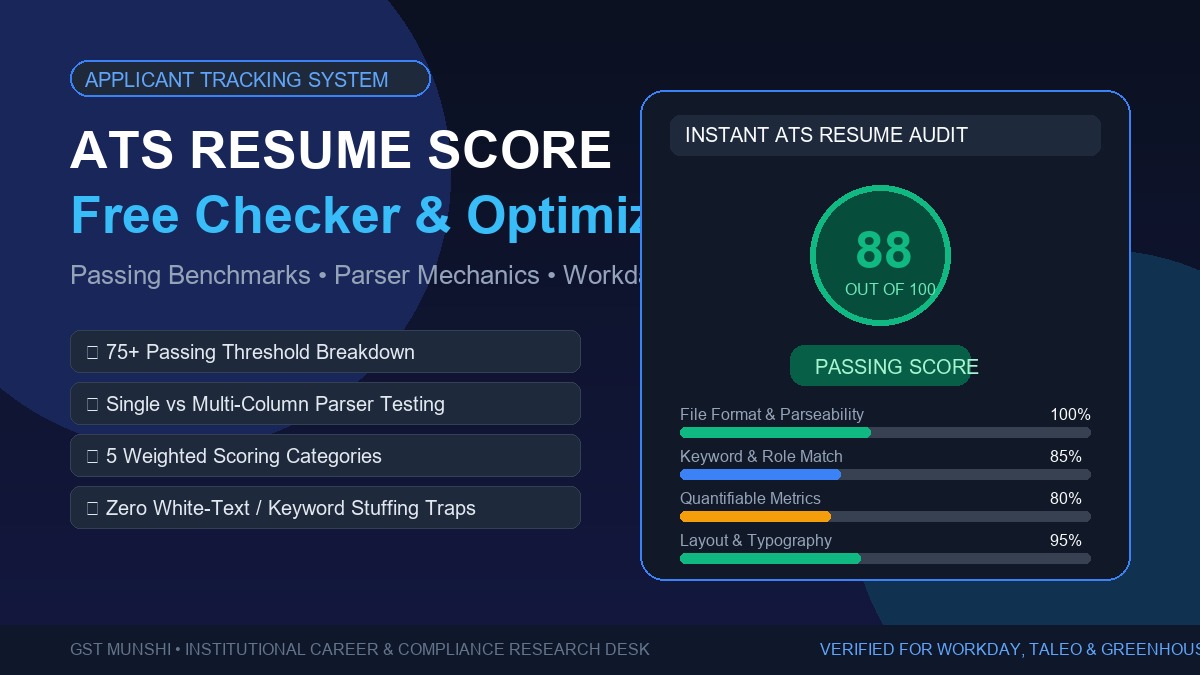
What is an ATS resume score and what is considered a passing benchmark?
The minimum score threshold needed to rank in the top 20% applicant pool for recruiter review.
Average human review window for parsed candidates before a yes/no interview decision is made.
Proportion of submitted resumes filtered out by automated parser errors before human eyes see them.
Shift from literal keyword stuffing to contextual skills ontology and CAR achievement scoring.
Interactive ATS Resume Score Checker & Diagnostic Tool
Use the diagnostic matrix below to calculate your real-time ATS resume score. Adjust file formats, layout choices, keyword coverage, and quantifiable metric percentages to identify exact points lost and preview recruiter-ready optimizations.
ATS Resume Score Calculator & Optimization Checker
Test your document format, keyword alignment, quantification depth, layout hygiene, and contact structure against real enterprise ATS parsing standards.
Excellent parseability and strong keyword alignment. Your resume architecture ensures smooth automated extraction across Workday, Taleo, Greenhouse, and iCIMS, giving you a high statistical probability of advancing to human review.
Detected Optimization Gaps (2)
Instant Action ChecklistAudit the job description for specific required software, technical protocols, and methodology phrases. Incorporate 3–5 additional exact terms into your experience bullets.
Add measurable numbers, percentages, dollar values, or team sizes to at least 70% of your work history bullet points to maximize semantic scoring.
How Modern ATS Parsers Work: From Binary File to Candidate Profile
To improve your ATS resume score, you must understand the technical process that occurs when you click submit on an enterprise job portal. An Applicant Tracking System is not an artificial intelligence recruiter that reads your document like a human. Instead, it is a relational database management platform equipped with a deterministic document parsing engine.
When you upload a file to platforms like Workday, Oracle Taleo, Greenhouse, or iCIMS, the system initiates a four-stage ingestion pipeline. First, the document ingestion layer converts your formatted file into raw text strings. If your file contains vector coordinates, multi-column tables, or graphic layers, this conversion process frequently introduces character encoding corruption.
Second, the classification module uses regular expressions and natural language processing to divide your raw text into discrete data buckets: Personal Contact Information, Work Experience, Education, and Skills. If you use non-standard headings such as "My Career Journey" instead of "Work Experience," the classifier fails to recognize where your job history begins and ends, leaving critical relational fields completely blank.
Third, the entity extraction algorithm scans the text against pre-configured skill ontologies. It extracts job titles, company names, employment date ranges, educational degrees, and technical competencies. Finally, the scoring engine compares your extracted entities against the hiring manager's job specification, assigning a weighted match score that dictates whether your profile appears at the top of the recruiter dashboard.
The 75+ Passing Threshold: Why It Matters in Corporate Recruiting
In competitive corporate recruitment, a single job posting for a software engineer, financial analyst, or marketing manager frequently receives between 250 and 1,000 applications within the first 72 hours. Corporate recruiting teams do not have the operational capacity to review every submission manually. Instead, talent acquisition teams rely on ATS ranking filters to segment applicants into three distinct operational tiers.
Candidates who achieve an ATS resume score of 75 or higher enter Tier 1, known as the High-Match Shortlist. Recruiters typically configure their dashboards to display only candidates scoring in the top 20th percentile. When your score reaches 85 or above, your application is highlighted with a green high-match indicator, ensuring that your profile is among the first 15 to 25 resumes opened by the hiring team.
Applicants scoring between 60 and 74 fall into Tier 2, the Marginal Review Pool. These candidates may pass baseline binary knockout questions (such as legal work authorization or degree requirements), but their match percentage is too low to appear on the primary dashboard. Recruiters only review Tier 2 candidates if the initial shortlist yields insufficient qualified talent.
Finally, applications scoring below 60 are relegated to Tier 3, the Automated Rejection Queue. In most enterprise workflows, systems automatically send templated rejection notices to Tier 3 candidates after 5 to 10 business days without any human ever viewing the submitted document. Achieving a 75+ score is therefore the essential gateway to human evaluation.
The 5 Critical Dimensions of ATS Resume Scoring
A comprehensive ATS resume score is not based on a single metric. Enterprise platforms evaluate documents across five weighted dimensions, each targeting a specific structural or linguistic attribute of your career record:
Evaluates file format integrity, single-column reading flow, and standard section headers. If a parser fails to extract text in natural linear order, points in all subsequent categories are compromised.
Measures semantic overlap between your resume and the target job description. Factors include exact matching of core tools, industry methodologies, and dedicated technical skills classification.
Modern parsers evaluate whether bullet points feature quantifiable results (percentages, revenue, efficiency gains) and strong imperative verbs rather than passive obligation statements.
Verifies standard system typography (Calibri, Arial, Georgia), uniform font sizing (10–12pt body), and total absence of graphical skill bars, progress dials, and embedded headshots.
Checks that your name and contact data reside in the primary document body rather than hidden headers or footers, that reverse-chronological dates use consistent Month/Year formatting, and document length stays within 1 to 2 pages.
Comparison Matrix: ATS-Friendly Format vs Graphic Canva Resumes
Job seekers often download visually elaborate templates from design marketplaces, believing that colourful sidebars, profile photos, and graphical skill bars will help them stand out. While these templates may look striking to the human eye, they create severe barriers for automated parsing software:
| Architecture Feature | ATS-Optimized Standard (.docx / Text PDF) | Graphic / Canva Design Template |
|---|---|---|
| Parser Extraction Accuracy | 98% – 100% data extraction accuracy | 25% – 50% data loss due to vector layer corruption |
| Reading Order Continuity | Predictable linear left-to-right flow | Jumbled sentences across multi-column margins |
| Tables & Text Boxes | Zero tables or floating frames used | Heavy use of floating text boxes; often skipped entirely |
| Font Encoding & Ligatures | Standard system fonts (Calibri, Arial, Georgia) | Non-standard Google web fonts; ligatures turn into '?' |
| Skill Ratings & Gauges | Text-based bulleted taxonomy list | Graphic bars and star icons; completely unreadable |
| Recruiter Scan Efficiency | Instant 6-second scan via clean layout | Cluttered visual noise leads to reader fatigue |
| Recommended Use Case | All corporate online portals (Fortune 500 & Tech) | In-person interviews or creative design portfolios only |
Parser Engine Differences: Workday vs Taleo vs Greenhouse vs iCIMS
Not all Applicant Tracking Systems evaluate resumes identically. The four dominant enterprise platforms have distinct parsing philosophies, indexing rules, and scoring algorithms:
| Parser Platform | Primary Enterprise Market | Parsing Engine Tech | Handling of Text PDFs | Multi-Column Sensitivity | Scoring Model |
|---|---|---|---|---|---|
| Workday | Fortune 500, Enterprise Tech, Global Banks | Proprietary skills cloud ontology | Excellent for standard text PDFs | High risk; fusions happen frequently | Skills match percentage + experience recency |
| Oracle Taleo | Government agencies, Healthcare, Manufacturing | Traditional keyword string matcher | Reliable, prefers .docx standard | Extreme risk; reads straight across columns | Strict exact-match frequency scoring |
| Greenhouse | High-growth tech startups, SaaS firms | Modern NLP with full-text search indexing | Flawless text PDF extraction | Moderate; parses text but layout distorts | Boolean recruiter queries + scorecard match |
| iCIMS | Retail, Logistics, Mid-to-Large Corporations | Textkernel multilingual parsing engine | Very high accuracy across PDF and Word | High risk; corrupts contact and date fields | Candidate qualification ranking index |
Step-by-Step 5-Phase SOP to Optimize Your Resume for ATS Scanners
Follow this verified five-phase standard operating procedure to elevate your resume from an unindexed draft to an elite 85+ score profile before submitting to any corporate applicant portal:
Phase 1: Deconstruct the Target Job Description & Extract Hard Skill Entities
Carefully read the target job description and highlight the recurring technical tools, certifications, and methodology requirements. Separate required core competencies from preferred qualifications. Identify exact industry keywords (e.g., "Kubernetes", "GAAP Accounting", "HubSpot CRM", "Agile Scrum") and create a checklist of terms that must be represented in your work history.
Phase 2: Eliminate Multi-Column Frameworks, Tables & Graphic Elements
Convert your document into a strict single-column structure with 0.5 to 1.0 inch margins. Remove all tables, floating text boxes, graphic icons, headshots, and graphical skill bars. Ensure that all content flows vertically from top to bottom. Place your name, phone number, email, and location in the main body text rather than inside Microsoft Word header or footer blocks.
Phase 3: Standardize Section Headings & Date Chronology
Label each section using universal, standard terminology: "Professional Summary", "Work Experience", "Education", "Technical Skills", and "Certifications". Standardize your employment dates to reverse-chronological order with month and four-digit year (e.g., "04/2021 – Present" or "April 2021 – Present"). Consistent date syntax prevents parser calculation errors when computing your total years of relevant experience.
Phase 4: Rewrite Bullet Points Using Context-Action-Result (CAR) & Metrics
Transform passive obligation statements into quantifiable achievements. Begin each bullet point with a decisive action verb, describe the specific problem solved or technology deployed, and conclude with the measurable outcome. Ensure that at least 65% of your bullet points feature verifiable numbers, percentage gains, dollar values, or project volumes.
Phase 5: Validate Plain-Text Parseability & File Format Export
Perform a plain-text audit: copy all text from your document (Ctrl+A / Cmd+A) and paste it into a plain text editor like Notepad. Verify that your name, contact information, job titles, and bullet points appear in logical order without garbled symbols or missing words. Save your finalized document as a standard .docx file or export directly as a selectable-text PDF.
Real-World Transformations: Weak Duty Bullet vs ATS-Optimized Bullet
Examining side-by-side bullet point revisions reveals why generic duty descriptions receive low semantic ratings while quantified, keyword-rich statements secure top ranking scores:
“Responsible for developing backend APIs in Python and working with database queries for client applications.”
“Architected 14 RESTful microservices in Python (FastAPI, PostgreSQL), cutting API latency by 42% across 2.4 million daily active users.”
“Assisted the finance team with quarterly budgeting, financial models, and variance analysis reports for leadership.”
“Engineered dynamic DCF financial models and rolling budgets for $45M operating portfolio, identifying $1.2M in annual cost variances.”
“Managed company social media campaigns, ran email marketing blasts, and tracked website visitor analytics.”
“Spearheaded multi-channel B2B acquisition campaigns across Google Ads and LinkedIn, driving a 168% increase in qualified pipeline leads and generating $820K ARR.”
“Helped oversee warehouse inventory tracking, coordinated logistics vendors, and worked on reducing delivery delays.”
“Revamped fulfillment operations across 3 regional distribution hubs, reducing inventory stockout rates by 38% and lowering average transit time from 4.2 to 2.1 days.”
Verified Expert Insights & Talent Acquisition Disclosures
Practical hiring recommendations and technical parser realities shared by enterprise talent leaders and senior corporate recruiters:
“Candidates often believe recruiters read all 300 resumes received for an open role. In reality, Workday organizes candidates into match score brackets. When I open a requisition, I immediately filter for candidates with a 75%+ semantic skills match. If your resume gets mangled by a two-column template or lacks core tools in plain text, you literally do not appear on my screen.”
“The single biggest reason qualified applicants fail our initial ATS screen is Canva resumes with dual columns. When our parser processes a two-column PDF, it reads horizontally across both columns, fusing company names from column A with job titles from column B. The result is total profile corruption. Stick to a clean single column; save the fancy design for your portfolio link.”
“Please stop hiding white text keywords in your resume footer. Modern ATS platforms like Greenhouse and Taleo strip all styling and show recruiters plain ASCII text in uniform black font. Your hidden keyword block shows up as an obvious block of text at the bottom. It results in an instant ethical rejection 100% of the time.”
“A high ATS resume score gets you past the robotic gatekeeper, but a human still has to spend 6 seconds scanning your bullet points. If every bullet begins with 'Responsible for', you blend into the background. Every bullet must have a metric: % saved, $ generated, or team headcount managed. Numbers anchor recruiter eyes instantly.”
Verified Video Walkthroughs: ATS Resume Formatting & Optimization
Watch in-depth video tutorials by executive recruiters and resume strategists breaking down parser mechanics, keyword matching techniques, and document layout standards:



Frequently Asked Questions About ATS Resume Scoring
Essential answers to common questions regarding applicant tracking systems, parsing algorithms, and resume optimization:
Q1.What is an ATS resume score and what number is considered passing?
An ATS resume score is a quantitative rating from 0 to 100 generated by Applicant Tracking Systems to evaluate how accurately your resume matches the target job description's keywords, required skills, and formatting standards. A score of 75 or higher is universally considered the passing threshold. Candidates scoring 75+ typically advance to the top 20% tier that human recruiters review during the initial screening round.
Q2.Why do Applicant Tracking Systems automatically reject over 70% of resumes?
Over 70% of submitted applications fail ATS screening due to three primary structural failures: unparseable file formatting (such as Canva multi-column layouts, tables, or scanned images), missing required hard skill keywords listed in the job specification, and lack of quantifiable performance metrics. When an ATS parser cannot extract candidate employment dates or core competencies, it assigns a low match rank that places the application below the recruiter's review cut-off.
Q3.Can ATS parsers read PDF resumes or should I always submit a Word (.docx) file?
Modern enterprise ATS platforms like Workday, Taleo, Greenhouse, and iCIMS can parse text-based PDF documents exported directly from Word or Google Docs without difficulty. However, graphic PDFs generated in design suites like Canva, Photoshop, or InDesign often flatten text into vector coordinates or image paths, rendering them unreadable. A clean, single-column Microsoft Word (.docx) document or a standard selectable-text PDF remains the safest universal standard.
Q4.Is white-text keyword stuffing effective for increasing my ATS resume score?
No. Pasting invisible white text or microscopic keywords into headers and footers is an obsolete tactic that actively triggers automated blacklisting. Contemporary ATS parsers extract all document strings into plain text ASCII format before calculating match percentages. The system displays all extracted text to the recruiter in uniform black font, immediately exposing hidden keyword blocks and disqualifying the applicant for ethical violations.
Q5.How do multi-column layouts and text boxes affect ATS parseability?
Multi-column templates, floating text frames, and sidebars severely degrade parseability because ATS parsers read documents horizontally from left to right across the entire width of the page. When scanning a two-column resume, the parser frequently fuses unrelated text from opposite columns into a single incoherent sentence, scrambling job titles, company names, and dates into unindexed fragments.
Q6.How frequently should target keywords appear throughout an ATS-optimized resume?
Core keywords should appear naturally between 2 to 4 times across different resume sections, including your Professional Summary, Core Competencies taxonomy list, and Work Experience bullet points. Excessive keyword density above 4% risks triggering algorithmic spam filters, while mentioning a skill only once without supporting work context yields weak semantic relevance scores.
Q7.What is the difference between keyword matching and semantic context in modern ATS?
Traditional keyword matching relies on exact string equality, requiring an exact verbatim match for phrases like 'Financial Modeling.' Modern semantic ATS parsers utilize natural language processing (NLP) to recognize conceptual equivalents, related industry acronyms, and contextual seniority. They reward candidates who embed hard skills within actionable accomplishment statements rather than isolated lists.
Q8.Can an ATS score guarantee that I will receive an interview invitation?
An ATS score of 75+ guarantees that your application clears automated gating filters and appears on the recruiter's priority shortlist. However, the ultimate interview invitation depends on the human recruiter's manual 6-second review of your career narrative, qualitative achievements, cultural fit, and competitive positioning relative to other applicants.
Related Career & Professional Growth Guides
Explore interconnected resources on salary matrices, digital income opportunities, and professional skills: