
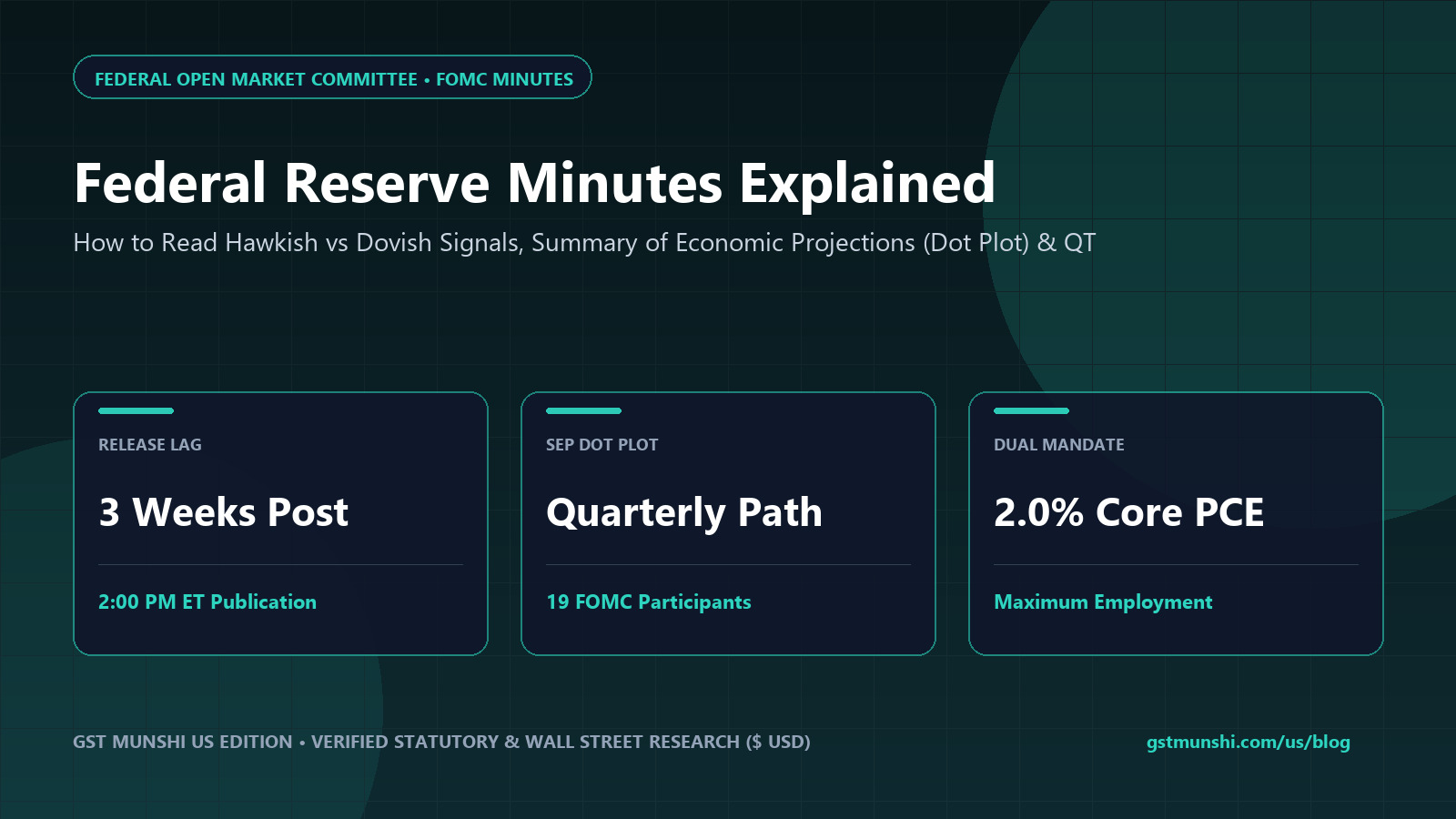
What are the Federal Reserve (FOMC) Minutes, when are they released, and why do they move the stock and bond markets?
The Federal Reserve Minutes are the official detailed written record of each Federal Open Market Committee (FOMC) monetary policy meeting, published at 2:00 PM Eastern Time exactly three weeks after the policy decision. Investors scrutinize the Fed Minutes because they reveal the internal debate among all 19 FOMC participants—exposing how many officials favored rate cuts, rate hikes, or balance-sheet adjustments—allowing Wall Street to price future interest rate probabilities before the next FOMC meeting.
Federal Reserve Minutes Tone & Taylor Rule Fed Funds Rate Calculator
Input current US Core PCE inflation, the U-3 unemployment rate, and the neutral real rate (r*) to compute the Taylor Rule policy benchmark and see how FOMC Minutes language moves Wall Street.
1FOMC Statement vs. Fed Minutes vs. Full Transcripts: The 3-Tier Disclosure Timeline
Under Section 12A of the Federal Reserve Act (12 U.S.C. § 263), the Federal Open Market Committee meets eight times a year in Washington, D.C. to set the target range for the overnight Federal Funds Rate and direct open-market operations. Because a single sentence from the central bank can move trillions of dollars in global equities and bonds, the Fed releases information in three carefully staged tiers.
Tier 1 occurs on Meeting Day (Wednesday at 2:00 PM ET): the FOMC releases a brief 4-to-5-paragraph Policy Statement announcing the immediate interest rate vote, followed at 2:30 PM ET by the Fed Chair's live press conference. Because the Policy Statement is a consensus document of fewer than 500 words, it intentionally smooths over disagreements inside the committee.
Tier 2 occurs exactly three weeks later (Wednesday at 2:00 PM ET) with the release of the FOMC Minutes—an 8-to-12-page narrative document detailing staff economic forecasts, financial conditions, and the full spectrum of policy arguments raised by all 19 participants. (Tier 3, the word-for-word verbatim meeting transcript identifying speakers by name, is sealed for five years to allow candid policy debate.)
- Meeting Day (Day 0 at 2:00 PM ET): Concise FOMC Policy Statement + Quarterly Summary of Economic Projections (SEP Dot Plot in March, June, September, December).
- FOMC Minutes Release (Day +21 at 2:00 PM ET): Detailed 8–12 page breakdown of internal debates, risk assessments, and balance-sheet mechanics.
- Verbatim Transcripts (Year +5): Full word-for-word attribution released five years later for historical and academic audit.
2The Secret Quantitative Dictionary of 'Fed-Speak': Decoding 'Several,' 'Many' & 'Most'
To protect the candor of deliberations, the FOMC Minutes never name individual Governors or Regional Bank Presidents (except when recording formal dissenting votes at the very end). Instead, Federal Reserve economists use a strict, calibrated hierarchy of quantitative qualifiers to tell Wall Street exactly how many of the 19 policymakers supported a given argument.
Understanding this hierarchy prevents investors from overreacting to media headlines. When a financial news alert flashes 'Fed Officials Discussed Raising Rates,' looking at the actual qualifier in the Minutes reveals whether that view was held by 'a couple of participants' (just 2 out of 19 people, likely non-voting regional hawks) or 'almost all participants' (17 to 18 out of 19 policymakers).
- 'All' / 'Almost all participants': 17 to 19 officials (Unanimous or near-unanimous committee consensus).
- 'Most' / 'The vast majority' / 'A substantial majority': 11 to 16 officials (Dominant baseline policy view).
- 'Many participants': Roughly 7 to 10 officials (A major faction within the committee).
- 'Several' / 'Some participants': Roughly 4 to 6 officials (A notable minority view worth monitoring).
- 'A few' / 'A couple of participants': Only 2 to 3 officials (Outlier or edge-case commentary).
3Hawkish vs. Dovish Signals: Balancing the Federal Reserve's Statutory Dual Mandate
Every paragraph in the FOMC Minutes revolves around the Federal Reserve's statutory Dual Mandate enacted by Congress in the Federal Reserve Reform Act of 1977 (12 U.S.C. § 225a): promoting (1) Maximum Employment and (2) Stable Prices (defined by the FOMC since 2012 as 2.0% annual inflation measured by the Personal Consumption Expenditures, or PCE, price index).
When the Minutes are described by Wall Street economists as 'Hawkish,' the text shows participants expressing heightened concern that core inflation remains sticky above 2.0%, signaling that the Fed will keep interest rates higher for longer (or hike further). Hawkish minutes typically cause 2-Year and 10-Year Treasury yields to jump, the US Dollar Index (DXY) to rally, and growth stock P/E multiples to dip.
Conversely, when the Minutes are 'Dovish,' participants emphasize cooling payroll growth, rising unemployment risks, or confidence that inflation is sustainably returning to 2.0%. Dovish minutes boost CME FedWatch rate-cut probabilities, lower Treasury yields and mortgage rates, and ignite rallies across the S&P 500 and rate-sensitive small-cap indices (Russell 2000).
4Why Section 1 of the Minutes (SOMA Manager Report & Balance Sheet QT) Is Gold for Bond Traders
While retail traders skip straight to the final 'Committee Policy Action' section, institutional bond desks read the opening section—'Developments in Financial Markets and Open Market Operations' presented by the System Open Market Account (SOMA) Manager at the Federal Reserve Bank of New York.
This section details bank reserve balances, Overnight Reverse Repo Facility (ON RRP) usage, and Quantitative Tightening (QT) Treasury and MBS runoff caps. Historically, every major Federal Reserve decision to taper or end balance-sheet runoff was discussed in detail inside the FOMC Minutes one to two meetings before any formal announcement appeared in the Policy Statement.
FOMC Minutes Language Decoder & Cross-Asset Market Impact Matrix
| FOMC Minutes Phrase / Signal | Policy Stance | 2Y & 10Y Treasury Yield Impact | S&P 500 & Mortgage Rate Reaction |
|---|---|---|---|
| 'Almost all participants judged upside risks to inflation remained elevated' | Strongly Hawkish | Yields Rise (+5 to +15 bps) | Growth Stocks Dip; 30-Yr Mortgage Rates Tick Higher |
| 'Most participants noted risks to employment and inflation had moved into better balance' | Neutral / Equilibrium | Yields Trade Range-Bound | Low Volatility; Fundamentals & Earnings Drive Stocks |
| 'A vast majority observed that easing policy at the next meeting would likely be appropriate' | Strongly Dovish | Yields Fall (-8 to -18 bps) | S&P 500 & Tech Rally; Mortgage Refinance Rates Drop |
| 'Many participants suggested slowing the pace of balance sheet runoff fairly soon' | Liquidity Dovish (QT Taper) | 10Y Term Premium Compresses | Supports Bond Market Liquidity & Narrower MBS Spreads |
4-Step Institutional Workflow for Reading the Fed Minutes at 2:00 PM ET
Open the Official Board of Governors PDF at federalreserve.gov
Rather than relying on 1-sentence social media headlines at 2:00 PM ET, open the official FOMC Minutes release and jump to 'Participants' Views on Current Conditions and the Economic Outlook.'
Count the Qualifier Hierarchy ('Almost All' vs. 'A Couple')
Check whether hawkish or dovish remarks are attributed to 'most/almost all participants' (actionable policy consensus) or merely 'a couple/a few participants' (non-consensus noise).
Compare the Minutes Against Current CME FedWatch Probabilities
remember the meeting occurred 3 weeks ago; if a major CPI inflation or Nonfarm Payrolls report came out after the meeting date, the market may already look past dated FOMC commentary.
Wait 15–20 Minutes After 2:00 PM ET Before Executing Trades
Algorithmic headline scanners trigger whipsaw spikes between 2:00 PM and 2:10 PM ET; wait for the 2-Year Treasury yield to establish a clear direction before placing equity or bond orders.
Curated Expert Video Walkthroughs & Wall Street Briefings


Frequently Asked Questions (Verified Statutory Answers)
Q1: What time of day are the Federal Reserve FOMC Minutes released?
The Federal Reserve Board releases the FOMC Minutes at exactly 2:00 PM Eastern Time (ET), typically on a Wednesday three weeks after the conclusion of each scheduled FOMC policy meeting.
Q2: How many times a year are FOMC Minutes published?
Because the Federal Open Market Committee holds eight regularly scheduled meetings per year (approximately every six weeks), eight regular sets of FOMC Minutes are published annually.
Q3: What is the difference between 'members' and 'participants' in the FOMC Minutes?
This is a subtle but vital distinction in Fed-speak: 'participants' refers to all 19 officials in the room (the 7 Federal Reserve Board Governors plus all 12 Regional Federal Reserve Bank Presidents). 'Members' refers strictly to the 12 officials who hold a formal vote in that calendar year (the 7 Governors, the New York Fed President, and 4 rotating Regional Bank Presidents).
Q4: What is the Fed 'Dot Plot' and is it part of the FOMC Minutes?
The Dot Plot is part of the Summary of Economic Projections (SEP), which is released on Meeting Day at 2:00 PM ET at four quarterly meetings per year (March, June, September, and December). Each of the 19 participants places an anonymous dot showing where they project the Fed Funds Rate will end the next three years and in the longer run.
Q5: Why does the Fed prefer Core PCE inflation over the Consumer Price Index (CPI)?
Published by the Bureau of Economic Analysis (BEA), the Personal Consumption Expenditures (PCE) price index covers a broader range of household healthcare and service expenditures and dynamically updates item weights as consumers substitute cheaper goods—making Core PCE the FOMC's official 2.0% statutory yardstick.
Q6: Where can anyone read the official FOMC Minutes for free?
Every FOMC Policy Statement, SEP Dot Plot, and FOMC Minutes document is published free of charge on the official Board of Governors website at federalreserve.gov/monetarypolicy/fomccalendars.htm at 2:00 PM ET on release day.

Curated Expert Insights & Verified Consumer Disclosures
“Always check the calendar gap when trading FOMC Minutes: the Minutes are a 3-week-old snapshot. If Nonfarm Payrolls or Core CPI surprised sharply during those 21 days, recent live speeches by the Fed Chair and New York Fed President carry more weight than the lookback text.”