
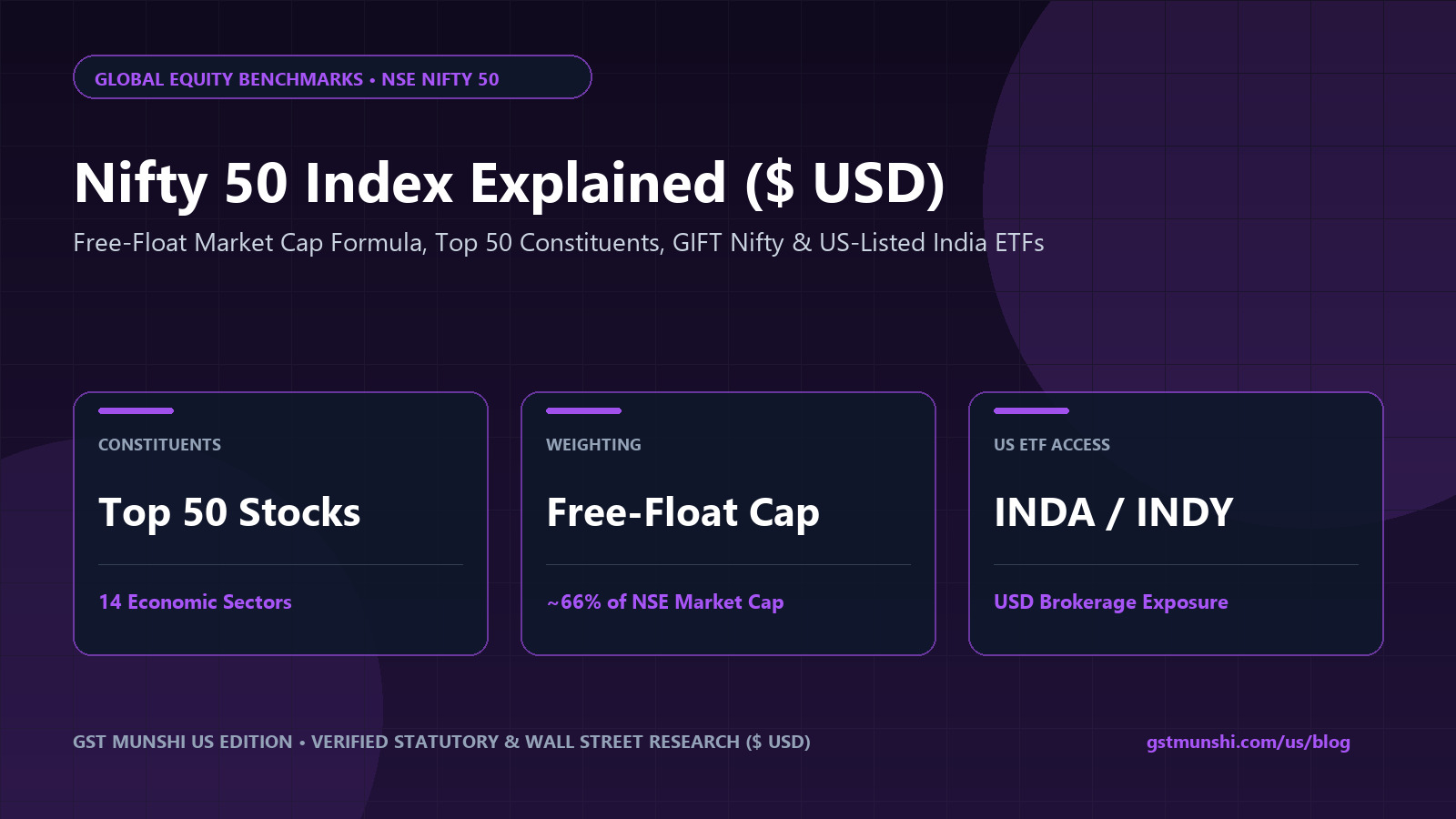
What is the Nifty 50 Index, how is it calculated, and how can US and global investors invest in it?
The Nifty 50 ('National Stock Exchange Fifty') is the flagship benchmark equity index of the National Stock Exchange of India (NSE), tracking the 50 largest and most liquid publicly traded Indian corporations across 14 economic sectors. Calculated using the Free-Float Market Capitalization method (with a base date of November 3, 1995 and a base value of 1,000), the Nifty 50 represents roughly 66% of India's total float-adjusted equity market value and is accessible to US investors in $ USD via NASDAQ-listed ETFs such as the iShares India 50 ETF (INDY).
Nifty 50 Index Free-Float Sector Weight & $ USD Return Simulator
Simulate investing in the NSE Nifty 50 Index in $ USD via US-listed ETFs (such as iShares INDY / INDA), factoring in free-float sector weights and annual USD/INR exchange rate adjustments.
1What Does 'Nifty 50' Mean & How the Free-Float Market Capitalization Formula Works
Coined in 1996 as a portmanteau of 'National Stock Exchange' and 'Fifty,' the Nifty 50 is owned and managed by NSE Indices Limited (formerly IISL), a wholly owned subsidiary of the National Stock Exchange of India. Just as the S&P 500 serves as the institutional barometer for the United States economy, the Nifty 50 serves as the primary equity benchmark for the world's fastest-growing major large-cap stock market.
Since June 26, 2009, the Nifty 50 has been computed using the Free-Float Market Capitalization weighted methodology. Unlike Total Market Capitalization (which multiplies share price by all issued shares), Free-Float Market Capitalization multiplies a company's share price only by the shares readily available for trading by the public in the open market—explicitly excluding shares held by founding 'promoters,' strategic corporate parents, government stakes, and employee lock-ins.
To calculate the live Nifty 50 index level every second, the aggregate Free-Float Market Capitalization of all 50 constituents is divided by the Base Market Capitalization of the index (from the base date of November 3, 1995, equal to ₹2.06 trillion adjusted by a corporate-action divisor) and multiplied by the base index value of 1,000.
- Investible Weight Factor (IWF): IWF = (Total Shares − Promoter & Locked-In Shares) ÷ Total Shares. A company with 45% promoter holding has an IWF of 0.55.
- Free-Float Formula: Nifty 50 Index Value = (Current Free-Float Market Cap of 50 Stocks ÷ Base Free-Float Market Cap) × 1,000.
- Semi-Annual Rebalancing: The Index Maintenance Sub-Committee reviews and reconstitutes the Nifty 50 twice a year (effective the last trading day of March and September) using 6-month average data ending January 31 and July 31.
2How a Stock Qualifies for the Nifty 50: Liquidity, Impact Cost & F&O Mandate
To prevent illiquid stocks from distorting India's benchmark index, NSE Indices Limited enforces four rigorous quantitative eligibility criteria before any company can enter the Nifty 50. First, the company must be a domiciled Indian company listed on the NSE and must already be an active constituent of the Nifty 100 Index.
Second, the stock must be approved for trading in the NSE Futures and Options (F&O) derivatives segment—a critical requirement that guarantees deep institutional two-way liquidity and allows market makers to hedge index baskets seamlessly. Third, the stock must have traded at an average impact cost of 0.50% or less during the past six months for 90% of observations on a portfolio order size of ₹100 million (~$1.2 million USD).
Fourth, a stock is automatically added to the Nifty 50 during semi-annual reconstitution if its 6-month average Free-Float Market Capitalization is at least 1.5 times the average Free-Float Market Capitalization of the smallest existing constituent in the index.
3Nifty 50 Top 10 Constituents & Sector Weightages Compared to the S&P 500
While the US S&P 500 is heavily weighted toward Information Technology (~31%–34%), the Nifty 50 is anchored by Financial Services (~33.5%), reflecting the central role of private-sector banking and credit expansion in India's GDP growth. Meanwhile, Indian IT outsourcing leaders (which earn the majority of their revenue in $ USD from Fortune 500 enterprises) form the second-largest sector (~13.8%), providing a natural currency hedge when the US dollar strengthens.
Because Free-Float Market Capitalization favors widely held institutions over government-owned enterprises with low public float, private-sector giants like HDFC Bank (which has 100% public free float and 0% promoter holding) and ICICI Bank command the highest weights in the Nifty 50, alongside Reliance Industries, Infosys, ITC, Tata Consultancy Services (TCS), Larsen & Toubro (L&T), Bharti Airtel, Axis Bank, and State Bank of India.
4GIFT Nifty Futures & How US Investors Buy the Nifty 50 in $ USD (INDY, INDA, FLIN)
For global institutional desks and US retail investors, tracking and trading the Nifty 50 happens nearly 21 hours a day through GIFT Nifty (formerly SGX Nifty)—a USD-denominated futures contract traded on the NSE International Exchange (NSE IX) at GIFT City in Gujarat, India. GIFT Nifty operates across two extended sessions covering Asian, European, and US Wall Street trading hours, serving as the primary overnight global cue before the domestic NSE cash market opens at 9:15 AM IST (11:45 PM ET).
US investors do not need a foreign brokerage account to invest in the Nifty 50. On standard US brokerages (Fidelity, Vanguard, Schwab, Interactive Brokers), investors can buy the iShares India 50 ETF (NASDAQ: INDY), which directly tracks the Nifty 50 Index in $ USD, or lower-cost broad large-cap alternatives like the Franklin FTSE India ETF (NYSE Arca: FLIN, 0.19% expense ratio) and iShares MSCI India ETF (Cboe: INDA, 0.65% expense ratio).
Nifty 50 Index vs. US S&P 500 & US-Listed India ETF Comparison
| Benchmark / Vehicle | Underlying Exposure | Weighting & Currency | Expense Ratio / Access |
|---|---|---|---|
| NSE Nifty 50 Index | Top 50 Indian Large-Cap Stocks across 14 Sectors | Free-Float Market Cap (Base 1995 = 1,000) | Direct Index Benchmark (~66% of NSE Float) |
| iShares India 50 ETF (NASDAQ: INDY) | Tracks the Exact Nifty 50 Index (50 Holdings) | Traded in $ USD on NASDAQ (9:30 AM–4:00 PM ET) | 0.89% Expense Ratio (Direct Nifty 50 US ETF) |
| Franklin FTSE India ETF (NYSE: FLIN) | Broad Indian Large & Mid-Cap Equities (200+ Stocks) | Float-Adjusted Cap in $ USD on NYSE Arca | 0.19% Expense Ratio (Lowest-Cost US India ETF) |
| iShares MSCI India ETF (Cboe: INDA) | Top ~85% of Indian Equity Market Cap | Traded in $ USD with Deep US Options Chain | 0.65% Expense Ratio ($9B+ Institutional AUM) |
| GIFT Nifty Futures (NSE IX) | USD-Denominated Nifty 50 Index Futures | $2 × Nifty Index Point Multiplier ($ USD) | Nearly 21-Hour Global Institutional Trading |
4-Step Guide to Analyzing & Investing in the Nifty 50 Index
Monitor GIFT Nifty & USD/INR Exchange Rate for Global Cues
Before domestic NSE trading opens, check GIFT Nifty USD futures and the 10-Year US Treasury / DXY Dollar Index to gauge foreign institutional investor (FII) flows.
Choose the Right Investment Vehicle for Your Tax Jurisdiction
US-based investors should use SEC-registered ETFs (such as FLIN, INDA, or INDY) in US brokerage accounts to receive standard IRS Form 1099 tax reporting and avoid complex IRS Form 8621 PFIC rules triggered by foreign-domiciled mutual funds.
Evaluate Nifty 50 Trailing P/E Ratio Against Its 10-Year Historical Band
Historically, the Nifty 50 trades within a 20x to 24x trailing P/E band; valuations near 18x–20x represent high-margin-of-safety accumulation zones for long-term investors.
Use Nifty 50 as a 5%–10% Emerging Markets Satellite Alongside S&P 500
Because the Nifty 50 is led by domestic banking and infrastructure while the S&P 500 is led by global AI and semiconductors, pairing the two provides genuine geographic and sector diversification.
Curated Expert Video Walkthroughs & Wall Street Briefings



Frequently Asked Questions (Verified Statutory Answers)
Q1: What is the difference between the Nifty 50 and the BSE Sensex?
Both are flagship Indian large-cap stock market indices that use the Free-Float Market Capitalization methodology. The Nifty 50 tracks the top 50 companies listed on the National Stock Exchange (NSE) with a base value of 1,000 (1995), whereas the S&P BSE Sensex tracks the top 30 companies listed on the Bombay Stock Exchange (BSE) with a base value of 100 (1978–1979).
Q2: Why does HDFC Bank have a larger weight in the Nifty 50 than Reliance Industries if Reliance has a higher total market cap?
Because the Nifty 50 uses Free-Float Market Capitalization rather than Total Market Capitalization. Roughly 50% of Reliance Industries shares are held by its promoter group (and therefore excluded from free float), whereas HDFC Bank is 100% publicly held (1.00 Investible Weight Factor), giving HDFC Bank a larger free-float weight.
Q3: Can US investors buy the Nifty 50 in a Roth IRA or regular US brokerage account?
Yes. Any US brokerage account (Fidelity, Schwab, Vanguard, E*TRADE, Robinhood) can purchase the iShares India 50 ETF (ticker: INDY on NASDAQ), which holds all 50 Nifty 50 constituents and trades in $ USD during regular New York market hours.
Q4: Why should US taxpayers avoid buying India-domiciled Nifty 50 mutual funds directly?
Under Internal Revenue Code Sections 1291–1298, the IRS classifies non-US mutual funds and non-US ETFs as Passive Foreign Investment Companies (PFICs), subjecting US citizens and residents to complex annual Form 8621 filings and punitive mark-to-market ordinary tax rates. Buying US-domiciled ETFs (like INDY, INDA, or FLIN) completely avoids PFIC classification.
Q5: How often do stocks get added to or removed from the Nifty 50?
The Nifty 50 is reconstituted semi-annually every March and September. A maximum of 10% of the index size (up to 5 companies per year) can be replaced through regular semi-annual reviews, with 4 weeks' advance public notice given before changes take effect.
Q6: What is GIFT Nifty and when does it trade?
GIFT Nifty is the US-dollar-denominated derivatives contract on the Nifty 50 Index traded on the NSE International Exchange (NSE IX) in GIFT City, India. It trades nearly 21 hours a day across two sessions, allowing global investors in London, New York, and Singapore to hedge and price Indian equities while the domestic Mumbai market is closed.
Curated Expert Insights & Verified Consumer Disclosures
“Critical tax rule for US Citizens and Green Card holders: Never buy foreign-domiciled mutual funds or ETFs directly on overseas exchanges in taxable accounts due to punitive IRS Section 1291 PFIC taxation. Always access Nifty 50 exposure via US-listed 1940-Act ETFs like INDY, INDA, or FLIN.”