
What is the Full Retirement Age (FRA) for Social Security, and when can you start claiming benefits?
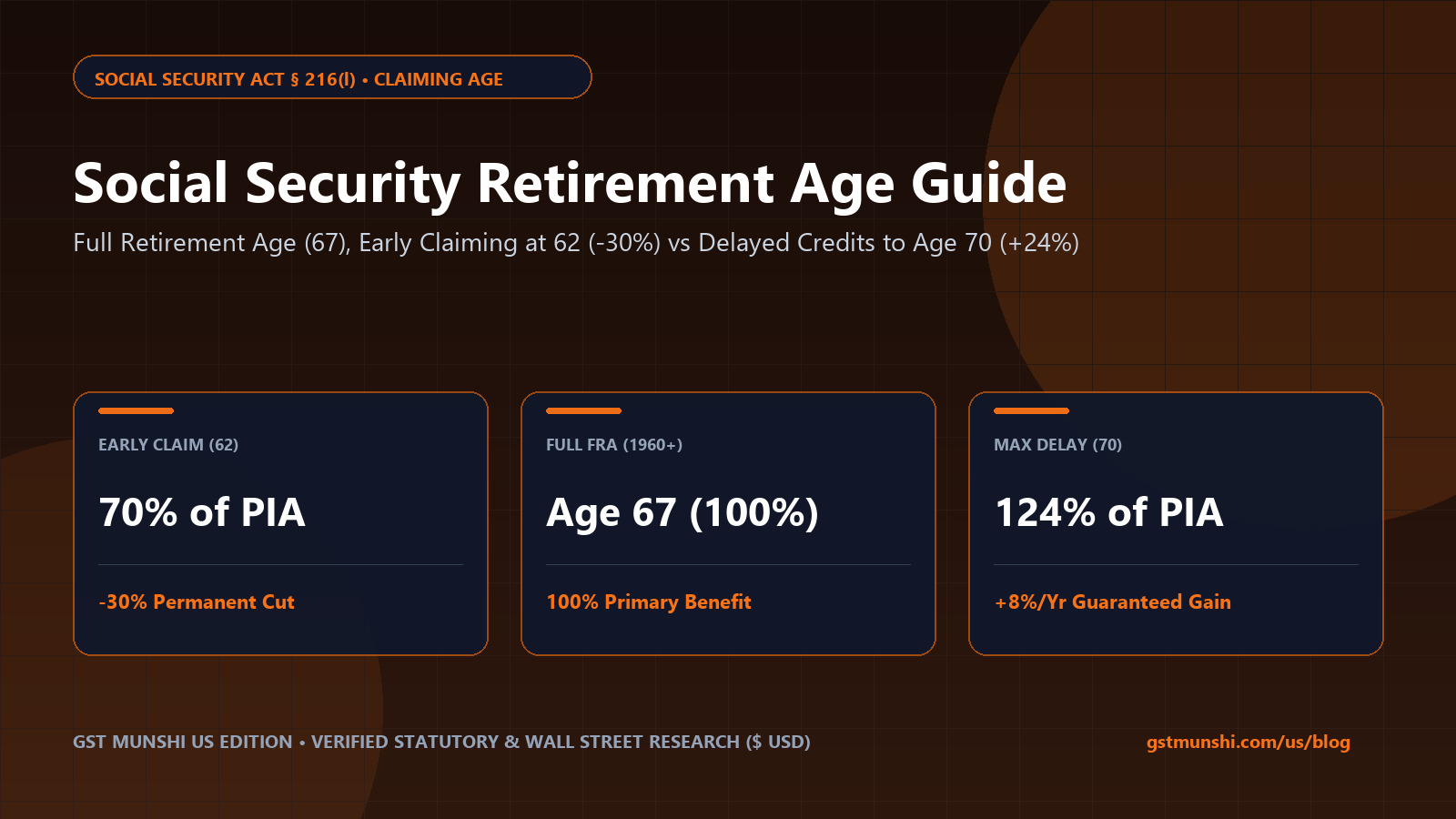
Under Section 216(l) of the Social Security Act (42 U.S.C. § 416(l)), Full Retirement Age (FRA) is exactly 67 years old for anyone born in 1960 or later (and between 66 and 10 months for those born in 1959). You can claim Social Security retirement benefits as early as age 62, which permanently reduces your monthly payout by up to 30% (receiving 70% of your full benefit), or delay claiming up to age 70 to earn an extra 8% per year in guaranteed Delayed Retirement Credits (receiving 124% of your full benefit).
Social Security Full Retirement Age (FRA) & Claiming Age 62–70 Payout Calculator
Enter your birth year, your estimated Full Retirement Age Primary Insurance Amount (PIA), and your target claiming age to calculate your exact statutory benefit multiplier and cumulative payout through age 85.
1Full Retirement Age (FRA) by Birth Year Under the 1983 Social Security Amendments
For decades after the Social Security Act of 1935 was enacted, Full Retirement Age (also called Normal Retirement Age) stood at 65. However, in the bipartisan Social Security Amendments of 1983 (Public Law 98-21, codified at 42 U.S.C. § 416(l)), Congress enacted a phased schedule gradually raising the Full Retirement Age from 65 to 67 to reflect rising American life expectancy and strengthen the Old-Age and Survivors Insurance (OASI) Trust Fund.
Under this statutory schedule, Americans born between 1943 and 1954 had a Full Retirement Age of 66. Beginning with the 1955 birth cohort, FRA increased by two months per birth year: 66 and 2 months (1955), 66 and 4 months (1956), 66 and 6 months (1957), 66 and 8 months (1958), and 66 and 10 months (1959).
For every worker born on or after January 2, 1960, Full Retirement Age is now fully phased in at exactly 67 years old. (Under SSA legal rules, an individual attains their age on the day before their birthday, meaning someone born on January 1, 1960 is legally treated under the 1959 birth-year rule of 66 and 10 months.)
- 40 Work Credits Requirement: To qualify for retirement benefits on your own work record, you must earn at least 40 Social Security credits (maximum 4 credits per year, equal to 10 years of covered work).
- 35-Year AIME Calculation: SSA indexes your 35 highest-earning years for national wage growth to calculate your Average Indexed Monthly Earnings (AIME) and Primary Insurance Amount (PIA).
- Medicare Stays at Age 65: Even though Social Security Full Retirement Age is 67, Medicare Part A and Part B eligibility still begins at age 65.
2Claiming Early at Age 62: The Exact Monthly Reduction Formula (20 C.F.R. § 404.409)
Workers who have accumulated 40 work credits can elect to claim retired-worker benefits as early as age 62. Under SSA regulations, you must be 62 for the entire calendar month to receive a benefit for that month; therefore, unless you were born on the 1st or 2nd day of the month, your first eligible benefit month is the month following your 62nd birthday.
Because early claimants collect checks for up to 60 extra months before age 67, federal law (20 C.F.R. § 404.409) applies an actuarial reduction for every month you claim prior to your Full Retirement Age. Specifically, your Primary Insurance Amount is reduced by 5/9 of 1% per month for the first 36 months of early claiming (totaling a 20% reduction over three years), plus 5/12 of 1% per month for each additional month beyond 36 months (an extra 10% reduction for the 24 months between age 62 and 64).
Consequently, a worker with a Full Retirement Age of 67 who claims immediately at age 62 suffers a permanent 30.0% monthly reduction—receiving 70% of their full benefit for the rest of their life. For a spouse claiming on a partner's record at age 62, the reduction is even steeper at 35% (reducing the 50% spousal benefit down to 32.5% of the worker's PIA).
3Delaying Past 67 to Age 70: How 8% Annual Delayed Retirement Credits Work
For every month you postpone claiming Social Security beyond your Full Retirement Age up to age 70, the Social Security Administration awards Delayed Retirement Credits (DRCs) equal to 2/3 of 1% per month—or a guaranteed 8.0% simple increase per full year of delay.
For someone born in 1960 or later (FRA 67), waiting three years until age 70 increases their monthly check by 24% (36 months × 2/3 of 1%), locking in 124% of their Primary Insurance Amount. Because annual CPI-W Cost-of-Living Adjustments (COLAs) compound on top of that higher base, a retiree who delays from 62 to 70 receives a monthly check that is 77.1% larger (124% ÷ 70% = 1.7714) in real purchasing power every single month for life.
There is zero financial benefit to delaying past age 70; Delayed Retirement Credits stop accruing the month you turn 70. Even if you are still working at age 70, you should file your application immediately so you do not forfeit guaranteed monthly checks.
4The Retirement Earnings Test: What Happens If You Work While Claiming Before Age 67
Many Americans plan to claim Social Security at 62 or 64 while continuing to work part-time or full-time. If you claim benefits prior to reaching your Full Retirement Age, you are subject to the statutory Retirement Earnings Test (42 U.S.C. § 403(f)).
In years prior to the calendar year you reach Full Retirement Age, SSA withholds $1 in benefits for every $2 of W-2 wages or net self-employment income you earn above the annual exempt threshold ($23,400+ indexed annually). In the calendar year you actually reach Full Retirement Age, a much higher threshold applies ($62,160+ indexed annually) during the months prior to your birthday month, withholding $1 for every $3 earned above the limit.
Crucially, benefits withheld under the Earnings Test are NOT permanently lost: the exact month you reach Full Retirement Age (67), the Earnings Test disappears completely—meaning you can earn $500,000 a year with zero penalty—and SSA automatically recalculates your monthly benefit upward to credit you for every month checks were withheld.
- Only Earned Income Counts: W-2 wages and net self-employment count toward the Earnings Test; pensions, 401(k)/IRA withdrawals, dividends, interest, and rental income do NOT count.
- First-Year Monthly Rule: In your first year of retirement, SSA applies a special monthly test so high earnings earlier in the year before you retired do not penalize your post-retirement checks.
5Spousal & Survivor Claiming Rules: Why the Higher Earner Waiting to 70 Protects Both Spouses
For married couples, Social Security claiming is a joint-life actuarial decision rather than an individual one. When one spouse passes away, the smaller of the two monthly Social Security checks disappears permanently, and the surviving spouse steps up to 100% of the deceased higher earner's actual monthly check (including any Delayed Retirement Credits the higher earner accumulated).
Therefore, even if the higher-earning spouse has average life expectancy, delaying the higher earner's benefit until age 70 maximizes the guaranteed inflation-protected survivor pension for whichever spouse lives into their late 80s or 90s, while the lower-earning spouse can claim earlier at 62 or 67 to bring cash flow into the household.
Statutory Full Retirement Age & Monthly Benefit Percentage by Claiming Age
| Birth Year Cohort | Full Retirement Age (FRA) | Payout if Claimed at 62 | Payout at FRA | Payout if Claimed at 70 |
|---|---|---|---|---|
| 1943 – 1954 | 66 Years, 0 Months | 75.0% of PIA (-25.0%) | 100.0% of PIA | 132.0% of PIA (+32.0%) |
| 1955 | 66 Years, 2 Months | 74.17% of PIA (-25.83%) | 100.0% of PIA | 130.67% of PIA (+30.67%) |
| 1956 | 66 Years, 4 Months | 73.33% of PIA (-26.67%) | 100.0% of PIA | 129.33% of PIA (+29.33%) |
| 1957 | 66 Years, 6 Months | 72.50% of PIA (-27.50%) | 100.0% of PIA | 128.0% of PIA (+28.0%) |
| 1958 | 66 Years, 8 Months | 71.67% of PIA (-28.33%) | 100.0% of PIA | 126.67% of PIA (+26.67%) |
| 1959 | 66 Years, 10 Months | 70.83% of PIA (-29.17%) | 100.0% of PIA | 125.33% of PIA (+25.33%) |
| 1960 and Later | 67 Years, 0 Months | 70.0% of PIA (-30.0%) | 100.0% of PIA | 124.0% of PIA (+24.0%) |
4-Step Decision Framework for Choosing Your Social Security Claiming Age
Download Your Official PIA Statement on mySocialSecurity (ssa.gov)
Verify your exact estimated monthly checks at age 62, Full Retirement Age (67), and age 70, and confirm that all 35 years of your highest W-2 earnings are properly credited.
Check Whether You Will Work Between Ages 62 and 67
If you plan to continue earning W-2 wages above ~$23,400/year before age 67, avoid claiming early so your checks aren't withheld under the Retirement Earnings Test.
Evaluate Health, Longevity & Spousal Survivor Protection
If you are single with serious health conditions, claiming at 62–65 captures immediate wealth; if you are married or have family longevity past age 80, having the higher earner wait until 67–70 maximizes lifetime and survivor income.
Submit Your Online Application Up to 4 Months Before Your Target Month
SSA allows you to apply up to 4 months prior to the month you want benefits to begin, and still Remember to enroll in Medicare at age 65 (3 months before your 65th birthday) even if delaying Social Security to 67 or 70.
Curated Expert Video Walkthroughs & Wall Street Briefings




Frequently Asked Questions (Verified Statutory Answers)
Q1: Can a surviving widow or widower claim Social Security earlier than age 62?
Yes. Under 42 U.S.C. § 402(e)–(f), a surviving spouse (widow or widower) can claim reduced survivor benefits as early as age 60 (or age 50 if disabled). Additionally, a surviving spouse can claim a reduced survivor benefit at 60 while letting their own retirement benefit grow at 8% per year until switching to their own higher check at age 70.
Q2: Does delaying Social Security to age 70 also increase spousal benefits?
No. Spousal benefits for a living spouse are capped at 50% of the primary worker's Full Retirement Age PIA (reached when the claiming spouse turns 67). Delayed Retirement Credits earned between 67 and 70 increase only the worker's own retirement check and the future survivor benefit after the worker passes away.
Q3: Do I still need to sign up for Medicare at age 65 if my Full Retirement Age is 67?
Yes! Unless you are actively covered by a qualifying employer group health plan (with 20+ employees) through your own or your spouse's current employment, you must enroll in Medicare Part A and Part B during your 7-month Initial Enrollment Period around your 65th birthday to avoid permanent 10%-per-year Part B late-enrollment penalties.
Q4: Can an ex-spouse claim Social Security on my record?
Yes, if your marriage lasted at least 10 consecutive years, your ex-spouse is currently unmarried, and they are at least 62 years old. Crucially, an ex-spouse claiming on your record has zero impact on your own benefit or your current spouse's benefit—you are not even notified by SSA when an ex-spouse files.
Q5: What happens if I claim at 62 and then change my mind?
Within the first 12 months of claiming benefits, you can file SSA Form SSA-521 to withdraw your application (allowed once in your lifetime) and repay all benefits received so far, resetting your record as if you never claimed. If more than 12 months have passed, once you reach Full Retirement Age (67), you can voluntarily suspend your benefit to earn 8% annual delayed credits from 67 to 70.
Q6: Has Congress raised the Full Retirement Age to 68, 69, or 70?
No. Despite occasional policy proposals discussed in Washington think tanks, current federal statute (42 U.S.C. § 416(l)) sets the maximum Full Retirement Age at 67 for all individuals born in 1960 or later.





Curated Expert Insights & Verified Consumer Disclosures
“Many retirees forget that Delayed Retirement Credits DO NOT apply to spousal benefits. A spousal benefit caps out at 50% of the primary worker's PIA at Full Retirement Age (67)—there is zero bonus for a spouse waiting past 67 on a spousal-only claim.”